|
Report
from
Europe, the UK
and
Russia
Hardwood importers remain very cautious
While the European summer holiday season has now come
to end, hardwood importers across the EU remain
extremely cautious of forward buying. So far expectations
that reduced landed stocks in Europe after a very long
period of limited buying would stimulate greater forward
orders in the third quarter of the year have yet to be
realized.
In North Western Europe, hardwood sawn lumber trading
remains heavily focused on just-in-time top-up orders
from the large continental importers in the Benelux region.
While some of these importers have been trying to push up
prices for landed stocks so that they better reflect
replacement prices, there continue to be reports of cheap
offers around, particularly for sapele. This suggests that
there are still a few importers still carrying reasonable
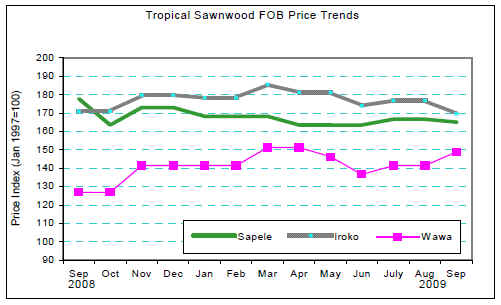
landed stocks of this species. UK prices for immediate
delivery of kiln dried FAS sawn sapele lumber sold from
landed stocks on the European continent now stand at only
630 euro/m3, while FOB prices for the same product
sourced from Africa stand at 580 euro/m³. Therefore there
is little incentive for importers to buy forward.
Forward orders for popular South East Asian species,
mainly various varieties of dark red and light red meranti
sawn lumber and bangkarai/balau decking, have also
remained low. Importers have generally been ordering
only small volumes and have been insisting on fastturnaround
times by Far Eastern shippers if they want to
secure sales. This is particularly true of bangkarai/balau
decking which importers generally want to receive by
mid-October so that they avoid carrying stocks over the
winter months. However, due to much reduced production
in the Far East, this has been a struggle for many shippers.
Demand for meranti tembaga sawn lumber in the UK has
now fallen to very low levels, the market having switched
almost completely to sapele. One agent noted ¡®for every
ten truckloads of sapele ordered nowadays, there¡¯ll be only
be one truckload of meranti¡¯. USD CIF prices for Far
Eastern hardwoods on offer to the European market have
remained stable over recent months, limited consumption
now balanced by tight supplies. Competition on European
wholesale markets for these products remains intense.
First decline in European flooring production in nearly 10 years
The European flooring sector has been one of the most
important areas of market growth for hardwoods over the
last decade. According to statistics produced by the
European Parquet Flooring Federation (FEP), in the ten
year period between 1997 and 2007, parquet production in
the FEP region increased 86% from only 53.8 million m²
to 100.3 million m². However, last year this market
suffered its first major reversal for at least a decade.
During 2008, parquet flooring production in the FEP
region declined by 16% to 84.72 million m².
Falling production was recorded last year in all the major
producing countries including Poland (down 8% to 15.3
million m²), Sweden (down 29% to 12.0 million m²),
Germany (down 15% to 11.0 million m²), Spain (down
19% to 8.2 million m²) and France (down 25% to 7.7
million m²).
The decline affected all types of parquet including multilayer
(down 15% at 65.2 million m²), solid wood (down
17% at 15.2 million m²), mosaic (down 19% at 2.2 million
m²) and lamparkett (down 4% at 2.1 million m²).
The overall make-up of species used to manufacture
parquet changed only slightly from the previous year. Oak
remained hugely dominant, accounting for 57.6% of all
flooring production and up marginally from 56.7% in
2007. Tropical woods accounted for 14.7%, a slight
decline on their 15.4% share the previous year. However
tropical woods remained important in flooring production
in several markets including 60% in Italy, 30% in Spain,
and 29% in Poland.
FEP statistics also indicate a significant fall in parquet
flooring sales during 2008 compared to the previous year.
Overall sales throughout the FEP region declined 10%
from 112 million m² in 2007 to only 102 million m² in
2008. Although there was a slight increase in consumption
in a few smaller markets including Romania, the Czech
Republic and Hungary, these gains were insufficient to
offset big losses in the largest markets. Sales in the largest
markets of Germany, Spain, Italy, and France respectively
fell by 14% (to 18 million m²), 22% (to 14 million m²),
5% (to 12.8 million m²) and 15% (to 10.6 million m²).
The FEP region includes: Poland, Sweden, Germany,
Spain, France, Austria, Norway, Denmark, Finland, Italy,
Romania, Hungary, Netherlands, Czech Republic,
Switzerland, and Belgium.
Modified softwood composite panels threaten tropical hardwood
Tropical wood¡¯s position in key sectors of the European
market has long been based on its natural qualities of
durability, toughness and resilience to wear. In the past,
softwoods, temperate hardwoods and composite panels
have generally been unable to match these qualities of
tropical hardwoods. Preservative treatments have offered
only a partial solution, being an emotive environmental
subject because the best treatments, such as creosote and
Copper Chromium Arsenic, are also toxic to humans.
Creosote and CCA have been heavily legislated against in
Europe limiting their use to specialist applications such as
sleepers and bridge decks. In practice, low levels of
demand have meant that these traditional forms of
treatment are no longer financially viable in many
countries. Some progress has been made with modern
pressure/vacuum treatment processes, but even with these
the chemical often only penetrates a few millimeters so all
cuts and holes have to be made good before treatment.
The problems associated with traditional forms of
preservation have stimulated a search for alternative
treatments. Two processes have been identified by the
softwood industry as having particular potential, namely
heat treatment and acetylation. Both these have now
developed to such an extent that they are beginning to
offer a significant competitive challenge to tropical
hardwoods.
The Scandinavian companies Finnforest and Stora Enso
are now producing Thermowood, a heat treated product
made by steam heating softwood to temperatures over
200C, driving out moisture and resin to enhance durability
and stability. The modified product is being marketed for
decking, garden furniture and external cladding. Kebony, a
product from Norway is produced by a similar process
except that ¡®tropical-wood-colour¡¯ is added to the
candidate softwood by impregnating furfuryl (a byproduct
from sugar making) before being subjected to
intense heating. Other heat treated brands include Plato
Wood and Lignia.
Acetylation, involves the use of naturally occurring acetic
acid to alter the molecular structure of wood. The treated
timber is more durable and stable without any marked
effect on visual appearance. Titan Wood¡¯s Accoya is
probably the most well known brand of this material and is
being marketed for exterior joinery applications,
particularly windows, doors, conservatories and cladding.
Accoya claims a service life of 50 years and a first
maintenance (of paints and coatings) period of 12 years.
At present, the ability of these products to compete with
tropical hardwoods is constrained by price. For example
Kebony is currently priced at between USD4,000 and
USD14,000 per m³ depending on quality, and is therefore
targeted specifically at the high end teak market. However
price levels are expected to come down as capacity
increases. In June 2009, the German trade journal EUWID
reported that European production capacity of thermally
treated wood is now around 160,000 m³, with known
capacity of 80,000 m³ in Scandinavia, 40,000 m³ in
German-speaking countries of central Europe, 30,000 m³
in the Netherlands, and 8,000 m³ in the Baltics. In 2009,
reported projects in Germany and Finland will extend
production by a further 20,000 m³. These figures may not
seem high, but are significant when set against the 600,000
m³ combined annual EU import volume of meranti and
sapele, the EU¡¯s two leading tropical joinery species.
In August, the UK trade journal TTJ reported claims by
Titan Wood that its two largest UK distributors had shown
sales increases of more than 200% in the May to July 2009
period compared with the same period in 2008 ¨C
remarkable growth during a period of generally sluggish
demand. TTJ notes that one of these distributors,
International Timber, puts the growth down to durability
and aesthetic reasons, plus people looking for a sustainable
alternative to tropical hardwood. Titan Wood also reckons
that Accoya has potential to take market share from steel,
PVCu, aluminium and concrete.
In a notable development from the perspective of tropical
hardwood plywood, in June 2009 Titan Wood and Medite
Europe Limited signed a joint development agreement to
commercialise new MDF and OSB panels made from
acetylized ¡®Tricoya¡¯ wood elements. By protecting the
OSB from wood rot and significantly improving durability
and dimensional stability, the market development strategy
for acetylized OSB targets external applications currently
occupied by tropical hardwood plywood in Europe.
New European Timber Trade Federation established
A new European Timber Trade Federation (ETTF) was
established on 1 July 2009 to represent trade interests at
European level. The management team of the ETTF is
headed by Andre de Boer of the Netherlands Timber Trade
Association (VVNH). De Boer will combine his role as
CEO of VVNH with his new role as ETTF General
Secretary until the end of this year, after which time he
will dedicate himself to his new tasks as ETTF. Other
positions on the board of ETTF will be held by the
Chairman of the Union pour le commerce des bois durs
(UCBD), Union pour le commerce des panneaux en bois
(UCIP), and Union pour le commerce des bois resineux
(UCBR) which have now merged into the ETTF. The
ETTF membership comprises 12 national importer
associations: Belgium, Denmark, France, Germany,
Greece, Italy, the Netherlands, Norway, Portugal, Spain,
Sweden and the UK. The official headquarters of the
ETTF will be in Brussels, Belgium, however de Boer will
coordinate Federation work from Almere in the
Netherlands. A key objective is to ensure more powerful
representation of the interests European wood importers at
EU level, for example in relation to on-going negotiations
surrounding legislative proposals which aim to minimise
the risk of illegal wood entering European supply chains.
|