|
1.
CENTRAL AND WEST AFRICA
Cameroon
The news in Cameroon is currently dominated by politics
with no major new developments in the timber sector.
Operational activity is expected to improve as the country
enters the long six-month dry season which will support
harvesting and transport activities.
Operators will use the dry weather to repair forest roads.
Despite improved physical conditions overall output
remains cautious due to subdued market demand.
Road transport is functioning under regular controls
including systematic checks at weighbridges. Laterite
roads close to traffic when there is heavy rain but such
interruptions are now rare. Railway operations are stable
with no major disruptions reported.
No major disruptions have been reported in milling
operations or in the supply of spare parts and other
production inputs. However, the pace of activity remains
restrained due to market uncertainty rather than
operational limitations.
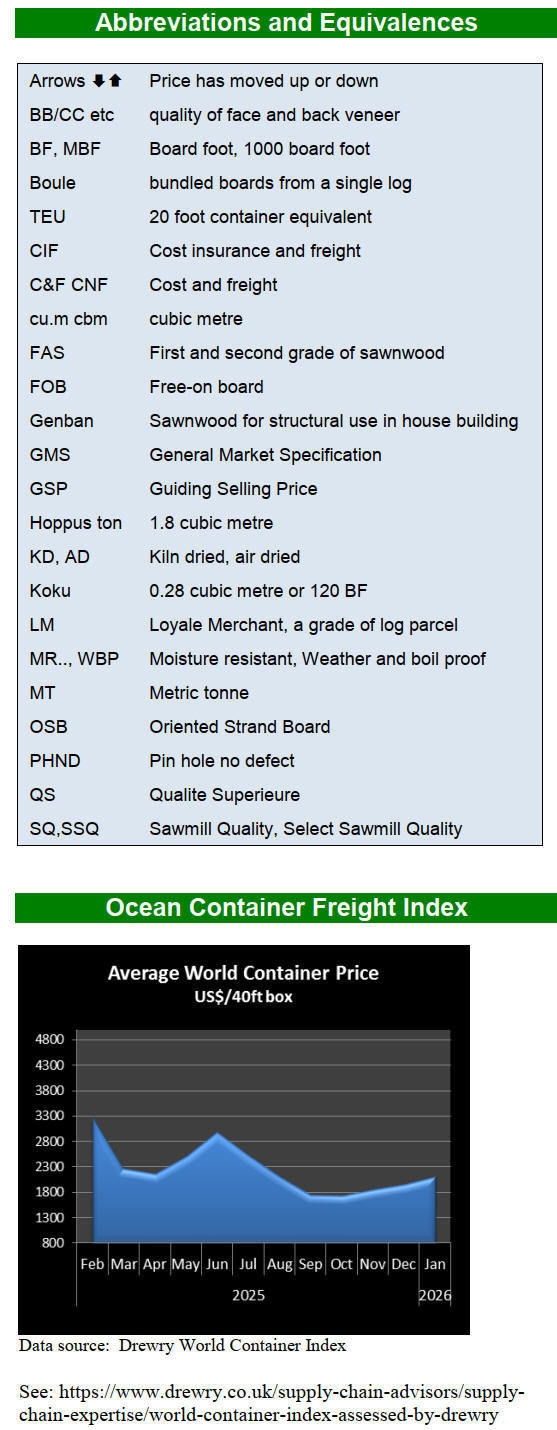
Exporters say container availability is adequate with no
shortages reported. Port operations are functioning
normally and there are no significant disruptions affecting
dispatch or loading activities.
Producers report demand remains weak across most export
markets including Europe, the United States and China.
Trade activity is cautious with buyers delaying
commitments amid uncertain global economic conditions.
Cholera cases have been reported in the country prompting
action from the authorities as well as the private sector, no
direct impact on forestry operations has been reported so
far.
Gabon
The increase in export duties is having a very negative
impact. FOB prices are rising at a time when demand,
especially in China, is already weak placing operators
under severe pressure. Despite the impact on prices
demand for some species remain resilient. Azobé
continues to show strong demand while Padouk and
Doussié exports to Belgium are becoming more stable.
Chinese buying interest in Belli is clearly increasing and
prices are following this upward trend. Okan is also seeing
improved demand in China. In contrast, Okoume demand
remains weak.
Electricity supply remains a daily challenge with two
regular power cuts per day, one during daytime and one at
night. According to the national electricity company
(SEEG) the system infrastructure is outdated and in urgent
need of upgrading.
Upcountry conditions remain mixed with some rainfall
still occurring at night. Harvesting continues under
cautious market conditions. Okoumé peeler logs are said
to be selling to mills in the Nkok Special Economic Zone
at around FCFA 85,000 per cu.m, with high-quality CS-
grade logs reaching approximately FCFA 90,000 per cu.m.
Due to heavy rain over previous months bush roads are in
very poor condition. In the Okondja region, some
concessions have been unable to transport logs to mills for
months.
Container availability remains normal with no reported
shortages. Port operations are stable and dispatch
procedures are functioning without major disruption.
Forestry authorities have begun renewed inspections as in
many cases the social contribution of FCFA 800 per cu.m
for local communities have not been fully collected. These
investigations are expected to continue nationwide
following direct instructions from the Presidency.
Market demand remains cautious. Producers are operating
cautiously, balancing production levels against weak or
selective international demand. The impact of the new
export duties is expected to become clearer in the coming
months as buyers respond to higher prices.
The Gabonreview has reported that on 14 January Maurice
Ntossui Allogo, Minister of Water and Forests,
Environment and Climate received a delegation from the
Forest Stewardship Council (FSC). Working sessions
provided an opportunity to strengthen the partnership
between GabonFSC and this leading international
organisation in sustainable forest management.
Discussions provided an opportunity to conduct a
thorough review of the "Zamba Heritage" project, a key
initiative aimed at enhancing the value of Gabonese
forests while ensuring their preservation.
See: https://www.gabonreview.com/forets-durables-le-gabon-
renforce-son-partenariat-avec-le-fsc/
Republic of the Congo
Political uncertainty linked to the upcoming presidential
elections in March is said to be limiting forestry sector
investments. The overall economic situation remains
fragile and is further affected by declining oil prices which
weighs heavily on the national economy and business
confidence.
Harvesting operations are ongoing with no major
disruptions reported. Activity levels remain moderate
reflecting restrained demand from key export markets
rather than technical or labour-related limitations.
Transport from northern Congo and the Central African
Republic continues to rely on long-distance routes to
Douala covering approximately 1,200 km from Bangui to
Douala, largely without continuous tarmac roads.
Conditions in the Likouala region have improved allowing
smoother transport flows. Road transport is benefiting
from ongoing repairs on laterite roads, improving
reliability. Trucking operations are functioning under these
improved conditions. No significant disruptions have been
reported in milling activities. The import of spare parts
and other production inputs remains adequate.
Container availability is sufficient with no reported
shortages. Pointe-Noire port is operating without container
constraints. Port operations remain steady with dispatch
and loading proceeding normally and no notable
disturbances reported.
Through the eyes of industry
The latest GTI report lists the challenges identified by the
private sector in the Republic of Congo and Gabon.
See: chrome-
extension://efaidnbmnnnibpcajpcglclefindmkaj/https://www.itto-
ggsc.org/static/upload/file/20260119/1768790612819116.pdf
2.
GHANA
Timber monitoring team inaugurated
The Government has inaugurated a nine-member National
Timber Monitoring Team (NTMT) to intensify efforts to
combat illegal logging and protect the country’s dwindling
forest resources. The NTMT is composed of personnel
from key security and regulatory institutions including the
Ghana Police Service, National Security, the Ghana
Armed Forces, the Forestry Commission and the Ghana
Timber Trade and Industry Association.
The NTMT mandate includes intelligence-led operations,
coordinated monitoring, fact-finding and stakeholder
engagement aimed at reducing illegal logging, unlawful
chainsaw use and encroachment into forest reserves. The
team is chaired by Alhaji Mohammed Kwaku Doku.
The Minister for Lands and Natural Resources, Emmanuel
Armah-Kofi Buah, issued a strong warning that the
government will take drastic enforcement action against
all forms of encroachment and destructive activities within
the forest landscape. He emphasised the vital ecosystem
services forests provide for human survival, climate
regulation and environmental sustainability, declaring zero
tolerance for illegal operations and other criminal practices
that exploit gaps in existing laws and systems.
The Minister further appealed to Metropolitan, Municipal
and District Assemblies (MMDAs), traditional authorities
and civil society organisations to actively support national
efforts to safeguard Ghana’s forests which continue to face
severe pressure from agriculture, mining and illegal
exploitation.
The Chief Executive of the Forestry Commission, Dr
Hugh Brown, described the initiative as timely and
critical, noting that illegal logging has reached alarming
levels and that efforts to stop such activities often
exposing forest officers to serious security threats is in the
right direction.
.
See: https://www.ghanabusinessnews.com/2026/01/13/nine-
member-national-timber-monitoring-team-inaugurated-charged-
to-curb-forest-encroachment/
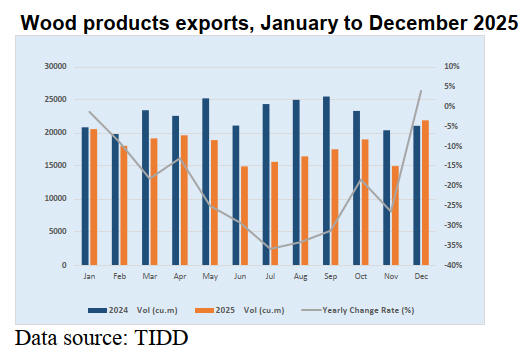
2025 wood product exports declined in both volume
and value
Data from the Timber Industry Development Division
(TIDD) revealed that Ghana’s total export of wood
products for December 2025 was 21,926 cu.m, a 4%
increase YoY. These exports generated a value of Eur8.99
million.
Cumulatively, wood product export for 2025 totalled
216,937 cu.m compared to 272,922 cu.m, in 2024, a 21%
volume decrease. The value of 2025 exports was
Eur98.38, a 20% decrease YoY.
Primary Products accounted for Eur51.42 million, 52% of
the total export receipts for 2025 while Secondary Wood
Products earned Eur41.90 million (43%) and Tertiary
Products accounted Eur5.06 million (5%).
The main market destination for wood products was Asia
at Eur50.29 million (51%of the total), Europe Eur25.10
million (26%), Africa Eur10.03 m illion (10%) US
Eur9.59 million (10%) and the Middle East Eur3.28
million (3%).
While the main products were air-dried sawnwood,
plywood (international markets) and kiln-dried sawnwood
with the top destinations as India, US, Greece, UAE and
Vietnam. The decline in exports was seen across primary,
secondary and tertiary wood products. Overall, Ghana's
timber exports declined in value and volume across all
product categories in 2025 compared to 2024.
Encouraging use of degraded land for forest
plantations
The Forestry Commission (FC) has pledged government’s
support to allocate an area of degraded forest land to West
Coast Wooden Products Limited, a producer of plywood,
so that their own plantations can be established.
According to the FC this step is to address the pressing
challenge of raw material scarcity faced by millers. The
initiative also aims to revitalise the company's operations,
enhance production and ultimately boost exports.
This move is part of the government's efforts to promote
the growth and development of the timber industry in
Ghana. The intervention is expected to have a positive
impact on the industry creating opportunities for
employment and income generation. The support may also
encourage other companies in the sector to expand their
operations, contributing to the country's economic growth.
The timber industry is a significant contributor to Ghana's
economy and this initiative is expected to enhance the
country's position in the global wood products market.
With this support, West Coast Wooden Products is poised
to increase its production and export volumes, earning
much-needed foreign exchange for the country.
This development also highlights the government's
commitment to promoting value-added wood processing
and exports. This approach will create more jobs, increase
revenue and promote sustainable forest management
practices in Ghana.
See: https://www.modernghana.com/news/1466191/restoring-
ghanas-degraded-lands-from-pilot-to.html
Economy projected to grow by 5.7% in 2026
Ghana's economy is projected to grow by 5.7% in 2026
driven by improved export performance, a stronger cedi
and easing inflation according to a recent analysis by the
global auditing firm Deloitte.
The forecast builds on recent gains in economic output,
easing inflation and a significant strengthening of the cedi.
The projection follows strong recent performance, with the
economy posting a real Gross Domestic Product (GDP)
growth of 6.3 percent in the second quarter of 2025.
The auditing firm indicates that the 2026 growth outlook
will be supported by key factors which include improved
export performance in the extractive industry particularly
gold. It also cited ongoing government initiatives,
including the 24-Hour Economy Programme and the
Accelerated Export Development Programme as key
factors.
Deloitte advises sustained capital spending, resource
planning and public-private collaboration to build
economic resilience. It also urged the government to
maintain fiscal discipline and leverage partnerships to
drive growth.
Source: https://www.myjoyonline.com/ghanas-economy-to-
grow-5-7-in-2026-deloitte-projects/
and
https://citinewsroom.com/2026/01/us-extends-agoa-for-three-
years-strengthening-ghana-trade-ties/
Through the eyes of industry
The latest GTI report lists the challenges identified by the
private sector in Ghana.
See: chrome-
extension://efaidnbmnnnibpcajpcglclefindmkaj/https://www.itto-
ggsc.org/static/upload/file/20260119/1768790612819116.pdf
Correction
In the previous report a caption read” Primary products
accounted for 66% of wood exports ending October 2025” it
should have read November not October.
3. MALAYSIA
68th consecutive month of trade surplus expansion
Malaysia’s exports climbed to a record in December
defying an expected year-end slowdown and pushing total
annual trade to RM3.1 trillion for the first time.
The trade surplus rose a marginal 0.1% to RM19.3 billion
marking the 68th consecutive month of expansion since
May 2020. On a month-on-month basis the surplus
narrowed the gap from November's slump surging over
200% as export growth outpaced the rise in imports.
Re-exports, which accounted for 25% of the total, surged
35% year-on-year to RM38.2 billion, while domestic
consumption , 75% of the total, rose 4%.
On a product basis, export growth was primarily fuelled
by the electrical and electronics sector which saw
shipments jump by RM14.9 billion. Other significant
contributors included metalliferous ores and metal scrap,
optical and scientific equipment, machinery and iron and
steel products.
By destination, higher exports were led by the United
States (up RM9.2 billion) followed by the European Union
(RM3.2 billion), Taiwan (RM2.2 billion), Viet Nam
(RM1.9 billion) and Hong Kong (RM1.2 billion). The
International Monetary Fund (IMF) has raised its
projection for Malaysia’s real GDP growth to 4.3% for
2026 and 2027.
See:
https://ceomorningbrief.theedgemalaysia.com/article/2026/1092/
Home/9/789850
and
https://theborneopost.pressreader.com/article/282226607130295
Furniture Fair MIFF2026
The Malaysian International Furniture Fair (MIFF) has
opened visitor registration for its 32nd edition, taking
place 4-7 March 2026 in two venues: Malaysia
International Trade and Exhibition Centre (MITEC) and
World Trade Centre Kuala Lumpur (WTCKL).
The announcement follows MIFF 2025's success, which
generated an estimated US$1.31 billion in on-site sales, up
3% from the previous year. MIFF 2026 will spotlight
design innovation, technology and sustainability through a
series of initiatives:
See: https://miff.com.my/
CITES permitting system - MyCITES
The MyCITES System is an online platform developed by
the Government of Malaysia under the Ministry of Natural
Resources and Environmental Sustainability (NRES) to
facilitate the management, monitoring and compliance of
trade in endangered species under the Convention on
International Trade in Endangered Species of Wild Fauna
and Flora (CITES).
The Malaysian Timber Industry Board (MTIB) acts as the
CITES Management Authority for timber species and
timber-based products. In this regard, the MyCITES
system became operational in January for CITES permit
applications involving import, export and re-export
activities of timber products subject to CITES regulations.
The system is available at www.mycites.gov.my.
With the launch of MyCITES, Malaysia will phase out the
manual issuance of paper-based CITES permits with
security stamp. Starting 1st January 2026, all import,
export, and re-export permits will be issued exclusively
through the electronic system.
All permits issued prior to 1st January 2026 will be
available as hard copy until the date of expiry.
All electronic permits issued via MyCITES will include a
signature, an embedded QR code for real-time verification
of permit validity and details and a permit number.
Permits will be printed by applicants and the QR code
shall serve as the primary tool for verification by
enforcement authorities.
For verification and authentication of permits issued by
Malaysia Parties are encouraged to use the QR code
scanning feature or access the MyCITES portal. Further
guidance on the verification process is available on the
MyCITES website.
For inquiries or assistance regarding the MyCITES
electronic permitting system contact the CITES
Management Authority of Malaysia at:
citesmalaysia@nres.gov.my.
See: https://www.mtib.gov.my/pengumuman/pemakluman-
sistem-mycites-malaysia.html
MTCC certification review
The Malaysian Timber Certification Council (MTCC) has
commenced the periodic revision of the MTCS ST
1002:2021 (Malaysian Criteria and Indicators for
Sustainable Forest Management) and MTCS ST
1003:2021 (Group Forest Management Certification).
As part of this revision process, a Standard Review
Committee (SRC) of 39 members is formed, representing
three (3) regions (Peninsular Malaysia, Sabah, and
Sarawak) of seven (7) stakeholder groups as stipulated
below:
Business and Industry
Forest Owners
Indigenous Peoples and Local Communities
Local Authorities
Non-Governmental Organizations (NGOs)
Scientific and Technological Community
Workers and Trade Unions
The SRC will serve as the multi-stakeholder “forum” for
the review process, guided by the Proposal for the Review
of MTCS ST 1002:2021 and MTCS ST 1003:2021, which
outline the scope, objectives, approach and timeline for the
standard review process.
Upholding MTCC’s value of inclusivity and transparency,
interested public stakeholders are invited to participate in
the standard review and revision process by channelling
their feedback and input to the selected SRC members or
directly to MTCC during the 60-days public consultation
period
The proposal for the review of MTCS ST 1002:2021 and
MTCS ST 1003:2021 document is available at:
https://mtcc.com.my/wp-content/uploads/2026/01/PROPOSAL-
FOR-THE-REVIEW-OF-MTCS-MTCS-ST1002-AND-MTCS-
ST1003-FINAL-2.pdf
See: https://mtcc.com.my/public-announcement-revision-of-the-
mtcs-st-10022021-and-mtcs-st-10032021-and-the-composition-
standard-review-committee-src/#
Encouraging industrial tree plantations (ITP)
A Development Programme is now in operation to
encourage more ITPs in the country. The ITP
Development Programme is a Government initiative
implemented through the Malaysian Timber Industry
Board (MTIB) to promote the cultivation of fast-growing
forest plantation species.
The programme aims to ensure a sustainable, high-quality
and continuous supply of raw materials to support the
growth of Malaysia’s timber industry.
Under the Thirteenth Malaysia Plan for the period of 2026
to 2030 the Government has provided a financial
allocation for the implementation of the ITP Programme.
This initiative targets the development of forest
plantations, with an estimated timber output of 760,000
cubic metres after eight years depending on the forest
plantation species. The ITP programme is open to private
companies, cooperatives and Government agencies.
See: https://www.mtib.gov.my/en/perkhidmatan/perladangan-
hutan/program-pembangunan-industrial-tree-plantation-itp.html
Through the eyes of industry
The latest GTI report lists the challenges identified by the private
sector in Malaysia.
See: chrome-
extension://efaidnbmnnnibpcajpcglclefindmkaj/https://www.itto-
ggsc.org/static/upload/file/20260119/1768790612819116.pdf
4.
INDONESIA
Revocation of permits in Sumatra
The Ministry of Forestry has welcomed the President’s
decision on revocation of permits for 28 companies that
violated regulations on forest area use in Sumatra
describing it as part of a broader policy to reorganise
economic activities based on natural resources.
Ristianto Pribadi, Head of the Ministry’s Public Relations
and International Cooperation Bureau, stated that the
Ministry respects and supports the actions taken by the
Forest Area Enforcement Task Force (Satgas PKH) in line
with existing laws and regulations, highlighting the
government’s commitment to regulating and disciplining
natural resource–based economic activities. The Ministry
affirmed its respect for ongoing law enforcement
investigations into potential criminal violations and
offered to provide technical support and forestry data as
needed.
In related news, the PKH Task Force has collected Rp7.07
trillion (about US$420 million) in administrative fines
from 48 palm oil and mining companies that violated
forest land-use regulations. PKH spokesperson, Barita
Simanjuntak, praised companies that complied with their
payment obligations, emphasising that such cooperation
supports fair, transparent and nationally aligned forest
management.
Simanjuntak stressed that enforcement efforts go beyond
fine collection and include reclaiming forest land and
recovering state assets.
See: https://www.antaranews.com/berita/5369090/kemenhut-
pencabutan-izin-28-perusahaan-tata-perekonomian-berbasis-sda
and
https://en.antaranews.com/news/399921/task-force-secures-rp7-
trillion-forest-use-fines-from-48-companies
4 million hectares of forest and reclaimed
The PKH Task Force has reclaimed 4 million hectares of
forest land within one year, according to State Secretary
Minister, Prasetyo Hadi. The achievement demonstrates
the government’s commitment to strengthening
governance and ensuring the proper management of
natural resources.
Of the reclaimed land, around 900,000 hectares have been
restored as conservation forests to support global
biodiversity including 81,793 hectares in Tesso Nilo
National Park, Riau Province. Established under
Presidential Regulation No. 5 of 2025, the PKH Task
Force is tasked with overseeing and regulating natural
resource–based business activities such as forestry,
plantations and mining.
See: https://www.antaranews.com/berita/5363690/satgas-pkh-
kuasai-kembali-409-juta-hektare-lahan-hutan-dalam-setahun
and
https://www.metrotvnews.com/read/NA0Cr9Ox-satgas-pkh-
tertibkan-4-09-juta-hektare-hutan-900-ribu-hektare-dijadikan-
kawasan-konservasi
Community based down-streaming plantation
development
The Indonesian Ministry of Forestry is preparing 390,000
hectares of social forestry land to support community-
based downstream processing of plantation timbers aiming
to increase value added, boost farmers’ welfare and
stimulate national economic growth.
Deputy Minister, Rohmat Marzuki, explained that the
government has begun the initial phase by aligning social
forestry land data for processing activities. Social forestry
business groups are already developing various
commodities including coffee, palm sugar, cocoa,
candlenut, pepper, nutmeg, cashew, vanilla and coconut.
To accelerate the programme the Ministry of Forestry and
the Ministry of Agriculture are coordinating downstream
development for six priority commodities: coffee, cocoa,
coconut, pepper, nutmeg and cashew.
The government also aims to expand social forestry
development to 1.1 million hectares by 2029 to support
national food self-sufficiency. Designated as a National
Strategic Project under the 2025–2029 National Medium-
Term Development Plan (RPJMN), the initiative will
cover 36 provinces, 324 regencies and cities and over
3,000 villages, promoting agroforestry-based land use and
active participation of communities living near forest
areas.
See; https://www.tempo.co/ekonomi/perhutanan-sosial-
disiapkan-untuk-hilirisasi-perkebunan-2108416
and
https://money.kompas.com/read/2026/01/19/170500126/wamenh
ut--ada-390.000-hektar-hutan-sosial-untuk-hilirisasi-perkebunan
and
https://www.antaranews.com/berita/5360126/kemenhut-390-
ribu-ha-perhutanan-sosial-untuk-hilirisasi-perkebunan
Fire area damage down 5% in 2025
The Ministry of Forestry reported that the total area
affected by forest and land fires in 2025 declined by 5%
compared to a year earlier falling to 359,619 hectares from
376,806 hectares. The government sees this reduction as
an indication that fire control efforts are becoming more
effective, particularly due to a stronger emphasis on
preventive measures.
According to Director of Forest Fire Control, Thomas
Nifinluri, the data is part of an integrated fire management
system that covers prevention, suppression and post-fire
handling and serves as a key reference for disaster
mitigation strategies and law enforcement.
The ministry also attributed the decline to stronger cross-
sector collaboration and greater commitment from
stakeholders, alongside a shift in policy toward prevention
as the primary approach.
Head of the Subdirectorate for Forest Fire Management,
Israr Albar, noted that the improvement is even more
pronounced when compared with 2023, when burned areas
reached around 1.1 million hectares, a reduction of about
69 percent. With warmer conditions expected in 2026 and
potential El Niño impacts in 2027, officials stressed the
need to further strengthen preventive efforts to reduce
future fire risks.
See: https://mediaindonesia.com/humaniora/848351/luas-
karhutla-2025-turun-5-persen-kemenhut-klaim-pengendalian-
makin-efektif
Indonesia's mangrove cover rises
Indonesia’s mangrove cover expanded by 15,164 hectares
in 2025 bringing the national total to 3,455,628 hectares
according to the Ministry of Environment. The increase is
recorded in the 2025 National Mangrove Map which was
finalised in December 2025. Mangrove forests are present
in all provinces except Highland Papua, with South Papua
hosting the largest area at 622,288 hectares followed by
West Papua, Central Papua, East Kalimantan and Riau.
To enhance mangrove management and protection, the
ministry has established 123 Mangrove Landscape Units
(KLMs) in partnership with 38 universities. These units
serve as designated management zones in downstream
river areas where environmental conditions such as
substrate and salinity support mangrove growth and are
closely connected to surrounding socio-economic systems.
See: https://en.antaranews.com/news/400498/indonesias-
mangrove-coverage-rises-to-346-million-hectares
and
https://rri.co.id/en/national/2115122/indonesia-s-mangrove-
coverage-expands-to-3-45-million-hectares
Rp153 trillion needed to restore degraded land
The government estimates it will need Rp153.78 trillion
over nine years to restore 12 million hectares of degraded
land under the Forest and Land Rehabilitation (RHL)
programme according to Deputy Minister of Forestry,
Rohmat Marzuki.
The initiative targets critical degraded areas with 6.3
million hectares located within forest zones and 5.7
million hectares outside forests. The programme runs until
2034 and aims to rehabilitate an average of 1.3 million
hectares annually, requiring about Rp17.08 trillion per
year from a combination of state and regional budgets.
In addition to public funding the government is exploring
alternative financing sources, including international
cooperation, the reallocation of non-tax state revenue
particularly reforestation funds and administrative fines
from illegal mining and unlawful oil palm plantations.
See: https://finance.detik.com/berita-ekonomi-bisnis/d-
8314352/pemerintah-butuh-rp-153-t-buat-rehabilitasi-12-juta-ha-
lahan-kritis.
and
https://hijau.bisnis.com/read/20260120/651/1945719/kebutuhan-
dana-untuk-rehabilitasi-hutan-dan-lahan-kritis-tembus-rp15378-
triliun.
Global coalition to grow carbon markets
Indonesia has joined ‘The Coalition to Grow Carbon
Markets’ through the Ministry of Forestry aiming to
strengthen global climate financing while highlighting the
country’s forestry sector and nature-based solutions. The
initiative focuses on expanding the use of high-integrity
carbon credits to unlock development funding, stimulate
economic activityand accelerate global climate goals.
Minister Raja Juli emphasised the coalition’s commitment
to ensuring that carbon credits are credible and impactful,
supporting both environmental sustainability and
economic growth.
The coalition which includes 10 other members such as
Canada, France, New Zealand and the UK seeks to
accelerate global emission reductions by incentivising
businesses to invest in high-quality carbon credits. Current
efforts focus on creating consistent national and regional
policies and maintaining market demand through
engagement with investors and buyers.
See: https://en.tempo.co/read/2082270/weighing-the-pros-and-
cons-of-inviting-foreign-universities-to-enter-
indonesia?tracking_page_direct
and
https://investor.id/national/425525/menhut-antoni-umumkan-
indonesia-gabung-koalisi-global-pasar-karbon-ini-urgensinya
Through the eyes of industry
The latest GTI report lists the challenges identified by the private
sector in Indonesia.
See: chrome-
extension://efaidnbmnnnibpcajpcglclefindmkaj/https://www.itto-
ggsc.org/static/upload/file/20260119/1768790612819116.pdf
5.
MYANMAR
6.
INDIA
EU-India trade agreement – hailed as a a
game changer
India and the European Union (EU) announced the
conclusion of negotiations for a Free Trade Agreement
(FTA), an important milestone in one of India’s most
strategic economic partnerships.
With a combined market estimated at over INR2091.6
Lakh Crore (approx. US$24 trillion) bringing unparalleled
opportunities for the 2 billion people of India and the EU,
the FTA unlocks significant potential for trade and
innovation.
The FTA delivers market access for more than 99% of
India’s exports by trade value while preserving policy
space for sensitive sectors and reinforcing India’s
developmental priorities.
Bilateral merchandise trade between India and the EU has
demonstrated sustained growth, valued approximately at
INR11.5 Lakh Crore (US$136.54 billion) in 2024-25, with
India exporting roughly INR6.4 Lakh Crore (US$75.85
billion) to the EU. India-EU trade in services reached
INR7.2 Lakh Crore (US$83.10 billion) in 2024.
The Indian government statement says, “This FTA of
strategic significance evolves India-EU relations from a
traditional into a modern, multifaceted partnership,
providing a stable and predictable environment for
exporters, enabling Indian businesses including MSMEs to
plan long-term investments, integrate into European value
chains, and ensure consistent favourable market access
amid global economic uncertainties”.
The world’s biggest free trade zone
Together, the EU and India represent around a quarter of
the world’s population, with two billion people, and about
25% of the world’s gross domestic product (GDP). The
EU-India trade agreement is the largest trade agreement
that both the EU and India have ever concluded and will
give the EU a significant competitive advantage in key
industrial and agri-food sectors.
The Agreement will strengthen trade, investment and
political ties between the world’s two largest democracies.
It will remove trade barriers and simplify procedures, open
new export opportunities and strengthen the EU’s
economic security by diversifying supply.
The EU and India already trade over €180 billion worth of
goods and services per year, supporting close to 800,000
jobs in the EU. The agreement is expected to have a strong
positive impact on EU's economy:
107%, estimated increase in EU annual goods
exports to India by 2032
€4 billion per year in savings on duties for
European exporters
90% of tariffs eliminated or reduced
Background
The EU and India started negotiating a free trade
agreement in 2007. The talks were suspended in 2013 and
relaunched in 2022. The negotiations were successfully
concluded in January 2026.
Alongside the free trade agreement, the EU and India are
also negotiating agreements on geographical indications
and investment protection.
See: chrome-
extension://efaidnbmnnnibpcajpcglclefindmkaj/https://www.com
merce.gov.in/wp-content/uploads/2026/01/Factsheet-on-India-
EU-trade-deal-27.1.2026.pdf
and
https://www3.nhk.or.jp/nhkworld/en/news/20260128_01/
and
https://commission.europa.eu/topics/trade/eu-india-trade-
agreement_en
Housing market shifts to value-led growth
According to an ICC–ANAROCK report released at the
ICC Real Estate Summit 2026 in New Delhi, India’s
residential real estate market is undergoing a fundamental
reset with larger homes emerging as a demand driver
signalling a shift from volume-led to value-led growth in
the sector.
The report shows that larger homes now account for 45–
50% of buyer demand, a sharp rise from about 30% in
2018 underscoring how Indian homebuyers are prioritising
space, wellness, flexibility and long-term value over entry-
level affordability.
The report highlights that this shift towards bigger homes
is driven by lifestyle changes, work-from-home adoption
and multi-generational living preferences. Developers are
recalibrating supply towards low-density, amenity-rich
projects with larger unit configurations, making homes
with three bedrooms, a living room or hall and a kitchen.
Today, 3BHKs and bigger homes the new mainstream
rather than a premium niche.
See: chrome-
extension://efaidnbmnnnibpcajpcglclefindmkaj/https://websiteme
dia.anarock.com/media/Indian_Residential_Real_Estate_A_Revi
ew_and_the_Road_Ahead_2c7b686f6f.pdf
and
https://www.constructionweekonline.in/business/icc-anarock-
report-3bhk-and-larger-homes-are-in-high-demand
In related news, as the Union Budget 2026 approaches
leaders in the real estate sector are urging the government
to take steps to revive affordable housing and strengthen
rental housing, cautioning that growth in the housing
sector is increasingly uneven and skewed toward luxury
developments.
Anuj Puri, chairman of the ANAROCK Group, said
India’s housing story remains strong on the surface but is
structurally imbalanced. He highlighted that in 2025 new
home sales volumes fell by 14%, yet sales value rose 6%
reflecting a boom in luxury housing while affordable
housing remains under stress.
See: https://www.linkedin.com/posts/theanujpuri_what-lies-
ahead-for-indian-real-estate-in-activity-7411408300732473344-
m0RK
and
https://timesofindia.indiatimes.com/business/india-
business/budget-2026-for-real-estate-luxury-housing-soars-
affordable-homes-lag-industry-pushes-for-tax-relief-rental-
income-support/articleshow/126770611.cms
India’s domestic demand resilience
For India, 2026 will be the year of ‘resilience’ in domestic
demand, decisive ‘reforms’ in fiscal, monetary and labor
policies and ‘recalibrations’ in trade policies say analysts
at Deloitte.
A report from Deloitte Global Economics Research Center
‘India economic outlook - January 2026” says good
economic performance in the second quarter of fiscal
2025/26 2026 reinforced expectations of an upward
revision in full-year growth.
Despite global headwinds such as higher US tariffs and
volatile capital outflows, India’s growth in the first half of
the fiscal year was powered by robust private consumption
and investment, aided by easing inflation and favorable
annual agricultural harvests.
Growth is expected to be supported by resilient domestic
demand, says Deloitte. High-frequency indicators,
including strong consumer confidence, vehicle
registrations and sales and easing inflationary pressures
point to continued support for economic activity.
However, some external indicators such as currency
depreciation and FPI outflows show emerging signs of
stress, posing downside risks to the outlook.
The government and the Reserve Bank of India (RBI)
remain resolved to strengthen domestic demand with fiscal
policy focused on boosting consumer spending through tax
relief and public investment.
With fewer demand-side policy options remaining the
next phase of reforms must pivot toward supply-side
improvements. This shift is essential to sustain momentum
and build resilience against external shocks. Recently, the
government hinted at a complete overhaul of Customs to
help improve the ease of doing business and reduce the
cost of compliance and logistics.
Deloitte says, “we expect full fiscal year growth to be
revised substantially upward, as third-quarter numbers are
likely to remain strong due to festive spending”.
See:
https://www.deloitte.com/us/en/insights/topics/economy/asia-
pacific/india-economic-outlook.html
INDIAWOOD 2026
Scheduled for 26 February to 2 March 2026 the Fair will
bring together stakeholders in India's rapidly growing
woodworking and furniture sector.
INDIAWOOD 2026 will be held at the Bangalore
International Exhibition Centre. The upcoming Fair comes
as India’s largely fragmented furniture industry undergoes
rapid formalisation driven by rising domestic demand,
global sourcing interest and deeper MSME participation.
India, the world’s fourth-largest furniture market was
valued at US$29.97 billion in 2025 and projected to reach
US$43.24 billion by 2030. Urban migration, steady real-
estate completion, government housing schemes and
growing digital adoption continue to support sustained
demand. Exports have expanded steadily over the past
decade.
See: https://www.hindustantimes.com/genesis/indias-furniture-
industry-enters-high-growth-phase-as-indiawood-2026-sets-the-
stage-for-international-ambition-101765888427946.html
Rupee hits record low against the US dollar
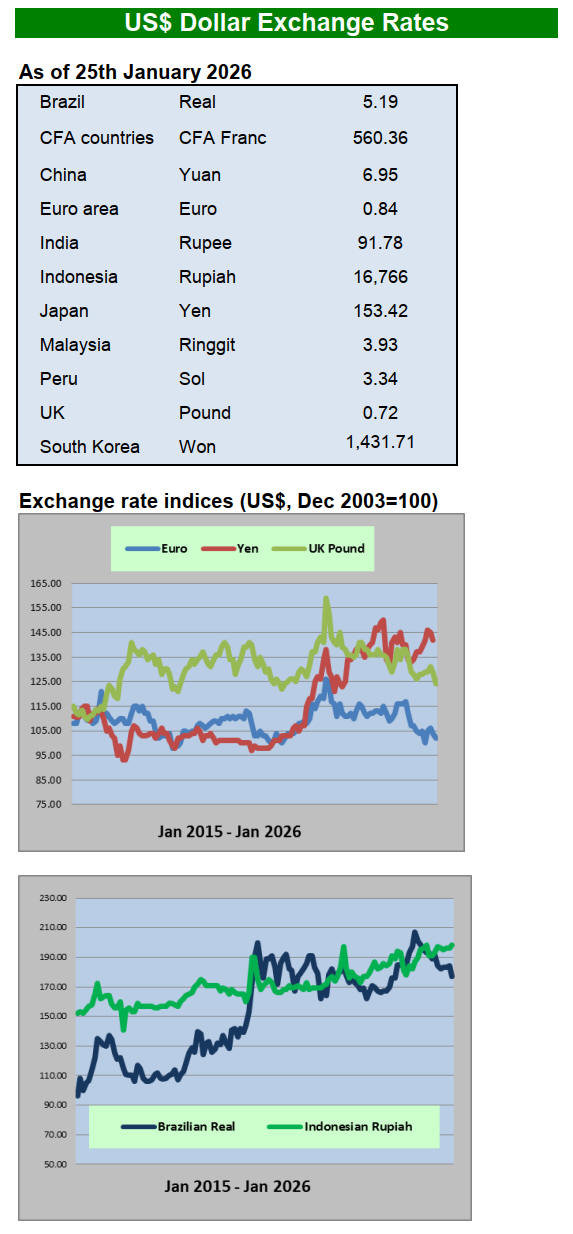
The Indian Rupee (INR) weakened in late 2025 and early
2026 hitting record lows against the US Dollar (around 90-
92 INR/US$) due to strong US Dollar, global risk
aversion, a sluggish domestic equity market, triggered by
heavy foreign capital outflows and a widening Indian trade
deficit driven by high import demand (esp. oil,
electronics). While a weaker rupees makes Indian exports
cheaper it also increases import costs.
Recently the rupee fell to 91.22 per US dollar, breaching
its previous recorded low in December.
See: https://timesofindia.indiatimes.com/business/india-
business/rupees-decline-continues-currency-closes-at-record-
low-of-90-97-against-us-dollar-depreciates-by-7-
paise/articleshow/126797436.cms
7.
VIETNAM
Wood and wood products (W&WP) trade
highlights
According to statistics from the Viet Nam Customs
Department W&WP exports in December 2025 reached
US$1.66 billion, up 12% compared to November 2025 and
up 6% compared to December 2024.
Of the total WP exports alone earned US$1.07 billion, up
7% compared to November 2025 but down 3% compared
to December 2024. In 2025e W&WP exports totaled
US$17.2 billion, up 6% compared to 2024 of whichthe
WP export share was US$11.7 billion, up 4% compared to
2024.
Viet Nam's W&WP imports in December 2025 stood at
US$320.2 million, up 16% compared to November 2025
showing an year-on-year growth of 25%. In 2025 W&WP
imports were estimated at US$3.23 billion, up 17% in
value compared to 2024.
Viet Nam's tali imports in December 2025 were 57,000
cu.m, worth US$21.8 million, up 5% in volume and 5% in
value compared to November 2025. Compared to
December 2024 imports increased by 11% in volume and
21% in value. In 2025, tali wood imports were 395,400
cu.m, worth US$148.6 million, up 25% in volume and
24% in value compared to 2024.
The imports of raw wood (logs and lumbers) from Africa
in December 2025 were reported at 90,000 cu.m, worth
US$34.0 million, up 7% in volume and 9% in value
compared to November 2025.
The total import volume in 2025 was 840,280 cu.m,
worth
US$302.44 million, up 15% in volume and 12% in value
compared to 2024.
Viet Nam's oak imports in December 2025 were 54,900
cu.m, worth US$28.4 million, up 15% in volume and 16%
in value compared to November 2025. Compared to
December 2024 imports were up 90% in volume and 63%
in value. In 2025, imports of oak were estimated at
558,900 cu.m, worth US$303.3 million, up 51% in volume
and 40% in value compared to 2024.
Imports of raw wood from the EU to Viet Nam in
December 2025 were reported at 60,000 cu.m with a value
of US$21.0 million, up 4% in volume and 9% in value
compared to November 2025 bringing the total import
volume in the year to 932,730 cu.m, with a value of
US$297.51 million showing an increase of 17% in volume
and 19% in value compared to 2024.
Viet Nam's office furniture exports in December 2025
brought in about US$35 million, down 5% compared to
December 2024. In 2025 office furniture exports earned
US$391 million, up 17% compared to 2024.
Exports reach record US$17 billion
Exports of wood and wood products reached nearly
US$1.7 billion in December 2025 alone bringing the total
export value for the year to US$17.2 billion, an increase of
nearly 6% compared with 2024.
Despite unprecedented challenges in global markets and
the growing impacts of climate change, 2025 marked a
milestone for Viet Nam’s wood industry as exports of
timber and wood products surpassed US$17 billion for the
first time.
In 2025, W&WP exports to the US totaled US$9.46
billion, up 4.4% year on year and accounted for
approximately 55% of the industry’s total exports. Viet
Nam continued to maintain its position as the largest
supplier of wooden furniture to the US market.
Viet Nam’s market share of the wooden furniture segment
in the US increased significantly, rising from 41% in the
first eight months of 2024 to 45% in the same period of
2025.
Meanwhile, exports to Japan recorded robust growth of
over 23% in 2025 reaching more than US$2.1 billion. This
marked the first time exports to Japan exceeded US$2
billion lifting Japan become the second-largest market for
Viet Nam’s wood industry.
Although exports to China slipped to third place they still
grew modestly reaching nearly US$2.1 billion. This was
the second consecutive year exports to China exceeded
US$2 billion. Collectively, the three billion-dollar
markets, the US, Japan and China accounted for nearly
80% of Viet Nam’s total wood and wood product exports
in 2025.
Other markets were considerably smaller in scale,
including the Republic of Korea with US$709 million,
Canada US$288 million and the UK with US$244 million.
In terms of product structure, wooden furniture remained
the backbone of the industry’s exports. According to the
Agency of Foreign Trade under the Ministry of Industry
and Trade, exports of wooden furniture reached US$9.4
billion in the first 11 months of 2025, accounting for
nearly 61% of the total export value.
Several other product categories also recorded export
values of over US$1 billion including wood chips at
US$2.2 billion; boards and flooring at US$2.1 billion and
wood pellets at US$1.1 billion.
Phung Quoc Man, chairman of the HCM City Handicraft
and Wood Industry Association, noted that 2025 presented
unprecedented challenges for the industry.
These included reciprocal tax policies, anti-dumping and
countervailing duty investigations from the US and
mounting pressure from the EUDR, as well as frequent
natural disasters and floods at home that disrupted raw
material supply chains and production.
Nevertheless, the industry managed to sustain export
growth despite these strong headwinds demonstrating the
increasing adaptability and resilience of Vietnamese wood
enterprises amid global market volatility.Key priorities for
the future include expanding large-timber forests,
promoting the application of science and technology,
advancing digital transformation and strengthening trade
promotion.
Efforts will also focus on diversifying export markets to
reduce dependence on key destinations, building the “Viet
Nam Wood” brand and developing forest environmental
services and carbon markets.
See: https://vietnamnet.vn/en/vietnam-s-wood-exports-reach-
record-17-billion-usd-in-value-
2484099.html#:~:text=Forest%20coverage%20remained%20stab
le%20at,billion%20USD%20in%20two%20months
and
https://www.vietnam.vn/en/nganh-go-viet-giu-ngoi-a-quan-the-
gioi-quyet-bo-tu-duy-gia-cong-gia-re
Exports fell short of the industry’s US$18 billion target
Speaking on the sidelines of a forum ahead of HawaExpo
2026 on January 21, Phung Quoc Man, chairman of the
Ho Chi Minh City Handicraft and Wood Processing
Association (Hawa), said 2025 exports rose nearly 6% per
cent from 2024. The figure fell short of the industry’s
US$18 billion target but still reflected strong efforts in a
year marked by volatility caused by US tariff policies,
Man said.
Data from the Forestry and Forest Protection Department
under the Ministry of Agriculture and Environment show
Viet Nam continues to rank among the world’s top five
wood exporting countries. In processed wood products,
including indoor and outdoor furniture, Viet Nam ranked
second globally with exports of US$11.7 billion, behind
only China.
For 2026, Hawa forecasts wood and wood product exports
of US$18 to 19 billion. To reach this goal Man said the
industry needs to deepen its presence in emerging markets
such as the Middle East and India, while investing more
heavily in technology to keep production costs
competitive.
HawaExpo 2026 will take place from March 4 to March 7.
Organisers said more than 2,500 international buyers from
83 countries and territories have registered with
delegations from the US and Canada accounting for over
50%.
See: https://dtinews.dantri.com.vn/vietnam-today/vietnam-wood-
exports-top-usd-17bn-as-us-keeps-dominant-share-
20260122153506496.htm
Overview of Viet Nam's wood pellet exports in 2025
According to Customs statistics, wood pellet exports in
2025 increased reaching US$1.25 billion, up 50%
compared to 2024. Japan was the main growth driver with
exports in the first 11 months of 2025 reaching US$834.5
million, up 84% over the same period.
Exports to South Korea stood at US$167.2 million, down
16%. South Korea's share dropped significantly, from 28%
to 16%.
In addition, wood pellets are also exported to other
markets such as the Netherlands where stable growth with
exports in the first 11 months of 2025 was recorded
reaching US$25.5 million.
The robust growth in the Japanese market showed that
demand for renewable energy and biomass power
commitments in that country provide great opportunities
for Viet Nam's wood pellet industry. However, relying too
heavily on a market that accounts for more than 77% also
carries certain risks.
VIFOREST has determined that because the Japanese
government continues to maintain a policy of subsidising
pellets to replace coal in thermal power plants this creates
conditions for Japanese businesses to sign long-term
contracts with Vietnamese suppliers. However, 2025 has
also recorded a significant increase in the cost of pellet
production mainly due to the high price of input materials.
In addition, compliance costs accounted for a substantial
proportion of the total cost, while the output selling price
did not increase correspondingly, causing profit margins to
narrow and the payback period to be prolonged.
The growth of operators engaging in the industry has led
to potential risks as more and more new investors
undertake production of wood pellets and accelerate
competition. In general, foreign enterprises that are in
better positions with invested capital can sustain wood
pellet business better than local enterprises.
Japanese investors, thus, have set up many wood pellet
factories in Viet Nam targeting exports to Japan. In
addition, some investors intend to expand production to
the biomass and thermal power sectors in Viet Nam.
To assure better wood pellet development strategy,
VIFOREST and Vietnamese operators are recommended
to build an up-to-date and reliable database needed for
trend analysis and risk warnings for the pellet industry.
Facing the risk of market fluctuations wood pellet
manufacturers need to strengthen solidarity and
cooperation more closely in supporting production and
building a maintaining reasonable price level, avoiding
competition by lowering prices below the production cost.
Forming a chain of production-supply-export, reducing
intermediaries, optimising logistics service are all
imperative for Vietnamese wood pellet producers and
traders. In addition, strengthening governance to improve
productivity and reduce production costs is needed.
Data provided by Viet Nam Customs Department and analysed
by VIFOREST
8. BRAZIL
Call for forest restoration projects in
Amazon
The Brazilian National Bank for Economic and Social
Development (BNDES) and Petrobras received 16
proposals, exceeding initial expectations for participation,
under the Programme “ProFloresta+” an initiative aimed at
financing and contracting forest restoration projects using
native species in the Amazon.
Selected projects will be able to access differentiated
BNDES’s credit lines including resources from the
Climate Fund dedicated to forest restoration with native
species.
Launched in 2025 during the 30th United Nations Climate
Change Conference (COP30), the BNDES call provides
for Petrobras to purchase carbon credits generated from
restoration projects in the Amazon subject to strict criteria
of environmental integrity, socio-environmental
safeguards and long-term contracts.
The initiative aims to restore up to 50,000 hectares in the
Amazon, with the potential to generate around 15 million
carbon credits in addition to mobilising more than BRL1.5
billion in investments for reforestation in the region.
The first call for proposals provides for the acquisition of
5 million carbon credits distributed across five contracts of
1 million Verified Carbon Units (VCUs) each.
The proposals will undergo technical evaluation with
Petrobras responsible for selecting the projects. The
outcome of the process, including the definition of
winning projects, volumes and prices to be paid for the
credits are expected to be announced in the first half of
2026.
See:: https://www.maisfloresta.com.br/amazonia-recebe-16-
projetos-em-edital-de-restauracao-florestal/
Logging in the Amazon
Amazonas was the second State with the largest area of
logging in the Brazilian Legal Amazon between August
2023 and July 2024 totalling 46,100 hectares, equivalent
to 15% of the 327,600 hectares logged across the Amazon
during the period analysed according to a study released in
December 2025 by the Simex network (Brazilian System
for Monitoring Timber Harvesting). The State ranks
behind only Mato Grosso (190,000 ha.) and ahead of Pará
(43,000 ha.).
Of the total area logged in the Amazon, 225,100 ha.
occurred with legal authorisation, while 31% (102,500 ha.)
took place illegally highlighting the persistence of
irregular activities particularly within protected areas. In
these areas, illegal logging in Conservation Units reached
8,100 ha., representing a sizeable increase compared to the
previous period.
In Amazonas, pressure on the forest is concentrated in the
southern part of the State with the municipality of Lábrea
standing out as it ranks second nationally in illegal logging
(12,700 ha.).
Encroachment into protected areas include the
Kaxarari
Indigenous Land stretching from Amazonas to Rondônia
State where 2,885 ha. were logged illegally.
The Remade text says experts point out that although the
total area logged remains relatively stable the recurrence
of illegal activities in protected areas shows structural
weaknesses in governance and enforcement mechanisms.
See: https://www.remade.com.br/noticias/21174/amazonas-e-o-
2%C2%BA-estado-que-mais-explora-madeira-na-amazonia--
aponta-estudo
Export update November and December 2025
In November 2025 Brazilian exports of wood-based
products (except pulp and paper) decreased 37% in value
compared to November 2024 from US$360.4 million to
US$226.0 million.
Pine sawnwood exports decreased 26% in value between
November 2024 (US$63.5 million) and November 2025
(US$47.1 million). In volume exports decreased 18% over
the same period, from 262,300 cu.m to 216,500 cu.m.
Tropical sawnwood exports decreased 0.3% in volume,
from 31,100 cu.m in November 2024 to 31,000 cu.m in
November 2025. In value, exports increased 5% from
US$13.1 million to US$13.8 million over the same period.
Pine plywood exports decreased 48% in value in
November 2025 compared to November 2024, from
US$72.3 million to US$37.3 million. In volume, exports
decreased 43% over the same period, from 223,300 cu.m
to 128,000 cu.m.
Tropical plywood exports decreased 19% in volume, from
2,700 cu.m in November 2024 to 2,200 cu.m in November
2025. In value, exports decreased 7% from US$1.5 million
to US$1.4 million over the same period.
As for wooden furniture, exports decreased 24% in value,
from US$58.9 million in November 2024 to US$44.5
million in November 2025.
In December 2025l Brazilian exports of wood-based
products (except pulp and paper) decreased 17% in value
compared to December 2024, from US$315.2 million to
US$263.2 million.
Pine sawnwood exports decreased 7% in value between
December 2024 (US$59.9 million) and December 2025
(US$55.7 million).
In volume, exports increased almost 4% over the same
period, from 245,100 cu.m to 253,700 cu.m.
Tropical sawnwood exports increased 31% in volume,
from 24,000 cu.m in December 2024 to 31,500 cu.m in
December 2025. In value, exports increased 33% from
US$9.4 million to US$12.5 million over the same period.
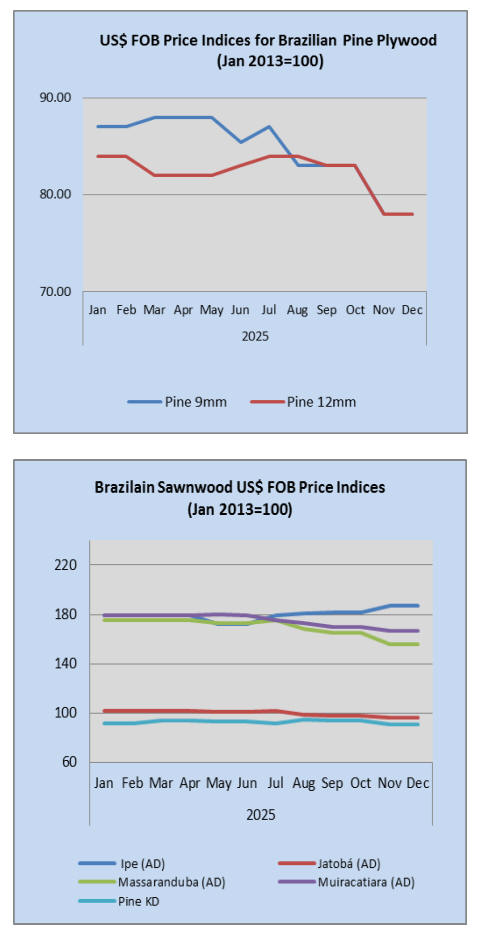
Pine plywood exports decreased 15% in value in
December 2025 compared to December 2024, from US$
69.2 million to US$58.6 million.
In volume, exports decreased 8% over the same
period,
from 214,800 cu.m to 198,500 cu.m.
Tropical plywood exports decreased 3% in volume, from
3,300 cu.m in December 2024 to 3,200 cu.m in December
2025. In value, exports decreased 5% from US$1.9 million
to US$1.8 million over the same period.
Wooden furniture exports in December decreased 12% in
value, from US$54.1 million in December 2024 to
US$47.1 million in December 2025.
Impact of the Mercosur–EU Agreement on the Brazilian
forestry sector
The recent Trade Agreement between Mercosur and the
European Union (EU) represents a structural shift for the
Brazilian forest sector, expanding access to one of the
largest consumer markets in the world.
With implementation Brazil moves from being merely a
major supplier and begins operating in an environment
where predictability, governance and technical compliance
become permanent requirements. For planted forests and
the pulp and paper segment the agreement favours
industrial and forestry investments as well as long-term
contracts.
The reduction of tariff barriers and regulatory
harmonisation strengthens Brazil’s competitiveness,
already anchored in high forest productivity, operational
scale, industrial efficiency and competitive pricing. On the
other hand, the Agreement raises the level of requirements
and productive performance alone is no longer sufficient,
requiring proof of practices, traceability, planning and
consolidated governance systems.
European environmental guidelines establish sustainability
as a technical criterion for market access emphasising raw
material origin, wood traceability and proof of
deforestation-free supply chains.
In this context, Brazil holds a relatively favorable position
given the predominance of planted forests, widespread
adoption of internationally recognised forest certification
and advances in responsible forest management.
Nevertheless, pressure increases on independent and
smaller-scale producers for whom investments in
technology, control systems and supply chain integration
become essential to remain in the market.
Large companies are likely to capture gains from scale,
asset appreciation and greater commercial security while
small and medium-sized producers will face a more
challenging environment.
See: https://policy.trade.ec.europa.eu/eu-trade-relationships-
country-and-region/countries-and-regions/mercosur/eu-
mercosur-
agreement_en#:~:text=On%2017%20January%202026%2C%20t
he,Interim%20Trade%20Agreement%20(iTA).&text=The%20E
U%20is%20Mercosur's%20second,%E2%82%AC57%20billion
%20in%202024.
and
https://www.madeiratotal.com.br/acordo-mercosul-uniao-
europeia-muda-o-jogo-para-o-setor-florestal-brasileiro/
and
https://www.businesseurope.eu/eu-mercosur-trade-agreement/
Timber exports in 2025
Brazil´s timber products exports declined by 3% in 2025
totalling US$1.6 billion compared to 2024, according to
ComexStat (portal for free access to Brazilian foreign
trade statistics). This decline was attributed to external
factors particularly the imposition of US tariffs on
Brazilian products and regulatory uncertainties associated
with the EUDR.
The products analysed include pine sawnwood, logs
and
plywood, tropical sawnwood and plywood as well as teak
logs and sawnwood. The main products by export value
were pine plywood (US$712.6 million) and pine
sawnwood (US$662.1 million) with the United States
remaining the main destination.
However, a gradual decline in shipments to this market
was observed beginning in April 2025 intensifying after
the announcement of reciprocal tariffs and becoming more
pronounced in September. By December exports to the US
fell from US$45.8 million (Dec/2024) to US$19.3 million
(Dec/2025).
Despite the adverse scenario export volumes showed signs
of recovery toward the end of the year driven by market
diversification. Pine sawnwood exports, after reaching
US$67.3 million in February and dropping to US$42.7
million in August closed December at approximately
US$55 million, with increased participation from Middle
Eastern buyers in Saudi Arabia and the United Arab
Emirates.
Pine plywood exports also recovered from November
influenced by the announcement of a potential EUDR
postponement raising exports from US$37.3 million to
US$58.6 million between November and December.
On the outlook for 2026 the sector anticipates a strategic
environment focused on operational efficiency, cost
reduction and market diversification while maintaining
competitiveness through quality and adaptability in the
face of the challenging geopolitical and regulatory
environment.
See: https://www.remade.com.br/noticias/21175/exportacoes-de-
madeira-acumulam-queda-de-3-por-cento-em-2025
Through the eyes of industry
The latest GTI report lists the challenges identified by the
private sector in Brazil.
See: chrome-
extension://efaidnbmnnnibpcajpcglclefindmkaj/https://www.itto-
ggsc.org/static/upload/file/20260119/1768790612819116.pdf
9. PERU
Wood product exports drop over 20% to US$62.2
million
According to the Center for Research on Global
Economics and Business in the Association of Exporters
(CIEN-ADEX) export shipments of wood products
totalled US$62.2 million during the first eleven months of
2025 reflecting an almost 22% decrease year on year.
According to figures from the ADEX Data Trade Business
Intelligence System exports included semi-finished
products (US$23.9 million), sawn timber (US$21.2
million), firewood and charcoal (US$5.3 million),
furniture and furniture parts (US$4.1 million) and
construction products (US$3.8 million).
The leading export destination was France with shipments
totaling US$9.8 million, a decrease of 29% compared to
the previous year. Following was the Dominican Republic
with US$9.6 million, a decrease of 4%, the United States
with US$9.5 million, a decrease of 18%, China with
US$6.6 million, a decrease of 39% and rounding out the
top five was Mexico with US$5.9 million, a decrease of
39%.
Furniture and parts exports up to November 2025
According to information provided by the Services and
Extractive Industries Management of the Association of
Exporters (ADEX) shipments of furniture and furniture
parts during the period January-November 2025 reached
an FOB export value of US$4.1 million, a decrease of 9%
compared to the same period in 2024.
The main markets for exports in this subsector during this
period was the US which accounted for 55% of exports
and showed a 4% decrease compared to the same period in
2024 followed by Italy(9% share). Antigua and Barbuda
ranked third (7% share )followed by Chile in fourth place (
6% share) and the Dominican Republic with a 5.2% share.
SERFOR promotes commercial forest plantations
Duringa Forum "Commercial Forest Plantations and
Agroforestry Systems: Deforestation-Free Production"
held at the University of the Pacific the National Forest
and Wildlife Service (SERFOR) highlighted the strategic
role of large-scale commercial forest plantations as a
sustainable alternative to boost Peru's economic, social
and environmental development.
SERFOR emphasised the importance of knowledge
management and the use of scientific evidence in policy
formulation. A few months ago SERFOR presented the
National Map of Lands with Potential for Commercial
Forest Plantations which identified nearly 11 million
hectares suitable for forestry projects in the country. These
areas are distributed across the highlands, rainforest and
coast.
See: https://www.gob.pe/institucion/serfor/noticias/1333851-
serfor-impulsa-las-plantaciones-forestales-comerciales-a-escala-
como-motor-de-desarrollo-sostenible-en-el-pais
|