Japan
Wood Products Prices
Dollar Exchange Rates of 25th
January
2026
Japan Yen 153.42
Reports From Japan
Election platform - stimulus to drive a return to
inflation and growth
The Japanese Prime Minster has called a snap election and
is running on a platform of stimulus to drive a return to
inflation and growth after decades of stagnation. She
launched her campaign with a vow to suspend the
consumption tax on food for two years. How this will be
paid for rattled investors and impacted the bond market.
Moves in the bond market extended sharply after demand
faltered at a recent 20-year auction. At the same time,
inflation has been running above the Bank of Japan's (BoJ)
target for nearly four years and the prospect of more
spending has been pushing down on the currency.
See: https://www.asahi.com/ajw/articles/16298108
BoJ raised its growth forecast for fiscal 2025 and 2026
The (BoJ) retained its hawkish inflation forecasts and
stressed it will remain vigilant to price risks from a weak
yen, interpreted as policymakers intend to keep raising
still-low borrowing costs. The yen slumped initially
despite the hawkish tone before suddenly spiking in a
move that put traders on high alert for possible currency
intervention by Japanese authorities to prop up the ailing
currency.
In a press conference after the board's decision to keep
interest rates steady, BoJ Governor, Kazuo Ueda, said
steady wage hikes were prodding more firms to pass on
labour costs. The BoJ maintained its key policy rate at
0.75% in a widely expected decision after having just
hiked the rate from 0.5% in December.
In a quarterly outlook report, the BoJ raised its growth
forecast for fiscal 2025 and 2026 and maintained its view
the economy will remain on course for a moderate
recovery. It also revised up its core consumer inflation
forecast for fiscal 2026 to 1.9% from 1.8% three months
ago, adding that risks to the economic and price outlook
were roughly balanced.
The central bank also maintained its pledge to keep raising
rates if economic and price developments move in line
with its projections.
See: https://www.asahi.com/ajw/articles/16306297 - Google
Search
and
https://www.asahi.com/ajw/articles/16304466
Aiming for zero consumption tax on food
Prime Minister Sanae Takaichi has indicated she will aim
for realising a zero consumption tax rate on food items
within fiscal 2026, which starts in April. Takaichi, also
president of the ruling Liberal Democratic Party (LDP),
made the remark during discussions on the proposed tax
cut, a key issue in the upcoming House of Representatives
election.
The LDP included in its policy pledges for the election a
commitment to accelerate discussions on reducing the 8%
consumption tax rate to zero for food items for two years.
See: https://japannews.yomiuri.co.jp/news-services/jiji-
press/20260125-306511/
Modest economic recovery supported by wage
prospects and firmer consumer sentiment
Government policymakers recently repeated their long-
held view that the domestic economy is likely to remain
on a modest recovery track counting on continued wage
hikes amid labour shortages and pointing to a pickup in
consumer sentiment.
Japan’s exports posted their fourth straight year-on-year
increase in December to hit a record high of yen 10.41
trillion, surpassing the previous high of yen 9.91 trillion
reached in December 2024.
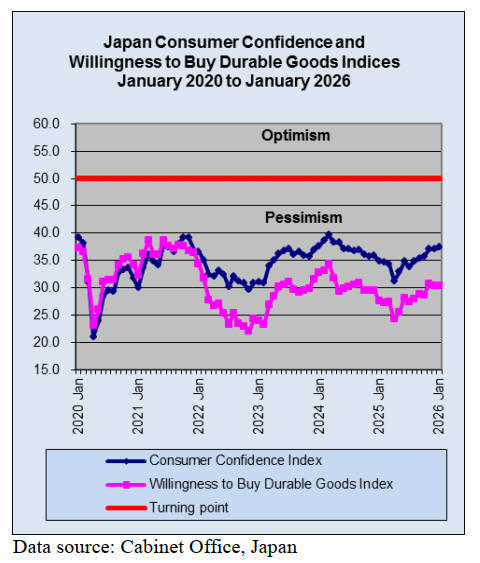
In its monthly report for January, the Cabinet Office
maintained its overall assessment saying the economy is
“recovering at a moderate pace, although the effects of the
U.S. trade policy are seen mainly in the auto industry.”
Japan's Consumer Confidence Index rose in January when
compared to the figure seen the previous month according
to the Cabinet Office data.
The overall livelihood index climbed to 36.8 as consumers'
willingness to buy durable goods rose. The employment
component gained while the income growth index went up
0.7 points to 42.0.
In terms of inflation expectations, the share of respondents
anticipating higher prices over the next year fell 0.5
percentage points from December.
See
:https://www.tradingview.com/news/macenews:743dedfef094b:0
-japan-govt-continues-to-see-modest-economic-recovery-on-
sustained-wage-hike-prospects-brighter-consumer-sentiment-
amid-easing-inflation/ - Google Search
and
https://www.tradingview.com/news/te_news:520976:0-japan-
consumer-morale-highest-in-21-months/
Market anticpates currency intervention
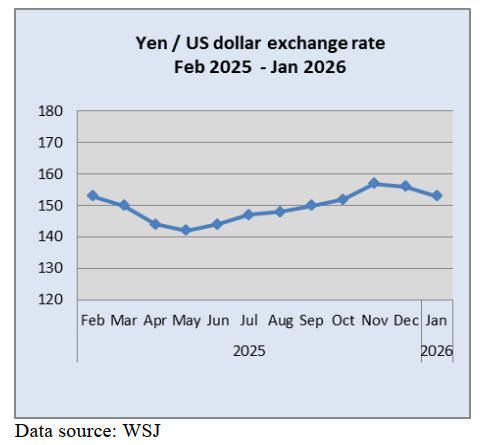
On Monday 27 January the yen gained amid broad
weakness in the dollar as traders remained on heightened
alert over possible Japanese intervention to halt the
currency’s recent slide. The Japanese currency jumped as
much as 1.2% versus the dollar. Volatility in foreign-
exchange markets came as Japan’s currency advisor,
Atsushi Mimura, said authorities in Tokyo will respond in
close coordination with their counterparts in Washington.
See:
https://www.japantimes.co.jp/business/2026/01/26/markets/yen-
extends-gains-dollar-pressure/ - Google Search
Foreign investors accounted for 27% of real estate
transactions in in Japan in 2025
According to the media a review of regulations governing
real estate ownerships is being considered and that after
gaining a better understanding of the situation the
government will contemplate imposing restrictions on real
estate acquisitions by foreign nationals.
However, concerns have been raised that excessive
regulations of real estate transactions could hinder
economic activity driven by investment.
The Asahi article points out that implementing regulations
targeting foreigners alone is considered difficult because
Japan is a signatory to World Trade Organization
agreements that uphold the principle of non-
discrimination.
See: https://www.asahi.com/ajw/articles/16230489 buyers
Assembled wooden flooring - Import update
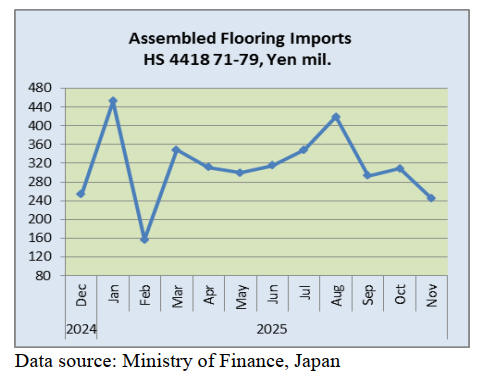
The October rise in the value of assembled wooden
flooring (HS441871-79) faded in November but if the
trend in previous years holds there may be another uptick
in December.
Year on year the value of November 2025 imports was
down over 20% compared to the level in November 2024
and month on month there was a 20% decline in the value
of imports.
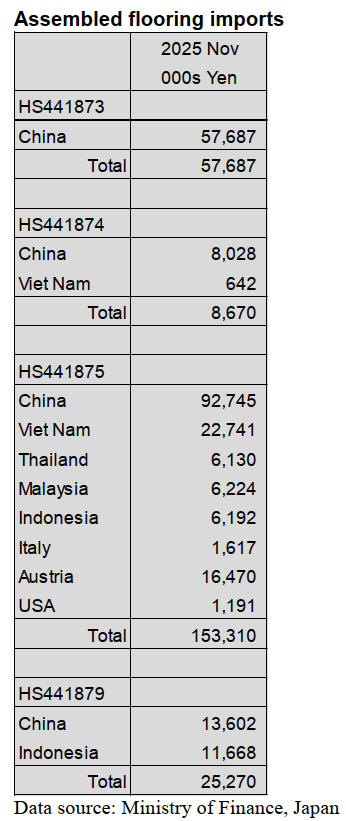
Of the various categories of assembled flooring
imports in
November, 62% was of HS 4418-75 (72% in October)
China and Vietnam being the top shippers, however, these
two shippers saw a sharp drop in the value of shipments to
Japan as did shippers in Thailand.
For the other categories HS4418-79 accounted for 24% in
November (22% in October) followed by HS4418-79
at10% (4% in October) and HS4418-74, 4% (2% in
October).
For HS4418-73 imports all originated in China. Shippers
in China and Indonesia were the only shippers of HS4418-
79 in November.
Plywood imports
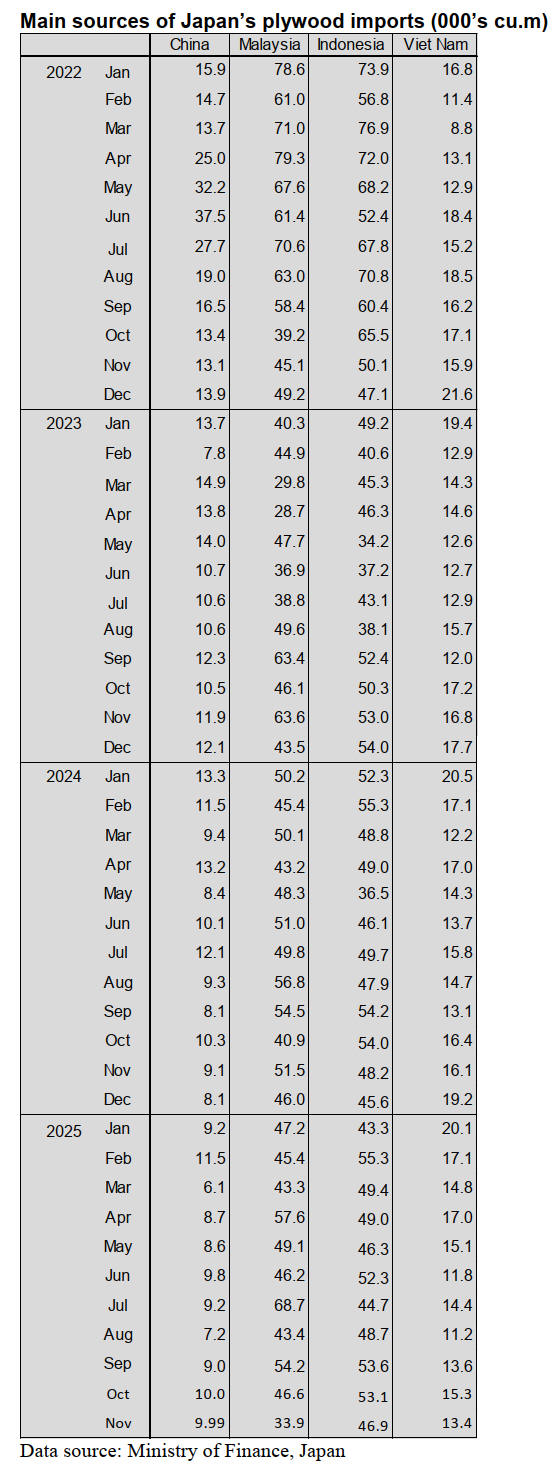
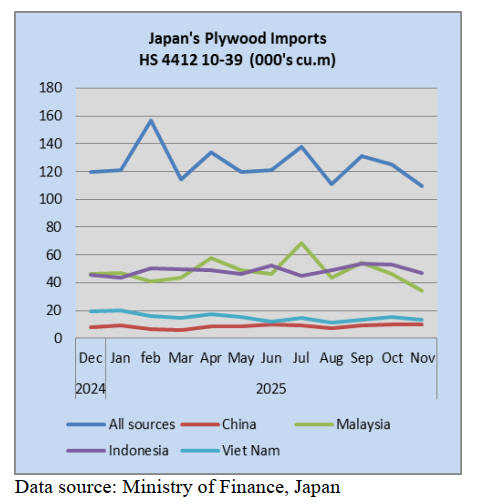
Indonesia and Malaysia continued as the top suppliers of
plywood to Japan in November and the combined volume
of shipments accounted for 73% of Japan’s plywood
imports (79% in October). The other top shippers being
Viet Nam and China. November 2025 plywood arrivals
were slightly down compared to the volume of October
with shippers in Malaysia and Indonesia posting declines.
In November 2025 arrivals of HS441210-39 were reported
at 109,850 cu.m (215,755 cu.m in October). As in previous
months of the various categories of plywood imported in
November 2025, HS441231 accounted for most (91%).
Trade news from the Japan Lumber Reports (JLR)
The Japan Lumber Reports (JLR), a subscription trade
journal published every two weeks in English, is
generously allowing the ITTO Tropical Timber Market
Report to reproduce news on the Japanese market
precisely as it appears in the JLR. For the JLR report
please see: https://jfpj.jp/japan_lumber_reports/
Demand and supply of lumber at Tokyo port
According to Tokyo Lumber Terminal Co., Ltd., the
inventory of lumber at the end of November 2025 is
139,000 cbms, 5.2 % less than October 2025. It is for the
first time in six months to decrease.
Incoming volume dropped significantly by 33.4%,
reflecting quarterly shipment adjustments by shippers and
trading firms and reduced monthly contract purchases
under the ongoing yen depreciation.
Meanwhile, shipments failed to recover to the September
and October levels. Looking at daily figures, product
inflows were 2,076 cbms against outflows of 2,502 cbms,
a 1.7% month-on-month decline. While this is in line with
April–September levels and does not indicate sluggish
demand, it was below the 2,600 cbms expected by the
Tokyo Lumber Terminal.
European lumber inflows amounted to 11,541 cubic
meters, down 42.1% month-on-month. Shipments totaled
14,448 cbms, a 12.1% decline from the prior month, with
inventories at 42,075 cbms, down 6.3%.
Since November, the weak yen has driven up costs,
making it difficult for shippers and trading companies to
increase the volume of lumber contracts from the U.S. and
Canada. Incoming volume was 8,492 cbms, down 25.7%
from the previous month, while outgoing volume was
8,529 cbms, a 29.9% decrease month-on-month. Stock
volume was 30,632 cbms, a 0.1% month-on-month
decrease.
Imports of Russian lumber totaled 5,172 cbms, down
39.7% from the previous month; outgoing volume was
9,846 cbms, a 4.1% decrease; and inventories stood at
35,324 cbms, down 11.7% month-on-month.
Russian lumber
Russian lumber prices, particularly for imported red pine
battens, are showing a bearish trend at the origin. Until
now, local sawmills have resisted price cuts due to high
production costs. However, with shipments to destinations
other than Japan stagnating and demand in Russia and
Central Asia slowing as winter sets in, they are now
showing a willingness to negotiate prices in order to
increase supply to Japan, which is relatively easier to sell
into.
However, with the yen weakening to the ¥155 range
against the dollar, landed costs remain high at around
¥95,000 per cubic meter (Ontario delivery).
In the domestic market, excess inventory in the Tokyo
metropolitan area has yet to be resolved. At the Tokyo
Lumber Terminal, although shipments exceeded arrivals in
November, inventories remain around 35,000 cubic
meters, which is considered high for this time of year.
On the price front, with distribution stocks largely
consisting of high-priced material, there is little room for
reductions, leaving current prices unchanged. As a result,
transactions are sluggish, and in the product market
retailers are limiting purchases to small, immediate needs.
Radiata pine logs and lumber
The wood packaging materials market showed a modest
recovery trend in September and October, but shipments
did not grow as expected from November onward, and in
December demand is clearly lower compared with the
same month last year.
For 2025, import volumes are projected at 140,000 cubic
meters for Chilean radiata pine lumber, an 18% decrease
from last year, and 195,000 cubic meters for New Zealand
radiata pine logs, also an 18% decline.
Chilean radiata pine lumber is projected to fall by half
compared with pre-COVID 2019 levels, while New
Zealand radiata pine logs are expected to decline by 45%
from the same year, both representing significant
decreases. The origin price of Chilean radiata pine lumber
remains at US$340 per cubic meter (C&F), but with the
exchange rate weakening from ¥146 to ¥153 to the dollar,
about a 4% decline, import costs for this material are
rising. At present, the domestic market price for Chilean
radiata pine squared timber is holding steady at around
¥63,000 per cubic meter (delivered to packaging
companies, including transport and fumigation costs).
The origin price of New Zealand radiata pine logs for the
Japanese market is holding steady at around US$160 per
cubic meter (C&F).
The price of domestically sawn slab boards is also holding
steady at around ¥66,000 per cubic meter, delivered to
wholesalers. Meanwhile, the price of the same material for
China is US$ 112–116 per cubic meter (C&F), down by 3
dollars from the previous month.
|


