US Dollar Exchange Rates of
10th
February
2026
China Yuan 6.91
Report from China
Decline in 2025 sawnwood imports
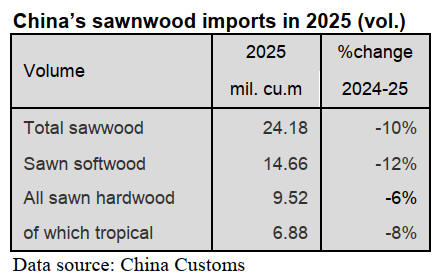
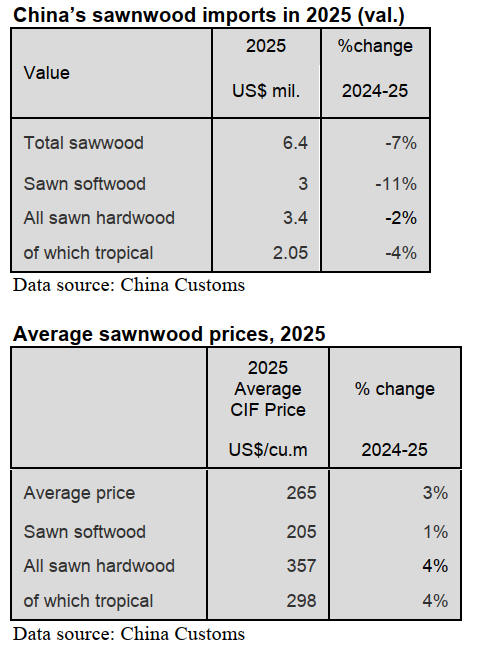
According to data from China’s Customs, 2025 sawnwood
imports totalled 24.18 million cubic metres valued at
US$6.40 billion, a year on year decrease of 10% in
volume and 7% in value on 2024. The average price for
imported sawnwood in 2025 was US$265 per cubic metre,
a year on year increase of 3%.
Of total sawnwood imports, sawn softwood imports fell
12% to 14.66 million cubic metres accounting for 61% of
the national total. The proportion of sawnwood imports
reduced about 1 percentage points year on year. The
average price for imported sawn softwood was US$205
per cubic metre in 2025, up 1% year on year.
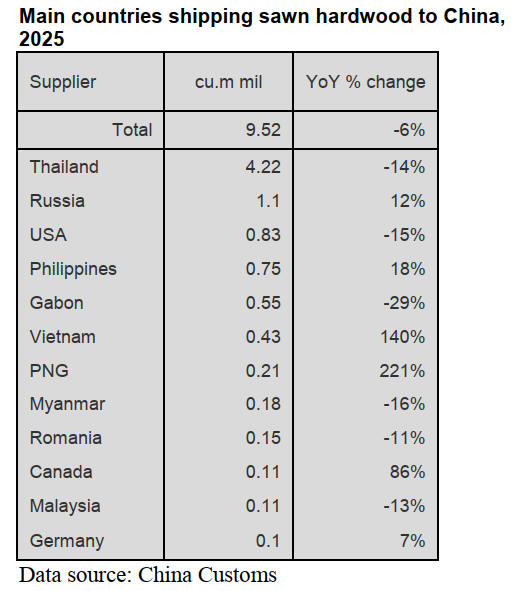
Sawn hardwood imports totalled 9.52 million cubic metres
valued at US$3.40 billion, a year on year decrease 6% in
volume and 2% in value on 2024. The average price for
imported sawn hardwoods was US$357 per cubic metre, a
year on year increase of 4% year on year.
Of total sawn hardwood imports, tropical sawn hardwood
imports were 6.88 million cubic metres valued at US$2.05
billion, a year on year decrease of 8% in volume and 4%
in value and accounted for about 28% of the national total.
The average price for imported tropical sawn hardwood
was US$298 per cubic metre, up 4% year on year.
The main reason for the decline in sawnwood imports was
the reduction in domestic demand. As the main driving
force for the import of sawnwood, the deep adjustment of
the domestic real estate market was the primary factor.
Currently, the new housing construction area has
plummeted by 64% compared to the average level over the
past decade, directly leading to a contraction in the
demand for construction materials including sawnwood.
Market data confirms the severe situation.
The proportion of new home sales in total transactions has
sharply declined from over half in 2022 to 26% in 2024
and the downward trend continued in 2025. The real estate
market in China remained sluggish which slowed
construction and manufacturing industries leading to a
decline in demand for sawnwood.
The real estate industry is the main downstream sector for
wood consumption. The number of new housing starts in
2025 decreased and the transaction volume of second-hand
houses declined resulting in a significant cooling of
demand for sawnwood from developers, decoration
companies and furniture factories. This contraction on the
demand side is the most direct reason for the decline in
sawnwood imports. The industry generally believes that
this trend is unlikely to be reversed in the short term.
Other key factors affecting imports were inventory
backlogs and cautious purchasing.
Due to the high domestic sawnwood inventory, traders and
processing enterprises generally adopted the "sales-driven
purchasing" strategy, reducing their willingness to
replenish stocks which further suppressed sawnwood
demand.
Another reason was supply chain cost increases.
Fluctuations in global shipping fees, rising raw material
costs and policy adjustments in some sawnwood exporting
countries have increased import costs and squeezed the
profit margins of enterprises.
Sudden halt of China-US timber trade. Beginning June
2025 China suspended imports of American logs (due to
quarantine issues) resulting in a significant decline in the
arrival of American sawnwood. Although it was not the
main reason for the decrease in the total import volume of
sawnwood, this move exacerbated the fluctuations in the
import pattern. The last reason for the decline was that the
price for imported sawnwood rose.
In conclusion, the significant reduction in sawnwood
imports in 2025 was the result of the combined effects of
demand contraction and cost pressure and the industry as a
whole is currently in a period of deep adjustment.
Decline in sawnwood imports from Russia
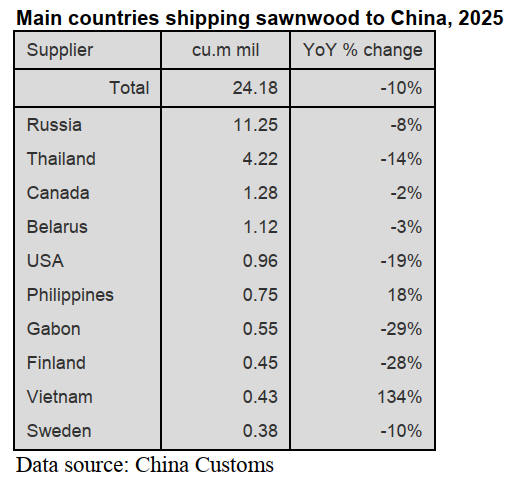
According to data from China Customs, Russia was the
largest supplier of China’s sawnwood imports in 2025 but
sawnwood imports from Russia fell 8% to 11.25 million
cubic metres, accounting for 47% of the national total at a
value of US$2.383 billion, down 5% on 2024. The average
price for imported sawnwood from Russia in 2025 was
US$212 per cubic metre, a year on year decline of 0.5%.
China's imports of sawnwood from Russia decreased both
in volume and value in 2025. Meanwhile, the increase in
transportation costs and the restricted logistics channels
have further intensified the pressure on the industry.
Although the trial operation of the Russian-Chinese Arctic
shipping route is expected to reduce transportation costs
by 28% and shorten delivery time by 14 days, it has not
yet established a large-scale transportation capacity.
Furthermore, the adjustment of the Chinese construction
and real estate market has led to a decrease in the demand
for sawnwood. Coupled with the increasingly strict
environmental policies, this has also prompted Chinese
timber merchants to accelerate the diversification of their
supply chains, thereby reducing their purchases of Russian
sawnwood to some extent.
China's sawnwood imports from the Philippines and
Vietnam increased significantly by 18% and 134% in
2025. China’s sawnwood imports from Thailand dropped
to 4.22 million cubic metres valued at US$1.103 million,
down 14% in volume and 12% in value on 2024 levels.
The average price for imported sawnwood from Thailand
in 2025 was US$262 per cubic metre, a year on year
increase of 3%.
Rise in sawn softwood imports from New Zealand
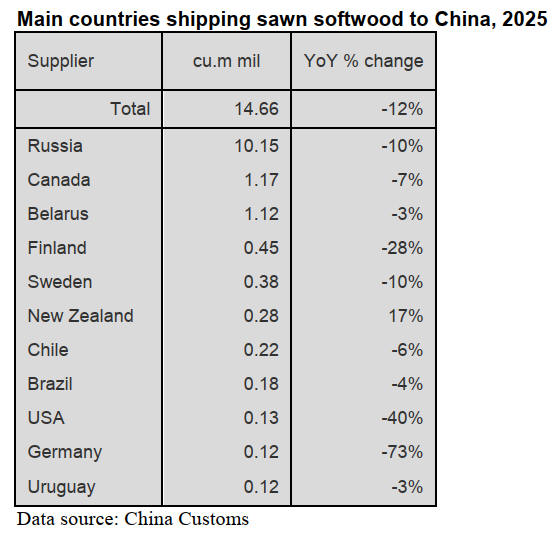
China’s sawn softwood imports from New Zealand, alone
among the top suppliers, rose 17% to 280,000 cubic
meters in 2025. The volume of sawnwood imported by
China from New Zealand increased in 2025. The main
reasons can be summarised as follows.
Changes in the domestic timber supply structure in China.
The country has continuously implemented a ban on
commercial logging of domestic natural forests resulting
in a significant reduction in large diameter log resources.
Sawmills have increased their reliance on imported raw
materials, especially for a stable supply of sawn softwood.
The market competitiveness of New Zealand timber. New
Zealand's timber is mainly composed of radiata pine. It is
stable and of uniform specifications. Moreover, due to the
upgrade of the China-New Zealand Free Trade
Agreement, China has abolished tariffs on 12 related tax
items of wood and paper products imported from New
Zealand. Approximately 99% of the wood and paper enjoy
tax-free treatment, thereby reducing the import cost of
sawn softwood.
Substitution effect and supply chain diversification. Due to
the impact of international circumstances the import
volume of timber from traditional supply countries such as
the United States and Germany has significantly
decreased. Chinese enterprises have accelerated the
diversification of their supply chains. As a stable and
reliable supply country New Zealand's exports of
sawnwood to China have increased.
In conclusion, the increase in China's imports of
sawnwood from New Zealand in 2025 was the result of
the combined effects of domestic resource constraints,
policy benefits, supply chain adjustments and changes in
the international situation.
Drop in sawn hardwood imports from Thailand
China’s sawn hardwood imports from Thailand, as the
largest supplier, dropped 14% to 4.22 million cubic metres
in 2025, accounting for 49% of the national total.
China's sawn hardwood imports from Thailand are mainly
rubberwood and fell in 2025 although China's imports of
sawn rubberwood have continued to grow in recent years.
Overall, the contraction of domestic demand and the
shortage of rubberwood raw materials as well as the rising
acquisition costs in Thailand affected the import
performance of Thai rubberwood in the Chinese market in
2025. The specific conditions are as follows:
The adjustment of some downstream industries in China
has weakened the willingness and ability to purchase raw
materials. Especially during the traditional consumption
peak season the impact of demand boosting policies was
less than expected which further led to a decline in the
rubberwood import volume.
The instability in the acquisition of rubberwood raw
materials within Thailand has become increasingly
prominent. On the one hand, uncertainty in the price trend
of rubberwood in recent years has affected the pace of
logging resulting in unstable rubberwood raw material
supply. On the other hand, adverse weather conditions
such as heavy rains have continuously driven up the costs
of rubberwood and processing. As a result, Thai exporters
have had to raise prices which, in turn, has led to an
increase in the annual import unit price.
China’s sawn hardwood imports from USA, Gabon,
Myanmar, Romania and Malaysia fell 15%, 29%, 16%,
11% and 13% respectively in 2025.
In contrast, China’s sawn hardwood imports in 2025 from
Vietnam and PNG surged 140% and 221% respectively.
Decline in sawn tropical hardwood imports
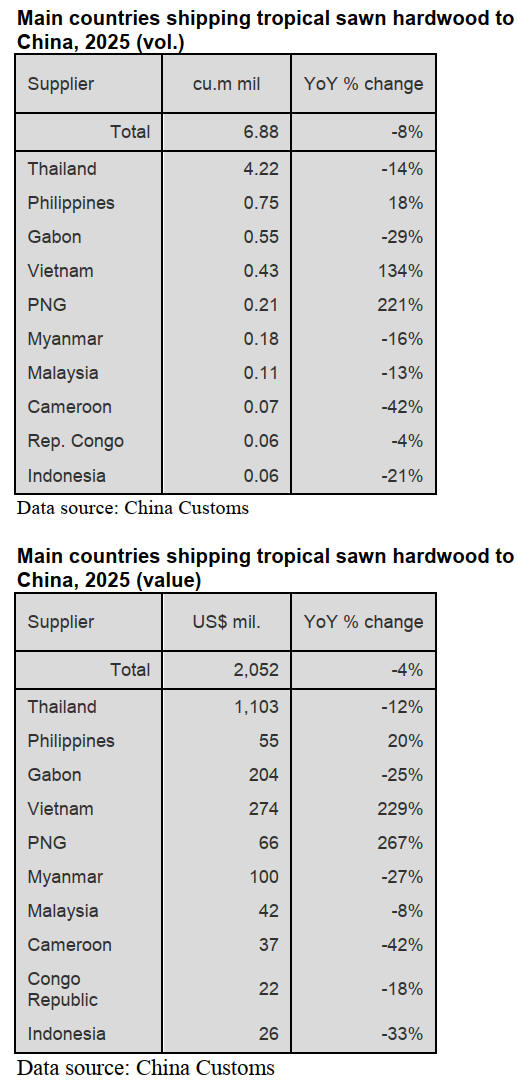
China’s sawn tropical hardwood imports in 2025 were
6.88 million cubic metres valued at US$2.052 billion, a
year on year decrease of 8% in volume and 4% in value
and accounted for about 28% of the national total.
Thailand still was the largest supplier of sawn tropical
hardwood imports and 2025 sawn tropical hardwood
imports from Thailand totalled 4.22 million cubic metres
valued at US$1.103 billion, a year on year decrease of
14% in volume and 12% in value, accounting for 61% of
the national total.
China's imports of tropical sawn hardwood from the
Philippines have increased significantly, jumping from the
third largest supplier to the second largest supplier,
replacing Gabon.
The Philippines was the second largest supplier of China’s
sawn tropical hardwood imports in 2025 and China’s
tropical sawn hardwood imports from the Philippines rose
18% to 750,000 cubic metres, but imports from Gabon
dropped 29% year on year to 550,000 cu.m.
The top three countries supplied 80% of China’s tropical
sawn hardwood requirements in 2025, namely Thailand
(61%), the Philippines (11%) and Gabon (8%) in 2025.
The main reasons for the decrease in China's sawn tropical
hardwood imports in 2025 was as follows.
The sluggish domestic real estate market has led to a
decrease in demand for tropical timber. Additionally, sawn
tropical hardwood industry is facing the following
challenges, including frequent fluctuations in log prices,
continuous increases in labour costs, the sluggish
construction market and the impact of US tariffs and anti-
dumping policies.
Moreover, reduced enterprise orders, rising freight costs
have further constrained local enterprises and enterprises
lack the motivation to import sawn tropical hardwood.
|


