|
Report from
North America
Imports of sawn tropical hardwood dipped in
November
After surging 25% in October, US imports of sawn
tropical hardwood dipped slightly in November, falling
4% from the October high. Despite the dip, the volume of
18,321 cubic metres imported was well above average for
the year and 8% over that of November 2024.
A 12% rise in imports from top-supplier Brazil and a
doubling of imports from Cameroon mitigated declines of
more than 20% from most of the other leading trade
partners.
Keruing imports fell 78% and imports of Ipe fell 38%
while imports of Sapelli rose 29%. Total imports of sawn
tropical hardwood are up 6% over the previous year
through November.
Hardwood plywood imports tumbled 18% in November
US imports of hardwood plywood fell for a second
consecutive month in November, declining 18% from the
previous month. At 232,877 cubic metres, November
imports were 9% less than in November 2024. The decline
was driven by a 64% drop in imports from Indonesia,
which fell to their lowest level since June 2023.
Also showing sharp declines were Imports from Vietnam,
down 32%, and from Russia, down 35%. Through
November, imports of hardwood plywood for 2025
outpace 2024 by 23%.
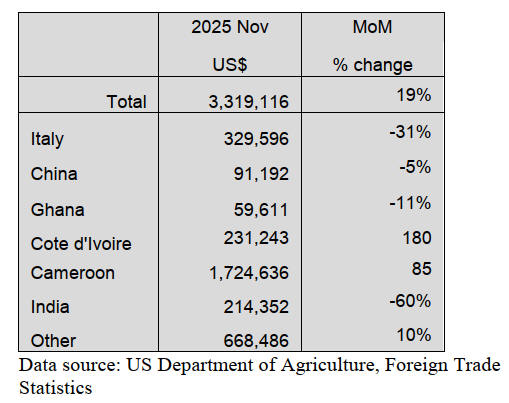
Veneer imports were strong in November
Imports of tropical hardwood veneer surged for a second
straight month in November, rising another 19% from the
previous month after a 95% gain in October. At more than
US$3.3 million, imports for the months were 125% higher
than in November 2024.
Imports from Cameroon soared 85% and accounted for
more than half of the imports for the month. Imports from
Cote d’Ivoire also rose sharply, up 180% from the
previous month. Total imports of tropical hardwood
veneer are up 20% over the previous year through
November.
Moulding imports rebound
After three months of decreases, US imports of hardwood
moulding rebounded somewhat in November, rising 10%
from October’s totals. At US$14.5 million, imports for
the month were 4% higher than in November 2024.
Strong gains in imports from Brazil, Malaysia and Canada
more than offset a 34% decline in imports from China
which have fallen to their lowest level since March 2023.
Year to date, total imports of hardwood moulding are up
10% versus 2024.
Hardwood flooring imports lag previous year
Through November, imports of both hardwood flooring
and assembled flooring panels trail 2024 imports by
significant margins. US imports of hardwood flooring slid
6% in November. At US$5.7 million, imports trailed the
November 2024 total by 21%.
Imports from China fell 72% in November and are down
46% for the year heading into December. Imports from
Brazil are down 51% for the year so far despite a 40%
monthly gain in November. It is likely that total imports of
hardwood flooring will end 2025 down from the previous
year as year-to-date imports are 6% behind 2024 through
November.
Imports of assembled flooring panels were down 12%
versus 2024 through November, despite a 24% surge in
November imports over the previous month. Even with the
gain, November imports were 27% lower than in the
previous November.
As with hardwood flooring imports, panel imports from
China tumbled 53% for the month and were down 45% for
the year. Imports from Thailand resumed in November
after four months of no reported activity, as imports for the
year from that country are down 60%.
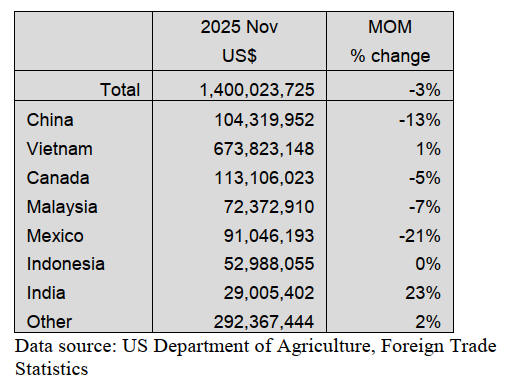
US wooden furniture imports drop to lowest level since
COVID
US imports of wooden furniture fell for a fourth
consecutive month in November, hitting their lowest level
since the 2020 COVID epidemic. November imports fell
3% from the previous month to just over US$1.4 billion,
which is 23% lower than in November 2024 and is the
lowest level of imports since June 2020. Imports from
Mexico (down 21%) and imports from China (down 13%)
saw the steepest declines. Total US imports of wooden
furniture are down 8% versus 2024 through November.
Meanwhile, the whole of the US furniture market remains
flat, according to tracking by Smith Leonard. New orders
were down 8% in October compared to the prior month of
September 2025 (following the 15% increase from August
2025). New orders were also down 1% in October 2025
compared to October 2024. However, year to date through
October 2025, new orders remain flat compared to 2024.
See: https://usatrade.census.gov/index.php?do=login
and
https://www.smith-leonard.com/2025/12/30/december-2025-
furniture-insights/
US furniture market projected to nearly double by 2035
The US furniture market, valued at US$178.9 billion in
2025 is forecast to reach US$345.5 billion by 2035,
growing at a compound annual growth rate (CAGR) of
6.8%, according to Astute Analytica. Residential furniture
dominates, accounting for 61% of sales, with wood
products making up 39% and seating furniture
representing 34% of the market.
The industry is supported by ongoing home renovations,
remote work trends, and technological advances in
production that lower costs and allow for greater product
customization. E-commerce and direct-to-consumer
channels are also driving growth.
Employment and manufacturing remain strong, with
269,177 workers across 5,649 establishments as of March
2025. The home furnishings sector is set to expand from
$217.53 billion in 2024 to $286.39 billion by 2029,
buoyed by projected home sales growth of 9% in 2025 and
13% in 2026.
Consumer behavior is evolving, with many delaying
purchases but planning to buy in predictable cycles. Forty
percent of sofa and sectional buyers who postponed
purchases intend to buy in the first half of 2025, while
bedroom and outdoor furniture see staggered buying
patterns. Challenges include intensifying omnichannel
competition, potential housing market slowdowns, and
supply chain disruptions from tariffs and geopolitical
tensions.
See: https://finance.yahoo.com/news/united-states-furniture-
market-set-120000635.html?guccounter=1
Tariffs drove construction materials prices up 2.8% in
2025
Construction input prices decreased 0.6% in December
compared to the previous month, according to an
Associated Builders and Contractors analysis of US
Bureau of Labor Statistics’ Producer Price Index data.
Nonresidential construction input prices decreased 0.7%
for the month.
Overall construction input prices are 2.8% higher than a
year ago, while nonresidential construction input prices
are 3.2% higher.
Prices increased in two of three energy categories in
December. Natural gas and unprocessed energy materials
prices were up 34.8% and 5.5%, respectively, while crude
petroleum prices were down 2.7% in December.
“Construction materials prices posted a welcome decline
in December, yet key inputs are still experiencing rapid
escalation,” said ABC Chief Economist Anirban Basu.
“This is especially true for materials most exposed to
tariffs.
“Prices for commodities less exposed to tariffs, like
asphalt or crushed stone, will likely remain tame in the
coming months due to soft demand for construction
services,” said Basu. “While that may limit increases in
overall materials prices, trade policy will continue to put
upward pressure on certain materials. This has not
significantly dimmed contractor optimism; 7 in 10 ABC
members expect their profit margins to remain stable or
grow over the next two quarters, according to ABC’s
Construction Confidence Index.”
See: https://www.bls.gov/ppi/
and
https://www.abc.org/News-Media/News-Releases/abc-tariffs-
drive-construction-materials-prices-up-28-in-2025
|


