Japan
Wood Products Prices
Dollar Exchange Rates of 10th
April
2026
Japan Yen 159.29
Reports From Japan
Consumer confidence - steepest decline since 2020
Japan's consumer confidence experienced its steepest
decline since April 2020 with the index plunging to 33.3 in
March 2026 driven by rising fuel costs, inflation fears and
Middle East tensions. This suggests that high inflation and
weakened sentiment will hurt household spending and
challenge the Bank of Japan's monetary policy, with
households especially worried about their livelihood and
future costs.
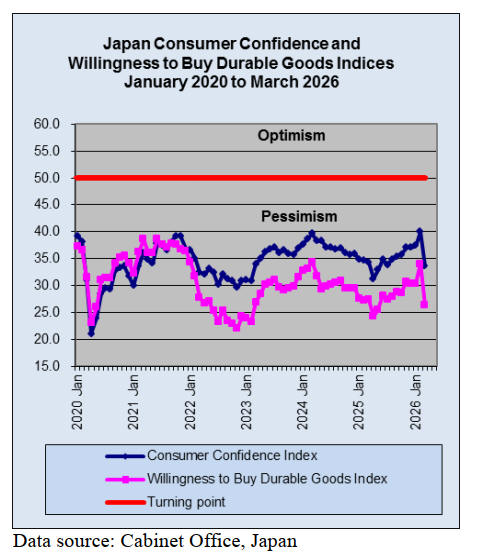
The decline in confidence is expected to lead to a
significant slowdown in consumer spending and the weak
data complicates the Bank of Japan's plans to raise interest
rates, as it battles with an economic slowdown. Japanese
consumers are tightening their belts due to the rising cost
of living, which is threatening the nation's fragile
economic recovery.
The latest data suggest escalating tensions in the Middle
East have already weighed heavily on Japan’s consumers,
raising the risk that softening sentiment could lead to a
decline in consumer spending. In the middle of last month,
Japan’s gasoline prices hit the highest in three decades
before coming down a little owing to government
subsidies.
See: https://www.businesstimes.com.sg/international/japans-
consumer-confidence-drops-most-covid-19
In related news, Japanese households' spending increased
at a slower pace than income over the past five years,
according to the latest Cabinet Office report indicating that
people saved more amid inflation.
According to the fiscal 2025 report on the country's
economic conditions, disposable income rose across all
age and income groups from 2019 to 2024 but
consumption growth was sluggish, with spending falling
in some groups.
The savings rate increased for all groups except those in
their 20s. Lower-income households were more affected
by inflation, as rising food costs accounted for a larger
share of their spending.
See:
https://www.nationthailand.com/blogs/news/general/40062377
Firms negatively affected by Iran crisis
A survey by Tokyo Shoko Research Ltd. showed that
around 80% of Japanese firms are experiencing negative
impacts from the ongoing crisis in the Middle East. Of
7,196 companies surveyed, 78% responded that they are
suffering negative effects.
Asked about reasons, 70%, the largest share, cited higher
costs stemming from soaring prices of crude oil-derived
materials, followed by climbing gasoline prices, cited by
65%. These response were especially prevalent in the
manufacturing and transportation sectors.
See:
https://www.nippon.com/en/news/yjj2026040900886/nearly-80-
pct-of-japan-firms-negatively-affected-by-iran-crisis.html
In related news, the Japan Center for Economic Research
(JCER) has published an assessment of how the Japanese
economy may be affected by the current oil crisis. The
analysis was prepared by Jun Saito, a Senior Research
Fellow.
JCER signals that the war in the Middle East will have a
serious effect if it last long as most of the crude oil
imported from the Middle East comes to Japan passing
through the Straits of Hormuz.
Any long term blockade of shipping through the Strait of
Hormuz will inevitably have a serious effect on the
Japanese economy through sharp drop in supply and steep
increase of prices in crude oil and everyday items
manufactured from oil based products.
See: https://www.jcer.or.jp/english/japanese-economy-
update_march-2026
Yen below 160 would be weakest in almost 40 years
In early April the yen fell to 159 to the US dollar, a rate
last seen in January.

Many suspect that if the yen drops to 160, the weakest in
almost 40 years, intervention becomes more likely The
yen lost ground against the dollar because oil prices soared
when the Middle East conflict started in late February.
Housing starts down sharply
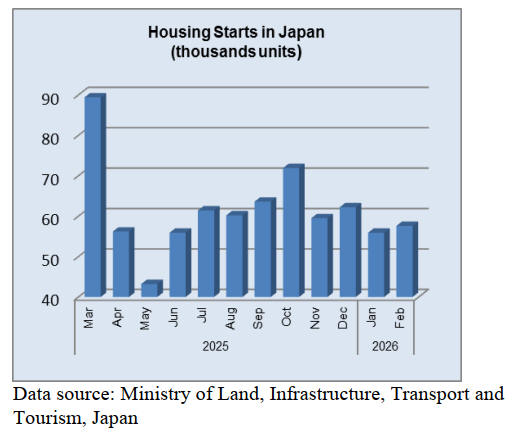
Japan’s housing starts fell almost 55% year on year in
February 2026 after another decline in January. The
February fall marked the fourth month of contraction and
the steepest decline since November 2025 pointing to
sustained weakness in the property sector amid higher
construction costs and soft demand.
Declines were broad-based across all segments, including
rental housing, owner-occupied homes, built-for-sale
housing, prefabricated housing and two-by-four homes.
See: https://www.mlit.go.jp/toukeijouhou/chojou/stat-e.htm
and
https://www.tradingview.com/news/providers/trading-
economics/
Strong fundamentals to support Japan real estate
outlook into 2026
According to Real Estate Asia, investor appetite for
Japanese real estate remains robust across sectors as the
real estate market continues to demonstrate resilience
despite global headwinds and rising interest rates. The
confidence is said to be “underpinned by stable economic
performance and strong corporate profits”.
See: https://realestateasia.com/commercial-other/news/strong-
fundamentals-support-japan-real-estate-outlook-2026
Japanese home builders gaining firm base in the US
Despite a cool housing market in the US Japanese builders
are moving in and soon will own 6% of the business in
America. Since 2020 Japanese builders have acquired 23
US single-family home builders, more than double the
number from 2013 to 2019. That doesn’t include the
multifamily developers and construction-supply
companies they have also bought.
Japanese companies are ramping up their presence in the
US at a time when the American home-construction
market is slowing down.
High mortgage rates have kept many US home buyers on
the sidelines. But for these Japanese builders, even a soft
US market is a better alternative than trying to expanding
at home.
See: https://www.resiclubanalytics.com/p/japanese-firms-buying-
spree-american-homebuilders-keeps-daiwa-house-trumark-
jkmonarch
and
https://www.wsj.com/real-estate/japan-is-placing-a-multibillion-
dollar-bet-on-the-u-s-housing-market-2ced2a01
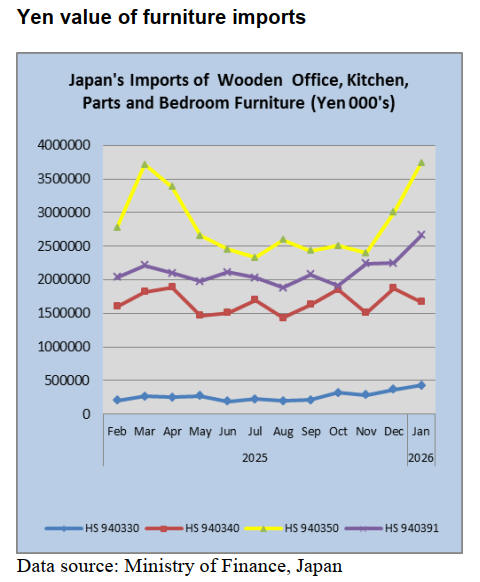
January 2026 wooden office furniture imports
(HS940330)
The value of January 2026 imports of wooden office
furniture (HS940330) was 16% higher than in December
2025 and around 8% higher than in January 2025. The top
supplier in January 2026 was China, accounting for 86 %
of imports. The other main suppliers were Turkey (2.5%)
and Italy (2.4%).
The value of imports from Turkey were considerably
higher than seen in the previous 12 months and the value
of imports from Italy, while only a small share of the value
of imports in January, was also much higher than in the
previous month.
A significant value of shipments was recorded from
Malaysia and Indonesia along with Denmark and Spain.
The top three shippers accounted for over 90% of Japan’s
January 2026 imports of wooden office furniture.
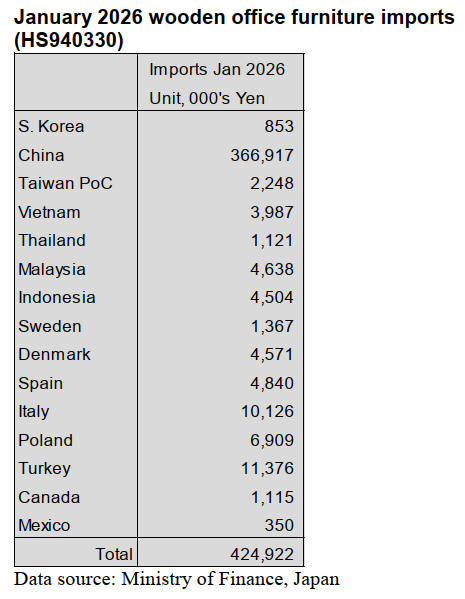
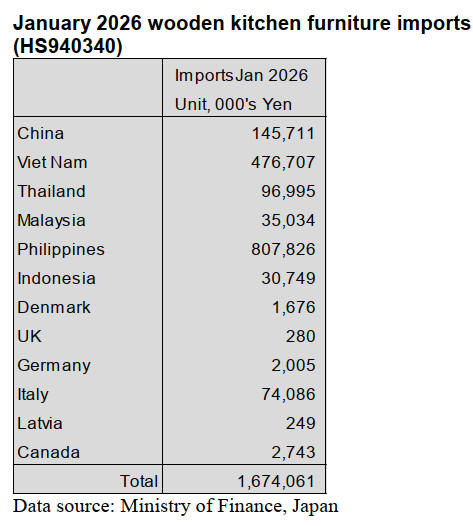
January 2026 wooden kitchen furniture imports
(HS940340)
In January 2026 the top three shippers of wooden kitchen
furniture (HS940340) were the Philippines, Viet Nam and
China. The value of shipments from the Philippines was
the highest accounting for 48% of the total value of
shipments of wooden kitchen furniture.
The other main suppliers were Viet Nam (28% of January
arrivals) and China at 9%. The other significant source of
imports of wooden kitchen furniture in January was
Thailand (6% of the monthly total).
Year on year the value of January wooden kitchen
furniture imports was down 11% compared to the valus of
December 2025 imports but 27% higher than in January
2025.
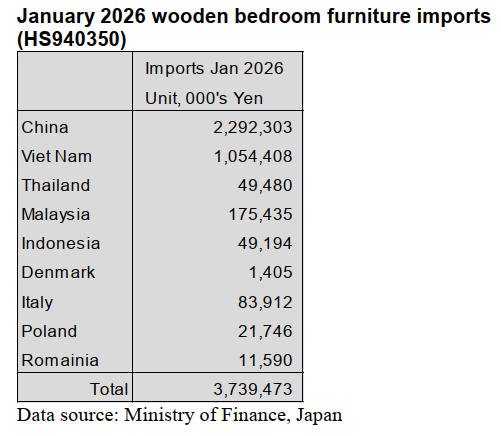
January 2026 wooden bedroom furniture imports
(HS940350)
There was a steep rise in the value of December 2025
imports of wooden bedroom furniture and the upward
trend continued into January 2026. January imports were
27% higher than in December 2025 and 8% more than in
January 2025. Over 95% of the value of HS940350 in
January was shipments from China (61%), Viet Nam
(28%) and Malaysia 9%.
The value of January shipments from China, Viet Nam
and Malaysia were all higher than in December 2025. The
other significant supplier of wooden bedroom furniture to
Japan is Italy but January arrivals were around the same
level as in December 2025. Year on year there was an 8%
rise in the value of January imports.
In January 2026 the number of shippers of wooden
bedroom furniture fell to 9 from the 15 main supply
sources in December 2025.
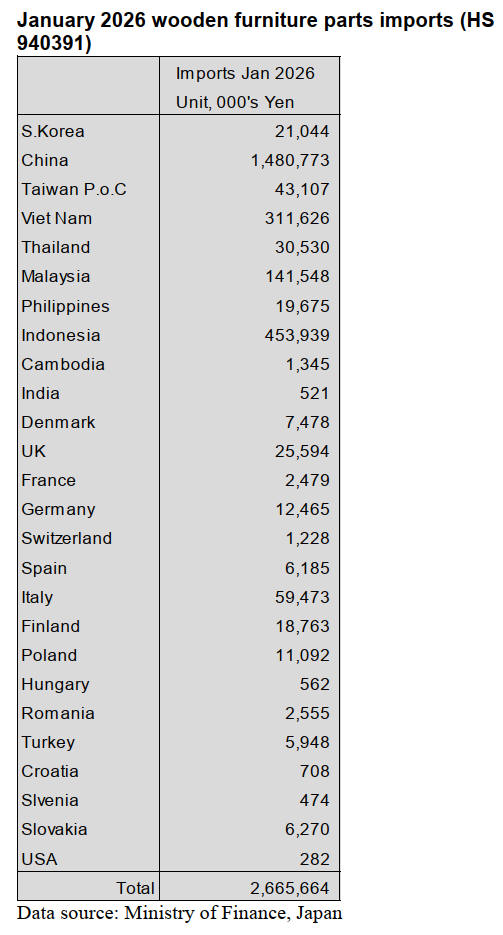
January 2026 wooden furniture parts imports
(HS940391)
Shippers in China and three SE Asian countries,
Indonesia, Viet Nam and Malaysia continued to account
for most of Japan’s imports of wooden furniture parts
(HS940391) in January 2026.
The main shipper in January was China (56% of total
imports of wooden furniture parts – 53% in December)
followed by Indonesia (17%) Viet Nam (12%) and
Malaysia (5%).
The value of arrivals of HS940391 in January 2026 from
the top three shippers, China, Indonesia and Viet Nam was
higher than in the previous month, it was only Malaysia
that recorded a slight month on month drop in the value of
shipments.
Trade news from the Japan Lumber Reports (JLR)
The Japan Lumber Reports (JLR), a subscription trade
journal published every two weeks in English, is
generously allowing the ITTO Tropical Timber Market
Report to reproduce news on the Japanese market
precisely as it appears in the JLR. For the JLR report
please see: https://jfpj.jp/japan_lumber_reports/
Lumber prices to rise further
Some lumber manufacturers belonging to the Miyakonojo
District Sawmill Cooperative in Miyazaki Prefecture plan
to raise prices for kiln-dried lumber products by ¥3,000
per cubic meter starting in March.
Freight rates, which had already been rising in stages due
to the “2024 logistics problem,” began climbing again late
last year. Shipping costs from Miyakonojo to the Kanto
region have reached ¥8,000 per cubic meter, while
transport to the Kansai region now costs ¥6,000 per cubic
meter. In addition, electricity bills, labor expenses, and
other sawmilling costs have continued to rise, prompting
industry to seek long-needed improvements in
profitability. The cooperative plans to implement further
increases in stages, with an eye toward a 10% rise within
the year.
South Sea logs and products
The supply–demand balance for tropical hardwood logs
remains stable. From late last year through January, Japan
received bulk shipments from Papua New Guinea and
container shipments from Malaysia’s Sabah and Sarawak
regions. While PNG cargoes arrived on schedule,
Malaysian container vessels were delayed by about a
month due to flooding at intermediate port following
severe rainstorms across Southeast Asia.
Loading operations in producing regions were only
slightly affected and because the delays occurred during a
period of relatively ample supply, sawmills and plywood
manufacturers were still able to secure the logs they
needed, limiting the overall market impact. The next round
of arrivals is expected around April to May, with contract
negotiations likely to accelerate once the rainy season ends
in producing regions.
For tropical hardwood and China-made products, prices
for Indonesian meranti laminated free boards have been
rising. The heavy rains that struck Southeast Asia also
caused damage in parts of Indonesia, slowing meranti log
production. Reduced log output has pushed up raw
material costs, prompting local manufacturers to move
quickly to pass these increases on to export prices. As a
result, upward price pressure is expected to continue until
production conditions normalize.
¥3,000 price hike
Acing persistently high costs across the board, Chugoku
Lumber implemented a ¥3,000-per-cubic-meter price
increase in March for its main products, including dry
beams, hybrid beams, and laminated cedar columns. This
marked the first price increase in about a year, the last one
having been implemented last spring.
Since last year, the yen has continued to weaken, with the
exchange rate fluctuating sharply in the mid-¥150 range to
the dollar. As a result, procurement costs for Douglas-fir
logs from the United States remain high. Cedar logs are
also firming nationwide due to tight supply. Over the past
one to two years, manufacturing costs—including labor
and electricity—have continued to rise. Delivery expenses
have also surged, keeping overall costs at elevated levels.
Although the company had made sustained efforts to
absorb these increases, maintaining current prices had
become difficult, leaving conditions increasingly
challenging.
Following the ¥3,000 increase, dry-beam standard
products are now priced at just over ¥73,000 per cubic
meter (delivered to precut plants), hybrid beams at slightly
above ¥80,000 per cubic meter, and laminated cedar
columns at ¥67,000 per cubic meter.
Wood demand forecast revised downward
At a meeting of the Forestry Policy Council, the Forestry
Agency presented proposed targets for the supply and use
of forest products to be included in the Basic Plan on
Forest and Forestry, which is being revised for the first
time in about five years.
The total wood demand and domestic timber utilization
targets for 2030 set in the current Basic Plan were revised
downward to reflect the declining trend in new housing
starts and a policy shift toward greater use of existing
housing stock. However, the plan again sets a target of 4.2
million cbms for domestic timber use in 2035, aiming for
an increase of 2 million cbms compared with the 2030
target.
The Basic Plan on Forest and Forestry is reviewed roughly
every five years, and the current plan was approved by the
Cabinet in June 2021. The plan sets target volumes for
total demand (domestic and imported) and domestic
timber utilization for five and ten years ahead.
At the latest council meeting, the ministry presented
proposed targets for 2030 and 2035, as shown in the
accompanying table.
For total demand for domestic and imported wood, the
category of ‘construction-use materials,’ which includes
lumber for residential and non-residential buildings, is
projected to see a modest increase. In contrast, ‘non-
construction materials,’ such as those used for pulp and
biomass power generation, are expected to remain flat
compared with 2024 levels.
Japan launches CO2 absorbing wood board
Four Japanese companies, Behomal, Swood, Kuwahara,
and Naito Architects, have jointly commercialised a new
domestically produced wood-based building material, the
“DAC Strand Board,” which absorbs and stores CO2.
They are now seeking corporate and municipal partners to
collaborate on construction projects, exhibitions, and
demonstration sites to support wider adoption of the
material. The product combines Swood’s non-oriented
strand board made from locally sourced timber with
Behomal’s CO2-absorbing material.
In addition to the strand board’s inherent carbon-
sequestration properties, the plant-derived material
developed by Behomal adds further CO2-fixing capacity.
As the material continues to absorb CO2 even after
installation, it effectively extends the time horizon of
carbon removal. The development of the DAC Strand
Board was driven by Behomal, a research-focused startup,
in collaboration with local companies across
manufacturing, design, and construction. Together, they
established an open-innovation framework that brought
regional expertise into each stage of the process.
See also: https://zenbird.media/new-japanese-building-material-
absorbs-carbon-dioxide-after-installation/
|


