|
1.
CENTRAL AND WEST AFRICA
Current tensions making buyers more cautious
Observers report activity levels in the timber industries are
stable with no major shifts in supply or production but
growing uncertainty is affecting forward business.
The most notable concern is the geopolitical situation
which is creating hesitation in placing new orders amongst
buyers, particularly for Middle East markets. This region
remains an important outlet, not only for direct
consumption in markets such as Dubai, Qatar and the
UAE but also as a redistribution hub for Iraq and Iran.
Current tensions are making buyers more cautious and the
coming weeks will be critical in determining whether
demand stabilises or weakens further.
Within West and Central Africa there has not yet been a
major impact on fuel prices as yet but overall living costs
remain high and continue to rise. Governments are
attempting to manage inflation by controlling the cost of
essential imports, especially food products. Despite these
efforts, inflationary pressure is clearly present across the
region.
For the timber sector the situation remains cautious.
Production is ongoing but new business, particularly
linked to export markets, is under pressure from external
uncertainties. Much will depend on geopolitical
developments and their impact on key destinations such as
the Middle East.
Gabon
The Gabonese timber sector remains operational but under
pressure from a combination of logistical challenges,
regulatory measure and shifting demand patterns. While
no major structural changes have been seen several
operational constraints continue to affect efficiency and
supply.
Electricity and water supplies remain critical issues.
Despite repeated meetings between the government and
the national utility (SEEG), power cuts continue with
multiple daily outages. In Libreville, water shortages have
become severe, leading to the installation of public water
distribution points. These disruptions are also impacting
industrial operations.
Harvesting continues but is constrained by poor road
conditions after prolonged rains. In particular, Azobé log
supply is reported as low as bush roads remain in very
poor condition. Some concessions in the Okondja Region
have been trying for months to transport logs to mills
without success. As a result, substitution with species such
as Okan is increasing, raising questions about acceptance
in key markets like the Netherlands.
Demand trends remain mixed across regions. Demand
from China is showing a gradual recovery particularly for
Okoume and Ovangkol which is supporting sawmill
activity. Vietnam continues to be a strong market for Tali,
Padouk and Niové.
The Philippines market is weakening while Middle East
demand has slowed due to geopolitical uncertainty.
However, expectations remain that demand could rebound
quickly once the situation stabilises, driven by
construction needs and re-export activity toward Iraq and
Iran.
Exports of Azobé to the Netherlands are continuing but at
reduced monthly volumes of around 1,500 cu.m, while
Bangladesh is emerging as an additional buyer for Azobé
and Okan.
A significant development recently reported is the
Ministry of Forestry decision to block exports by some
companies due to irregularities in their legal agreements.
This measure is expected to impact export volumes and
tighten compliance across the sector.
After a five-year restriction authorities are reviewing
existing Kevazingo stocks. Companies have been
instructed to declare their inventories and inspections are
underway. There are indications that exports may resume
under controlled conditions. However, market prices for
Kevazingo have collapsed due to prolonged absence from
the market and substitution by alternative decorative
species such as Ovangkol and Belli.
For the industry in Gabon the outlook remains cautious.
While demand from China is improving and alternative
markets are developing, supply constraints, particularly for
Azobé and infrastructure challenges continue to limit
growth. Regulatory tightening and compliance
enforcement may further reshape the sector in the coming
months.
The Ministry of Water and Forests with technical support
from the Nature Conservancy (TNC) and funding from the
Central African Forest Initiative (CAFI) hosted a training
workshop for investigators dedicated to combating illegal
logging.
Thirty agents from the forestry and judicial
administrations participated in this training focused on
strengthening skills in investigation, legal procedures, and
evidence management. The objective was to improve the
effectiveness of field missions and ensure the legal
soundness of cases submitted to the courts.
See: https://www.gabonreview.com/lutte-contre-lexploitation-
illegale-le-gabon-muscle-ses-enqueteurs-forestiers/
Cameroon
Harvesting activity is increasing as the dry season has
fully set in with no more rainfall affecting operations. This
allows operators to repair forest roads and improve access,
supporting higher production levels. However, despite
improved operational conditions, the international market
demand remains low to stable, limiting the pace of
expansion.
Sawmill production is picking up supported by the return
of most Chinese operators who are actively seeking
alternative markets for sawnwood. This is helping to
stabilise the sector after a slower period.
European demand is still quiet, particularly for Padouk,
Azobé and Ayous. Ayous exports to Italy and the
Netherlands remain under pressure largely due to
competition from alternative materials, including Brazilian
softwood.
Logistics remain generally functional. Container
availability is not an issue, with sufficient empty
containers available. Port operations in Douala and Kribi
are running normally, though congestion in Douala Port
continues to cause delays of up to seven days or more for
vessels waiting to berth. Douala handles general cargo,
logs and sawnwood while Kribi is increasingly used for
containerised exports, including shipments from North
Congo.
Electricity supply remains unreliable with regular power
cuts affecting major cities, similar to the situation in
Gabon. This continues to impact both industrial operations
and daily life.
No major new forestry regulations have been reported
during this period.
The outlook for Cameroon is considered by operators as
moderately positive from an operational perspective with
favorable weather conditions and increased harvesting
activity. However, market demand remains uneven,
particularly in Europe and for certain species like Ayous.
Continued port congestion and infrastructure issues,
especially electricity supply, remain key challenges for the
sector.
Republic of the Congo
Harvesting operations remain generally stable with no
major disruptions reported. Activity levels are steady,
supported by selective demand from export markets,
although overall momentum remains moderate.
Sawmill operations continue without significant technical
issues. The supply of spare parts, particularly for logging
machinery, is stable and not affecting production capacity.
Transport conditions remain manageable, with ongoing
reliance on key export corridors to Douala for northern
operations and Pointe-Noire for southern flows. Container
availability is sufficient and there are no shortages
reported at Pointe-Noire.
Port operations are functioning under normal conditions,
with no major disruptions in shipping or dispatch.
Demand remains stable but uneven across regions. The
Philippines continues to reduce purchases of sawn
Okoume, impacting overall volumes. However, Vietnam
remains a strong and consistent market, particularly for
Tali, which continues to support sawmill activity.
There is also niche demand from China for species such as
Okoume, Okan, Ovangkol and Belli, providing selective
opportunities for exporters. European demand remains
generally flat.
The Congolese timber sector remains stable, with balanced
operations and functioning logistics. Demand is selective
rather than broad-based, with Vietnam and niche Chinese
markets providing support. The overall outlook is steady
but cautious, with future developments likely influenced
by environmental policies and evolving international
demand patterns.
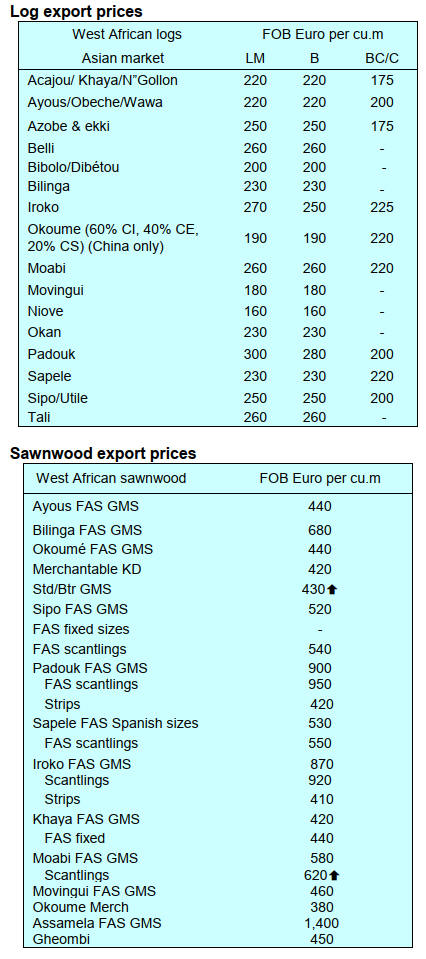
Through the eyes of industry
The latest GTI report lists the challenges identified by the
private sector in the Republic of Congo and Gabon.
See: chrome-
extension://efaidnbmnnnibpcajpcglclefindmkaj/https://www.itto-
ggsc.org/static/upload/file/20260416/1776326937171239.pdf
2.
GHANA
February wood product exports fell in volume and value
According to the Timber Industry Development Division
(TIDD) report Ghana's wood product exports in February
generated a value of Eur7.72 million from a volume of
15,427 cu.m. This marks an 8% decrease in value and a
24% decrease in volume when compared to February
2025( Eur8.41 million and a volume of 18,064 cu.m).
Major products exported during the month were air-dried
sawnwood (50%), plywood to the regional market (12%),
plywood (overseas) (11%), kiln-dried sawnwood (10%)
and billet (6%) with 8 other products accounting for the
balance.
The leading species harvested for production in terms of
volume were teak, eucalyptus, wawa/ayous, cedrela and
denya/okan. Thirteen (13) wood products were produced
from fifty-two (52) different species and were shipped to
thirty-six (36) markets.
The report also revealed that in the first two months of
2026 Ghana earned Eur14.57 million from the export of
31,168 cu.m of wood products. This registered a decrease
of 20% in value and a decrease of 19% in volume
compared to the same period in 2025
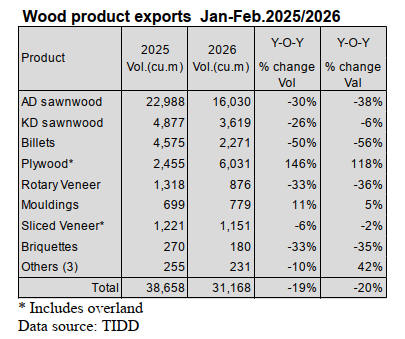
India (45%), Vietnam (7%), Burkina Faso (4%), Gambia
(4%) and United States of America (4%) were the top
export destinations. The average unit price of wood
products saw a slight decrease from Eur 70/cu.m in
January-February 2025 to Eur 467/cu.m in the same period
of 2026.
Chief of Staff calls for a deliberate push in manufacturing sector
The Chief of Staff, Julius Debrah, has called for renewed
national focus on manufacturing as a key driver of
Ghana’s economic transformation, stressing the need for
stronger collaboration between government and the private
sector to achieve sustainable growth.
Speaking at the Kwahu Business Forum he underscored
the importance of placing manufacturing at the centre of
the country’s development agenda, noting that a bigger,
more stable and inclusive economy cannot be realised
without a deliberate push in the sector.
He emphasised the need for government to lead by
creating an enabling environment to support industrial
expansion, citing policy clarity, macroeconomic
discipline, improved infrastructure, efficient regulation,
skills development and reliable power supply as critical
pillars.
According to him, these fundamentals are essential for
business growth, warning that without a stable and
predictable operating environment, long-term investment
in manufacturing will remain constrained. He, however,
urged the private sector to rise to the occasion and
complement public efforts through bold investments and
sustained innovation. He further encouraged businesses to
formalise their operations where necessary and scale
beyond their comfort zones to remain competitive and
contribute meaningfully to economic growth.
See: https://citinewsroom.com/2026/04/manufacturing-must-
anchor-ghanas-growth-agenda-julius-debrah/
Businesses attribute high production costs to utilities,
taxes and interest rates
The Chief Executive Officer (CEO) of the Ghana National
Chamber of Commerce and Industry (GNCCI), Mark
Baidoo-Aboagye, sai that despite recent improvements in
the country’s macroeconomic indicators, these have not
yet impacted positively on businesses citing structural cost
pressures and time-lags in the economy.
He acknowledged that the stabilisation of the local
currency is beginning to ease the cost of imports. He also
noted that lending rates, while down from previous highs,
remain challenging at between 20 and 25% which is
among the highest globally and a major constraint on
business growth.
He further explained, the cost of local production remains
high because of expensive utilities, taxes and financing
costs. This has translated into a situation where some
imported goods are cheaper than those produced locally
despite costs such as freight and port duties.
According to Mr. Baidoo-Aboagye, improved inflation
and exchange rates won’t help businesses if tariffs and
taxes stay high. He urged sustained efforts to cut
electricity and water tariffs, reduce tax burdens and lower
credit costs so firms benefit.
While commending the stabilisation of the economy, he
signalled vulnerability of businesses to rising fuel costs.
Stability alone won’t suffice; gains must create jobs,
productivity and expansion.
In a related development, the Association of Ghana
Industries (AGI) is appealing for a clearer and more
predictable regulatory guidelines to improve access to
credit for businesses, warning that ambiguities in the
current lending framework continue to constrain growth.
See: https://thebftonline.com/2026/04/09/editorial-business-
community-yet-to-feel-full-impact-of-improved-macroeconomic-
indicators/
and
https://www.myjoyonline.com/agi-pushes-for-clearer-lending-
rules-as-bog-expands-credit-access/
Non-traditional exports surges 30.7% in 2025
Ghana’s non-traditional export (NTE) sector earned US$5
billion in 2025, up 31% from US$3.83 billion in 2024
according to the Ghana Export Promotion Authority
(GEPA). The Authourity attributed the growth to stronger
value-added exports and early gains from the Accelerated
Export Development Programme (AEDP).
Ghana’s NTEs, refer to all exports excluding traditional
commodities which are key to diversifying Ghana’s
economy and increasing foreign exchange. Agricultural
NTEs grew significantly by 38% toUS $710.3 million.
See: https://www.msn.com/en-xl/africa/ghana/ghana-s-non-
traditional-exports-hit-5bn-in-2025-up-30-7-gepa-report/ar-
AA21g0nj
Through the eyes of industry
The latest GTI report lists the challenges identified by the
private sector in Ghana.
See: chrome-
extension://efaidnbmnnnibpcajpcglclefindmkaj/https://www.itto-
ggsc.org/static/upload/file/20260416/1776326937171239.pdf
3. MALAYSIA
Furniture makers call for business-friendly policies
It has been reported that the Malaysia Furniture Council
(MFC) has urged the government not to raise the
minimum wage saying any further increase could add to
cost pressures already weighing on the industry.
The government is expected to make a decision on
whether to revise or retain the minimum wage after
completing a review of the Minimum Wage Order 2024 by
September this year. Representing about 760 members, the
MFC is calling for more “business-friendly policies”. The
MFC also urged the government to adopt a more stable
and consistent policy framework for foreign worker
employment aligned with industry needs.
The appeal comes at a time of growing strain within
Malaysia’s furniture sector which is facing what industry
players describe as a “triple squeeze”, rising labour costs,
weakening global demand and intensifying competition
from regional manufacturers.
Since 2023 the export value of wooden furniture has
appeared to stagnate around RM 9-10 billion annually.
That can be traced back to the impact of some domestic
and issues such as volatile global demand, shifting US
trade policies and geopolitical tensions in the Middle East.
These have disrupted supply chains and pushed up input
costs, particularly for upstream suppliers such as sawmills
and particleboard manufacturers, said MFC.
See:
https://ceomorningbrief.theedgemalaysia.com/article/2026/1142/
Home/10/801056
Furniture Park to drive added value processing
A proposed furniture park aimed at strengthening
Sarawak’s timber industry and attracting investment
would be developed in Kuching before expanding to
Tanjung Manis, said Deputy Premier Awang Tengah Ali
Hasan.
He said the project, spearheaded by Sarawak Timber
Industry Development Corporation (STIDC), had been
approved under the 13th Malaysia Plan (13MP). The
furniture park initiative is part of the state government’s
broader push towards strengthening downstream activities
in the timber industry. Awang Tengah said the Park could
expand Sarawak’s furniture industry which remains
largely small-scale and family-based despite abundant
resources from both natural and planted forests.
See:
https://theborneopost.pressreader.com/article/281535117569088
Forest plantation area capped
The Perak State government has limited the extent of its
Forest Plantation Development Zone to 32,375 ha. or
around 3% of the State’s Permanent Reserved Forest
(PRF). Chief Minister Saarani Mohamad said the State
decided to scale down the development from 100,000 ha.
to ensure better environmental oversight and sustainable
forest management.
The development of forest plantations is being carried out
in phases with approvals not issued all at once. This
approach is aimed at enabling more structured planning
and closer monitoring of environmental impacts, he said.
See: https://www.thestar.com.my/news/nation/2026/04/17/forest-
plantation-areas-capped-at-3-of-reserves
Royalty rates halved in Sarawak
The Sarawak State government has approved a 50%
reduction in royalty rates and selected statutory charges
for natural forest timber under all Forest Timber Licences
(FTL) and Forest Plantation Licences (LPF) as part of a
temporary measure to support the forestry and timber
industry. The measure will remain effect for one year,
subject to review.
This initiative reflects the State government’s commitment
to support an industry facing rising fuel prices, global
market uncertainties, supply chain disruptions and
increasing operational costs.
The Forestry Department noted that current trends show
rising costs have led to a shift towards export oriented
production due to higher margins while domestic
processing activities have declined.
The Department added that timber production is projected
to stabilise at around 1.73 million cubic metres annually.
At the same time, it emphasised that the State remains
committed to forest restoration and environmental
sustainability through initiatives such as the Sarawak
Greening Campaign and Forest Landscape Restoration.
See:
https://theborneopost.pressreader.com/article/281500757826273
Sabah forest restoration
The Sabah State government will continue to intensify
efforts on forest conservation and protection, said Head of
State Musa Aman. He said the initiative would include
strengthening forest and climate governance as well as
promoting community development and green innovation.
He said several initiatives are being implemented,
including the adoption of Other Effective Area-Based
Conservation Measures (OECM) to support totally
protected areas (TPA) targets, the implementation of the
Sabah Timber Legality Assurance System Plus and the use
of satellite technology and Earth Observation Systems.
See:https://theborneopost.pressreader.com/article/281552297450
211
Through the eyes of industry
The latest GTI report lists the challenges identified by the
private sector in Malaysia.
See:chrome-
extension://efaidnbmnnnibpcajpcglclefindmkaj/https://www.itto-
ggsc.org/static/upload/file/20260416/1776326937171239.pdf
4.
INDONESIA
Indonesia recovers over US$21 billion in forest
assets
President Prabowo Subianto announced that the Forest
Area Enforcement (Satgas PKH) Task Force has
successfully reclaimed State assets valued at
approximately Rp370 trillion (US$21.65 billion). He
delivered this statement during an official handover event
in Jakarta, emphasising that the recovered assets represent
nearly 10% of Indonesia’s total State budget. The
president noted that this figure highlights the scale of
potential losses caused by illegal occupation of forest
areas.
Prabowo stressed that the recovery of these assets offers
opportunities to accelerate national development,
including upgrading schools, enhancing educational
facilities and expanding basic infrastructure. He also
expressed appreciation to the PKH Task Force for its work
in protecting state resources and reiterated that strong law
enforcement is essential to safeguarding national assets
and preventing future losses.
In related news, the Indonesian government has regained
control of more than 5 million hectares of forest land
previously used for palm oil plantations and mining
operations marking a major step in enforcing forest
protection.
Officials reported that since February 2025 the Forest
Area Enforcement Task Force (Satgas PKH) has reclaimed
over 5.88 million hectares from the palm oil sector and
about 10,000 hectares from mining activities.
See: https://en.antaranews.com/news/411931/indonesia-recovers-
over-21-billion-in-forest-assets-prabowo
and
https://en.tempo.co/read/2097525/prabowo-claims-forest-task-
force-saves-10-of-state-budget#goog_rewarded
and
https://en.antaranews.com/news/411908/indonesian-govt-
regains-5-million-hectares-of-forest-land
Country must not be defeated by criminal networks –
Attorney General
Indonesia’s Attorney General, S.T. Burhanuddin, has
stressed that the country must not be defeated by criminal
networks exploiting forest resources. He said Indonesia
possesses abundant natural resources, a key geopolitical
position and a strong demographic dividend. Despite these
strengths, the country still functions mainly as a supplier
of raw materials and a consumer market where much of
the added value benefits foreign parties.
He noted that this imbalance shows Indonesia has not fully
maximised its resource management for public welfare. As
a result, the State has a constitutional duty to actively
protect national interests and ensure social prosperity. To
achieve this law enforcement should not be seen solely as
a repressive tool but as an integral part of broader State
policy aimed at achieving social justice and improving the
well-being of its citizens.
See: https://en.antaranews.com/news/411919/indonesia-must-
not-lose-to-forest-sucker-mafia-attorney-general
Furniture industries face rising costs and export barriers
Indonesia’s furniture and handicraft industries are facing
mounting pressure from rising production costs and policy
challenges that are not yet fully supportive. Industry
players are dealing with multiple issues at once, including
higher energy costs, limited access to raw materials,
operational disruptions and export regulations. According
to HIMKI Chairman, Abdul Sobur, these factors are
interconnected and compound one another, creating real
and immediate strain on businesses.
Labour-intensive downstream sectors such as furniture
manufacturing are particularly vulnerable due to their
reliance on exports, sensitivity to cost changes and limited
ability to raise prices in competitive global markets.
Without efficiency gains or stronger policy support, rising
costs risk undermining Indonesia’s competitiveness.
Sobur emphasised the need for smoother raw material
supply and better liquidity support while urging the
government to adopt more targeted, sector-specific
policies and reassess overly strict regulations that may
hinder production and growth.
See:
https://money.kompas.com/read/2026/04/15/201800226/industri-
furnitur-ri-tertekan--biaya-naik-dan-ekspor-terhambat.
and
https://www.antaranews.com/berita/5526963/himki-tekankan-
kebijakan-terukur-untuk-jaga-daya-saing-furnitur-ri
Furniture exports to reach US$3 Billion in 2026
Indonesia’s furniture industry is targeting a rebound in
exports in 2026 aiming to surpass US$3 billion in sales
after falling short of its 2025 target. According to HIMKI
Chairman, Abdul Sobur, the goal is not just short-term but
part of the aim to restore a steady upward trajectory in
exports. The 2026 target of over US$3 billion (around
Rp51.45 trillion) marks an increase from the 2025 target
of US$2.9 billion, with actual exports reaching US$2.6
billion.
While the outlook for 2026 is considered promising,
challenges remain. Recovering global demand offers
opportunities for Indonesia to position itself as an
alternative supplier but the industry continues to face
pressures from rising production and logistics costs, high
interest rates and geopolitical uncertainty.
In the medium term, HIMKI aims to double exports to
US$6 billion within next five years with 2026 serving as a
consolidation period to rebuild momentum, expand
markets and strengthen competitiveness.
See: https://www.msn.com/id-id/berita/other/himki-targetkan-
ekspor-mebel-tembus-us-3-miliar-pada-2026-begini-
strateginya/ar-AA20Z0xI
Carbon market gains from social forestry scheme
The Mimister of Forestry, Raja Juli Antoni, said
Indonesia’s social forestry programme presents a key
opportunity to strengthen the country’s carbon economy
while improving community livelihoods. With a national
target of about 12.7 million hectares, the social forestry
scheme can help reduce greenhouse gas emissions and
generate income for local communities through carbon-
based incentives. Existing natural forests in these areas
help preserve carbon stocks, while agroforestry and land
rehabilitation efforts can further enhance carbon
absorption over time.
He emphasised that this approach is relatively cost-
efficient because it relies on existing ecosystems and
active community participation. In addition, carbon
trading opportunities can also be expanded in conservation
areas through ecosystem restoration.
The Minister noted that involving the private sector
through carbon-related business licensing could help close
conservation funding gaps, while simultaneously
supporting environmental protection and creating
sustainable economic value.
See: https://en.antaranews.com/amp/news/412231/indonesia-
eyes-carbon-gains-from-social-forestry-scheme
Forest carbon trading rules tightened to boost green economy
Indonesia has introduced stricter rules on forest carbon
trading to support the growth of a green economy,
according to Forestry Minister Raja Juli Antoni. The new
policy, outlined in Minister of Forestry Regulation No. 6
of 2026, aims to improve governance in the forestry
carbon market by making it more credible, transparent and
inclusive.
The regulation expands participation beyond corporations
to include social forestry groups, indigenous communities,
private forest owners and carbon service providers.
See: https://mediaindonesia.com/humaniora/879952/indonesia-
perkuat-aturan-perdagangan-karbon-hutan-lewat-permenhut-
62026
APHI support forest fire prevention amid El Niño threat
The Association of Indonesia Forest Concession Holders
(APHI) has reaffirmed its commitment to supporting
government efforts to prevent forest and land fires,
particularly in anticipation of a potentially extreme El
Niño. APHI Chairman, Soewarso, emphasised that the
forestry sector is working closely with both central and
regional governments to strengthen coordination and
preparedness as climate change increases the risk of
prolonged dry seasons and fire outbreaks.
To address these challenges, APHI is promoting
systematic preventive measures, including enforcing zero-
burning land preparation policies, improving the capacity
of forestry businesses and empowering local communities.
The Association is also advancing a Multi-Business
Forestry (MUK) approach based on landscape
management and community partnerships which aims to
boost economic growth while reducing land conflicts and
fire risks through more sustainable and integrated land use
practices.
See: https://www.antaranews.com/berita/5530193/aphi-
komitmen-dukung-pencegahan-karhutla-hadapi-el-nino
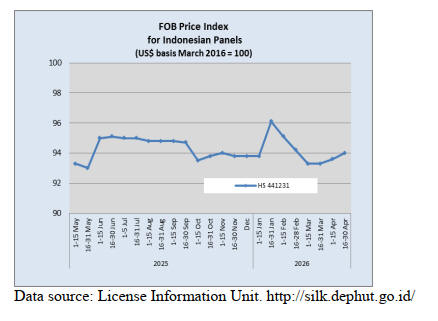
Through the eyes of industry
The latest GTI report lists the challenges identified by the
private sector in Indonesia.
See: chrome-
extension://efaidnbmnnnibpcajpcglclefindmkaj/https://www.itto-
ggsc.org/static/upload/file/20260416/1776326937171239.pdf
5.
MYANMAR
6.
INDIA
Role of agro-forestry in ensuring sustainable raw
material supply
The recently concluded ‘Progressive Punjab Investor
Summit 2026’ featured deliberations on growth prospects
in the wood panel and furniture industries with experts
highlighting the crucial role of agro-forestry in ensuring
sustainable raw material supply.
Raw material from agro-forestry enterprises has emerged
as a key source for the furniture and plywood sectors. It
was reported that it is possible agro-forestry plantations
could be exempt from the upcoming Tree Protection Bill
which is currently under consideration by the government.
The aim is to encourage farmers to adopt timber
plantations and strengthen the supply chain for the wood-
based industry.
During the panel discussions, industry experts discussed
several key issues affecting the sector, including industrial
labour safety in rural areas, sustainable raw material
supply and eco-friendly production practices. The panel
included Naresh Tiwari, Managing Director of Virgo
Panels, Sunil Shekhawat from Century Plyboards India
Limited, Mukesh Goyal, Director, Savitri Woods and
Inderjit Singh Sohal, President of the Punjab Plywood
Manufacturers Association.
The panellists highlighted that plywood products are
environmentally friendly and stressed the need to promote
plantations of fast growing trees such as eucalyptus and
poplar as they are highly suitable for the plywood industry
as they are recyclable and provide sustainable raw material
for wood-based manufacturing.
Experts also pointed out that encouraging agro-forestry
can create additional income opportunities for farmers
while supporting the State’s growing plywood and
furniture industry, ensuring both economic growth and
environmental sustainability.
See: https://www.plyreporter.com/article/154354/punjab-looks-
at-plantation-push-to-support-wood-ply-industry
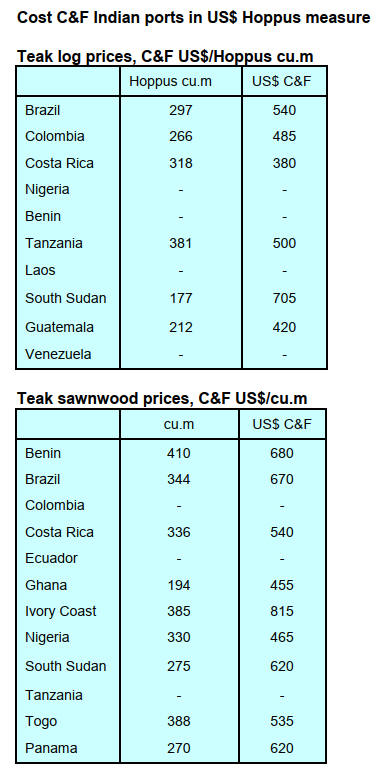
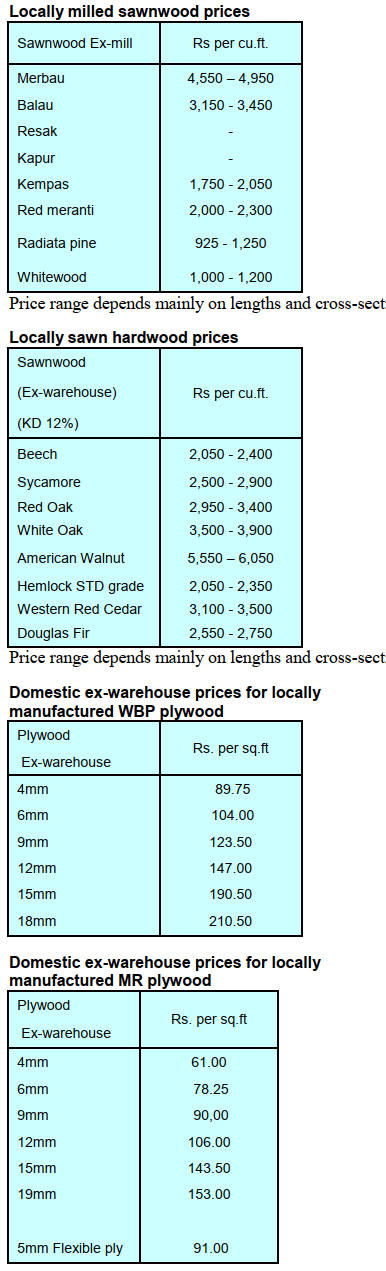
In related news , tensions in the Middle East have severely
disrupted the supply chains of crucial petrochemical inputs
like methanol and formaldehyde. The cost of
formaldehyde, a key component in plywood resin, has
jumped by over 30% creating financial stress within the
industry.
The Perumbavoor plywood cluster, one of India's largest,
is facing a severe shortage of urea which is essential for
producing urea-formaldehyde (UF) resin, the adhesive
backbone of commercial plywood.
Home to over 400 manufacturing units this cluster is a
major supplier of plywood in Southern India. The cluster
is supported by the Perumbavoor Plywood Manufacturers
Consortium which aims to improve product quality and
reduce production costs through a Common Facility
Centre.
In addition to supply chain issues the weakening rupee and
high import prices for logs have added to production costs.
Indian economy well placed to face impact of Middle East crisis
The Indian economy is seen to be relativelywell placed to
face the impact of the Middle East crisis, according to the
International Monetary Fund’s (IMF) latest World
Economic Outlook.
The IMF revised upwards India’s growth projection for
the current fiscal year to 6.5%, against 6.2% estimated
earlier citing the strong momentum from last year as well
as the fall in US tariffs on exports.
Inflation in India is expected to accelerate to 4.7% this
year as the impact of low food inflation wears off. Last
week, the World Bank raised India’s growth outlook to
6.6% compared with 6.3% estimated in October citing
robust domestic demand and strong export performance.
At the same time Standard and Poors (S&P) cautioned that
India is not immune to the effects of the war, which may
be felt on household and businesses. It also said India is
equipped to handle some strain.
Robust corporate balance sheets provide a cushion against
higher energy prices. Banks have strong capital and
profitability; India’s robust external position gives it
buffers to absorb some shocks from a higher import bill.
S&P says they do not expect any immediate impact on
ratings on the sovereign, corporates and banks. Even so,
govt’s efforts at fiscal consolidation could also face
temporary setbacks, the ratings agency said.
S&P projects a further weakening of rupee, in case oil
prices remained high, which will also adversely impact the
current account balance. While estimating GDP growth of
7.1% with oil price at US$85 a barrel, it projected the
expansion to moderate to 6.3% in case crude hovered
around US$130 levels. In such a situation, it also warned
of an adverse impact on corporate profitability and asset
quality of banks.
See:https://timesofindia.indiatimes.com/business/india-
business/india-better-placed-to-tackle-west-asia-war-impact-
agencies/articleshow/130271254.cms
and
https://www.spglobal.com/ratings/en/regulatory/article/scenario-
analysis-indias-strong-fundamentals-would-cushion-the-blow-of-
an-oil-shock-s101678305
The latest forecast from the India Meteorological
Department is making headlines. For 2026 the south west
monsoon is expected to be slightly weaker than usual
around 92 percent of average rainfall. Normally India gets
about 87 centimetre rain in the monsoon season.
A weak Indian monsoon (below 96% of normal rainfall)
severely impacts the economy by reducing agricultural
output, cutting rural incomes and driving up food inflation.
It causes smaller harvests of key crops like rice, soybeans
and pulses, leading to higher food prices, restricting
exports, and reducing demand for consumer goods.
7.
VIETNAM
Wood and Wood Product (W&WP) trade
highlights
According to statistics from the Viet Nam Customs
Department W&WP exports in March 2026 reached
US$1.4 billion, up 43% compared to February 2026, but
down 6% compared to March 2025.
WP export share was US$898.5 million, up 49%
compared to February 2026 but down 12% compared to
March 2025.
In the first 3 months of 2026 W&WP exports
earnedUS$4.0 billion, up 1% over the same period in
2025. WP exports dominated at US$2.6 billion, down 5%
over the same period in 2025.
W&WP exports to the US in March 2026 earned US$650
million, up 44% compared to February 2026 but down
28% compared to March 2025.
In the first 3 months of 2026 W&WP exports to the US
earned US$1.9 billion, down 11% over the same period in
2025.
The exports of living and dining room furniture in March
2026 contributed US$193 million to export earnings, up
44% compared to February 2026, but down 20%
compared to March 2025.
In the first 3 months of 2026 exports of living and dining
room furniture earned US$556.2 million, down 12% over
the same period in 2025.
In March 2026 W&WP imports to Viet Nam reached
US$286.9 million, up 52% compared to February 2026
and up 10% compared to March 2025.
In the first 3 months of 2026 W&WP imports to Viet Nam
were valued at US$792.3 million, up 19% over the same
period in 2025.
Viet Nam's tali wood imports in March 2026 were at
30,000 cu.m, worth US$12.5 million, up 15% in volume
and 11% in value compared to February 2026.
Compared to March 2025, imports has increased by 32%
in volume and 52% in value. Iin the first 3 months of
2026, tali imports were estimated 92,600 cu.m, worth
US$38.7 million, down1% in volume but up 15% in value
over the same period in 2025.
Viet Nam’s W&WP exports to Japan in March 2026
fetched US$190.4 million, up 3% compared to March
2025.
In the first quarter of 2026 W&WP exports to Japan
generated US$539.6 million, up 6% over the same period
in 2025.
In March 2026 exports of bedroom furniture contributed
US$141.6 million, up 44% compared to February 2026 but
down 22% compared to March 2025.
In the first 3 months of 2026 exports of bedroom furniture
totaled US$433.9 million, down 11% over the same period
in 2025.
Viet Nam's pine timber imports in March 2026 totalled at
86,000 cu.m, worth US$17.8 million, up 43% in volume
and 65% in value compared to February 2026 and up 1%
in volume but down 4% in value compared to March 2025.
In the first 3 months of 2026 pine imports were estimated
at 239,70 cu.m, worth US$46.3 million, up 19% in volume
and 12% in value over the same period in 2025.
W&WP export markets in first quarter of 2026
In the first quarter of 2026 exports of W&WP earned
around US$4 billion, an increase of 1.4% compared to the
first quarter of 2025.
Viet Nam's wood and wood products exports were largely
destined for the US which accounted for 49% of the
country's total export value for this product group,
reaching nearly US$1.96 billion, a decrease of 8%
compared to the first quarter of 2025.
The second largest market in terms of export value was
China at US$608 million, accounting for 15%, and a
strong increase of 47%. In March of 2026 alone, exports to
this market reached nearly US$215.98 million, an increase
of 33% compared to February of 2026 and a 44% increase
compared to March of 2025.
The other markets with high export values were Japan at
US$539.64 million, accounting for 14%, an increase of
6%, South Korea at US$148.33 million, accounting for
4%, a decrease of 21% compared to March of 2025.
Exports of wood and wood products to the EU reached
US$217.67 million, accounting for 5%, an increase of
48%. Exports to Southeast Asian markets reached
US$88.19 million, accounting for 2%, an increase of 4%.
Exports of wood and wood products to the RCEP markets
in the first quarter of 2026 reached US$1.43 billion,
accounting for 36%, an increase of 162% and exports to
the CPTTP market reached US$792.3 million, an increase
of 6.98%.
Overall, in the first quarter of 2026 exports of wood and
wood products to most markets increased in value
compared to the first quarter of 2025.
See:
https://asemconnectvietnam.gov.vn/default.aspx?ZID1=8&ID1=
2&ID8=148396
Exporters report strong order growth
Despite ongoing global uncertainties Vietnamese exporters
are reporting strong order growth through the second
quarter of 2026 driven by precautionary demand and
supportive government policies. However, contrary to
earlier concerns, order volumes in the second quarter rose
sharply as buyers stockpiled amid fears of prolonged
geopolitical tensions, oil price volatility and shipping
disruptions.
Company’s orders in Q2 have nearly doubled compared to
the previous quarter. In the first quarter around 350
containers of goods, including timber and finished
plywood were shipped. As of 21 April, shipments already
exceeded 500 containers.
for helping businesses maintain momentum. Lower
interest rates, faster lending procedures and streamlined
Customs clearance have provided tangible support for
exporters. Businesses expect continued efforts to cut red
tape and strengthen support for small and medium-sized
enterprises.
See: https://en.Viet Namplus.vn/export-orders-surge-despite-
global-headwinds-post341716.vnp
Programme for payment for forest environmental services reviewed
Recently, the Department of Forestry and Forest
Protection and the Viet Nam Forest Protection and
Development Fund held a conference to evaluate
achievements in 2025 and determine key tasks for 2026.
Mr. Tran Quang Bao, Chairman of the Management Board
of the Viet Nam Forest Protection and Development Fund,
Director of the Department of Forestry and Forest
Protection chaired the conference.
The conference was attended by more than 100 delegates
from Departments and Departments of the Ministry of
Agriculture and Environment, representatives of the
Department of Agriculture and Environment, the Forest
Protection and Development Fund of nearly 30 provinces
and cities and relevant units and partners.
The conference was an important opportunity to
comprehensively review the results of the implementation
of the policy on payment for forest environmental services
(DVMTR) in 2025 and at the same time orient key tasks
and solutions for 2026 in the context that the forestry
industry is strongly transforming towards green growth
and sustainable development.
Reports showed that in 2025, although the organisational
context of the apparatus will have many changes in the
direction of streamlining and efficiency, the system of the
Forest Protection and Development Fund from the central
to local levels was maintained and achieve many positive
results. The coordination of advising on the development
and improvement of policies and laws continues to be
promoted.
Many important legal documents with the content of
payment for forest environmental services have been
promulgated such as Law No. 146/2025/QH15, related
Decrees and Circulars, a number of draft Decrees are
being submitted to the Government for consideration.
These aim to help create a legal corridor for forestry
financial management and expand types of forest
environmental services, including forest carbon
sequestration and storage services , a field that is expected
to become a new financial resource in the near future. In
addition, the direction and administration work was
drastically and synchronously implemented with hundreds
of guiding documents, removing difficulties for the local
operators.
Funds for forest protection in 2024 was paid to hundreds
of thousands of forest owners who are organizations,
households, individuals, residential communities and
commune People's Committees with an amount of more
than VND3 billion
In 2026, in order to achieve the goal of collecting
VND3,500 billion in forest protection funding, ensuring
timely and effective disbursement, paying most of the
money to people before the Lunar New Year, maintaining
7.5 million hectares of forests supplying forest protection
the Forest Protection and Development Fund system
identified a number of key tasks to be performed
Speaking at the conference, Mr. Tran Quang Bao,
Chairman of the Management Board of the Viet Nam
Forest Protection and Development Fund, Director of the
Department of Forestry and Forest Protection emphasised
that after more than a decade of implementation the policy
of payment for forest protection has been affirmed as a
sustainable and effective financial mechanism, making an
important contribution to the protection of forest
resources, biodiversity conservation, response to climate
change and livelihood development for people.
With the foundation that has been built with stakeholders
the Forest Protection and Development Fund and the
Forest Protection and Development Fund system will
continue to promote the role of a financial bridge,
connecting interests between businesses and people to
protect forests, towards building a modern, sustainable
forestry economy and international integration.
See: https://vnforest.gov.vn/2026/03/27/chinh-sach-chi-tra-dich-
vu-moi-truong-rung-dong-hanh-cung-lam-nghiep-ben-vung/
Global Forest Investment Market Forum
On the morning of March 31, in Hanoi, the Global Forest
Investment Market Forum in Viet Nam was opened. The
event was organised by the Department of Forestry and
Forest Protection in collaboration with the UN-REDD
Programme and the United Nations Environment
Programme.
The forum opened with the goal of sharing and connecting
forest-based businesses, the J-REDD programme and
financial institutions to identify, build specific investment
opportunities and promote investment implementation
partnerships as well as introducing forest-based business
models that can be linked to results-based finance
mechanisms at scale.
Speaking at the opening session, Director General of the
Department of Forestry and Forest Protection Tran Quang
Bao expressed his honor to collaborate with UN-REDD
and partners to organise the Global Forest Investment
Market Forum in Viet Nam, an event of special
significance in the context of the world's efforts to find
effective solutions to respond to climate change, conserve
biodiversity and promote sustainable development.
Tran Quang Bao said the forum provided a space for
delegates to share international experiences on forest
investment development, carbon finance and sustainable
forestry business models; promote policy dialogue,
improve the investment environment for the forestry
sector; effectively connect businesses, investors and
national and regional REDD+ programs; build specific
partnerships, contributing to the formation of investment
projects that are capable of practical implementation and
bring positive impacts to forests and communities.
The Global Forest Investment Market Forum in Viet Nam
was organised in a face-to-face and online format with the
participation of delegates who are representatives of
countries with forests; private investors, businesses and
entrepreneurs in the forestry sector, representatives of
indigenous community groups, development partners,
intermediary organisations and coordinators along with
representatives of the UN-REDD Programme and partners.
See: https://vnforest.gov.vn/2026/03/31/khai-mac-dien-dan-thi-
truong-dau-tu-rung-toan-cau-tai-viet-nam/
8. BRAZIL
Strategic role of plantations in satisfying
growing demand
Data from the National Forest Information System (SNIF)
indicate that Brazil produced approximately 200 million
cubic metres of industrial roundwood in 2024. Of this
total, around 94% came from planted forests, which
occupy only 1.5% of the national territory.
This highlights the strategic role of plantations in
satisfying growing demand and shielding natural forests
from over harvesting, particularly in the context of a
global wood demand of 1.6 billion cubic metres per year,
which could double by 2050.
Historically, planted forests in Brazil have largely been
established on degraded lands or areas less suitable for
other agricultural uses.
Brazilian legislation prohibits the clearing of native
vegetation and requires legal reserves and permanent
preservation areas, including within forest-based
production systems or in planted forest properties.
According to the Brazilian Tree Industry Association
(Ibá), Brazil has 10.5 million hectares of planted forests
and approximately 7 million hectares of conserved natural
forests. In practice, for every hectare of planted forest,
companies maintain, on average, 0.7 hectares of native
vegetation.
In the State of Paraná, member companies of the Paraná
Association of Forest-Based Companies (Apre) maintain
an even higher ratio between productive and conservation
areas.
In addition to supplying raw materials, planted forests
contribute to carbon sequestration, support ecological
corridors, generate employment and foster regional
development representing a sustainable alternative to the
expansion of harvesting in native forests.
See: https://apreflorestas.com.br/noticias/florestas-plantadas-
respondem-por-94-da-madeira-para-fins-industriais-e-reduzem-
pressao-sobre-matas-nativas/
Criteria for validating forest restoration in degraded areas
During the workshop “Indicators for the Assessment of
Native Vegetation Restoration”, held in Belém, Pará, the
State Secretariat for the Environment (Semas), in
partnership with Embrapa and other institutions
established technical criteria to validate the recovery of
degraded areas, replacing subjective assessments.
This initiative aims to enhance legal certainty in rural
areas by providing clearer rules for the approval of
Degraded Area Recovery Plans (PRAD). It also seeks to
strengthen the Environmental Regularisation Program
(PRA) in the State of Pará, with potential to serve as a
reference for other states within the Legal Amazon
Region.
The minimum indicators defined for an area to be
considered under full recovery include canopy cover equal
to or greater than 80%, species richness (measuring the
diversity of planted or naturally regenerated species),
minimum plant density per hectare, presence of natural
regeneration (young plants and seedlings) and control of
invasive exotic species.
Requirements vary according to the profile of the rural
property, with stricter criteria for large holdings and
adjusted parametres for family farming operations and
traditional communities.
See: https://www.maisfloresta.com.br/para-define-criterios-
tecnicos-para-validar-recuperacao-de-florestas/
Export update
In March 2026 Brazilian exports of wood-based products
(except pulp and paper) decreased 34% in value compared
to March 2025, from US$340.4 million to US$226.1
million.
Pine sawnwood exports decreased 16% in value between
March 2025 (US$63.3 million) and March 2026 (US$53.0
million). In volume, exports decreased 11% over the same
period, from 263,000 cu.m to 235,200 cu.m.
Tropical sawnwood exports decreased 2% in volume, from
23,700 cu.m in March 2025 to 23,200 cu.m in March
2026. In value, exports increased 11% from US$9.5
million to US$10.5 million over the same period.
Pine plywood exports decreased 44% in value in March
2026 compared to March 2025, from US$94.9 million to
US$53.4 million. In volume, exports decreased 40% over
the same period, from 298,700 cu.m to 178,700 cu.m.
Tropical plywood exports increased 26% in volume, from
1,600 cu.m in March 2025 to 1,900 cu.m in March 2026.
In value, exports increased 19% from US$2.7 million in
March 2025 to US3.4 million in March 2026.
As for wooden furniture, exports decreased 9% in value,
from US$54.4 million in March 2025 to US$49.3 million
in March 2026.
Opportunities in the European market
Brazilian companies in the native timber sector will have
the opportunity to expand their international presence
through a trade mission to the Carrefour International du
Bois 2026, one of the world’s leading trade fairs for the
timber supply chain, taking place from June 1 to 4 in
Nantes, France.
Target markets include strategic European countries such
as France, Italy, Belgium, Denmark and the Netherlands,
known for their high demand for sustainable products and
innovative wood-based solutions.
Organised by the National Confederation of Industry
(CNI) in partnership with the Brazilian Trade and
Investment Promotion Agency (ApexBrasil) and State
industry federations (FIEMT, FIEAC, FIEMS, and
FIEPA) the initiative will open doors to strategic
international partnerships and provide deep immersion in
European market trends and consumption standards.
The programme focuses on business generation featuring
trade roundtables, guided visits and networking with
global buyers and companies. The goal is to position
Brazil’s timber industry as a competitive and sustainable
supplier while promoting market diversification.
See:
https://noticias.portaldaindustria.com.br/noticias/internacional/co
nexao-brasil-europa-abre-mercado-internacional-para-a-madeira-
nacional/
New export markets emerging
Brazil’s timber exports showed a modest recovery in
March 2026, with 2% increase in volume and 9% in value.
Despite this improvement, first quarter performance in
2026 remains negative with declines of 16% in volume
and 20% in value compared with the same period in 2025.
The sector continues to operate in a cautious environment,
influenced by geopolitical uncertainties, exchange rate
volatility and a decline in demand in traditional markets.
The United States, historically the main destination for
Brazilian exports, is losing dominance of demand for pine
sawnwood (US$8.1 million in March, down 28% from
February) now surpassed by Mexico (US$11.2 million).
For pine plywood the US remains the leading market but
other destinations are gaining such as Germany (from
US$5 million in January to US$7.1 million in March),
Mexico (from US$3.5 million to US$5.3 million) and
Sweden (from US$0.8 million to US$2.5 million over the
same period).
In addition to reduced competitiveness in the US, the
Brazilian timber sector has been affected by instability in
the Middle East which has curtailed shipments to the
region. The conflict involving Iran led to a significant drop
in pine sawnwood exports. Saudi Arabia reduced imports
from US$6.7 million in January to US$2.7 million in
March while exports to the United Arab Emirates declined
from US$6.5 million to US$1 million during the same
period.
Looking ahead to 2026, even with US tariffs reduced to
10%, Brazilian exporters continue to face strong
international competition, high production and freight
costs and a less favorable exchange rate reinforcing the
need for more strategic market positioning and
diversification into new markets.
See: https://www.maisfloresta.com.br/exportacoes-de-madeira-
tem-retomada-timida-em-marco-mas-acumulam-queda-de-20-no-
trimestre/
9. PERU
Higher February exports
In February 2026 wood product exports registered a FOB
value of US$11.6 million,an increase compared to the
US$8.5 million reached in the same period of 2025.
This increase represented a positive percentage change of
around 36%, according to the Center for Research on
Global Economics and Business of the Association of
Exporters (CIEN-ADEX).
Exports included semi-finished goods (US$5.4 million),
sawnwood (US$3.5 million), furniture and parts (US$1.1
million), construction products (US$537,000) and
firewood and charcoal (US$515,000).
The leading destination was France, with shipments
totaling US$2.8 million. The United States followed with
US$1.7 million, China with US$1.4 million, the
Dominican Republic with US$1.3 million and Belgium
with US$936,000 completing the top five markets.
Exports of furniture and furniture parts in February 2026 increased
According to information provided by the Services and
Extractive Industries Management of the Association of
Exporters (ADEX), shipments of furniture and furniture
parts during February 2026 reached an FOB export value
of US$1.0 million, representing a year on year doubling of
growth.
The main market for exports in this subsector during this
period was the United States which accounted for 70% of
the total, followed by Italy with 12%. In third place is
Panama with 7% participation, followed by Ecuador in
fourth place with 7% and rounding out the top five was
Chile with 2% participation.
Campaign to plant 10 million trees by 2028
With the goal of planting 10 million trees by 2028 the
National Forest and Wildlife Service (Serfor) launched a
2026 campaign of the ‘Sustainable Productive Forests
Program’, which includes a US$25 million investment to
promote commercial forestry plantations and transform
degraded lands into productive opportunities for thousands
of rural families.
Driven by Serfor through the Sustainable Productive
Forests Program (BPS), this initiative has benefited
organisations and has enabled the planting of more than
2.5 million trees for timber production, generating more
than 4,000 direct jobs. The intervention is taking place in
Cajamarca, Áncash, Junín, Pasco, Huánuco, San Martín
and Madre de Dios.
See: https://www.gob.pe/institucion/serfor/noticias/1384843-
gobierno-lanza-la-campana-2026-del-programa-bosques-
productivos-sostenibles-con-la-meta-de-instalar-10-millones-de-
arboles-al-2028
National measurement to strengthen the fight against illegal logging
Peru has begun its fifth national assessment of the 2025’
Measurement of the Index and Percentage of Illegal
Logging and Timber Trade’, a process that will strengthen
decision-making and control measures against illegal
activity in the forestry sector. This measure is the fifth
nationwide assessment within the framework of
strengthening the country's forest governance.
The 2025 assessment is being conducted at a virtual event
that brings together representatives from the regional
governments of Madre de Dios, Loreto, Ucayali, San
Martín, Amazonas and Huánuco, as well as from the
Technical Forestry and Wildlife Administrations.
The process is being carried out with the participation of
national and regional authorities as well as specialists who
make up the Inter-institutional Advisory Team, which
strengthens the quality of the information and ensures a
participatory and transparent approach.
See: https://www.gob.pe/institucion/osinfor/noticias/1383192-
peru-inicia-medicion-nacional-para-fortalecer-la-lucha-contra-la-
tala-ilegal
|