Japan
Wood Products Prices
Dollar Exchange Rates of 24th
April
2026
Japan Yen 158.64
Reports From Japan
Oil crisis - economic implications have been immediate
The economy in Japan is holding up well at the moment in
the face of the impact of the Iran crisis on the price of
energy imports but things could become serious if the oil
supply chain does not recover quickly. The crisis in Iran
and the disruption around the Strait of Hormuz have
driven up oil prices as about a fifth of global oil and LNG
supplies usually pass through the Strait.
For Japan, the economic implications have been
immediate. Real GDP grew 0.3% quarter on quarter in
October-December 2025 and 1.2% for the full year while
the February 2026 Consumer Price Index was up 1.3% and
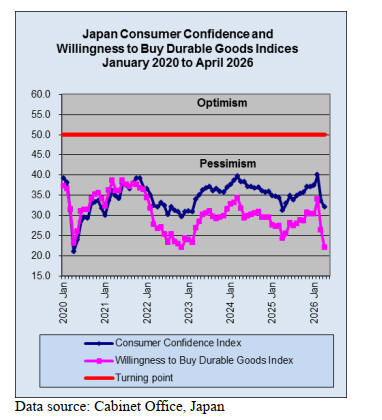
unemployment stood at 2.6%. Household spending in
February fell 1.8% in real terms and consumer confidence
dropped.
What makes Japan notable is the widening gap between
relatively calm markets and a much darker mood on the
ground. The Bank of Japan said this month that regional
economies were "recovering at a moderate pace, though
some areas remain weak."
However, the outlook has deteriorated with the Cabinet
Office's Economic Survey showing the, the Economy
Watchers Outlook Index, falling in March to its lowest
level since the COVID-19 period. This has been
interpreted as suggesting consumers are likely to cut back
further on spending, particularly on discretionary
spending.
See: https://japan-forward.com/how-serious-is-the-hormuz-risk-
for-japans-economy
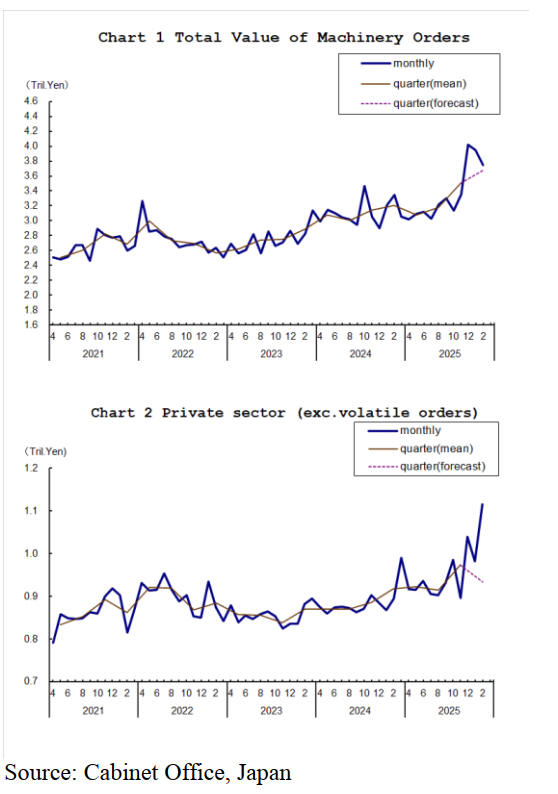
Machinery orders in February 2026
The value of machinery orders received by 280
manufacturers operating in Japan decreased by 5% from
the previous month in February. Private-sector machinery
orders, excluding those for ships and those from electric
power companies, increased by almost 14% in February.
Machinery orders are a critical leading economic indicator
in Japan. Released monthly by the Cabinet Office, data on
private-sector order (excluding volatile, large-scale ships
and electric power items) provide insights into corporate
capital expenditure trends 6–9 months ahead. They serve
as a proxy for business sentiment and planned investment
in manufacturing and non-manufacturing sectors.
See:
https://www.esri.cao.go.jp/en/stat/juchu/2026/2602juchu-e.html
2025 - Fifth year of trade deficit
Government data shows Japan suffered a trade deficit of
around US$11 billion in the last financial year, remaining
in the red for the fifth straight year. In 2025, high US
tariffs, implemented since April 2025, dragged down auto
exports, a cornerstone of Japan’s international trade.
The country's trade deficit has been declining since a
massive drop in fiscal 2022 due to the Corona Virus
pandemic but it has deepened this business year due to the
Middle East conflict which is driving up the cost of
imports especially as the yen is particularly weak at
present.
See:
https://mainichi.jp/english/articles/20260422/p2g/00m/0bu/019000c
March trade balance - good news
The latest data from the Ministry of Finance shows that
the trade balance for March 2026 was a surplus of yen 667
billion, an explosive growth compared to February. This
marked the second consecutive month of a surplus trend.
Although the overall figure still fell short of the market
consensus it indicates that, supported by external demand,
Japan's trade fundamentals are gradually recovering.
Exports in March increased by 12% year-on-year, beating
market expectations and setting a new single-month record
high, primarily benefiting from strong orders for electronic
components such as semiconductors and non-ferrous
metals. However, imports in March grew by 11% year-on-
year, significantly higher than the initially estimated 7%.
See: https://datatrack.trendforce.com/blog/content/56468/japans-
march-trade-surplus-surges-to-667-billion-yen-exports-hit-
single-month-record-high-but-import-cost-pressures-emerge
Household spending stalled
Despite household savings reaching a record high in Japan
people are reluctant to spend highlighting a growing
preference for savings amid concerns that rising oil prices
will drive inflation higher.
See:
https://mainichi.jp/english/articles/20260421/p2a/00m/0bu/022000c
Interest rates
As anticipated, the Bank of Japan (BoJ) maintained its
benchmark short-term interest rate at approximately
0.75%, the third time holding rates steady. At the same
time policymakers simultaneously raised inflation
forecasts, indicating potential future hikes.
The Bank updated projections, raising the fiscal year 2026
core inflation forecast to 2.8% (up from 1.9%) while
cutting growth projections, highlighting concerns over
energy-driven inflation.
Despite the pause, the BoJ Board indicated that monetary
tightening is their aim when economic conditions allow.
The latest decision aims to balance keeping a check on
weak yen-induced inflation while not choking off
economic growth amid global uncertainty.
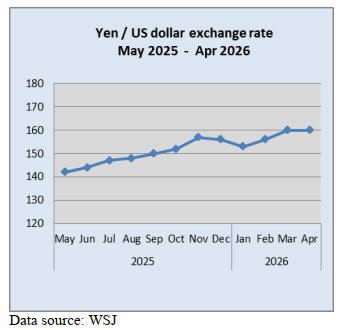
Yen steady after BoJ meeting
The yen strengthened modestly immediately following the
26 April Bank of Japan (BoJ) meeting as the Board
members delivered a "hawkish tone." Although rates
remained at 0.75%, three board members dissented in
favor of an increase.
The yen saw temporary support and strengthened against
the dollar bringing US$/JPY exchange rate below the 159
level. Despite keeping policy steady, the increased dissent
(3 members) in favour of a rate increase was viewed as a
move toward policy normalisation, which supported the
currency.
However, the yen breached the 160 to the US dollar in the
last few days of April.
Brisk private consumption and production across
the
country
The Ministry of Finance kept its economic assessments
unchanged for all of the country's 11 regions in its latest
quarterly report citing brisk private consumption and
production activity. The Ministry kept its overall
assessment of the Japanese economy unchanged for the
11th straight quarter, saying that it was recovering
gradually.
The ministry upgraded its view on production activity for
the Kanto eastern and Shikoku western regions. On
employment, it lowered its view for Hokkaido, the
country's northernmost prefecture. The report listed
concerns about the impact of the conflict in Iran.
See: https://www.nippon.com/en/news/yjj2026042200597/
Policymakers concerned speculative investment
driving home prices out of reach
There are signs that policymakers are growing cautious
about speculative investment that could drive home prices
out of reach. The Bank of Japan has indicated it will
monitor real estate loans by regional banks. Local
governments have warned against quick reselling of
properties.
Used condominium prices in central Tokyo fell for the
second month in March, raising concerns that Japan’s
property boom may be losing momentum and a correction
is possible.
See:
https://www.japantimes.co.jp/business/2026/04/23/economy/toky
o-used-condominium-price-fall/
Import update
Assembled wooden flooring - Import update
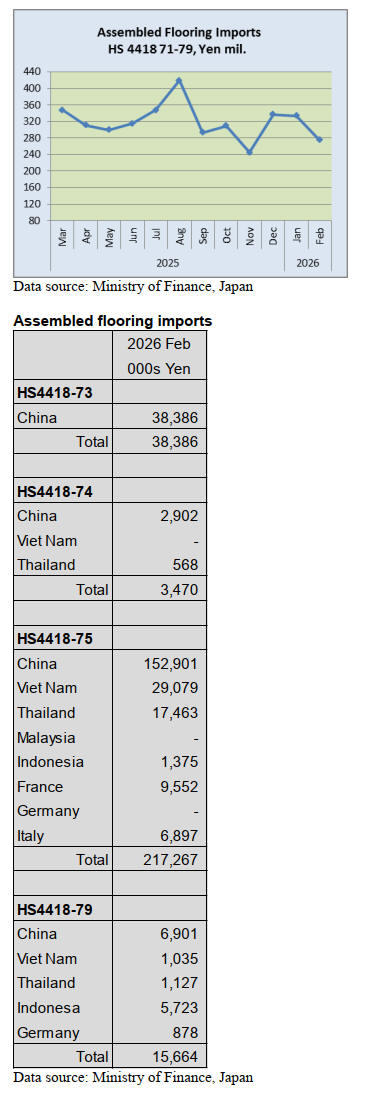
Imports of assembled wooden flooring (HS441871-79)
dropped sharply in February. Shippers in China account
for most of Japan’s imports of assembled flooring and
shipments slowed due to the Spring Festival holidays.
Manufacturing activity in China historically slows
significantly during the Spring Festival (Lunar New Year),
with factory operations often pausing for 1–2 weeks and
experiencing reduced output for up to a month. In
February 2026, the official manufacturing Purchasing
Managers' Index (PMI) fell to 49.0, marking a second
straight month of contraction largely due to the holiday,
which coincided with the longest on record (February15–
23).
Shipments of HS441871-79 from China in February were
down 75% year on year and down 18% month on month.
The other main shippers also saw February shipments
slide. The drop was mainly the result of Lunar New Year
holidays celebrated in Malaysia and Viet Nam. The Lunar
New Year, known locally as Imlek, is a major public
holiday in Indonesia and this holiday also slowed output
and shipments.
Of the various categories of assembled flooring imports in
February around 75% of total imports were of HS4418-74
with most originating in China (90% in January).
All imports of HS4418-73 originated in China. For the
other categories, HS4418-79 accounted for 6% (7% in
January followed by HS4418-74 at 1.5% (4% in January).
Plywood imports
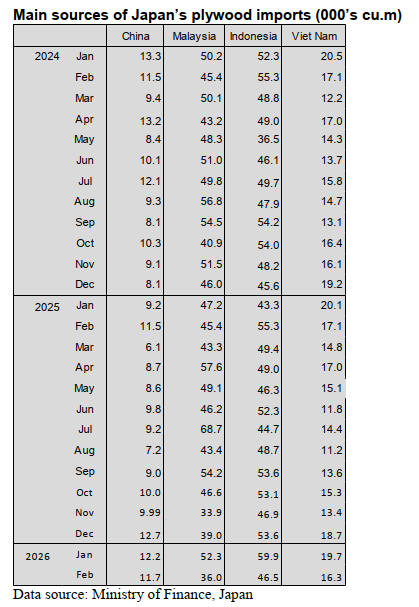
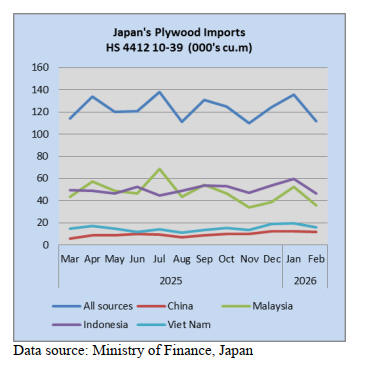
In February 2026 Indonesia and Malaysia continued as the
top suppliers of plywood to Japan with the combined
volume of shipments from the two main shippers
accounting for 74% of February arrivals (83% in January).
January 2026 shipments from Malaysia were down sharply
compared to the volume shipped to Japan in January 2025
whereas shipments from Indonesia were up slightly.
The other main shippers of plywood to Japan in February
were Viet Nam and China. February arrivals from Viet
Nam were down from the previous month whereas arrivals
from China were at around the same level as in January.
In February 2026 arrivals of HS441210-39 were reported
at 111,600 cu.m (135,803 cu.m in January). As in
previous months, of the various categories of plywood
imported in January 2026, HS441231 accounted for most
followed by HS4412-33 and HS4412-34 with the balance
being HS4412-39 and HS4412-10.
Trade news from the Japan Lumber Reports (JLR)
The Japan Lumber Reports (JLR), a subscription trade journal
published every two weeks in English, is generously allowing the
ITTO Tropical Timber Market Report to reproduce news on the
Japanese market precisely as it appears in the JLR. For the
JLR report please see: https://jfpj.jp/japan_lumber_reports/
Hormuz shock hits raw materials
As the effective closure of the Strait of Hormuz enters its
second month, naphtha prices have surged, and concerns
over petrochemical supply disruptions are spreading
across global markets. What began as an impact centered
on resin-based construction materials is now extending to
engineered wood products such as plywood and laminated
lumber, both of which rely heavily on adhesives in their
manufacturing.
Some market participants have already begun moving in
anticipation of further price increases, while others are
voicing growing concern about the outlook for supply and
the possibility of additional disruptions as the situation
continues to evolve and remains difficult to foresee with
any confidence, especially given the broader geopolitical
uncertainty surrounding the Middle East.
By late March, adhesive manufacturers had not yet made
formal moves to request price increases from plywood,
laminated-lumber, or other engineered-wood producers.
Industry observers note that raw-material suppliers are
announcing price hikes at different times and with
varying timing, making it difficult for adhesive
manufacturers to determine the eventual scale of cost
increases.
The rapidly shifting situation has also made it harder to
judge whether higher prices will actually secure stable
supply, especially as discussions of production cuts
among petrochemical manufacturers continue to circulate
and add to uncertainty across the industry as a whole,
creating a sense of unease among many involved in the
supply chain and prompting increasingly cautious
attitudes among producers and buyers alike.
Adhesive manufacturers say they are making every
effort
to ensure stable supply, though some have indicated that
certain product categories may face supply restrictions or
potential price revisions depending on procurement
conditions.
Among domestic plywood manufacturers, the degree of
impact varies depending on procurement routes and
suppliers of adhesives and adhesive raw materials, but no
major disruptions were reported in March. Plywood mills
had already begun calling for higher prices for structural
plywood in February, before the effective closure of the
Strait of Hormuz, yet sluggish demand in March has
slowed their efforts.
The possibility of adhesive price increases, combined
with rising transportation costs, is adding further strain to
the market and complicating attempts to improve
profitability for many producers who were already facing
challenging conditions and limited room to maneuver in
their pricing strategies, especially as cost pressures
accumulate and uncertainty persists.
Laminated-lumber manufacturers have not yet received
concrete requests from adhesive suppliers regarding price
increases or supply adjustments. For now, they are focused
on passing through higher import costs for whitewood and
redwood lamina—cost increases driven by the weaker
yen— as they move from March into April.
Many manufacturers have also begun considering the scale
and timing of additional price increases from May onward,
reflecting the growing pressure they face as procurement
costs continue to rise and as the broader market
environment becomes increasingly uncertain and difficult
to navigate, with little clarity on how long current
conditions may persist or how severely they may intensify
in the months ahead, particularly if the geopolitical
situation remains unstable and continues to influence raw-
material markets.
Manufacturers of petrochemical-based building materials
have been announcing significant price increases one after
another. Kaneka Kentec will raise prices for extruded
polystyrene foam by 40 percent for orders placed on or
after April 1, while DuPont Styro will implement a similar
40 percent increase from May 1.
Both companies cite rising procurement costs due to the
weaker yen and the deteriorating situation in the Middle
East, along with continued increases in logistics expenses.
Other companies, including Otani Paint, Fukuvi Chemical
Industry, Sangetsu, Achilles and Oshika have announced
supply controls or potential price revisions across a wide
range of petrochemical products.
Some have already begun shipment adjustments and have
indicated that further increases may be unavoidable if
procurement conditions worsen, particularly for products
that rely heavily on petrochemical-derived raw materials
whose availability is becoming more uncertain as the
situation develops and remains unstable, with companies
preparing for the possibility of prolonged constraints and
further volatility.
Logistics costs are also rising. With crude oil prices
surging, five major container carriers—Maersk, ONE,
Hapag-Lloyd, CMA CGM and MSC—have introduced
emergency fuel surcharges ranging from USD 50 to 200
per container. These surcharges apply to all long-haul
routes and are expected to raise transportation costs for
imported materials, particularly European products that
require long-distance shipping. European suppliers have
already been informed of the surcharges and have begun
reconsidering their second-quarter contract prices.
As a result, negotiations are expected to begin later than
planned, with a strong upward pricing stance that reflects
the increasingly difficult procurement environment and the
uncertainty surrounding future supply conditions as the
situation in the Middle East continues to unfold and shows
no clear sign of resolution, leaving many market
participants wary of further volatility and preparing for the
possibility of prolonged instability in both supply and
pricing across multiple sectors that depend on
petrochemical-related materials.
Plywood
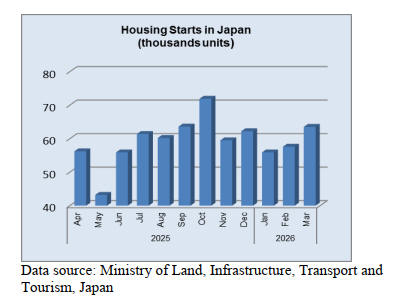
Domestic demand for Japanese softwood structural
plywood remains weak due to sluggish housing starts,
though geopolitical tensions in the Middle East have
triggered some speculative buying. The effective closure
of the Strait of Hormuz has raised concerns about adhesive
raw-material supplies, and some manufacturers are already
facing procurement limits for April.
This uncertainty has led certain buyers to place larger-
than-usual orders, even as plywood mills maintain a
cautious stance because their inventories are not abundant
and raw-material outlooks remain unclear.
Manufacturers had planned to raise prices for 12-mm
softwood structural plywood above ¥1,100 per sheet from
March, but actual market prices in the Tokyo area settled
at ¥1,040–1,060. With raw-material costs expected to rise
further, producers are pushing more firmly for price
increases in April.
Imported tropical hardwood plywood is experiencing
similar dynamics. Concerns about future supply and
expectations of higher prices have prompted some
domestic buyers to secure physical stock. In Tokyo,
coated formwork plywood is trading at ¥1,840–1,900 per
sheet, while standard formwork and structural plywood
remain around ¥1,620. Indonesian ordinary plywood
also shows stable pricing across major thicknesses.
Export prices for tropical hardwood plywood remain firm.
Indonesian ordinary plywood is offered at US$970 per m³
for 2.4-mm panels, US$880 for 3.7-mm, and US$850 for
5.2-mm. Prices for 12-mm coated formwork, formwork,
and structural plywood remain unchanged.
Indonesian manufacturers appear inclined to delay
contract negotiations in hopes of passing on rising
adhesive and freight costs.
Domestic logs and lumber
Domestic Japanese softwood products—especially
cedar—remain in tight supply in the Kanto region. Precut
factories have recently been actively securing 4-meter KD
premium-grade cedar bracing, quickly reducing available
volumes, though overall market activity is sluggish and
prices stay flat at ¥65,000–70,000 per m³.
Some precut factories are shifting from whitewood to
cedar as a more economical option, reflecting weak
whitewood demand. Cedar beams (4 m × 105 mm) are
also harder to source, though prices remain steady at
¥63,000–65,000 per m³.
Douglas fir products saw slow movement in March.
Meanwhile, KD premium-grade cedar studs (3 m × 105
mm) continue to sell briskly in direct-to-user channels,
with some wholesalers calling supply “tight.”
Some sawmills have raised direct-shipment prices by
about ¥2,000, bringing transactions to ¥60,000–62,000 per
m³, though the wholesale market remains subdued.
In log markets, Japanese cypress has seen notable
declines. In the Chugoku region, post-grade logs dropped
to ¥18,000 per m³ and sill-grade and medium-diameter
logs to ¥17,000, each down ¥6,000. Kyushu and Tochigi
also saw continued declines, extending a trend since last
autumn.
High prices last fall encouraged more harvesting, while
demand, especially for sill products, slowed, contributing
to the downturn.
New U.S. certification for Japanese timber
The Japan Wood Products Export Association announced
on January 8 that the ALSC (American Lumber Standard
Committee) has approved design values for Japanese cedar
timber.
In the United States, structural lumber is generally
classified as “lumber” for residential 2x4 materials with a
cross-sectional thickness of less than four inches and as
“timber” for larger sections,those with a thickness of four
inches or more,used mainly in commercial buildings such
as stores and offices.
With the ALSC’s approval, Japan has effectively laid the
groundwork for exporting larger-section cedar products—
such as square and rectangular timbers—to the U.S.
market.
Japan’s government is stepping up support for domestic
timber exports, and the industry is aiming to expand sales
channels for higher value-added structural lumber in the
U.S., the world’s largest market for wood-frame housing.
Japan has already obtained ALSC approval for design
values for domestically produced structural lumber,
cypress in April 2024 and cedar in April 2025, allowing
both to be used as 2x4 structural materials.
This marks the third such approval, following a project
commissioned to the Japan Lumber Inspection & Research
Association and carried out with support from Oregon
State University and the Forestry and Forest Products
Research Institute.
According to the Association, efforts are now underway to
obtain approval for cypress timber as well, a move that is
expected to support the development of overseas markets
for Japan-style homes built with traditional post-and-beam
construction using cedar and cypress.
Japan’s flat-home market surges
The share of single-story homes in the housing market is
on the rise. According to the Ministry of Land,
Infrastructure, Transport and Tourism’s Building Starts
Statistics, single-story homes accounted for 22.4% of all
residential units started in 2025, up 5.7 percentage points
from the previous year.
Even looking only at the past five years, the share has
risen steadily, from 12.4% in 2021 to 13.5% in 2022,
14.9% in 2023, and 16.7% in 2024, before surpassing 20%
in 2025. In terms of unit numbers, annual starts hovered in
the 50,000 range from 2021 to 2023, climbed into the
60,000 range in 2024, and exceeded 80,000 in 2025.
One factor behind the trend is the expansion of single-
story home offerings by major housing manufacturers,
along with increased supply of single-story subdivisions
by builders in suburban and regional markets. Franchise-
based homebuilders are also seeing strong sales of single-
story models. The industry’s push toward single-story
homes is driven by factors such as shrinking household
sizes, the need for senior-friendly layouts, and efforts to
reduce the amount of building materials used.
The rise in single-story homes may also reflect the impact
of the April 2025 revision to the Building Standards Act,
which narrows the scope of the Category 4 exemption.
Japan’s building confirmation system, similar to building-
permit reviews in other countries, was revised to tighten
oversight of most structures. While building confirmation
reviews have become mandatory in principle under the
amended law, single-story wooden structures with a total
floor area of 200 square metres or less are now classified
as “new Category 3 buildings” and remain exempt from review.
|


