US Dollar Exchange Rates of
24th
April
2026
China Yuan 6.82
Report from China
Rise in per capita income
The National Bureau of Statistics has reported Household
Income and Expenditure in the first quarter of 2026. The
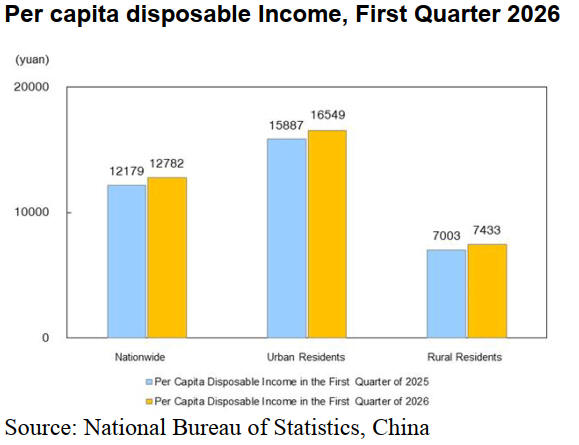
nationwide per capita disposable income was 12,782 yuan,
a nominal increase of 4.9% over the same period of the
previous year and a real increase of 4.0% after deducting
price factors.
The per capita disposable income of urban residents was
16,549 yuan, an increase of 4.2% and the per capita
disposable income of rural residents was 7,433 yuan, an
increase of 6.1%.
Per capita disposable Income, First Quarter 2026
Household consumption expenditure
In the first quarter of 2026 the nationwide per capita
consumption expenditure was 7,955 yuan, a nominal
increase of 3.6% over the same period of the previous
year. The per capita consumption expenditure of urban
residents was 9,635 yuan, an increase of 2.9% and the per
capita consumption expenditure of rural residents was
5,569 yuan, an increase of 4.4%.
Per capita consumption expenditure, first quarter of 2026
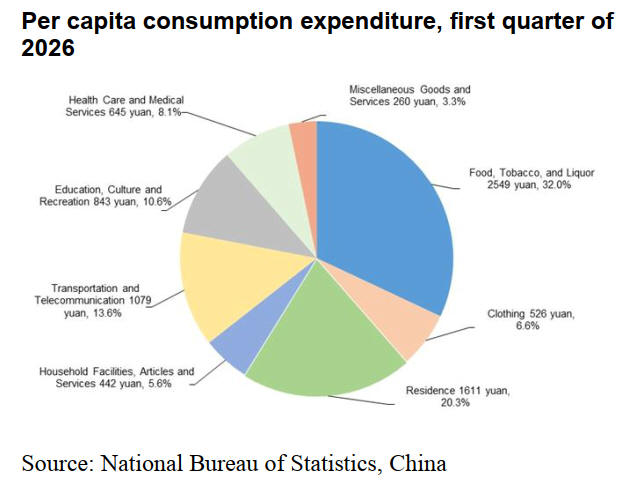
In the first quarter, the nationwide per capita consumption
expenditure on household facilities, articles and services
was 442 yuan, an increase of 6.1%, accounting for 5.6% of
the per capita consumption expenditure.
See:
https://www.stats.gov.cn/english/PressRelease/202604/t2026041
7_1963349.html
Industrial capacity utilisation rate
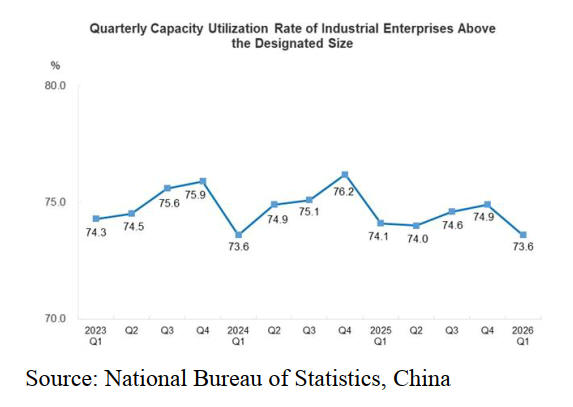
In the first quarter of 2026 the capacity utilisation rate of
industrial enterprises above the designated size nationwide
was 73.6%, down by 1.3 percentage points from the fourth
quarter of the previous year and down by 0.5 percentage
points from the same period of the previous year.
In terms of three main sectors in the first quarter of 2026,
the capacity utilisation rate of the mining industry was
72.1%, that of the manufacturing industry 73.9% and that
of the production and supply of electricity, gas and water
was 71.9%.
See: https://www.stats.gov.cn/english/PressRelease/202604
Canada initiates anti-dumping/subsidy investigations against Chinese
plywood
The Canada Border Services Agency (CBSA) has initiated
investigations under the Special Import Measures Act in
respect of alleged injurious dumping and subsidising of
decorative and other non-structural plywood originating in
or exported from China. The investigations follow a
complaint filed by Columbia Forest Products (CFP),
Hearst, Ontario and the Canadian Hardwood Plywood and
Veneer Association (CHPVA).
The goods subject to investigation fall under the following
HS tariff classifications: 4412.10.00.00, 4412.31.00.00,
4412.33.00.10, 4412.33.00.20, 4412.33.00.30,
4412.33.00.90, 4412.34.00.00, 4412.39.00.10,
4412.39.00.21, 4412.39.00.22, 4412.39.00.23,
4412.39.00.90, 4412.91.00.00, 4412.92.00.00 and
4412.99.00.00.
The CBSA will investigate whether imports are being
dumped and/or subsidised and will make preliminary
decisions within 90 days of 10 April at which time
provisional duties may apply.
See: https://www.cbsa-asfc.gc.ca/sima-lmsi/i-
e/donp22026/donp22026-in-eng.html
Panel industry has entered era where human values
become decisive
The ‘2026 Guangzhou Custom Furniture Exhibition and
the ‘57th China Home Industry Fair’ (Guangzhou)’ was
concluded.
One conclusion was that an industry direction has become
clearer as eastern aesthetics infuses the board materials
with cultural warmth, hardcore technology builds a solid
health foundation and humanistic care defines a new
height of value.
For enterprises, only by embracing eastern aesthetics,
delving into technology and reconstructing the value logic
can they establish a firm footing in an industry under
transformation.
For consumers, the future choice of board materials is
essentially a choice of lifestyle, health needs and cultural
preferences. There is no need to make trade-offs between
environmental protection, appearance level and
functionality.
The E1-level standard merely marks the beginning of an
industry transformation. The competition for human value
will be the ultimate battlefield of the industry. Departing
from Guangzhou, Chinese wood panel materials are
moving from Made in China to Created in China and from
Material Suppliers to Life Style Service Providers. With
the spirit of the East and the backbone of technology, they
are creating a new global brand for Chinese wood panel
materials and opening a brand-new chapter for the high-
quality development of the industry.
See:
https://www.wood365.cn/Industry/IndustryInfo_283962.html
China's exports of woodworking machinery and
accessories - US$2 billion in 2025
As one of the world's largest suppliers of woodworking
machinery and furniture accessory suppliers China's
exports of woodworking machinery (including
accessories) reached US$2.308 billion in 2025. Of the
total, the Asian market accounted for nearly 50%.
Southeast Asia contributed over 60% of the growth in the
Asian market becoming the driving force for exports.
Currently, the furniture industry in Southeast Asia is in a
period of capacity expansion and equipment upgrading. As
a result of the global shift in industrial production furniture
production capacity is shifting from China, Europe and the
United States to Southeast Asia.
It has been estimated that the total investment in the
furniture manufacturing sector in Southeast Asia reached
US$131 billion in 2025, with a year-on-year growth of
approximately 19%.
Most of the manufacturing plants in SE Asia are small and
medium-sized enterprises and face problems such as
outdated equipment and an automation rate of less than
30%.
They plan to update their equipment and at the same time
raise the self-sufficiency rate of raw materials to lower
dependence on imports.
Against the background of the reshaping of the global
economic landscape and the persistent sluggishness of
demand in Europe and the United States, Southeast Asia
has emerged as the major overseas market for Chinese
enterprises in woodworking machinery, accessories and
raw materials.
According to 2025 data, Viet Nam, with its strongest
manufacturing capacity, the most vigorous demand for
equipment and materials and the most closely coordinated
China-Viet Nam supply chain has become the foundation
of Chinese machinery and accessory suppliers.
In addition, Malaysia, Indonesia and Thailand constitute a
diversified matrix for Chinese enterprises to go global in
Southeast Asia. Overall, Viet Nam is the top priority
market for Chinese woodworking machinery and
accessory enterprises to expand their business. The main
reason for this is:
Viet Nam, as a rising star in global furniture exports, has
seen a simultaneous surge in capacity expansion and
equipment renewal. It has the highest reliance on China's
woodworking machinery, wood panels and accessories
and Viet Nam imports and growth rate rank first in
Southeast Asia.
The Vietnamese furniture industry focuses mainly on low-
end export assembly work and this is highly compatible
with the mid-range equipment and general materials
available in China. The cost for Chinese machinery
exporters to adapt equipment for Viet Nam is low and the
two-way timber trade between China and Viet Nam has
further strengthened the synergy of the industrial chain.
Viet Nam has a high dependence on products from China.
Vietnam's imports of woodworking machinery and
accessories from China reached US$420 million in 2025,
an increase of 18% on 2024. China became Viet Nam's
largest supplier of woodworking machinery in Southeast
Asia. Among these, the import growth rates of high-end
products such as automated panel saws, edge banding
machines and CNC equipment exceeded 25%.
Analysts suggest in the short term, Chinese enterprises
should seize the opportunity for equipment renewal by
Southeast Asian furniture manufacturers, leveraging their
cost-competitive advantages and the benefits of the RCEP
policy to quickly capture market share.
In the medium term it was suggested enterprises could
establish a regional value chain of Chinese R&D +
Southeast Asian production + global sales, promoting
product localisation and service localisation to reduce
trade risks.
In the long term, they should rely on the growth potential
of the Southeast Asian market to achieve an upgrade from
product export to brand, seizing the initiative in the
reshaping of the global furniture industry landscape and
promoting the expansion of China's woodworking
machinery and furniture industries.
See:
https://www.wood365.cn/Industry/IndustryInfo_284000.html
China GTI report for March
Data from the China Green Times revealed that China's
annual timber output reached 140 million cubic metres in
2025, an increase of almost 37% from 2020. The output
value of wood processing and the manufacturing of wood-
and bamboo-based products stood at 3.4 trillion yuan and
the total value of customised home furnishings exceeded
300 billion yuan.
To-date, China's forestry and grassland industry has
formed four pillar sectors, wood and bamboo processing,
economic forests, ecotourism and non-timber forest-based
economy, each with an annual output value exceeding one
trillion yuan making the country the world's largest
producer, consumer and trader of major forest products.
In terms of sustainable forest management, China is also
making rapid progress. In 2025, the country completed
afforestation and forest improvement on around 3.56
million hectares, while the three-year pilot programme for
sustainable forest management covered an area of over
2.66 million hectares. In the real estate sector, the Chinese
government is working to stabilise the property market
and promote the construction of better homes.
The latest government work report stressed the need for
city-specific policies to control new supply, reduce
existing inventory and optimise housing availability while
accelerating the renovation of dilapidated and unsafe
housing and methodically advancing the construction of
homes which are safe, comfortable, green and smart.
In March 2026 China released the Outline of the 15th
Five-Year Plan (2026-2030) for National Economic and
Social Development which proposes improving the
housing security system and promoting the stable and
healthy development of the real estate market, moves
expected to drive further improvement in demand for the
timber industry.
In March 2026 the GTI-China index registered 61.1%, an
increase of 30.0 percentage points from the previous
month and rose above the critical value (50%) after five
months, indicating that the business prosperity of the
timber enterprises represented by the GTI-China index
expanded from the previous month.
The main reason was that enterprises fully resumed work
and production after a long Spring Festival holiday, with
both production volume and new orders in the timber
industry increasing significantly from the previous month.
Regarding the twelve sub-indices, all (production, new
orders, export orders, existing orders, inventory of finished
products, purchase quantity, purchase price, import,
inventory of main raw materials, employees, delivery time
and market expectation) were above the critical value of
50%. Compared to the previous month all the twelve
indices had increased with growth ranging from 7.7 to
44.3 percentage points.
The challenges reported by enterprises included
insufficient orders, high cost of raw materials, weak and
intense price competition.
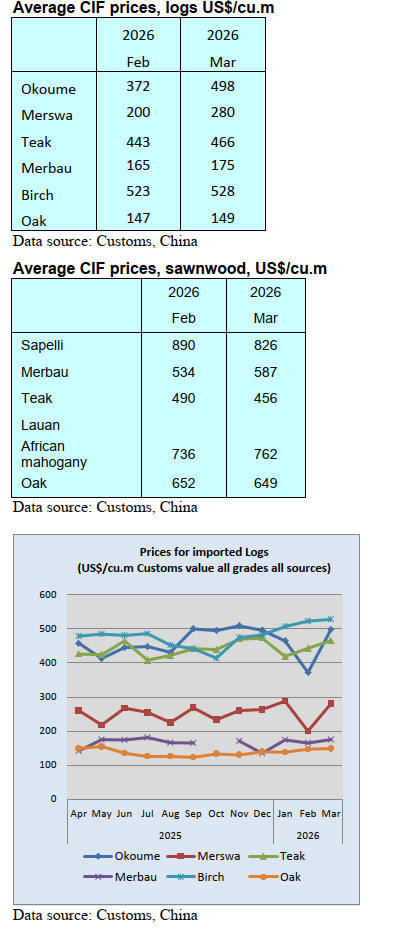
Price trends
|


