|
Report from
Europe
Anti-dumping measures drove shift in European
plywood imports
Total EU+UK imports of plywood from outside the region
in 2025 were 3.87 million cu.m, up 3% compared to 2024.
Import value was US$1819mil. in 2025, the same as the
previous year.
This apparent stability in overall imports last year
obscures major shifts in the sourcing of plywood by
European manufacturers, particularly driven by anti-
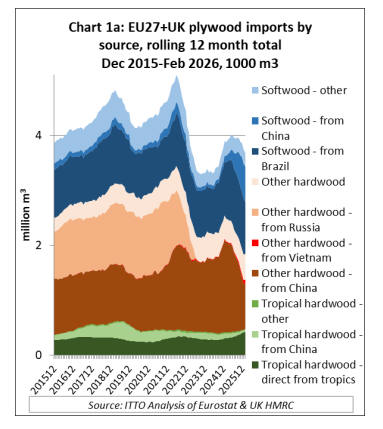
dumping measures imposed by the EU. Looking at the
data more closely, it becomes clear that total imports
increased rapidly in the first half of 2025 but then fell
sharply in the second half of the year (Chart 1a).
The decline in EU+UK imports in the second half of the
year followed imposition of provisional anti-dumping
duties of 62.4% on EU imports of all hardwood plywood
from China, excepting only those from a single Chinese
supplier for which a preliminary duty of 25.1% was
imposed after they provided additional information during
the EU’s anti-dumping investigation.
On 19 November 2025, a definitive duty of 86.8% was
imposed on all EU imports of hardwood plywood from
China, excepting products from the one company that
provided additional information which is subject to 43.4%
duty.
EU+UK imports of Chinese plywood faced with temperate
hardwood fell 40% to 959,800 cu.m in 2025, while
imports of Chinese plywood faced with tropical hardwood
were down 58% to 38,200 cu.m.
In terms of share of total plywood import quantity in the
EU+UK region, the share of Chinese temperate hardwood
products fell from 43% in 2024 to 25% in 2025 while the
share of Chinese tropical hardwood products fell from
2.4% to just 1% over the same period (Chart 1b).
The imposition of definitive anti-dumping duties implies
this downward trend will likely continue. The duties do
not apply in the UK, but the UK’s large plywood
importers also sell into the EU single market, notably in
Northern Ireland and are also expected to reduce their
imports of Chinese hardwood plywood in the future.
Direct EU+UK imports of tropical hardwood plywood
from tropical countries made significant gains in 2025.
Import volume increased 36% to 405,800 cu.m while
import value was up 22% to US$266m. The share of direct
imports of tropical hardwood plywood in total EU+UK
plywood imports increased from 7.9% in 2024 to 10.5% in
2025.
This rise in volume and share for Europe’s direct imports
of tropical hardwood plywood showed signs of
accelerating in the opening weeks of 2026.
This trend may well continue, particularly following the
EU’s decision to impose definitive anti-dumping duties of
5.4% on Brazilian softwood plywood on 15 April 2026.
Provisional duties at the same rate had already been in
effect since 5 November 2025.
The EU+UK imported 1,043,900 cu.m of softwood
plywood from Brazil in 2025, 9% more than the previous
year. The share of Brazilian softwood plywood in total
EU+UK imports increased from 25.3% in 2024 to 27.0%
in 2025. However, by the end of February 2026, EU+UK
imports of this commodity were already down 30%
compared to the same period in 2025, this at a time when
there is typically a rush to import before the annual duty-
free quota is fulfilled.
However, almost inevitably, the potential gap in supply
that opened following the imposition of EU anti-dumping
duties imposed on hardwood plywood from China and
softwood plywood from Brazil is now being filled by a big
increase in EU+UK imports of softwood plywood from
China.
EU+UK imports of Chinese softwood plywood increased
six-fold from 95,000 cu.m in 2024 to 630,000 cu.m in
2025. The primary raw material for coniferous plywood
exported from China to European markets is understood to
be radiata pine imported in log form from New Zealand.
Plywood production and consumption still slow in
Europe
While EU plywood manufacturers have been very actively
engaged in raising anti-dumping concerns with the
European authorities to boost market prospects for their
own products, the signs are this has yet to raise domestic
production levels.
Data for EU wide production of plywood in 2025 is not
yet available, but production in Finland, a leading supplier,
is projected to have fallen 5% last year, impaired by high
raw material and production costs and continuing market
volatility.
The combined effects of import stockpiling in advance of
the definitive anti-dumping duties and weak activity in the
European construction sector have dampened overall
demand. Construction activity has been slow in Europe in
the last twelve months, and the latest data suggests this
trend is set to continue.
The latest PMI data from S&P Global indicates that
eurozone construction activity was contracting in the first
quarter of this year.
The PMI posted 44.6 in March, well below the 50.0
threshold separating growth from contraction, and falling
from 46.0 in February, signaling that activity continued to
fall sharply, with the rate of contraction accelerating, and
pointing to deteriorating conditions in each of the last 47
months.
The rate of decline in the eurozone construction PMI in
March was the sharpest seen for five months and
accompanied by the most pronounced reduction in new
order intakes since last October. The reduction came amid
rapid inflation in input prices during March, with inflation
at the highest level since November 2022.
Firms often pointed to surging energy prices as a key
factor behind the acceleration following the outbreak of
war in the Middle East. The conflict also led firms to be
pessimistic regarding the outlook for the coming year,
sharply reversing a brief spell of more positive sentiment
seen in February.
The three largest eurozone economies all recorded
declines in construction output during March. France
registered the strongest decrease, the strongest in a year-
and-a-half. Italian construction companies saw a renewed
and solid decline, while construction activity in Germany
bucked the wider trend to record a slower reduction.
Similarly in the UK, the S&P Global Construction Sector
PMI stood at 45.6 in March, well below the neutral 50.0
value for the fifteenth month in a row. March data
indicated a solid reduction in UK construction output,
albeit at a slightly less marked pace than in the previous
month. Residential work remained by far the weakest-
performing category.
The latest UK survey also suggested that operating
margins were under considerable pressure from a rapid
acceleration in input cost inflation. Construction
companies widely noted that the war in the Middle East
had pushed up fuel, transportation and raw material prices.
They also cited falling confidence among clients and a
lack of new project starts.
One of the few bright spots for the European plywood
trade is that freight rates have remained quite low and
stable over the last twelve months. According to the
Drewry's World Container Index, rates from Shanghai to
Genoa are currently hovering around US$3,071 per 40ft
container, while rates to Rotterdam are at around
US$2,147 per 40ft container. The latter rate has remained
broadly stable since September last year and is down from
US$3450 in July 2025 and from rates exceeding US$8000
a year earlier in 2024.
Strong start to the year for direct European imports of
tropical hardwood plywood
Imports of plywood faced with tropical hardwood into the
EU+UK region were 462,200 cu.m in 2025, 12% more
than in 2024. In value terms, imports increased 9% to
US$301m last year.
EU+UK imports of tropical hardwood plywood have
started this year strongly. In the opening two months, they
were 81,100 cu.m, 30% more than in the same period in
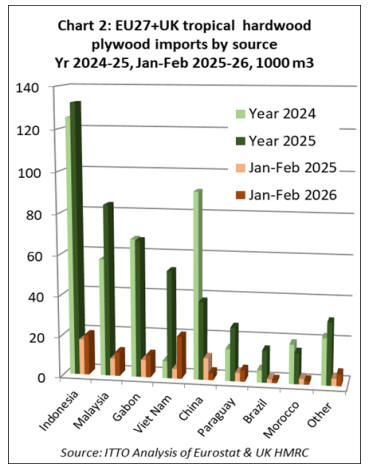
2025. Imports have increased particularly strongly from
Malaysia and Vietnam, offsetting the large decline in
imports from China. (Chart 2).
EU+UK hardwood plywood imports direct from tropical
countries were 405,800 cu.m in 2025, 36% more than in
2024. In the opening two months of this year, they were
75,000 cu.m, a gain of 55% compared to the same period
last year.
EU+UK hardwood plywood imports from Indonesia were
132,300 cu.m in 2025 and 19,700 cu.m in the first 2
months of 2026, respectively 6% and 12% more than the
previous year. Imports from Malaysia increased 46% to
83,900 cu.m in 2025 and were up 37% to 11,700 cu.m in
the first two months of this year.
EU+UK imports of plywood from Gabon were 67,000
cu.m in 2025, 1% less than the previous year. However,
they were 11,100 cu.m in the opening two months of this
year, 29% more than in the same period in 2025.
According to Eurostat statistics, the pace of increase in
EU+UK imports of tropical hardwood plywood from
Vietnam has been rapid, although from a small base.
Imports from this source increased more than five-fold to
52,700 cu.m in 2025. In the first two months of 2025, they
were 20,900 cu.m, a gain of 338% compared to the same
period last year.
EU+UK imports of tropical hardwood plywood have also
been rising from Latin America. Imports from Paraguay
were 26,300 cu.m in 2025, 67% more than the previous
year. In the opening two months of this year, they were
5,500 cu.m, 32% more than the same period in 2025.
Imports of tropical hardwood plywood from Brazil were
15,700 cu.m in 2025, a gain of 164%. Imports from Brazil
have started this year more slowly, at 1,200 cu.m in the
first two months, 33% less than the same period in 2025.
The increase in direct EU+UK imports of tropical
hardwood plywood from tropical countries has offset the
significant decline in imports from China. Imports of
38,200 cu.m from China in 2025 were 58% less than the
previous year. The decline has accelerated this year with
imports of just 3,600 cu.m in the first two months of 2026,
67% less than the same period in 2025.
Sharp fall in European imports of temperate hardwood
plywood
EU+UK imports of temperate hardwood plywood from
outside the region fell dramatically last year driven by the
sharp decline in imports from China, beginning in June
following imposition of the EU anti-dumping measures.
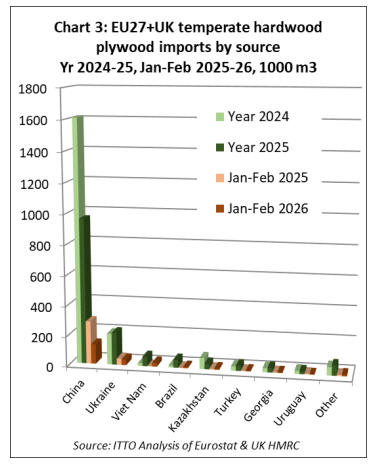
Total imports during 2025 were 1,479,000 cu.m valued at
US$795m, respectively 28% and 24% less than the
previous year. Import quantity from China fell 40% to
960,000 cu.m, while value from China was down 44% to
$392m (Chart 3).
With Russia out of the picture due to the sanctions
imposed in 2022 by both the EU and UK following the
invasion of Ukraine, no other non-EU supply country
comes to close to China in terms of volume production.
EU+UK imports of temperate hardwood plywood from
Ukraine staged a minor recovery last year, rising 4% to
214,000 cu.m, but were down 10% to 37,600 cu.m in the
opening two months of 2025.
Brazil is supplying Europe with more plywood
manufactured from hardwood plantation logs in the south
of the country. EU+UK imports of this commodity
increased 314% to 53,000 cu.m in 2025. The EU’s
imposition of anti-dumping duties on softwood plywood
from Brazil, starting November last year, seems to have
intensified this trend, with imports of non-tropical
hardwood plywood from the country reaching 8,400 cu.m
in the first two months of 2026, a four-fold gain compared
to the same period in 2025.
Vietnam is also now exporting significant quantities of
temperate hardwood plywood manufactured from
imported logs. EU+UK imports from this source increased
253% to 63,000 cu.m in 2025. In the first two months of
2026, imports of this commodity from Vietnam, at 26,600
cu.m, were nearly ten times the volume imported during
the same period in 2025.
Despite efforts in the EU+UK to crackdown on
circumvention of sanctions on Russian wood products,
temperate hardwood plywood products from countries
neighboring Russia - which may contain Russian wood -
have continued to flow into the region.
EU+UK imports of temperate hardwood plywood from
Kazakhstan fell 50% to 37,000 cu.m in 2025, but were up
again, by 53% to 8,700 cu.m, in the opening two months
of 2026. Imports from Georgia were 30,000 cu.m in 2025,
14% more than the previous year. Imports of 4,300 cu.m
from Georgia in the January to February period this year,
were 17% more than the same period in 2025.
EU+UK imports of temperate hardwood plywood from
Turkey are also increasing. They gained 27% to reach
35,000 cu.m in 2025 and were up 84% to 5,100 cu.m in
the first two months of 2026. Although early days, this is a
particularly intriguing development that might point the
way to a wider trend in the European plywood market.
There are reports of northern European plywood
manufacturers establishing new ventures in Turkey reliant
on logs imported from the EU and that sell finished
plywood back into the EU. The aim is to reduce plywood
manufacturing costs by locating in a country where labour
and energy costs are lower than in the EU, while allowing
much shorter shipping cycles compared to locations in
China and Southeast Asia and offering FSC and EUDR
compliance through their reliance on wood originating in
the EU.
Shifting plywood destinations in Europe
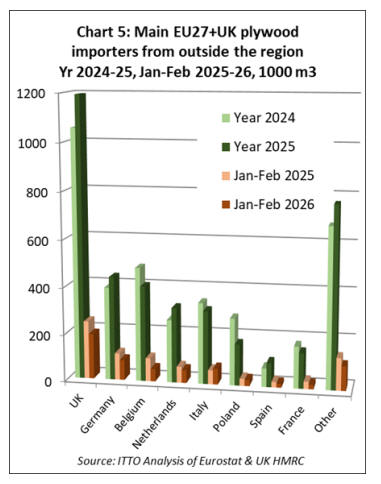
The UK is by far the largest single destination for plywood
imported into the EU+UK from outside the region,
accounting for 31% of the total (Chart 5). Lying outside
the EU single market and having no domestic production,
this is not surprising.
Imports into the UK from outside the region were
1,192,800 cu.m in 2025, 13% more than the previous year.
However, UK imports so far this year have been slower,
down 22% in the first two months compared to the same
period in 2025.
Total EU imports of plywood from outside the region were
2,666,800 cu.m in 2025, a 1% decline compared to the
previous year. The decline in imports has accelerated in
the first two months of this year, down 24% to 85,400
cu.m.
Imports from outside the region increased last year into
Germany (+13% to 439,400 cu.m), Netherlands (+20% to
317,700 cu,m), and Spain (+31% to 102,800 cu.m), but
declined into Belgium (-16% to 403,800 cu.m), Italy (-
10% to 310,100 cu.m), Poland (-38% to 174,600 cu.m),
and France (-15% to 150,500 cu.m).
Imports so far this year are down significantly into nearly
all the main EU markets, the only exception being Italy
where imports are up 14% in the opening two months.
|


