|
1.
CENTRAL AND WEST AFRICA
China is gradually returning to the market
Price increases are now becoming more visible in the West
and Central African timber sector. These increases are
mainly linked to higher export taxes and lower production
levels in certain key species, particularly Azobé and
increasingly Okan, where log availability remains limited.
China is gradually returning to the market, bringing some
renewed activity to the sector. Chinese-owned mills are
again actively cutting Okoume and although price
increases remain modest, operators are satisfied to see
orders returning after a quieter period.
Operators in the region say the Philippines market has
stabilised while Vietnam continues to perform strongly.
Demand remains firm not only for Tali but also for
Padouk and Ovangkol, helping to support production
levels in several exporting countries.
Demand in Europe, however, remains slow.
Environmental policies and CO₂ reduction measures
continue to affect industrial activity and construction
demand.
Across West and Central Africa the rainy season
continues, except in the central and northern regions of
Cameroon and in the CAR where conditions are drier.
Operationally, there are no major changes to report. Many
countries continue to struggle with recurring electricity
cuts.
Gabon
The Gabonese timber sector remains active despite
continued operational and financial pressures. The
domestic market for Okoume and Bilinga remains stable,
particularly for local housing and construction demand.
Okoume peeler logs supplied to the NKok Special
Economic Zone are reportedly trading around
FCFA85,000 per cu.m, with higher quality CS-grade logs
reaching as much as FCFA90,000 per cu.m. Local sawn
Okoume prices in retail outlets have increased
significantly and are now ranging between FCFA140,000
and 150,000 per cu.m.
Although estimates suggest that China’s Zhangjiagang
Port still holds roughly one year of mixed tropical log
stocks, Chinese buyers have unexpectedly returned to the
Okoume market with renewed demand bringing some
optimism to producers and exporters.
The repairs to the road between Okondja and Makokou
have now been partially completed, however, transport
conditions remain difficult due to heavy rains. Road
repairs continue across central Gabon, particularly in the
regions of Lastourville, Lopé and Makokou. Under
normal conditions, transport to Owendo Port now takes
approximately three days but bad weather still causes
delays.
Electricity disruptions continue across the country. Power
shortages remain a concern for both industrial activity and
daily operations.
Producers say the fiscal climate in the country with
regards to strict enforcement of some regulations is
creating challenges. Recently, the Forestry Task Force has
intensified tax inspections and reportedly identified more
than 50 companies with outstanding tax obligations. Land
Tax payments, originally due before 21 March 2026,
continue to be a major burden. Many companies are
seeking instalment arrangements due to weak market
conditions and the impact of increased export duties
introduced earlier this year.
Analysts suggest the outlook for Gabon remains mixed.
Chinese demand for Okoume is improving and local
construction demand continues to support domestic
consumption. However, persistent infrastructure
weaknesses, delayed government projects, electricity
shortages and increased fiscal pressure continue to weigh
heavily on the sector.
The market remains operational but cautious, with
producers closely monitoring demand recovery in Asia
and the impact of ongoing regulatory and tax measures.
Cameroon
Harvesting activity continues to increase across
Cameroon, supported by improving operational conditions
and the gradual return of Chinese demand. Production
levels are rising and most Chinese operators are now back
in operation. It appears that China’s renewed purchasing
activity is providing some support to the sector after a
prolonged slowdown.
Demand conditions remain mixed depending on
destination and species. Middle East: stable demand for
redwood species, Vietnam: continues to be a strong
market, Philippines: remains weaker than a year ago,
Europe: still slow, particularly for Padouk due to CITES
restrictions,
Italy and the Netherlands: Ayous demand remains low.
CITES regulations continue to affect trade flows,
particularly for Padouk and it has been suggested that
some operators are increasingly seeking alternative export
destinations with fewer regulatory constraints.
Environmental and regulatory pressures continue to shape
the market environment. In addition to existing EUTR
requirements and the change to the EUDR, there is
growing concern about the possible expansion of species
under CITES regulation.
Operating costs in Cameroon remain high compared to
neighbouring countries. Fuel prices are significantly above
those in Gabon, for example it has been reported petrol is
priced at around 964FCFA/litre in Cameroon versus
575FCFA/litre in Gabon and diesel is sold at: around
808FCFA/litre versus 595FCFA/litre in Gabon.
High logistics and transport costs continue to affect
competitiveness.
Republic of the Congo
Harvesting operations in Congo remain generally stable
with production continuing across both northern and
southern regions. Road repairs on laterite transport routes
are ongoing and helping improve logistics in some
production areas.
Southern Congo continues to be the country’s main
Okoume producing region while northern Congo remains
focused primarily on Sapelli, Sipo and other redwood
species. Sawmills are currently holding log stocks
estimated at two to three months of production.
No major disruptions are reported in sawmill activity.
Spare parts availability remains stable and labour
conditions are generally manageable. Port operations are
reported as stable. Pointe-Noire continues to function
efficiently as a major deep-sea hub port with no container
shortages reported.
Northern Congo operators continue exporting logs and
sawn timber through Douala and Kribi in Cameroon, while
southern operations mainly use Pointe-Noire. This split
export structure remains important due to geography and
infrastructure conditions.
Although Congo introduced restrictions on log exports the
trade continues under a quota and an authorisation system.
Demand conditions remain relatively stable. The
Philippines has reduced purchases of sawn Okoume, in
Viet Namg demand for Tali continues, demand in China
for Okoume, Okan, Ovangkol, Belli and Azobé has
become more active. In Europe demand remains very
selective for mainly redwoods.
Chinese demand is becoming increasingly important again
for the regional market.
See: https://afrinz.ru/en/2026/04/russian-orthodox-church-
receives-official-status-in-congo/
The Congolese timber sector remains operationally stable
supported by active Asian demand and functioning
logistics. However, the continued use of export quotas and
other related trade regulations has created uncertainty
around the long-term policy direction. Demand from
China and Vietnam currently remains the main support for
the industry.
2.
GHANA
Stemming illegal logging continues to be a challenge
The Ghana Timber Millers Organisation (GTMO) has
expressed concern over the increasing incidence of illegal
logging, describing it as a menace that is undermining
operations and threatening livelihoods in the sector.
The Chief Executive Officer of the GTMO, Dr. Kwame
Asamoah Adam, said the situation was forcing companies
to scale down production and lay off workers while
struggling to meet financial obligations, raising concerns
about the sustainability of the industry.
At a media briefing, he explained that, while registered
companies operate under agreements (Timber Utilization
Contracts) with the Forestry Commission to harvest timber
annually for both domestic use and export, illegal
operators are entering legally assigned concessions to steal
logs.
Dr. Adam further suggested that a large proportion of
illegally harvested timber is being exported to
neighbouring countries depriving Ghana of revenue.
Concerned civil society organisations and Ghana Coalition
Against ‘galamsey’ have expressed their concerns to the
government. They are calling for government to move
beyond routine responses and adopt a more coordinated
and decisive national strategy to stem out illegal logging.
Meanwhile, the Minister for Lands and Natural Resources,
Emmanuel Armah-Kofi Buah, has highlighted Ghana’s
efforts to combat deforestation and environmental
degradation at the ongoing 21st Session of the United
Nations Forum on Forests in New York. He outlined key
initiatives including the Ghana Forest Plantation Strategy
and REDD+ Strategy while reaffirming government’s
commitment to fighting illegal mining to protect forests
and water bodies.
500 FLEGT licenses issued
The Forestry Commission has said it is intensifying
measures to ensure forest laws compliance and curb illegal
logging through its Forest Law Enforcement, Governance
and Trade (FLEGT) licensing system.
The Executive Director of the Timber Industry
Development Division (TIDD), Dr. Richard Gyimah,
disclosed that Ghana has issued around 500 FLEGT
licenses valued at approximately Eur14.3 million covering
about 22,500 cubic metres.
He explained that under Ghana’s Voluntary Partnership
Agreement with the EU, the system has helped to ensure
that exporters comply with all legal requirements, from
obtaining valid harvesting permits to meeting social
responsibility obligations with forest fringe communities
through both digital and field verification systems to
monitor compliance.
See: https://ghanaiantimes.com.gh/ghana-timber-millers-raise-
alarm-over-rising-illegal-logging/
Secondary and tertiary wood products supersede
primary product exports
According to the Timber Industry Division (TIDD) report
for the first two months of 2026, wood products export for
the period were 31,168 cu.m valued at Eur14.57 million.
In the same period in 2025 the figures were 38,658 cu.m
and Eur18.15 million.
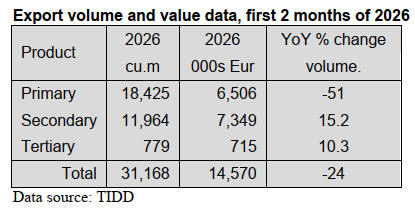
TIDD data revealed that Ghana’s primary products export
of air-dried sawnwood, billets, kindling, air-dried boules
and poles in 2026 dipped by 51% and 40% in volume and
value respectively against figures for the same period in
2025.
For the first two months of 2026 the total volume of air-
dried sawnwood exports dropped by 30% compared to the
same time in 2025. Earnings for the period also fell (-38%)
compared to the same period in 2025.
Secondary wood products export sincluding kiln-dried
sawnwood, sliced and rotary veneers and plywood
increased to Eur7.35 million in the first two months of this
year, up from the Eur6.63 million during the same period
in 2025.
Kiln-dried sawnwood exports in 2026 were 3,619 cu.m, or
12% of total export volume. This was a slight drop in
volume when compared to 2025 levels. Kiln dried
sawnwood exports generated 6% less revenue, declining
from Eur3.29 million in 2025 to Eur3.10 million this year.
Asia continued as Ghana’s leading trading partner for
wood product exports for the period January to February
2026 accounting for 18,776 cu.m in volume and Eur7.72
million in value. This represented 60% and 53% in volume
and value respectively of total wood exports for the first
two months. Compared to the same period in 2025, this
showed decreases of 28% in value and 31% in volume.
India, Viet Nam and China were the key markets while
exports to the EU market in January and February
accounting for 20% of the volume and 26% of the value of
the total export for the period, down slightly on the same
period in 2025.
Ghana’s wood exports to the ECOWAS region were
Eur1.15 million or 77% of the total export values within
Africa. The major trade was plywood shipments to
Gambia, Burkina Faso, Togo, Senegal, Benin and Nigeria.
Appeals for additional resources to protect forests
The Forestry Commission has called for increased
resources to strengthen the protection of forest reserves
across the country. Speaking to the media, the Manager of
Field Verification and Audit at the Forestry Commission,
Frank Ankomah, said illegal activities within forest
reserves continue to pose a major challenge.
He indicated some individuals invading forest reserves are
heavily armed, making it difficult for Forestry
Commission personnel assigned to protect the reserves to
confront them effectively. He therefore appealed to
government to provide the necessary resources to enable
the commission to effectively safeguard the country’s
forest reserves.
The Director of Operations for the Timber Industry
Development Division (TIDD), Mawuli Doe, also said the
Commission has intensified efforts to deal with illegal
timber operators and other offenders.
In a related development, Members of Parliament’s Select
Committee on Lands and Natural Resources have called
for urgent reforms in Ghana’s forest protection strategy
following a visit to the Nkawie Forest District in the
Ashanti Region. The Committee expressed concern over
the growing threat posed by illegal chainsaw operators,
illegal mining activities and inadequate staffing within the
Forestry Commission.
Chairman of the Committee, Collins Dauda, said the
country’s long-standing reliance on task forces to fight
illegal logging and ‘galamsey’ has failed to yield results.
Ghana has declared forest and rivers security zones where
the government has charged the National Anti-Illegal
Mining operations Secretariat (NAIMOS) to be ruthless in
dealing with illegal miners.
See: https://www.adomonline.com/forestry-commission-calls-
for-more-resources-to-protect-forest-reserves/
and
https://3news.com/news/parliamentary-select-committee-on-
lands-raises-concern-over-galamsey-illegal-logging-and-staff-
shortages-in-forest-reserves
Ghana trade delegation to participate at Carrefour
International du Bois
Following Ghana’s start of FLEGT licensing in October
2025 a trade delegation is to attend the Carrefour
International du Bois in Nantes, France in 2-4 June. The
Ghana delegation will be hosted by the ATIBT on its stand
in the Nantes Parc Beaujoire Fair complex.
On 2 June there will be an EU–Ghana Timber Trade and
Investment Forum in the Canopée meeting room at the
show ground. This will address the key issues facing the
Ghanaian timber sector in the European market and will
include a dialogue on the ‘future of collaboration between
EU and Ghana forest-based industries’.
Participants will hear an update on the European tropical
timber market, demand trends, EUDR and CITES
requirements and the prospects for FLEGT-licensed
timber presented by the European timber import sector.
ATIBT has reported a panel, moderated by a
representative from FAO will also explore EU–Ghana
collaboration opportunities in forest plantation
development, implementation of the Ghana Plantation
Strategy 2016–2040, smart forestry technologies and
potential partnerships between Ghanaian and European
actors.
This will be followed by an open Q&A roundtable and
B2B matchmaking.
ATIBT said; “This forum represents a concrete
commercial opportunity for European importers and
distributors seeking to secure their supply chains in the
face of growing requirements under the EU Deforestation
Regulation (EUDR). Ghanaian FLEGT licenses attest that
the timber is legal, traceable from forest to port and
sourced from forests managed in accordance with national
laws”.
See - https://www.atibt.org/en/news/13861/ghana-comes-to-cib-
2026-a-flegt-licensed-sector-ready-to-meet-european-markets
3. MALAYSIA
Wood-based sector facing a triple burden
The Malaysian Timber Association (MTA) has called for
government intervention warning that the wood-based
sector is facing a triple burden of higher taxes, rising
diesel costs and foreign labour shortages which have
eroded its competitiveness in global markets. The
Association also said the combined pressures are driving
up costs and constraining production in the sector.
MTA warned that “this is no longer a cyclical challenge
but a structural threat to one of Malaysia’s key export
industries”, adding that decisive policy action now will
determine whether Malaysia strengthens or surrenders its
position in the global timber and furniture market.
MTA noted that Malaysia remains among the world’s
leading furniture exporters and stressed that any prolonged
disruption to the sector risks far-reaching economic
consequences, including job losses, weakened supply
chains and erosion of global market share.
It said the expansion of the Sales and Service Tax (SST),
effective since July 2025 which removed the tax
exemption for sawn timber, has resulted in cost increases
across the entire value chain. Sawn timber is now subject
to a 5% sales tax leading to an estimated 8% to 12%
increase in downstream production costs due to a “tax-on-
tax” effect from mill to finished products.
The Association urged the Ministry of Finance to reinstate
the full tax exemption for sawn timber and recognise it as
a raw material for construction materials to eliminate
cascading cost and restore export competitiveness. In
addition, the industry is also grappling with elevated diesel
prices. Given the industry remains heavily dependent on
diesel it has no buffer against price volatility.
To mitigate the impact the MTA has proposed a targeted
fuel support mechanism, including a subsidy quota and
called for diesel prices to be capped to provide immediate
relief and stabilise the supply chain. At the same time, the
timber and furniture sector continues to face acute labour
shortages, with some mills operating at just 60% capacity
due to delays in workers quota approvals.
MTA also said the industry faces escalating recruitment
costs, including agent fees, levies, compliance, medical
screening and accommodation. Together with a multi-tier
levy system these are squeezing already thin margins,
particularly for small and medium enterprises.
“These pressures are also limiting reinvestment in
automation and long-term productivity improvements,” it
added. The Association called for a fast-tracked and one-
stop recruitment system to reduce delays and costs.
Sabah Ports congestion
The media in Sabah reports the Federation of Malaysian
Manufacturing (FMM), Sabah Branch, has raised concerns
on congestion at Sabah Ports, describing the disruption as
a manmade logistical crisis that is crippling the State’s
industrial competitiveness.
FMM Sabah chaiperson, Liaw Hen Kong, said port
operations in the State had reached a “state of paralysis”,
with severe disruptions to container trucking, frequent
vessel omissions, massive container rollovers and
prolonged delays in gate-in and gate-out activities
becoming the “new normal”.
“What is truly infuriating is that feeder operators
announced a ‘Congestion Surcharge’ and ‘General Rate
Increase (GRI)’ effective 7 May, citing the port’s failure to
clear the backlog,” he said.
“This is a direct consequence of port operational failure
and means Sabah businesses must bear the cost”, Liaw
stressed.
He said, Sabah manufacturers, already burdened by higher
raw material and fuel costs compared to Peninsular
Malaysia, are now facing soaring detention and demurrage
charges as well as additional surcharges.
Operational bottlenecks at the port have created a
significant cost-push inflationary environment. As
manufacturers absorb punitive surcharges and storage fees
they have reached a breaking point where these expenses
must be passed on to consumers. This not only erodes
public purchasing power but also stifles business
profitability” he said. The Federation urged immediate
intervention to resolve the crisis and safeguard the
competitiveness of Sabah industries.
See:https://theborneopost.pressreader.com/article/281565182380325
and
https://theborneopost.pressreader.com/article/281590952188211
Kenaf downstream industry
Malaysia is intensifying efforts to develop its kenaf
downstream industry as part of a broader strategy to
enhance agro-commodity value and support smallholder
incomes.
This was highlighted by Plantation and Commodities
Minister Dr Noraini Ahmad while visiting the non-woven
thermobonding kenaf processing plant in Saujana which is
operated by the National Kenaf and Tobacco Board. This
facility, developed with an investment of RM25 million,
has an annual production capacity of up to 2,400 metric
tonnes of non-woven kenaf products.
It is estimated these factories could generate a market
value of between RM16 million and RM18 million
annually, catering to both domestic and export demands.
Fire resistant doors from oil palm trunk
A Malaysian company has been recognised by the
Malaysia Book of Records (MBR) for developing the
country’s first fire-resistant door made from oil palm trunk
(OPT) biomass.
The MBR said the pioneering innovation transformed
agricultural waste into a high-performance building
material, marking a significant step forward in sustainable
manufacturing and green construction solutions.
It noted that Malaysia, as one of the world’s largest palm
oil producers, managed approximately 5.6 million hectares
of plantations, which accounted for about 17% per cent of
the nation’s land use.
See: https://www.bernama.com/en/general/news.php?id=2537256
4.
INDONESIA
Export benchmark prices for May 2026
Veneers
Natural Forest Veneer US$755/cu.m
Plantation Forest veneer US$946/cu.m
Wooden Sheet for
Packaging Box US$1,101/cu.m
Wood Chips
Woodchips in chips or
Particles US$90/tonne
Woodchips US$97/tonne
Processed Wood
Processed wood products which are leveled on all four
sides so that the surface becomes even and smooth with
the provisions of a cross-sectional area of 1,000 sq.mm to
4,000 sq.mm (ex 4407.11.00 to ex 4407.99.90)
Meranti (Shorea sp) US$1,346/cu.m
Merbau (Intsia sp) US$1,047/cu.m
Rimba Campuran
(Mix Tropical hardwood) US$740/cu.m
Eboni US$2,785/cu.m
Teak US$3,252/cu.m
Pinue and Gmelina US$731cu.m
Acacia US$652/cu.m
Sengon (P. falcataria) US$1,350/cu.m
Rubberwood US$433/cu m
Balsa (Ochroma sp) and
Eucalyptus. US$559/cu.m
Sungkai (P. canescens) US$1,298/cu.m
Processed wood products which are leveled on all four
sides so that the surface becomes even and smooth of
Merbau wood with the provisions of a cross-sectional area
of 4,000 sq.mm to 10,000 sq.mm (ex 4407.11.00 to ex
407.99.90) US$1,500/cu.m.
Tight log supply and soaring prices - plywood
production impacted
Indonesia’s plywood industry experienced a sharp decline
in early 2026 as a result of tight log supply and rising log
prices. The Indonesian Wood Panel Association (Apkindo)
reported that roundwood production from natural forests in
the first quarter fell by around 30% year-on-year. This
decline affected all major production regions, with
Sumatra recording the steepest drop, followed by
Kalimantan, Java-Bali and Eastern Indonesia.
Apkindo said the reduction in supply was partly caused by
the revocation of several forest concession permits, which
reduced raw material availability for processing industries.
At the same time log prices continued to climb. Meranti
log prices rose to around Rp2.5 million–Rp2.6 million per
cubic metre while prices in Java reached Rp3.8 million–
Rp4 million per cubic metre. Apkindo said the
combination of limited supply and rising prices was
reflected in plywood production figures, with national
output in March 2026 falling to approximately 158,000
cubic metres, down 31% from February and around 40%
lower than the same month last year. Overall production in
the first quarter 2026 declined by about 30% year-on-
year.
The industry’s challenges have been compounded by
soaring energy costs. Since early March 2026 industrial
fuel prices reportedly surged by around 100% due to
global energy supply disruptions linked to geopolitical
tensions in the Middle East. The higher fuel costs have
affected logging operations, transportation, factory
activities and supporting materials such as adhesives,
while international shipping costs have also become
increasingly volatile.
Apkindo warned that manufacturers now face a difficult
dilemma as rising production costs are forcing companies
to consider higher selling prices even as global demand
weakens, threatening the competitiveness and profitability
of Indonesian plywood exports.
See:
https://ekonomi.bisnis.com/read/20260502/257/1970799/produks
i-kayu-lapis-anjlok-apkindo-pasokan-seret-dan-harga-log-naik.
and
https://ekonomi.bisnis.com/read/20260504/257/1971008/manufa
ktur-tertekan-sektor-kayu-lapis-diversifikasi-tekstil-desak-
stimulus-fiskal
Calls for productivity-driven labour policies to
strengthen manufacturing competitiveness
The Indonesian Furniture Industry and Craft Association
(HIMKI) has called on the government to adopt
productivity-driven labour policies to strengthen the
competitiveness of the manufacturing sector amid growing
geopolitical and economic pressures.
HIMKI Chairman Abdul Sobur emphasised that, while
labour protection remains a fundamental principle in
industrial development, it must be balanced with the need
to improve efficiency, flexibility and global
competitiveness. He noted that Indonesia’s manufacturing
sector is facing challenges, not only from global market
conditions but also from domestic issues such as low
labour productivity and rising production costs.
To address these challenges HIMKI is advocating flexible
work policies based on productivity and output, incentives
for companies investing in workforce training and
technology and wage systems that incorporate
performance-based incentives.
The Association also urged the government to strengthen
workforce skills development programmes that are better
aligned with industry demands. Abdul Sobur added that
the effectiveness of labour policies at the implementation
stage is often influenced by public communication and
industrial relations dynamics on the ground.
See: https://www.antaranews.com/berita/5546811/himki-dorong-
kebijakan-tenaga-kerja-berbasis-produktivitas
Indonesia opens carbon market to communities and
businesses
Indonesia has introduced a new regulation opening its
forestry carbon market to communities and private sector
players in an effort to accelerate emissions trading and
maximise the economic value of its tropical forests.
Through Forestry Ministry Regulation (Permenhut) No.
6/2026, companies are now allowed to offset greenhouse
gas emissions by investing in forest conservation,
sustainable forest management and ecosystem protection.
Forestry Minister, Raja Juli Antoni, said the policy marks
a shift toward a more transparent and inclusive carbon
market after years of slow progress. The regulation is also
intended to ensure that local communities benefit directly
from conservation efforts.
The Minister emphasised that Indonesia’s new forestry
carbon trading regulation is designed to ensure greater
transparency, accountability and trust in the carbon
market. Through Ministerial Regulation No. 6/2026, the
government aims to establish a clearer framework for
businesses, local communities and international partners
involved in forestry-sector carbon trading. The minister
highlighted that maintaining integrity in carbon trading is
a top priority.
See: https://jakartaglobe.id/news/indonesia-opens-forestry-
carbon-market-to-communities-businesses
and
https://en.antaranews.com/news/414063/forestry-minister-vows-
transparent-accountable-carbon-trading
Industry welcomes new carbon trading regulation
Industry stakeholders have welcomed Indonesia’s new
forestry carbon trading regulation, describing it as a major
step toward strengthening the country’s carbon market and
accelerating the green economy.
During a forum in Jakarta discussing the regulation’s
implications, representatives from the government, the
Indonesian Chamber of Commerce and Industry and
carbon project developers said the policy provides greater
certainty for the forestry carbon sector.
Business leaders emphasised that the success of
Indonesia’s carbon market will depend on strong
coordination and trust among stakeholders. The regulation
introduces clearer project developer criteria, carbon credit
issuance procedures, participation mechanisms for
international markets and stronger environmental and
social safeguards.
However, industry players also urged the government to
quickly issue implementing rules on project risk
management and long-term investment certainty to
encourage greater green investment in Indonesia.
In related news, the Association of Indonesia Forest
Concession Holders (APHI) plans to expand forestry
carbon projects by utilising 16–17 million hectares of
natural forest within its concession areas, beyond the 16
carbon project pipelines it currently manages.
Purwadi Soeprihanto said the initiative is part of APHI’s
response to the issuance of Minister of Forestry
Regulation No. 6/2026 which regulates carbon trading
through greenhouse gas emission offsets in the forestry
sector. He explained that some concession areas will
continue to be used for timber production, while others
have strong potential for carbon credit development.
Purwadi expressed optimism that forestry carbon trading
could generate circular economic benefits for Indonesia’s
timber industry, provided the resulting carbon credits
remain competitive in the market.
He emphasised that carbon projects should not only focus
on generating carbon units, but also on delivering social
and environmental benefits. This includes benefit-sharing
mechanisms for local communities so that profits from
carbon trading are distributed more broadly, as well as
ensuring biodiversity conservation and ecosystem
protection in project areas.
See: https://ecobiz.asia/industry-welcomes-indonesias-new-
forestry-carbon-trading-regulation/
and
https://lestari.kompas.com/read/2026/04/22/093307686/kadin-
permenhut-baru-jadi-angin-segar-kembangkan-pasar-karbon-
sukarela
and
https://katadata.co.id/ekonomi-hijau/ekonomi-
sirkular/69e83badba1e9/aphi-siap-tambah-proyek-karbon-
kehutanan-pascaterbitnya-permenhut-62026
Studies to strengthen anti-corruption measures in the
forestry sector
Indonesia’s Corruption Eradication Commission (KPK) is
conducting two studies to strengthen corruption prevention
in the country’s forestry sector, focusing on corruption
risks in forest product trade and downstream processing,
as well as vulnerabilities in the governance of forest area
allocation procedures.
The initiative was launched due to the sector’s high
strategic and economic value which KPK Deputy for
Prevention and Monitoring, Aminuddin, said requires
transparent, accountable and integrity-based management.
He emphasised that the KPK’s role extends beyond law
enforcement to supporting systemic improvements in
corruption prevention.
To carry out the studies the KPK is collaborating with the
Ministry of Forestry, Ministry of Industry and Ministry of
Trade on efforts focused on integrating data, aligning
policies and strengthening supervision across the forestry
supply chain.
Aminuddin stated that the collaboration is intended to
improve regulations, oversight effectiveness and
information system integration throughout the sector. The
studies are expected to be completed in 2026 and are
intended to produce not only recommendations but also
concrete implementation measures to improve forestry
governance in Indonesia.
See: https://www.antaranews.com/berita/5547695/kpk-buat-dua-
kajian-guna-cegah-korupsi-pada-sektor-kehutanan-indonesia
Ford Foundation cooperation on customary forest
recognition
Indonesia’s Ministry of Forestry is strengthening
cooperation with the Ford Foundation to accelerate the
recognition and designation of customary forests as part of
broader efforts to improve forest governance and empower
indigenous communities in forest conservation.
The initiative was discussed during a meeting between
Forestry Minister, Raja Juli Antoni, Deputy Minister
Rohmat Marzuk and Heather Gerken, President of the
Ford Foundation. Raja Juli Antoni stated that accelerating
customary forest recognition has become a key focus of
current forestry governance reforms.
To support this goal the Ministry has established an
inclusive task force involving government institutions,
academics, civil society groups and non-governmental
organisations. The government is also seeking to
accelerate recognition for 95 Indigenous Law
Communities.
Heather Gerken reportedly praised Indonesia’s
commitment to indigenous peoples and forest protection,
saying the country has demonstrated strong global
leadership on indigenous issues following COP30.
She added that the Ford Foundation is prepared to provide
technical and legal assistance to help realise Indonesia’s
long-term vision for customary forest recognition and
conservation.
See: https://infopublik.id/kategori/nasional-sosial-
budaya/968199/kemenhut-dan-ford-foundation-perkuat-kerja-
sama-pengakuan-hutan-adat
Indonesia forms task force for national park financing
Indonesia has established a task force to develop
innovative financing mechanisms for national park
management as part of efforts to strengthen biodiversity
conservation and improve community welfare.
Hashim Djojohadikusumo, who chairs the task force,
emphasised that the initiative is aimed at protecting
ecosystems for future generations rather than
commercialising conservation areas. He stressed the
principle of “ecology before tourism,” with tourism
intended to support conservation efforts rather than
dominate them.
See: https://mediaindonesia.com/humaniora/884868/pemerintah-
bentuk-satgas-inovasi-pembiayaan-taman-nasional-dorong-
skema-di-luar-apbn
5.
MYANMAR
6.
INDIA
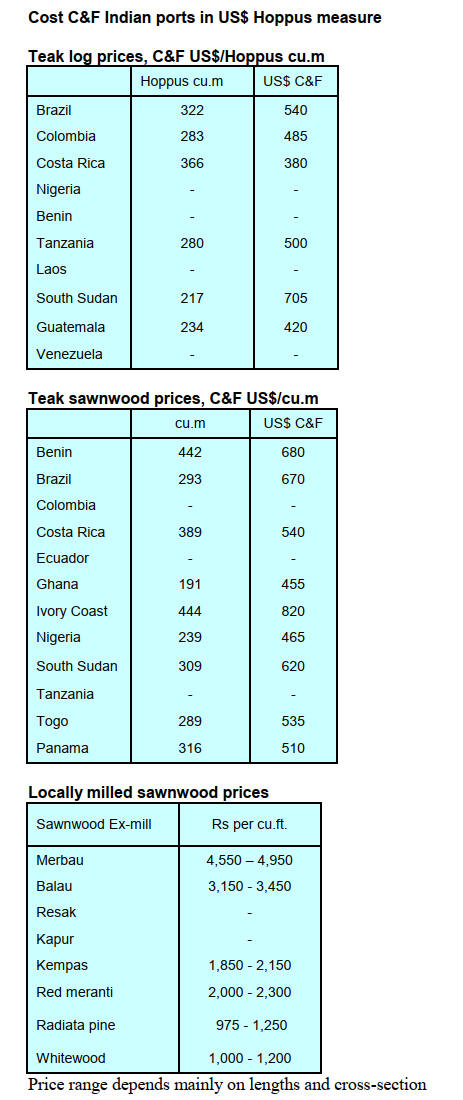
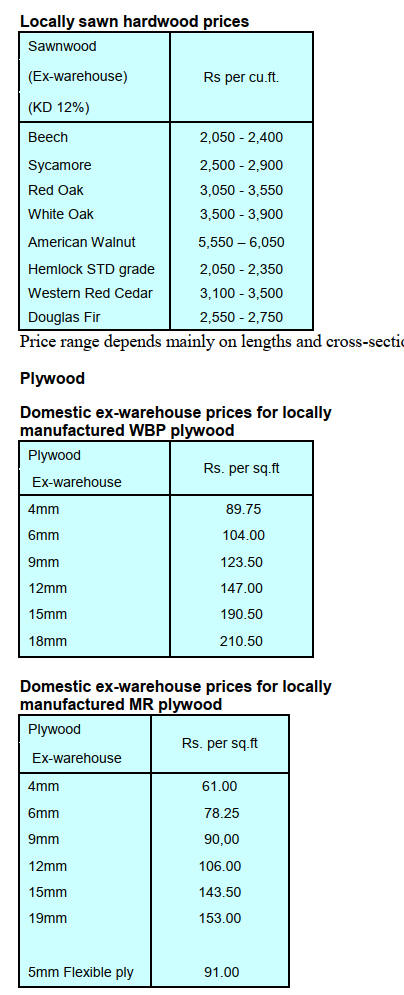
Duty-free access for New Zealand softwood
It has been suggested that Duty-Free access for New
Zealand softwood under the recently signed FTA may
drive down prices, raising questions about long-term
impacts on domestic log suppliers.
The Indian media has hailed the Free Trade Agreement
(FTA) between New Zealand and India, signed in April
2026 as this will open trade opportunities with duty-free
access for 100% of India‘s exports and lower tariffs for
95% of imports from New Zealand.
Mr. Agneshwar Sen, the Trade Policy Leader from Earnst
and Young (EY India) said “India has secured this without
compromising its most sensitive sectors. Dairy, edible oils,
sugar, spices, onions and key agricultural commodities are
explicitly excluded from India’s concession list, protecting
domestic farmers and industry”.
Other sensitive products, such as apples, kiwis and
Manuka honey, while not excluded, are protected through
Tariff Quote Ratios (TQR).
TQR sets limits on the amount of product that can be
exported and applies additional tariffs once those limits
are exceeded.
However, over 54% of New Zealand products, such as
wood, wool and sheep meat are duty free. Some have
raised questions about the FTA‘s impact on domestic
suppliers, especially softwood producers. As domestic
softwood production is minimal India relies on imports,
importing around 85% of its softwood. New Zealand is
one of the main exporters of softwood to India.
According to the Ministry of Commerce, in 2019 NZ
pinewood imports were valued at around US$521 million.
This dropped to US$381 million in 2020 due to the
pandemic leading to a decline in imports until 2024.
In 2024-25, imports increased to around US$587 million.
This is expected to be further amplified by the FTA,
especially given the duty-free status of wood products
from the start of the Agreement.
India’s softwood market has been estimated as growing at
11% annually and is projected to reach US$1.06 billion by
2032. This surge is driven by rapid urbanisation,
construction requirements and furniture manufacturing.
Used frequently in plywood, softwood is a cost-effective
choice for many plywood producers. However, plywood
producers in many parts of south India say they primarily
use domestic hardwoods such as rubberwood and Gurjan
for plywood production.
According to the online marketplaces IndiaMart
and TradeIndia, the current price of Indian softwood,
varying by type of wood, ranges from around INR150 to
INR1,200 per cubic foot. NZ Radiata Pine prices are said
to be around INR500 per cubic foot.
Prior to the FTA, most softwood imports from New
Zealand faced duties of around 5.5 to 11%, hence the
higher price. Given the FTA, further price declines are
expected for imported pine making the sector even more
price-competitive. Even if the shift is not immediate, the
potential drop in imported softwood prices could gradually
influence how manufacturers source materials, leading to
altered market dynamics.
See: https://www.theweek.in/news/biz-
tech/2026/05/01/softwood-imports-india-nz-fta-impact.html
and
https://www.mfat.govt.nz/en/trade/free-trade-agreements/free-
trade-agreements-concluded-but-not-in-force/new-zealand-india-
free-trade-agreement
The Maharashtra Global Furniture City
Bharat Cluster Ventures Private Limited has signed a
Memorandum of Understanding (MoU) with the State
government of Maharashtra for the development of India’s
first integrated furniture Park, the ‘Maharashtra Global
Furniture City’ said the Association of Furniture
Manufacturers & Traders.
This is envisioned as a world-class integrated industrial
ecosystem that will empower MSMEs, reduce import
dependency, create large scale employment, strengthen
exports and position Maharashtra as a global hub for
furniture manufacturing.
This MoU is not merely an agreements it is a shared
commitment to nation-building through organised
industry, innovation and collaboration, according to the
Association of Furniture Manufacturers & Traders.
See: https://www.linkedin.com/posts/bharat-cluster-ventures-
private-limited_today-marks-a-truly-historic-and-deeply-
emotional-activity-7419752788177567744-h2W8
Seeking a decentralised energy strategy
Biju Dharamapalan, Dean of Academic Affairs at Garden
City University in writing for The Pioneer, says recent
disruptions in LPG supply across several parts of India
have exposed an uncomfortable reality, the country’s
energy security rests on a fragile and highly centralised
system. In this context, the idea of social forestry deserves
renewed attention.
Introduced in India during the 1970s and 1980s, social
forestry was never just about planting trees. It was a
broader vision of community self-reliance, encouraging
villages and local institutions to grow fuelwood, fodder
and timber on common lands, roadsides, canal banks and
private fields. At its core was a simple but powerful
principle: essential resources, especially cooking fuel,
should remain locally available and sustainable.
Over the years, however, the rapid spread of LPG
connections has changed India’s energy habits. LPG
improved millions of lives by reducing indoor pollution
and relieving women of the burden of collecting firewood.
Yet it also created near-total dependence on a centralised
fossil-fuel-based system.
India already possesses strong policy frameworks for
afforestation and green development. Programmes such as
the Green India Mission, the National Afforestation
Programme, CAMPA funding and the Nagar Van Yojana
have invested heavily in restoring degraded landscapes
and expanding tree cover. Yet these initiatives are largely
viewed through the lens of environmental conservation
and carbon capture, rather than as part of a decentralised
energy strategy. Reviving social forestry today does not
mean returning to the past. It means combining traditional
wisdom with modern planning and science.
See: https://dailypioneer.com/news/why-india-must-revive-
social-forestry-for-energy-security
7.
VIETNAM
Wood and Wood Product (W&WP) trade highlights
As of early May 2026, Viet Nam's wood and wood
product (W&WP) industry has been navigating a complex
landscape marked by significant legal and trade-defense
challenges in key markets. Despite these hurdles, the
industry has remained resilient, supported by a strategic
shift toward market diversification.
While the U.S. continues to be Viet Nam’s largest export
market, exporters are actively expanding their presence in
Japan, China, South Korea, EU and the Middle East, with
approximately 45 new markets being targeted as a buffer
against potential US tariffs.
Japan has shown particularly strong growth, becoming
Viet Nam’s second-largest export destination, with exports
increasing by more than 23% over the past year. China
remains the third-largest market, driven by rising demand
for Vietnamese wood chips, with imports increasing by
around 3.5% annually in recent reporting periods. Exports
to Spain rose sharply by 63% due to strong market
demand while Canada has emerged as an important
market, especially for bedroom furniture products.
Viet Nam’s hardwood and decorative plywood exports to
the United States are currently facing severe pressure,
following the announcement of preliminary anti-dumping
and countervailing duties exceeding 190% in March 2026.
Final determinations are scheduled for May 2026.
According to statistics from the Viet Nam Customs Office,
W&WP exports in April 2026 reached US$1.43 billion, up
3% compared to March 2026, but down 1% compared to
April 2025. Of this total, WP exports accounted for
US$941.7 million, increasing by 5% month-on-month but
decreasing by 4% year-on-year. Overall, during the first
four months of 2026, W&WP exports totalled US$5.4
billion, up 0.4% compared to the same period in 2025. WP
exports contributed US$3.5 billion, representing a decline
of 5% year-on-year.
Viet Nam’s wooden furniture exports in April 2026 were
valued at US$822.4 million, up 3% compared to March
2026 but down 6% compared to April 2025.
In the first four months of 2026, total wooden furniture
exports reached US$3.1 billion, down 6% compared to the
same period in 2025.
Viet Nam’s imports of raw wood (logs and sawnwood) in
March 2026 reached 601,109 cubic metres, valued at
US$204.5 million, up 58% in volume and 58.8% in value
compared to February 2026. Compared to March 2025,
imports increased by 3% in volume and 15.0% in value.
Overall, during the first three months of 2026 raw wood
imports totalled 1.6 million cubic metres, worth US$542.7
million, representing increases of 11% in volume and 20%
in value compared to the same period in 2025.
Viet Nam’s non-timber forest product (NTFP) exports in
March 2026 were estimated at US$83.37 million,
representing a significant increase of 50% compared to
February 2026 and an increase of 6% compared to March
2025. In the first three months of 2026, total NTFP exports
reached US$239.18 million, up 14% over the same period
in 2025.
As of early May 2026, Viet Nam’s wood and wood
product industry is targeting total exports of approximately
US$18 billion for 2026.
In the first quarter of 2026, exports were estimated at
around US$3.95 billion, representing a modest increase of
approximately 1% compared to the same period in 2025.
Stronger demand from China, Japan and the EU has
helped offset weaker demand from the US market, while
many enterprises have reportedly secured export orders
through August 2026.
The Vietnamese Government plans to initiate negotiations
in June to transfer more than 5 million forest carbon
credits to the non-profit organisation Emergent at a
minimum price of US$10 per credit. These credits are
generated from projects implemented in Viet Nam’s
Central Highlands and South-Central regions.
To maintain timber exports to Europe, Viet Nam is
accelerating the completion of provincial forest boundary
databases and forest mapping systems to ensure
compliance with the EU Deforestation Regulation
(EUDR) before the end of 2026. In addition, beginning in
2026, Viet Nam has been deploying advanced
technologies including Artificial Intelligence (AI), big data
and cloud computing to monitor forest changes through
satellite imagery and strengthen forest governance and
traceability systems.
See: https://english.thesaigontimes.vn/vietnam-targets-q2-2026-
completion-of-forest-carbon-credit-issuance/
Viet Nam boosts shipments to Europe
The Viet Nam Timber and Forest Products Association
said that wood industry enterprises are accelerating
exports to the European Union (EU) as demand recovers
and EU partners increase orders. According to Viet Nam
Customs, exports of wood and wood products reached
about US$17.2 billion in 2025, up nearly 6% from the
previous year, the highest level on record.
In addition to traditional markets such as the United
States, Japan and China, exports to the EU have shown
positive signs, driven by rising demand for processed
wood products and high-end furniture. European orders
maintained a positive trend in the first months of 2026.
Many wood exporters are ramping up shipments to the
European market.
As EU demand rebounds, Vietnamese enterprises are
boosting exports and front-loading shipments ahead of
traceability requirements while investing in supply chain
digitalisation and raw material transparency.
See: https://en.sggp.org.vn/vietnams-wood-producers-
boost-shipments-to-european-market-
post123776.html?utm_source=chatgpt.com
US - 196% preliminary duties on Vietnamese hardwood
plywood
The US Department of Commerce issued preliminary
antidumping duty rates of 196.14% on hardwood and
decorative plywood imports from Viet Nam in February
this year, one of the steepest trade barriers imposed on any
wood product category this decade.
Chinese hardwood plywood faces a 187.27% rate, while
Indonesian exporters suffer rates ranging from 19.98% to
84.94%, according to the Federal Register notice
published in March.
These antidumping duties stack on top of countervailing
duties announced in January: 4.37% to 26.75% for Viet
Nam, 2.40% to 128.66% for Indonesia and a country-wide
81.34% rate for China. US Customs and Border Protection
began collecting cash deposits in March meaning
importers are already bearing these costs. Final
determinations for Viet Nam and Indonesia are scheduled
for mid-July 2026.
What's Covered and What's Not
The investigations, petitioned by the Coalition for Fair
Trade in Hardwood Plywood, target a specific product
scope: hardwood and decorative plywood. This includes
veneered panels, furniture-grade sheets and decorative
laminates used in cabinetry, flooring underlayment and
interior fit-out. Procurement managers should note that
structural plywood products, including film-faced
formwork plywood, construction sheathing and marine-
grade structural panels, fall under different tariff
classifications and are not subject to these particular
orders.
Trade barriers reshaping sourcing
The combination of steep AD/CVD duties on hardwood
plywood and Section 232 tariffs on softwood is
fundamentally reshaping procurement economics for US
importers. With combined duty rates potentially exceeding
200% on Vietnamese and Chinese decorative panels,
buyers will likely increasingly look to domestic
production, alternative sources not yet subject to orders or
reformulate their product specifications to fall outside the
scope of the investigations.
For structural and formwork plywood, which remains
outside these AD/CVD actions, the trade environment is
comparatively stable though Section 232 baseline duties
still apply. European demand offers steady growth without
the tariff complexity, while Middle East and Indian
infrastructure programmes continue to absorb volume.
Procurement teams should closely track the mid-July final
determinations, as duty rates may shift significantly from
preliminary levels.
See: https://vinawoodltd.com/blog/plywood-timber-market-brief-late-april-
2026?utm_source=chatgpt.com
8. BRAZIL
Brazil’s planted forest sector
Brazil’s planted forest sector covered 10.52 million
hectares in 2024 when the last survey was conducted,
representing a 2.8% year on year increase and
consolidating its position as one of the pillars of the
national bio-economy. Eucalyptus leads at 8.1 million
hectares, followed by pine with 1.9 million hectares,
mainly concentrated in the states of Minas Gerais, Mato
Grosso do Sul, São Paulo, Paraná and Santa Catarina.
The sector also stands out for its high productivity with
Brazilian eucalyptus reaching an average of 34.4 cu.m per
hectare per year, one of the highest rates in the world,
increasing competitiveness and reducing costs.
For rural producers, planted forests represent an
alternative for income diversification, especially with the
expansion of eucalyptus cultivation in marginal areas. This
growth follows the global demand for renewable products
with Minas Gerais standing out as one of the main
productive and industrial hubs.
In 2024, the planted tree industry generated gross revenue
of BRL240 billion, with record production of pulp (25.5
million tonnes), paper (11.3 million tonnes) and wood
panels (9.7 million cubic metres). The sector created
around 720,000 direct jobs and up to 3.86 million jobs
when considering indirect economic effects.
From an environmental perspective, expansion occurs
mainly on degraded land, contributing to soil recovery,
water resource protection and carbon capture, reinforcing
Brazil’s strategic role in the transition to a low-carbon
economy.
See: https://maisfloresta.com.br/setor-de-florestas-plantadas-
fatura-r-240-bilhoes-e-bate-recordes/
Larger area needs to be brought under management
plans
The State of Mato Grosso has consolidated itself as the
main hub of the Amazon timber industry, accounting for
44% of roundwood transactions in the region (64 million
cubic metres) and 40% of other timber products between
2010 and 2023. In 2024, the State recorded a 38% decline
in domestic market sales, while exports grew by 81%,
mainly to the United States, China and Europe, increasing
demands for traceability and environmental compliance.
One of the main challenges lies in the regularisation of the
activity, since 39% of the 2.95 million hectares exploited
in those days had no forest management plan or official
authorisation.
Although the State maintains 1.8 million hectares under
Sustainable Forest Management Plans (SFMP), experts
highlight the need to expand this area by an additional
3.24 million hectares to ensure economic, environmental
and commercial sustainability. Despite being the national
leader in forest management, illegal logging has been
reported in strategic municipalities such as Aripuanã,
Colniza and Juara.
The analysis from Imaflora highlights that Mato Grosso
has strong potential to strengthen its leadership in the
sustainable production of native Amazon timber.
However, progress in traceability, monitoring,
environmental regularisation and diversification of species
and products will be essential to improve competitiveness
in both domestic and international markets.
See: https://imaflora.org/noticias/mato-grosso-lidera-a-industria-
madeireira-na-amazonia-com-oportunidades-de-expansao-do-
manejo-e-da-rastreabilidade
Costs rising and export competiveness slipping
The escalation of geopolitical tensions involving the
United States and Iran has affected Brazilian timber
exports through higher logistics costs, increased
operational risks, changed trade routes and reduced
shipments. Consequently, this situation has put pressure
on the entire forestry production chain due to rising oil
prices and higher freight, fuel and industrial input costs in
early 2026.
Brazilian timber exports to the Middle East recorded a
sharp decline in the first quarter of 2026. After shipments
reached nearly US$18 million in January, volumes
dropped significantly in February and fell to around US$6
million in March. Countries such as the United Arab
Emirates and Saudi Arabia recorded declines of up to
80%, mainly affecting products such as pine sawnwood,
plywood and furniture.
Economic and geopolitical instability has reduced
international demand for forest products and made
strategic planning more difficult for exporting companies
as the forestry sector operates on long-term cycles. Market
volatility and rising oil prices have increased operating
costs and undermined business competitiveness and
predictability.
In response, the Brazilian forest sector is seeking to
diversify markets, strengthen the domestic market, invest
in higher value-added products and improve logistics
efficiency.
See: https://www.portaldoagronegocio.com.br/florestal/mercado-
florestal/noticias/guerra-no-oriente-medio-derruba-exportacoes-
de-madeira-do-brasil-e-eleva-custos-no-setor-florestal
Cipem and IDB develop strategy to expand exports
The Center of Timber Producers and Exporters of Mato
Grosso State (Cipem) has launched a new strategy to
expand exports of the forest sector in partnership with the
Inter-American Development Bank (IDB).
The initiative is part of the Export Culture Promotion Plan,
coordinated by the Ministry of Development, Industry,
Trade and Services (MDIC), with a focus on increasing
competitiveness, economic diversification and the
sustainable promotion of Brazilian exports.
During a meeting with the IDB, Cipem presented an
overview of the state’s forest sector, highlighting its
productive potential, product diversity and the main
bottlenecks limiting access to international markets. The
institution emphasised that the main objective is to
structure development policies and trade promotion
measures without changing the current environmental
legislation.As a first step, a survey will be conducted
among member companies to identify their profile, interest
in exporting and the main sector challenges.
The information will be collected by the unions affiliated
with Cipem and consolidated to support future strategic
actions.
An export promotion policy will be based on strategic
pillars such as institutional coordination, business
promotion, strengthening the sector’s image and financing
mechanisms.
Cipem also highlighted Brazil’s strong growth potential in
the global forest products market, emphasising sustainable
forest management as a key competitive advantage of
production in Mato Grosso.
See: https://cipem.org.br/cipem-sela-parceria-com-bid-para-
ampliar-exportacoes/
9. PERU
February exports of semi-finished products
encouraging
According to information provided by the Services and
Extractive Industries Management of the Association of
Exporters (ADEX) in February, exports of semi-finished
products reached a value of US$5.4 million FOB,
representing a growth of over four times that in the same
period of 2025.
France was the main export destination accounting for
49% of the total for this product group share. The value of
exports to France was over six times that in the same
period in 2025. Belgium ranked second with a 16% share,
showing a positive growth four times that compared to the
same period of the previous year. Denmark ranked third
with a 7% share, registering a positive percentage change
eight times that in the same period in 2025.
SERFOR - new forest fire detection and response plan
Within the framework of the 2025–2027 Multi-sectoral
Plan for Forest Fires, the National Forest and Wildlife
Service (SERFOR) has strengthened monitoring, early
detection and response to forest fires by optimising its
SERFOR Forest Fire Alert platform which operates
throughout the country.
Through an updated network of contacts, SERFOR
coordinates directly with regional and local governments
to verify alerts in the field. This mechanism has increased
fire confirmation by 70%, allowing for better resource use
and improved planning of response and restoration
actions.
With this initiative the Agency reaffirms its commitment
to using technology to improve prevention, strengthening
environmental safety and enabling timely responses to
forest fires in Peru.
See: https://www.gob.pe/institucion/serfor/noticias/1388745-
serfor-optimiza-la-deteccion-y-respuesta-ante-incendios-
forestales-con-plataforma-de-monitoreo-a-nivel-nacional
OSINFOR to Monitor 337,000 ha.of forests in 2026
With the goal of promoting the sustainable use of forest
resources in the Amazon the Supervisory Agency for
Forest Resources and Wildlife (OSINFOR) has scheduled
134 monitoring operations in 2026 in areas with
authorised permits located in the Department of Loreto.
These actions aim to cover 337,193 hectares of forest
where the State has authorised the harvesting through
permits. According to OSINFOR's 2026 Annual
Monitoring Plan and Five-Year Evaluation Program, 48
monitoring operations will be carried out in forestry
permits granted to indigenous communities, 54 on private
properties, 11 on timber concessions and five on
conservation concessions.
See: https://www.gob.pe/institucion/osinfor/noticias/1390351-
loreto-el-osinfor-supervisara-mas-de-337-000-hectareas-de-
bosques-en-2026
Peru's forest economy is built on massive Amazonian
resources, the second largest in South America, yet it
remains underutilised, contributing less than 1% to GDP.
While harbouring high biodiversity and timber potential,
the sector is heavily plagued by informality, with roughly
75% of timber harvested informally and high rates of
deforestation driven by agriculture, illegal mining and
illegal logging.
See: chrome-
extension://efaidnbmnnnibpcajpcglclefindmkaj/https://www.idos
-research.de/uploads/media/GGGI-
DIE_Fact_Sheet_Estimating_the_Ecomomic_Value_of_Peru__s
_Forest_Sector_-_Beyond_Conventional_Wisdom.pdf
|