US Dollar Exchange Rates of
25th
May
2026
China Yuan 6.77
Report from China
Decline in China’s sawnwood imports
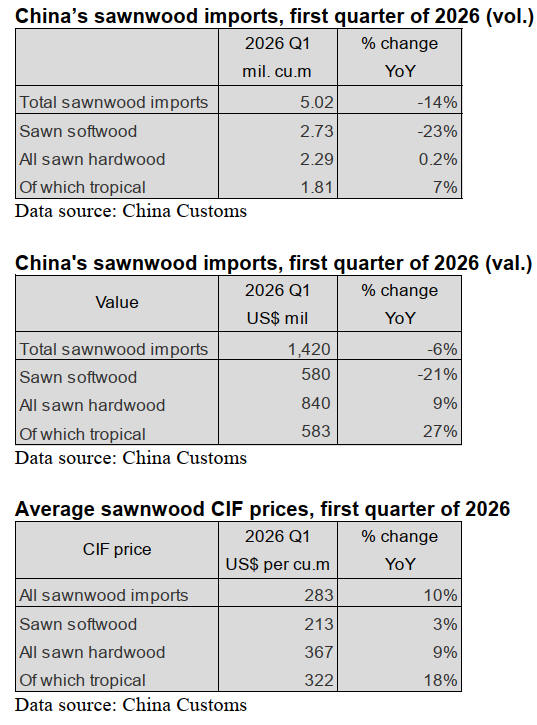
According to China Customs, China’s sawnwood imports
in the first quarter of 2026 totalled 5.02 million cubic
metres valued at US$1.42 billion, down 14% in volume
and 6% in value compared to the first quarter of 2025.
The average price for imported sawnwood was US$283
CIF per cubic metre, up 10% over the same period of
2025.
Of total sawnwood imports, sawn softwood imports
dropped 23% to 2.73 million cubic metres and accounted
for 54% of the national total. The average price for
imported sawn softwood rose 3% to US$213 CIF per
cubic metre over the same period of 2025.
Sawn hardwood imports rose just 0.2% to 2.29 million
cubic metres and accounted for 46% of the national total.
The average price for imported sawn hardwood increased
9% to US$367 CIF per cubic metre over the same period
of 2025.
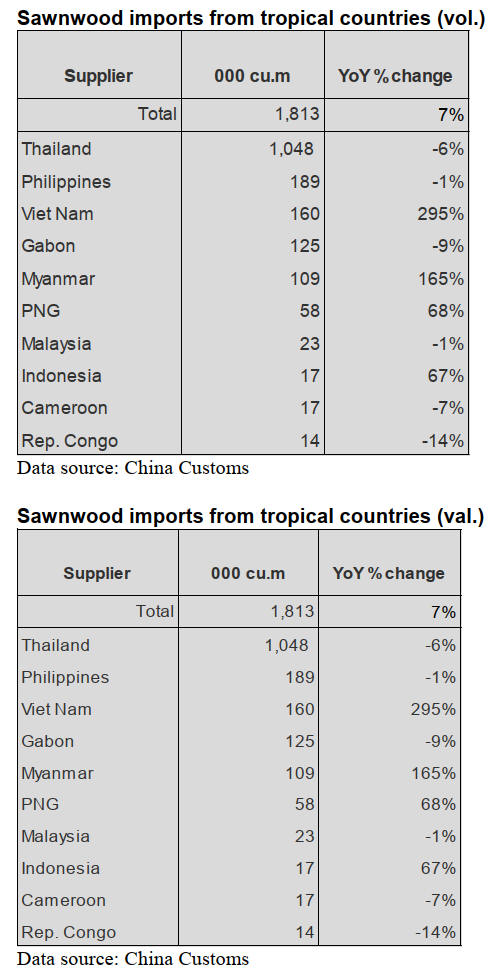
Of total sawn hardwood imports, imports of sawnwood
from tropical countries were 1.81 million cubic metres
valued at US$583 million CIF, up 7% in volume and 27%
in value from the same period of 2025 and accounted for
36% of the national total import volume. The average
price for imported tropical sawnwood was US$322 CIF
per cubic metre, up 18% from the same period of 2025.
China's imports of sawnwood decreased by 14% year-on-
year to 5.02 million cubic metres in the first quarter of
2026. The main reasons for the decline were the continued
sluggishness in new housing construction which
suppressed the demand for construction-grade sawn
softwood coupled with the contraction of Russian as well
as a short-term decline due to the Spring Festival holidays.
Weak demand for real estate
The import volume of construction sawnwood, especially
sawn softwoods like fir, spruce and scots pine which
account for nearly 50% of the total imports, dropped
significantly dragging down total import volumes.
Russian supply contraction
Russian imports have dropped by almost 30% year-on-
year, with the share of total imports decreasing from 47%
to 39%. Russian exports to China have been affected by
the geopolitical strategy shift to Central Asia/Middle East
and the cautious purchasing approach in China.
Spring Festival and seasonal factors:
The volume of China’s sawnwood imports in February
2026 dropped by 25% year-on-year. Although it partially
recovered after the Spring Festival with the decline
narrowing to 16% in March 2026, the overall quarterly
volume still contracted significantly.
Optimisation of import structure
High value-added sawn hardwood species such as ash and
North American hardwoods have experienced some
growth but their share was insufficient to offset the
declining overall trend of sawnwood imports. At the same
time, some sawnwood originally sourced from the United
States and Canada is arriving in China via Viet Nam
reflecting a supply chain restructuring rather than a
decline.
Decline in sawnwood imports from Russia
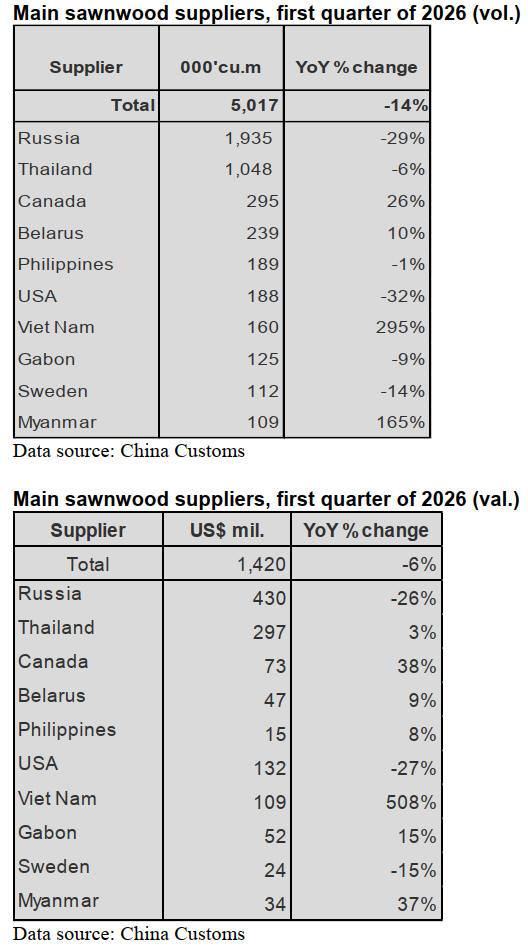
China’s sawnwood imports from Russia and Thailand fell
29% and 6% to 1.935 million cubic metres and 1.048
million cubic metres respectively in the first quarter of
2026. The decrease in sawnwood imports from the two top
countries directly resulted in the significant decline of the
total sawnwood imports in the first quarter of 2026.
Russia still was the largest suppliers of China’s sawnwood
imports in the first quarter of 2026. The proportion of
China’s sawnwood imports from Russia accounted for
39% of the total sawnwood imports volume, down 7
percentage points over the same period of 2025.
Thailand was the second largest supplier of China’s
sawnwood imports in the first quarter of 2026. The
proportion of China’s sawnwood imports from Thailand
accounted for 21% of the total sawnwood imports volume,
up 2 percentage points over the same period of 2025.
China’s sawnwood imports from the two top countries,
Russia and Thailand, accounted for 60% of the national
total in the first quarter of 2026.
China’s imported
sawnwood species from Russia were
spruce and fir, Korean pine and Mongolian scots pine,
birch, oak, ash, poplar and maple dropped 32%, 29%,
17%, 26%, 24, 59% and 3% respectively in the first
quarter of 2026.
It is worth noting that China's sawnwood imports from
Viet Nam and Myanmar increased by 295% and 165%
respectively in the first quarter of 2026.
Main sawn softwood sources, first quarter of 2026
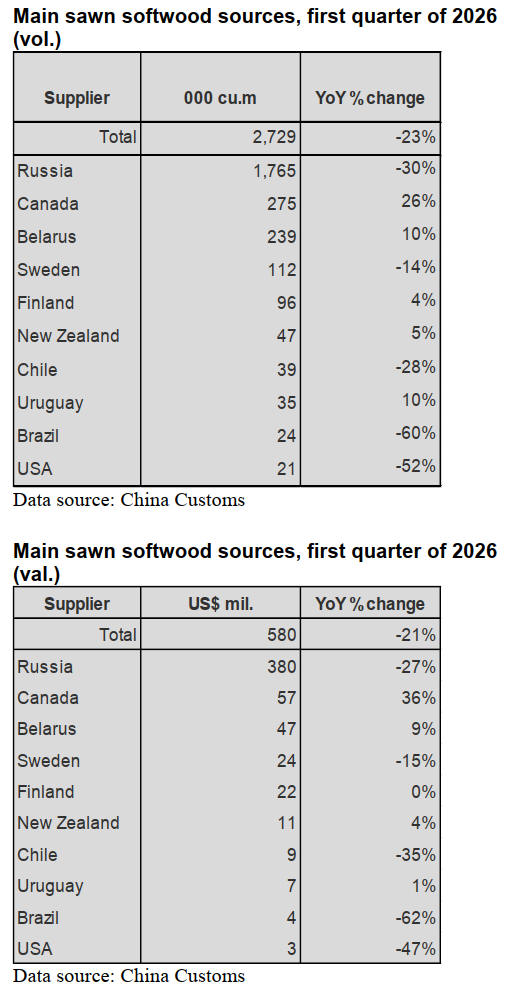
Russia was the largest supplier for China’s sawn softwood
imports. 65% of China’s sawn softwood is imported from
Russia but imports from Russia fell 30% to 1.765 million
cubic metres in the first quarter of 2026.
In addition, China’s sawn softwood imports from Sweden,
Chile, Brazil and USA decreased 28%, 60% and 52%
respectively in the first quarter of 2026.
In contrast, China’s sawn softwood imports from Canada,
Belarus, Finland, New Zealand and Uruguay rose 26%,
10%, 4%, 5% and 10% respectively in the first quarter of
2026.
Surge in sawn hardwood imports from Viet Nam
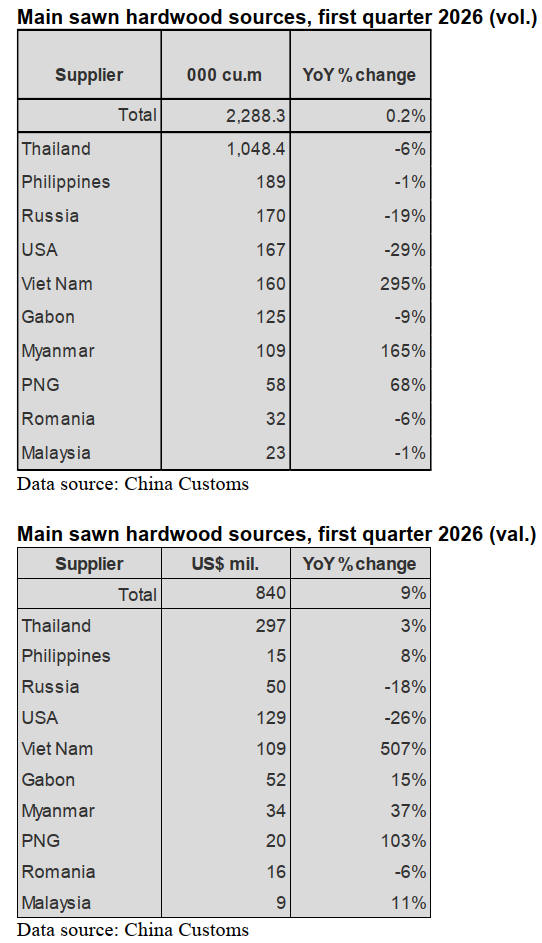
According to China Customs, China’s sawn hardwood
imports from Viet Nam surged 295% to 160,000 cubic
metres in the first quarter of 2026. In addition, China’s
sawn hardwood imports from Myanmar surged 165% to
109,000 cubic metres in the first quarter of 2026.
Thailand was the largest supplier of China’s sawn
hardwood imports. 46% of China’s sawn hardwood
imports are imported from Thailand. China’s sawn
hardwood imports from Thailand fell 6% to 1.048 million
cubic metres in the first quarter of 2026.
In addition, China’s sawn hardwood imports from the
Philippines, Russia, USA, Gabon, Romania and Malaysia
dropped 1%, 19%, 29%, 9%, 6% and 1% respectively in
the first quarter of 2026.
In contrast, China’s sawn hardwood imports from PNG
grew 68% in the first quarter of 2026.
Rise in sawnwood imports from tropical countries
China’s sawnwood imports from tropical countries rose
7% to 1.813 million cubic metres in the first quarter of
2026. The top three tropical suppliers of China’s
hardwood sawnwood imports were Thailand (58%), the
Philippines (10%) and Viet Nam (15%). 84% of China’s
tropical sawnwood imports were from these three
countries in the first quarter of 2026.
China’s sawnwood imports from Viet Nam surged 295%
in the first quarter of 2026, which directly resulted in the
increase of the national total tropical sawnwood imports in
the first quarter of 2026.
China imported ash, oak and other North America
hhardwoods from Viet Nam. China also imported some
cherry, Chinese redwood, maple, poplar and beech
sawnwood for the first time in the first quarter of 2026.
It worth noting that China’s tropical sawnwood imports
from Myanmar, PNG and Indonesia also rose 165%, 68%
and 67% respectively in the first quarter of 2026.
The main reason for the significant increase in China's
imports of tropical sawnwood from Myanmar was the
large volume of imported teak sawnwood. In contrast,
China’s tropical sawnwood imports from Thailand, the
Philippines, Gabon, Malaysia, Cameroon and the Republic
of Congo dropped 6%, 1%, 9%, 1%, 7% and 14%
respectively in the first quarter of 2026.
April GGSC report
Customs data show that in the first quarter of 2026,
China’s total log imports reached 7.164 million cubic
metres, down 11% year-on-year, while the average import
price edged down 3% from the same period last year.
Sawnwood imports totaled 5.017 million cubic metres, a
decrease of 14% year-on-year, though the average price
rose almost 10%.
Entering the second quarter, infrastructure and housing
construction projects across various regions had resumed
intensive work and coupled with the execution of
previously accumulated orders the timber market was
showing signs of a pickup.
Recently, many Chinese
provinces released their lists of
key provincial-level projects for 2026, with the number of
timber industry-related projects reaching an all-time high
which may inject new momentum into the industry.
Looking ahead to the full year, a report jointly released on
April 29 by the Chinese Academy of Social Sciences and
the Social Sciences Academic Press projects that China’s
national land greening targets will be largely met in 2026.
The report also forecasts that the country’s forest product
exports may see stability, while wood product prices are
expected to rise.
In April 2026, the GTI-China index registered 53.5%, a
decrease of 7.6 percentage points from the previous month
and above the critical value (50%) for two consecutive
months, indicating that the business prosperity of the
timber enterprises represented by the GTI-China index
expanded from the previous month.
Regarding the twelve sub-indexes, ten indices (production,
new orders, export orders, existing orders, inventory of
finished products, purchase quantity, purchase price,
employees, delivery time and market expectation) were
above the 50% critical value while the remaining two
indices (imports and inventory of main raw materials)
were below the critical value. Compared to the previous
month, all the 12 sub-indices decreased with declines
ranging from 2.2 to 11.0 percentage points.
See: chrome-
extension://efaidnbmnnnibpcajpcglclefindmkaj/https://www.itto-
ggsc.org/static/upload/file/20260515/1778810654194472.pdf
|


