|
1.
CENTRAL AND WEST AFRICA
Modest price increases observed
FOB prices throughout the region have begun to trend
slightly higher as producers try to pass on some of the
increased operating costs including increased taxation,
rising fuel prices and higher logistics expenses. While the
increases remain relatively limited producers are under
pressure to recover additional costs throughout the supply
chain.
One of the most positive developments recently has been
the return of Chinese buying activity. Demand for both
Okoumé and various redwood species has improved
bringing new orders to producers in Gabon, Cameroon and
Congo.
This renewed demand has helped stabilise the market and
is supporting the recent firming of prices. While increased
demand remains moderate the overall market sentiment is
firmer than earlier in the year.
Industries in the region are beginning to shift production
into the traditional summer holidays mode. There is
always reduced business activity during July, August and
to some extent, September. Buyers in Europe and North
America are expected to remain cautious and carefully
manage landed stocks as the annual vacation period
approaches.
Weather conditions across the region
Weather conditions remain mixed. Gabon has entered its
dry season with comfortable temperatures between 26°C
and 28°C while Cameroon continues to experience heavy
rainfall. Northern Congo remains wet, while Southern
Congo has entered a drier period. The Central African
Republic continues to experience seasonal rains. These
weather patterns continue to influence harvesting
operations, road conditions and timber transportation.
Freight rates continue to move higher
Shipping rates from Cameroon, Congo and Gabon to
Antwerp have reportedly increased by approximately €20
per cubic metre, particularly on services operated by major
European shipping lines. Other carriers are also
experiencing cost pressures, resulting in additional upward
pressure on logistics costs. Container freight charges to
China and the Middle East have also recorded slight
increases.
Middle East - outlook remains uncertain
The timber trade to the Middle East remains stable but
cautious. Market participants are closely monitoring
geopolitical developments in the region. There is optimism
that improved stability around the Gulf region and the
Strait of Hormuz could support renewed construction
activity and stimulate timber demand from Iraq, Iran and
neighbouring countries. Any increase in regional building
activity would likely provide additional opportunities for
African hardwood exports.
The overall market remains relatively quiet but stable.
The return of Chinese demand is providing important
support for producers while modest price increases are
helping partially offset higher production and transport
costs. Prospects for the coming months will largely depend
on post-summer demand in Europe, continued Chinese
purchasing activity and developments in Middle Eastern
markets. If these factors remain favourable the sector
could see a gradual improvement during the second half of
2026.
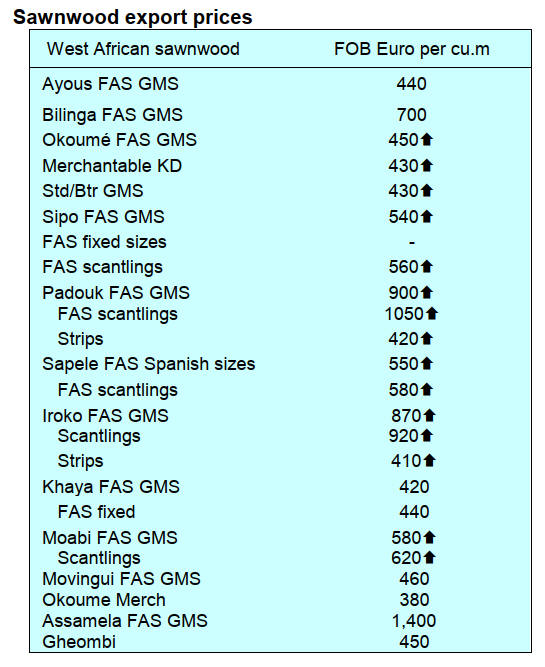
Gabon
Gabon has now entered the dry season, with temperatures
ranging between 26°C and 28°C and virtually no rainfall
in the interior regions. Improved weather conditions are
supporting harvesting operations and transport logistics
with activity expected to remain favourable through
September.
China has returned to the market with renewed demand for
Okoumé and selected hardwood species, providing an
important boost to producers and processors across the
country.
Production levels are gradually increasing as market
demand improves. Key harvested species remain Okoumé,
Okan, Azobé and various redwood species.
Azobé supply remains tight
It has been reported that Azobé log supplies remains
critically low due to the lingering impact of poor forest
road conditions following previous rainy seasons. Some
concessions in the Okondja region have reportedly been
attempting to move logs to mills for more than five
months.
As a result, buyers are increasingly evaluating substitute
species such as Okan, Mukulungu and Obonga. The
willingness of European end-users, particularly in the
Dutch market, to adopt alternative species remains an
important factor for future trade flows.
Domestic market demand firm
The domestic market continues to show stable demand.
Sawn Okoumé is currently selling at approximately
FCFA150,000–160,000 per cubic metre in local markets
while Dabema is trading between FCFA180,000 and
200,000 per cubic metre.
Transport and Infrastructure
Road conditions have improved significantly with the
arrival of the dry season and ongoing maintenance works.
Transport times from the eastern and southern production
regions to Owendo Port have been reduced to
approximately two days under normal conditions. Laterite
roads are undergoing repairs, improving access from key
timber-producing areas such as Makokou and Okondja.
Gabon continues to pursue ambitious infrastructure
projects linked to the mining sector. Studies are underway
for a second railway corridor connecting the Belinga iron
ore project to the future deep-water ports of Kobe-Kobe
and Mayumba.
The proposed development would include approximately
600 kilometres of railway and 550 kilometres of road
infrastructure. According to project representatives, first
exports through the future Kobe-Kobe port are targeted for
April 2029.
Despite these plans, funding remains a challenge. Several
infrastructure projects continue to face delays due to
limited financing.
Power and water supply critical challenges
Power supply remains one of Gabon's most significant
operational challenges. Electricity outages continue daily
with two to three interruptions lasting several hours each.
The national utility company, SEEG, acknowledges that
the electricity network is outdated. Discussions continue
with French utility specialist Suez although no tangible
improvements have yet been observed.
Water shortages remain equally problematic. Many
households and businesses rely on water collection points,
storage tanks or private boreholes.
Demand and export trends
European demand remains relatively subdued although
some improvement has been reported as inventories
continue to be consumed. Azobé exports to the
Netherlands remain steady at approximately 1,500–2,000
cu.m per month. Emerging demand continues from
Bangladesh and Pakistan for both Azobé and Okan.
Chinese demand remains selective but continues to
support exports of Okoumé and specialty products.
Interest in Azobé table tops remains particularly strong
with reported FOB prices around €680 per cubic metre.
Port operations at Owendo remain stable, with no
significant disruptions reported. Container availability
remains adequate and transport between production areas
and port facilities is functioning normally.
Regulatory environment
CITES-listed species, including Padouk, Khaya, Doussié
and Kevazingo, continue to face tighter regulatory
controls. However, permit processing times in Europe
have reportedly improved, with approvals now generally
taking no longer than two weeks.
The supposed proposed future expansion of CITES listings
remains a concern for producers throughout the region and
continues to be closely monitored.
Tax increases to affect competitiveness
The export duty increases introduced on 1 January 2026
remain a major challenge for Gabon's timber industry.
These charges have increased costs and placed Gabonese
exporters at a disadvantage relative to neighbouring
countries. In response to the new duty rates, prices for
most major sawn timber species have risen by
approximately €20 per cubic metre, with costs being
shared between producers and buyers where possible.
AGOA reinstatement opens opportunities
A positive development for Gabon was the restoration of
eligibility under the African Growth and Opportunity Act
(AGOA). After previously being excluded, Gabon has
once again been included among the participating African
countries benefiting from preferential access to the U.S.
market.
Some observers view the decision as part of broader
geopolitical efforts by the United States to maintain
economic influence in Africa amid growing Chinese
involvement across the continent.
Outlook
The overall market outlook is cautiously positive. Dry-
season conditions are supporting production and transport,
while renewed Chinese demand is helping stabilise orders
and prices. However, electricity shortages, infrastructure
constraints, tax increases and regulatory pressures
continue to weigh on the sector.
The key themes to watch during the second half of 2026
remain Chinese demand, the development of major
infrastructure projects, the evolution of CITES regulations
and the industry's ability to adapt to tighter fiscal and
environmental requirements.
Cameroon
Cameroon has entered its main rainy season which is
expected to continue from late June through early
December. As a result, harvesting activity has begun to
slow, particularly in areas where weather conditions are
affecting access and transportation.
Trucking operations continue under generally normal
conditions although some laterite roads are being closed
once again during periods of heavy rainfall. Rail transport
remains operational without major disruption.
An important recent development is the rehabilitation of
the road linking northern Congo to Sangmelima. This
route is strategically important for forestry operators in
northern Congo who use it to transport to the Port of Kribi.
Containerised timber shipments are increasingly routed
through Kribi while conventional sawn timber and logs
continue to move through the Port of Douala.
Plans are progressing for the expansion of Kribi Port,
including the development of additional log storage areas
and sawn timber facilities to reduce pressure on Douala's
increasingly congested operations.
County by country demand remains mixed
Middle East demand for redwood species remains stable.
Ayous demand remains weak in Italy and the Netherlands.
Demand in the Philippines remains subdued. Viet Nam
continues to show strong demand for species such as Tali
and other hardwoods. European demand remains slow,
particularly for Padouk.
Government inspections and increased controls by forestry
and finance authorities continue to influence production
decisions and operational planning.
Several mills have ceased operations or relocated outside
the Douala area, while many remaining sawmills are
operating on a single-shift basis with forward order books
of only around one to two months.
A notable regulatory feature remains the government's
quota system for log exports. Export allocations are linked
to each company's sawn timber production performance,
tax compliance and adherence to forestry regulations.
While intended to encourage domestic processing many
operators view the system as complex and inconsistent
with allocations varying significantly between companies.
Operators continue to face permit requirements for
CITES-listed species, but processing times have improved
considerably. Both Cameroon and European authorities
are now generally issuing CITES approvals within
approximately two weeks, reducing one of the major
bottlenecks previously affecting international trade.
Outlook
The combination of seasonal rains and cautious
international demand is likely to limit production growth
during the coming months. However, improving Chinese
demand, stable Middle Eastern markets and efficient
transport links through both Douala and Kribi continue to
provide support for the sector.
Republic of the Congo
Weather conditions remain mixed across the Republic of
the Congo. Northern regions have returned to rainy-season
conditions while southern areas have entered a drier period
that is expected to continue for several months.
These differing weather patterns continue to influence
harvesting and transport operations across the country,
with northern concessions facing more challenging
operating conditions than those in the south.
Transport infrastructure remains generally functional.
Maintenance and repairs continue on key laterite road
networks, helping to maintain access to production areas
despite seasonal weather conditions. Northern operators
continue to utilise transport corridors through Cameroon,
including routes to Douala and Kribi ports, while southern
producers remain focused on Pointe-Noire.
The Port of Pointe-Noire continues to operate normally
and remains one of Central Africa’s most important deep-
water ports. The port functions as a major logistics hub for
regional exports and continues to support Congo’s timber
sector efficiently. Development and expansion projects
remain under consideration as authorities seek to
strengthen the port's regional role and accommodate future
trade growth.
No significant disruptions to port operations or cargo
handling were reported during the period.
Log inventories at sawmills are said to be adequate with
operators generally holding two to three months of stock.
Northern Congo continues to be dominated by species
such as Sapelli, Sipo and other redwood species which
remain important export products for both European and
Asian markets.
Forestry administration remains strict
The forestry administration continues to maintain a strong
reputation for oversight and control of forest operations
and exports. No major regulatory changes were reported
during the period, although compliance requirements
remain closely monitored by authorities. Export
documentation and operational controls continue to be
enforced rigorously.
Outlook
The outlook for the second half of 2026 remains
cautiously positive. Stable operations, adequate timber
stocks, efficient port infrastructure and continued demand
from Asian markets provide support for the sector.
Key issues include seasonal weather conditions in northern
production areas, evolving international demand, potential
developments in carbon-credit programmes and future
regulatory discussions concerning individual species.
Through the eyes of industry
The latest GTI report lists the challenges identified by the
private sector in the Republic of Congo and Gabon.
See: https://www.itto-
ggsc.org/static/upload/file/20260615/1781506386105682.pdf
2.
GHANA
AGI partners Danish industries to enhance
sustainability principles
The Association of Ghana Industries (AGI), in partnership
with the Confederation of Danish Industries, has launched
a ‘Sustainable African Value Chain Initiative’ (SAVI).
This aims to build business capacity to embed
sustainability principles across operations and value chains
through capacity building, technical assistance, peer
learning, stakeholder engagement and implementation
support.
Speaking at the launch, AGI President Dr. Kofi Nsiah-
Poku said, SAVI will help firms identify sustainability
risks and opportunities and translate them into actions to
boost performance and competitiveness.
He noted that sustainability is the new global driver for
businesses where stakeholders prioritise strong
environmental and social and governance (ESG)
credentials, consumers demand supply chain transparency.
New regulations in international markets are requiring
stricter action on climate issues, responsible sourcing and
sustainability reporting.
Dr. Nsiah-Poku enumerated the positive aspects from
embracing sustainability to include efficient delivery,
access to wider market, stronger investor confidence,
reduced operational risks and long-term profitability. The
initiative aligns with AGI’s mission to foster a globally
competitive industrial sector that supports its ongoing
work on resource efficiency, climate resilience,
responsible conduct and decarbonisation.
The AGI President linked SAVI to Ghana’s ambition to
become a manufacturing hub under AfCFTA and to its
Paris Agreement commitments on emissions reduction and
climate resilience. Denmark’s Ambassador, Jakob Linulf,
urged African producers to meet EU sustainability
standards to increase exports of high-quality goods to
Europe which would drive job creation and economic
development.
Ambassador Linulf said SAVI reflects Denmark’s Africa
Strategy and commitment to mutually beneficial
partnerships, fostering stronger business ties and
promoting sustainable production and trade between
Ghanaian and Danish firms.
See: https://www.myjoyonline.com/agi-partners-danish-
industries-to-advance-value-chain-sustainability/
Four out of 16 wood products accounted for 90% of
exports
Ghana exported a total of 66,572 cu.m of wood products
during the period January to April 2026 earning Eur29.34
million, according to the Timber Industry Development
Division (TIDD) of the Forestry Commission source.
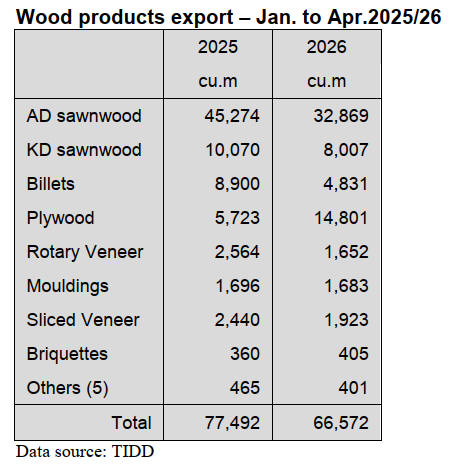
Sixteen wood products contributed to the total export
volume in the first four months of 2026, of which air and
kiln-dried sawnwood, billet and plywood (overseas and
regional) accounted for 91% of the total wood products
shipped. For the same period in the previous year these
four products accounted for 90% of the export volume.

All the leading wood products registered declining
volumes in 2026 when compared to the same period last
year, except plywood which recorded a rise in export
volume.
The major markets for Ghana’s wood products during
January to April 2026 were the Asia (38,084 cu.m,),
Europe (13,841 cu.m), Africa (9,510 cu.m), N.America
(4,521 cu.m) and the Middle East (617 cu.m)
The African regional market registered increases of 35%%
in value and 38% in volume against the same period in
2025, Eur2.96 million from 6,901 cu.m of wood products
exported.
Major destinations in Africa included Egypt, Morocco and
South Africa with the ECOWAS sub-region contributing
Eur3.17 million from 8,173 cu.m of the total African wood
products exported compared to Eur2.29 million from
5,765 cu.m for the same period in 2025.
Leading species processed in terms of volume during the
period included teak, denya/okan, dahoma, wawa, cedrela,
eucalyptus and gmelina.
EU supports Ghana restoration of degraded forests
The European Union (EU) is funding an initiative where
an estimated 14,000 hectares of degraded forests across
Ghana’s High Forest and Savanna zones are to be restored.
The Initiative known as the Ghana Forest Restoration
Grant (GFRGS) is expected to build capacity amongst
20,000 farmers and rural residents to support
government’s “Tree for Life” initiative led by the Ministry
of Lands and Natural Resources and the Forestry
Commission.
The EU recently held an event for the GFRGS at the Subri
River Forest Reserve, a key target area. The event brought
together government officials, traditional leaders,
residents, environmental partners and grant recipients. The
event highlighted early successes in Ghana’s flagship
restoration efforts reinforcing the country’s dedication to
rehabilitating degraded forests and enhancing rural
livelihoods.The €6 million project is being implemented
by the European Forest Institute under the EU Sustainable
Forest and Cocoa Programme which works with
communities through agroforestry, natural regeneration
and tree planting.
The Head of the EU Cooperation in Ghana, Ms. Silvia
Severi, said support will promote deforestation-free cocoa,
sustainable land use and climate resilience and said
community-led restoration is key to transforming
landscapes and lives.
The Western Regional Minister, Mr. Joseph Nelson noted
the projects would deliver environmental and socio-
economic benefits by creating livelihoods and
strengthening local capacity.
It is estimated that from late 2025 to 2027 four projects
will receive funding from Proforest, World Vision, Nature
and Development Foundation and Goshen Global Vision
and will be implemented with communities-led partners.
See: https://efi.int/collection/eu-sustainable-forest-and-cocoa-
programme
and
https://thebftonline.com/2026/06/17/ghana-forest-restoration-
grant-scheme-to-restore-14000-degraded-forests/
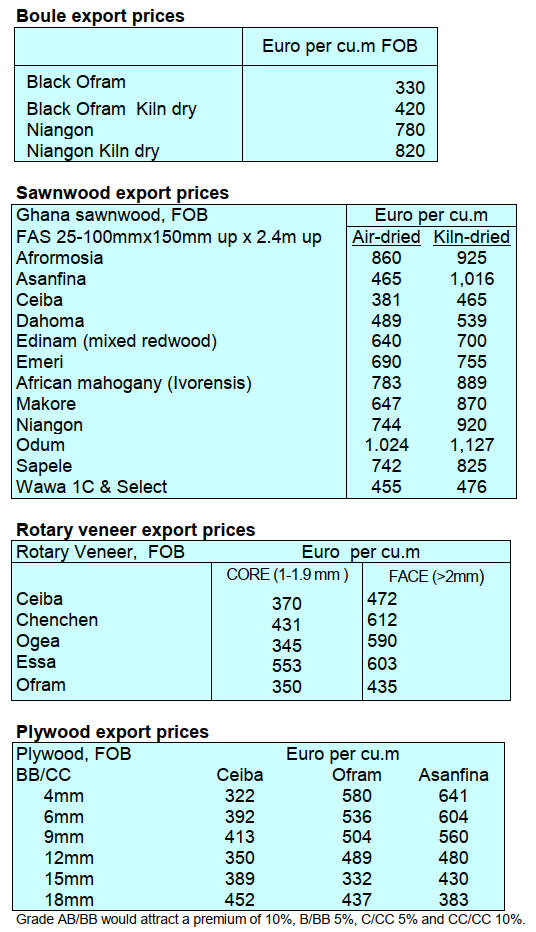
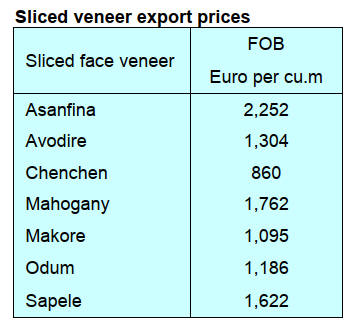
Through the eyes of industry
The latest GTI report lists the challenges identified by the
private sector in Ghana.
See: https://www.itto-
ggsc.org/static/upload/file/20260615/1781506386105682.pdf
3. MALAYSIA
15% increase in wood product exports targeted
The Ministry of Investment, Trade and Industry (MITI) is
targeting a 15% increase in the value of wood product
exports this year following the encouraging performance
last year when export earnings topped RM14 billion.
The MITI Deputy Minister, Sim Tze Tzin, said Malaysia’s
wood-based industry has diversified to more than 160
international markets thanks to its reputation for high-
quality.
He said the “Made by Malaysia” approach would continue
to be strengthened to increase the competitiveness of the
industry which is now an important contributor to the
country’s exports and GDP.
Malaysian-made furniture continues to be in high demand
in the international market with the US being the largest
export accounting for around 49% of the sector’s total
exports, followed by Singapore at 9.5%.
He added that other major markets include Japan and
Australia accounted for about 5% of exports last year.
See:
https://theborneopost.pressreader.com/article/282162182908112
Wood and bio-composite product development
The Malaysian Timber Industry Board (MTIB) through
the Bio-composite and Fiber Centre (FIDEC) organised a
Consultation and Industry Engagement Session for the
Development of Sustainable Wood and Bio-composite
Products.
The programme aims to strengthen synergy between the
government and industry players in driving the
sustainability of the country's timber sector.
This session focused on several items related to
sustainable wood and bio-composite product development
projects, including:
• Increasing industry understanding of the implementation
of plantation wood and biomass-based projects.
• Delivering programmes on technology adaptation to
improve the efficiency of the production processes and
management of raw materials from plantation wood and
biomass such as oil palm trunk.
• Emphasising the importance of Life Cycle Assessment
(LCA) and Eco-label Certification to meet international
sustainability standards.
Calls for suspension of foreign labour fee increase
The Sarawak Timber Association (STA) is calling on the
Sarawak government to immediately suspend the increase
in foreign worker renewal fees under the Foreign Workers
Transformation Approach (FWTA) system. It also called
on the government to clarify the status of the announced
FWTA fee review and engage affected stakeholders.
The STA pointed out that Sarawak’s growing economy
was expected to require more than 300,000 foreign
workers in the near future and at the proposed renewal fee
of RM1,854 per worker, industries in the State could face
an estimated annual cost of RM556 million.
“Constructive consultation is necessary to ensure that
policy objectives are achieved without placing
unnecessary burdens on businesses that continue to
contribute significantly to Sarawak’s economic
development,” said the STA.
In related news, the continual strong demand for foreign
workers has highlighted a paradox in the Malaysian labour
market. Malaysian Employers Federation (MEF)
president, Dr. Syed Hussain Syed Husman, said the
Statistics Department reports Malaysia’s unemployment
rate is 2.9% of which youth unemployment is 10.1% other
statistics indicate there are 3.47 million manufacturing
vacancies but only 326,407 manufacturing applicants.
The MEF president said the issue was not just job
availability but whether they matched the skills, desire and
expectations of Malaysian jobseekers. He said an
abundance of vacancies remains in the manufacturing,
construction, agriculture and hospitality sectors but these
were often not the preferred choices of young Malaysians.
Syed Hussain said young workers today placed greater
emphasis on career progression, meaningful work,
flexibility and work-life balance compared with previous
generations. He said there was also a growing gap between
what jobseekers expect to be paid and what employers
could realistically offer.
The president of Federation of Malaysian Manufacturers
(FMM) Lee Chor Kok, said the challenge extended
beyond wages. The barriers to local recruitment in
manufacturing go well beyond pay, he said. One of the
most underestimated barriers he said, was the perception
that manufacturing work was low-status, physically
demanding and had limited career prospects.
See: https://www.mtib.gov.my/en/activity/sesi-konsultasi-dan-
libat-urus-industri-bagi-pembangunan-produk-kayu-dan-
biokomposit-lestari.html
and
https://www.thestar.com.my/news/nation/2026/06/22/employers-
say-labour-mismatch-must-be-addressed
Certified forests in Malaysia
Latest statistics from the Malaysian Timber Certification
Council show a total of 5.92 million hectares of certified
forests in Malaysia under the MTCC/PEFC Scheme. There
are 25 MTCS/PEFC Certified Natural Forest (FMU) and
11 MTCS/PEFC Certified Forest Plantations (FPMU).
There are 363 companies holding the MTCS/PEFC Chain
of Custody certificates.
See:www.mtcc.com.my
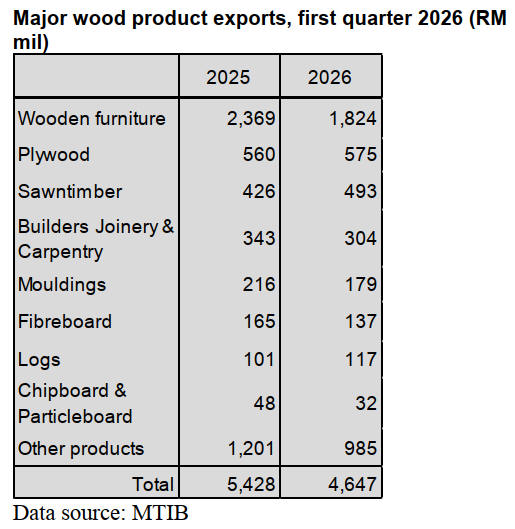
Wood product exports, first quarter 2026
Malaysia’s first quarter 2026 wood product exports faced
headwinds, with regional timber exports, such as those
from Sarawak, dropping 10% year-on-year to RM564
million. This decline reflected broader global market
softness, though value-added segments like wood pellets
showed a 3.3% increase
Through the eyes of industry
The latest GTI report lists the challenges identified by the
private sector in Malaysia.
See: https://www.itto-
ggsc.org/static/upload/file/20260615/1781506386105682.pdf
4.
INDONESIA
Strengthening forestry law to keep pace
with evolving
challenges
Deputy Minister of Forestry, Rohmat Marzuki, said there
is a need to strengthen Indonesia’s Forestry Law to keep
pace with evolving legal, policy and sustainability
challenges. He said revisions are necessary to provide
greater legal certainty in forest governance while ensuring
a balance between economic, social and environmental
functions. The proposed reforms would also reinforce the
recognition and protection of indigenous peoples and
communities living in and around forest areas.
Marzuki highlighted unresolved tenure conflicts as one of
the forestry sector’s most pressing issues, citing
overlapping claims involving forest lands, community
areas, indigenous territories and permits from other
sectors.
A revised Forestry Bill is expected to strengthen legal
certainty, accelerate conflict resolution, support carbon
market development and promote sustainable forest
management that benefits both the environment and local
communities.
See: https://www.antaranews.com/berita/5602392/wamenhut-
penguatan-uu-kehutanan-demi-pengelolaan-hutan-berkelanjutan
Data-Driven forest governance
The Minister of Forestry, Raja Juli Antoni, has launched
the ‘Jaga Rimba Decision Support System’ (DSS), a
digital platform aimed at strengthening data-driven forest
governance and improving decision-making across the
forestry sector. The initiative is part of the ministry’s
broader digital transformation agenda designed to provide
faster, more accurate and transparent information.
The ‘Jaga Rimba’ DSS integrates geospatial information
from across the Ministry of Forestry and its nine
directorates general providing a basis for policymaking
and forest management.
See: https://gorontalo.antaranews.com/berita/409413/menhut-
luncurkan-dss-jaga-rimba-permudah-tata-kelola-hutan
Refining the Multi-Business forestry concept
The Ministry of Forestry is refining the Multi-Business
Forestry (MUK) concept through revisions to Ministerial
Regulation No. 8 of 2021 on forest governance planning
and the utilisation of protected and production forests. The
update is intended to strengthen the implementation of
MUK after five years, ensuring it better meets its intended
goals in managing forest use and governance.
Director General of Sustainable Forest Management,
Laksmi Wijayanti, said the revision will address key issues
such as forest boundary clarity, land-use overlaps,
community benefit distribution, licensing, investment
facilitation, business operations and market dynamics.
Beyond technical adjustments the revision aims to align
forest use with ecosystem restoration while transforming
governance into a more simplified, digital and trust-based
system involving government, communities and permit
holders.
See: https://m.antaranews.com/amp/berita/5615019/kemenhut-
pertajam-konsep-muk-melalui-revisi-regulasi-p8
and
https://mediaindonesia.com/humaniora/902327/regulasi-
multiusaha-kehutanan-direvisi-demi-dorong-manfaat-ekonomi-
hutan
Review of Business Permit compliance
The Ministry of Forestry is strengthening law enforcement
efforts by reviewing companies’ compliance with permit
requirements to support soil and water conservation and
prevent environmental degradation. Director General of
Forestry Law Enforcement, Dwi Januanto Nugroho, said
the ministry continues to assess licensing compliance in
regions such as Sumatra and Aceh as part of broader
disaster mitigation measures.
In addition, the ministry is enhancing its complaint-
handling system to monitor businesses’ fulfillment of
forestry obligations, while ensuring that administrative,
civil and criminal sanctions can be applied concurrently
when violations are identified.
See: https://www.antaranews.com/berita/5602196/kemenhut-
evaluasi-kepatuhan-izin-usaha-utamakan-konservasi-tanah-air
Strict action against land clearing by burning
Forestry Minister, Raja Juli Antoni, has called on
communities and private companies to immediately stop
using fire as a land-clearing method, warning that law
enforcement authorities, including the police and the
Attorney General’s Office, will take strict action against
violators.
Speaking at the 2026 Special Coordination Meeting on
Forest and Land Fire Mitigation, he highlighted the
seriousness of Indonesia’s wildfire situation, noting that
approximately 81,000 hectares of land had burned by May
2026 due to El Niño conditions which are expected to
peak in July. To address the growing risk, the central and
regional governments have strengthened coordination on
mitigation measures, including weather modification
operations and canal-blocking efforts to reduce the
likelihood and spread of forest and land fires.
In related news, Indonesia has reactivated the Forest and
Land Fire (Karhutla) Coordination Desk to strengthen
inter-agency coordination in anticipation of increased
wildfire risks linked to the El Niño phenomenon in 2026
and 2027.
Coordinating Minister for Political and Security Affairs,
Djamari Chaniago, said the move is part of the
government’s preparedness efforts ahead of the dry
season, as El Niño is expected to heighten drought
conditions, reduce rainfall, increase hotspots and raise the
likelihood of forest and land fires.
The government has identified six high-risk provinces:
Riau, Jambi, South Sumatra, West Kalimantan, Central
Kalimantan and South Kalimantan.
The reactivated coordination desk is intended to improve
inter-agency collaboration, avoid overlapping
responsibilities and enhance operational readiness through
optimised standby posts, integrated patrols, stronger early
warning systems and better-prepared personnel and
equipment.
See: https://en.antaranews.com/news/419624/minister-urges-
strict-action-against-land-clearing-by-burning
and
https://en.antaranews.com/news/419673/indonesia-reactivates-
forest-fire-desk-to-face-el-nino-threat
Indonesia, Norway assess forest rehabilitation under
FOLU 2030
Indonesia’s Environmental Fund Management Agency
(BPDLH) and Norway’s Project Management Unit for the
Norway Contribution (PMU-NC) jointly assessed forest
and land rehabilitation progress under the FOLU Net Sink
2030 programme in Hulu Sungai Tengah, South
Kalimantan. The monitoring covered 82 hectares of
restored land across two villages to evaluate plant growth,
vegetation development and overall site conditions.
See: https://en.antaranews.com/news/419861/indonesia-norway-
assess-forest-rehab-under-folu-2030
Germany urged to support finalisation of the Economic
Partnership Agreement
President Prabowo Subianto has urged Germany to
support the rapid finalisation of the Indonesia–European
Union Comprehensive Economic Partnership Agreement
(IEU-CEPA), stressing that the deal would bring tangible
benefits to businesses for both regions. The IEU-CEPA,
which is targeted for ratification in the second half of 2026
and entry into force in 2027, aims to eliminate tariffs on
more than 98% of traded goods and expand cooperation in
trade, services and investment.
See: https://en.antaranews.com/amp/news/419243/prabowo-
urges-germany-to-support-ieu-cepa-finalization
Through the eyes of industry
The latest GTI report lists the challenges identified by the
private sector in Indonesia.
See: https://www.itto-
ggsc.org/static/upload/file/20260615/1781506386105682.pdf
5.
MYANMAR
6.
INDIA
New series of price indices
The Office of Economic Adviser has announced it will
release revised series for wholesale price indicies with a
base year of 2022-23. The new series will replace the
existing series of WPI with base year 2011-12.
In addition, the Office is also releasing a new series of
Output Producer Price Index (OPPI), Trial Input Producer
Price Index (IPPI) and Service Producer Price Index
(Service PPI). The transition from WPI to PPI is in line
with international best practices adopted by advanced
economies and the recommendations of the International
Monetary Fund (IMF).
The all India Wholesale Price Index (WPI) inflation for
May 2026 was 9.68% on a year-on-year basis compared to
8.26% in April 2026. The index for All Commodities for
May 2026 stood at 109.9 (108.8 in April 2026). Year on
year inflation for Primary Articles, Fuel and Power and
Manufactured Products was 4.99%
See:https://eaindustry.nic.in/press_release/press_release_202606.
pdf
Manufacturing accelerated in May
India's manufacturing sector activity growth accelerated to
a three-month high in May, driven by demand strength,
infrastructure projects and new business gains, even amid
inflationary pressures. According to the HSBC India
Manufacturing Purchasing Managers' Index (PMI), this
was above the April reading of 54.7, indicating the
strongest improvement in sector in three months.
Pranjul Bhandari, Chief India Economist at HSBC, said
“India's final manufacturing PMI points to another month
of possible precautionary stockpiling as the Middle East
conflict remains unresolved. Output growth accelerated,
while purchasing activity and stocks of finished goods
rose at a faster pace."
See: https://www.ipsos.com/en-in/india-tops-global-consumer-
confidence-rankings-may-lseg-ipsos-pcsi
Disconnect between housing policy and economic
realities
The Confederation of Real Estate Developers'
Associations of India (CREDAI) represented India’s real
estate sector at the World Urban Forum held in May 2026.
The CREDAI President, Shekhar G. Patel, said, “de-
risking housing finance requires affordable housing
policies that remain aligned with economic realities and
evolving urban costs.
Private capital will participate at scale only when housing
projects remain viable for developers, financially
accessible for buyers and sustainable from a lending
perspective. Housing finance frameworks must therefore
evolve in a way that balances affordability, project
viability and long-term investment confidence.”
He suggested India’s affordable housing challenge is
increasingly becoming a policy-definition and project-
viability issue rather than a demand issue. He noted that
while demand for 60-90 square metre homes remains
strong, many such homes no longer qualify as affordable
housing because of the Rs. 45 lakh price cap.
The definition of affordable, framed around 8 years ago,
has remained unchanged despite inflation averaging nearly
6% annually and housing prices in several cities rising by
8-10% annually.
Further, excessive taxation and approval-related costs,
including GST, stamp duty, infrastructure charges and
approval premiums can account for nearly 35% to 50% of
the final sale value in many cases impacting affordable
housing viability and creating a growing disconnect
between housing policy definitions and economic realities.
See: https://credai.org/media/view-details/?file_no=105
In support of export competitiveness
The Indian rupee has been among Asia's weakest-
performing currencies in recent months. But despite the
sustained pressure on the currency, the Reserve Bank of
India (RBI) has refrained from deploying aggressive
measures which, say experts, could be a strategic move.
While the rupee has fallen more than 11% against the US
dollar over the last 14 months its weakness appears even
sharper when viewed against other major currencies. The
picture becomes particularly significant in comparison
with China.
According to ArunaGiri N, Founder, CEO and Fund
Manager at TrustLine Holdings, the Chinese yuan has
appreciated by nearly 5% during the same period. As a
result, the rupee has effectively depreciated by more than
19% against the yuan. That shift, experts say, could help
India maintain export competitiveness at a time when
Chinese manufacturers continue to succeed in global
markets through aggressive pricing.
See: https://www.ndtv.com/business-news/indian-rupee-fall-
currency-depreciation-rbi-2013-crisis-us-dollar-china-yuan-
india-exports-11590304
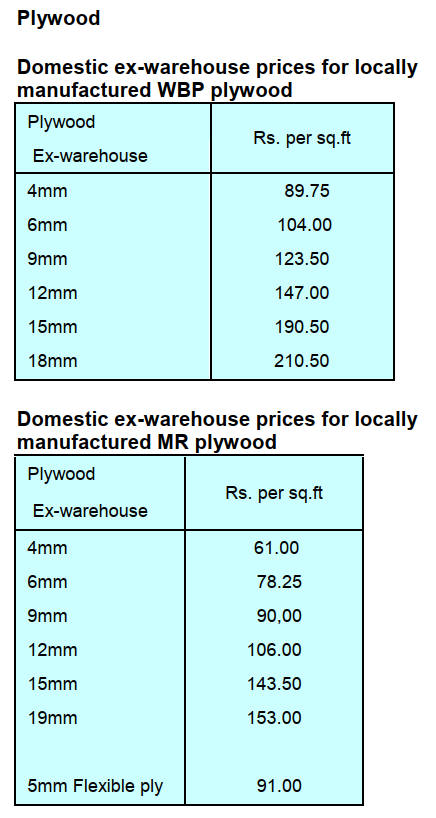
Price hike for Nepali plywood
Rising chemical prices have driven up production costs for
Nepal based plywood manufacturers. It is reported that
companies in Nepal have increased prices for plywood by
as much as 15%. Plywood Importers in India have
reported that they are purchasing Nepalese plywood at
higher prices since the start of geopolitical tensions in
West Asia.
Manufactureres in Nepal have obtained BIS licences over
the last few months and have become an exporter of
commercial plywood with the majority of exports directed
to India.
The influx of affordable Nepali plywood, which can be
priced lower than comparable India made products, has
earlier also impacted the domestic Indian manufacturers,
particularly in states bordering Nepal such as Uttar
Pradesh and in Delhi, Rajasthan, Gujarat and Maharashtra.
See: https://www.facebook.com/plyreporter/posts/plywood-from-
nepal-30-costlier-compared-to-2023-nepal-based-plywood-
industry-is-/1110377097758446/Date: 10/04/2026
Rainfall deficit as monsoon progress stalls
Central India faces 63% rainfall deficit as monsoon’s first
round loses momentum and the government has direct
contingency plans to protect crops in 200 districts. The
shortfall in rainfall is concentrated in the regions
the monsoon has failed yet to cover; Maharashtra, the
Konkan coast and the adjoining regions of central India.
The India Meteorological Department (IMD) statistics
show that, apart from northwest India, which has received
5% more rain than normal for this time of the year, all
other regions are in the red, including east and northeast
India (43%), central India (63%) and the southern
peninsula (14%).
Chairing a review of kharif (period for monsoon crop
growning and harvest) preparations Union Agriculture
Minister, Shivraj Singh Chouhan, directed States to
identify districts facing low or uneven rainfall and to draw
up crop-wise contingency plans so that affected farmers
could be “immediately provided with alternatives, advice
and assistance.” Analysts have pointed out that serious
farm disruption could add to retail food inflation, a risk
that the Reserve Bank of India has flagged.
See: https://www.thehindu.com/sci-tech/energy-and-
environment/india-stares-at-35-monsoon-
deficit/article71109891.ece
7.
VIETNAM
Wood and wood product (W&WP) trade
highlights
According to statistics from the Viet Nam Customs
Department, W&WP exports in May 2026 reached US$1.4
billion, down 9% compared to April 2026 but up 1%
compared to May 2025. Of this total, WP exports
amounted to US$927.5 million, down 8% from April 2026
and down 8% from May 2025.
In the first five months of 2026, W&WP exports totalled
US$7.1 billion, up 3% year-on-year. Exports of wood
products reached US$4.5 billion, down 4% compared to
the same period in 2025.
Viet Nam’s W&WP exports to Japan reached US$172
million in May 2026, up 1% compared to May 2025.
During the first five months of 2026, W&WP exports to
Japan totaled US$904.8 million, an increase of 5%
compared to the same period in 2025.
Viet Nam’s exports of kitchen furniture amounted to
US$106 million in May 2026, down 20% compared to
May 2025. Cumulatively, in the first five months of 2026,
exports of kitchen furniture reached US$476 million, a
decline of 15% year-on-year.
W&WP imports into Viet Nam reached US$339.8 million
in May 2026, up 5% compared to April 2026 and up 13%
compared to May 2025. In the first five months of 2026,
W&WP imports totaled US$1.45 billion, representing an
increase of 20% compared to the same period in 2025.
Viet Nam’s imports of wood raw materials in May 2026
reached 689,800 cubic metres, valued at US$241.8
million, up 8.0% in volume and 11.2% in value compared
to April 2026 and up 2.6% in volume and 14.2% in value
compared to May 2025.
In the first five months of 2026, imports of wood raw
materials totaled 2.93 million cubic metres, valued at
US$1 billion, up 10.7% in volume and 20.8% in value
year-on-year.
Viet Nam’s imports of pine wood reached 140,000 cubic
metres in May 2026 valued at US$27 million, up 16% in
volume and 14% in value compared to April 2026 and up
36% in volume and 26% in value compared to May 2025.
In the first five months of 2026 imports of pine are
estimated at 523,700 cubic metres valued at US$100.7
million, up 35% in volume and 26% in value compared to
the same period in 2025.
Viet Nam’s NTFP exports reached US$80.91 million in
May 2026, up 1% from the previous month and up 1%
compared to May 2025. During the first five months of
2026, NTFP exports totaled US$399.96 million, an
increase of 9% year-on-year. This positive growth
momentum indicates a recovery in demand across major
markets for handicrafts, furniture and decorative products
made from natural materials.
Wood product exports
The domestic wood and timber industry maintained
positive export growth in the first five months of 2026
despite global economic uncertainties and increasingly
stringent sustainability requirements from major markets,
according to industry insiders.
Ngô Sỹ Hoài,, Secretary General of the Viet Nam
Timber
and Forest Products Association (Viforest), said exports of
wood and wood products reached US$7.1 billion during
the January-May period, up 4% compared with the same
period in 2025. Of which processed wood products,
mainly value-added indoor and outdoor furniture,
accounted for approximately US$4.5 billion.
The US remained Viet Nam's largest export
destination
with sales estimated at around US$3.5 billion, representing
nearly half of the industry's total exports. Other key
markets included China, Japan, the European Union (EU)
and South Korea, with shipments to China and the EU
recording notable growth.
According to business leaders many export orders had
been secured through the end of the second quarter, with
some companies already receiving contracts for the third
quarter.
The positive performance comes despite persistent
challenges stemming from trade defense measures, rising
logistics costs and increasingly demanding requirements
related to legal timber sourcing, carbon reduction and anti-
deforestation standards.
To achieve the sector's export target of around
US$19
billion this year enterprises are continuing to diversify
markets, accelerate green transformation and increase the
share of deeply processed products while taking advantage
of free trade agreements.
Developments in the Middle East have also become a
key
factor closely monitored by exporters. Recent positive
signals from negotiations between the US and Iran have
eased concerns over disruptions to global energy supplies
and contributed to lower oil prices. A decline in energy
prices could help reduce fuel and international shipping
costs, providing support for the wood sector, where
logistics expenses account for a significant portion of
export costs.
Huỳnh Quang Thanh, General Director of Hiep Long
Woodworking, said geopolitical tensions in the Middle
East had created difficulties for exporters in the first
months of 2026 but the industry still recorded year-on-
year growth.
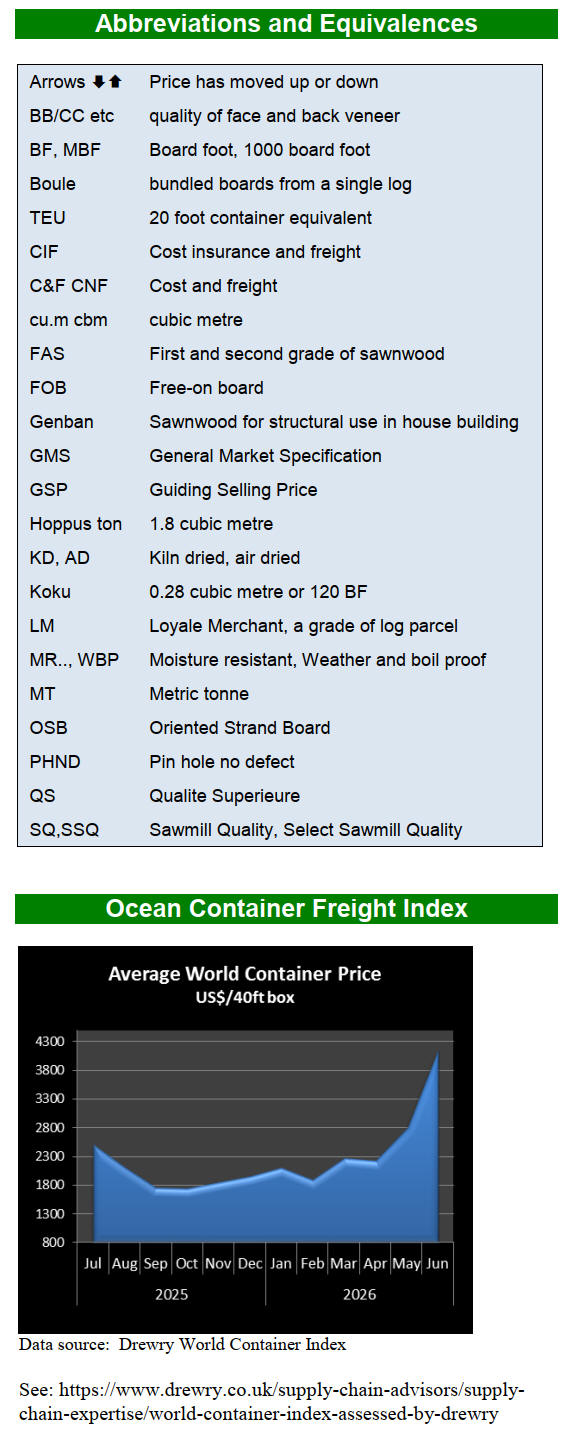
He noted that ocean freight rates surged following
the
conflict in the Middle East. Shipping a 40-foot container
to the US previously cost around US$1,800-1,900, but
since March rates had at times risen to US$4,300-4,500
per container.
A director of another wood enterprise also shared
similar
expectations, saying that stabilisation in the Middle East
could facilitate the movement of shipments that had
previously been disrupted. He added that reconstruction
demand for infrastructure and housing in the region after
the conflict could create new opportunities for Viet
Namese wood exporters.
Apart from the US, India was also being viewed as a
promising market thanks to its large population and rising
demand for premium furniture products. An increasing
number of Indian buyers had approached Vietnamese
companies to negotiate orders for high-end product lines.
See: https://vietnamnews.vn/economy/1783921/wood-exports-
maintain-growth-momentum-as-firms-eye-middle-east-
rebound.html
EUDR, export enterprises must fully digitise
European Union (EU) has just announced the latest update
to the Anti-Deforestation Regulation (EUDR) effective
May 4, 2026, with a series of notable changes related to
product scope, accountability mechanisms and information
technology systems.
Notably, while EU continues to emphasise goal of
reducing administrative burden on businesses, core
requirements for traceability, supply chain transparency
and control of deforestation risks are becoming
increasingly stringent. According to the latest update,
EUDR simplifies accountability declaration process for
micro and small businesses in initial production stage.
EU has also expanded scope of applicable products,
adding instant coffee and palm oil derivatives – products
assessed as posing a risk of deforestation in some regions
of the world.
At EU Regulations Update Conference on Non-
Deforestation Products (EUDR), following official
announcement of updated regulations on 4 May, Mr. Cyril
Loisel, First Secretary of EU Delegation to Viet Nam,
stated that the changes could help businesses reduce their
administrative burden by approximately 75%. In
particular, Viet Nam's assessment as a country with a low
rate of deforestation will create favorable conditions for
businesses to implement a simpler accountability
mechanism.
However, it is noteworthy that "simplification" does
not
mean losing standards. In fact, recently issued third
version of the EUDR guidelines continues to tighten
requirements for traceability and data transparency. This is
the most difficult part for many Vietnamese agricultural
export businesses today.
According to the regulation, the EU requires
traceability
down to each geographical coordinate (geolocation),
meaning each shipment must have its exact source
location identified using GPS data, digitised maps and
satellite imagery.
This is a landmark change. Previously, businesses
primarily relied on paper documents or certifications of
growing areas for verification; now, control mechanism
has shifted to verification using digital data and satellite
technology. In other words, EUDR is transforming
traceability from a "recommended" requirement into a
mandatory condition for accessing the EU market.
See:
https://asemconnectvietnam.gov.vn/default.aspx?ID1=2&ID8=14
9230&ZID1=8&utm_source=chatgpt.com
Wood exports maintain growth but challenges persist
Viet Nam’s wood product exports maintained their growth
momentum in the early months of 2026, bolstered by a
strong performance in Asian markets, particularly China.
However, the industry is simultaneously grappling
with
significant challenges, ranging from trade defense
measures and increasingly rigorous EU "greening"
requirements to the urgent need for digital and green
transformation to maintain competitiveness.
According to the Ministry of Agriculture and
Environment, exports of wood and wood products in May
2026 arnd around US$1.55 billion. Despite the overall
growth, there is a clear divergence across export markets.
In the first five months of 2026 exports to the US
declined
by 6.5% year-on-year. In contrast, exports to China surged
by 48%, while the Japanese market saw a 6% increase.
Among the 15 largest export markets, the Netherlands
recorded the highest growth, with export values increasing
2.3 times, whereas South Korea experienced the sharpest
decline at 19%.
In addition to competitive pressure, the industry is facing a
rise in trade defense measures. On 11 March 2026 the
Office of the United States Trade Representative (USTR)
initiated a Section 301 investigation into imported wooden
furniture, including products from Viet Nam, regarding
allegations related to trade surpluses and currency
manipulation.
The Viet Nam Timber and Forest Product Association
(VIFOREST) noted that the industry stands at a crossroads
as importing markets tighten environmental standards,
carbon emission regulations and raw material traceability
requirements.
The EU is currently leading the global green
consumption
trend, making criteria for sustainability, transparency, and
environmental responsibility mandatory for imported
wood products. Although the EU accounts for only about
5% of Viet Nam’s total wood exports it remains the
market that defines the highest standards. Businesses must
meet these benchmarks to maintain their global standing.
Beyond external factors, domestic wood enterprises
are
also struggling with internal regulations. Most notably,
obstacles persist regarding the management of Value
Added Tax (VAT) for ordinary semi-processed wood
products, adding further strain to the industry’s operations.
See: https://en.vcci.com.vn/economic-news/wood-exports-
maintain-growth-but-industry-still-faces-dual-pressure-118114
High-quality carbon credits create new opportunities
for Viet Nam
Dr. Nguyễn Sỹ Linh, Head of the Climate Change
Division at the Institute of Strategy and Policy on
Agriculture and Environment under the Ministry of
Agriculture and Environment has said Viet Nam’s
emissions trading system was recognised by the World
Bank for the first time in its State and Trends of Carbon
Pricing 2026 report. Under the current roadmap, Viet Nam
plans to pilot the system starting with around 110 major
firms in the thermal power, steel and cement industries.
The global carbon market is undergoing a significant
shift
from prioritising volume to emphasising the quality of
carbon credits which is widely expected to create new
opportunities for Viet Nam in developing forest carbon
credits.
According to Linh, the World Bank’s State and Trends
of
Carbon Pricing 2026 report shows that the global carbon
market has expanded significantly over the past decade. In
2015, only 58 countries and territories had made use of
compliance carbon pricing instruments. That number has
now increased to 87. The number of emissions trading
systems (ETS) worldwide has risen from 19 to 40, while
carbon crediting mechanisms have increased from 21 to
47.
The World Bank noted that the global carbon market
is
entering a new stage of development, with focus shifting
away from increasing the volume of credits issued and
toward enhancing credit quality and environmental
integrity.
A clear example of this shift is the growing share of
credits generated from forestry and land-use activities,
which now account for about 36%t of the market.
Meanwhile, credits from renewable energy projects have
declined by around 38 % from previous periods.
This trend reflects increasing demand for
high-quality
carbon credits, particularly those generated through
nature-based solutions.
Although the carbon market is taking shape, demand
will
not emerge automatically requiring project developers to
proactively prepare. Quality will also be the primary factor
determining the future value of carbon credits.
Meanwhile, the market is shifting from credit
trading to
investment in credit-generating projects, with greater
attention to carbon rights, land-use rights, benefit-sharing
mechanisms and project governance transparency.
As Viet Nam continues to finalise its regulatory
framework and plans to fully operationalise its carbon
market by 2029, these trends are expected to serve as
important references for policymakers, businesses and
project developers in formulating market participation
strategies, particularly in the forest carbon credit sector.
The Ministry of Agriculture and Environment expects
to
submit applications for the issuance of forest carbon
credits covering the 2023–25 period in the third quarter of
2026.
See: https://vietnamnews.vn/environment/1782655/high-quality-
carbon-credits-create-new-opportunities-for-viet-nam-s-carbon-
market.html?utm_source=chatgpt.com
Land restoration efforts stepped up as degradation
affects 11.8 million hectares
Viet Nam’s forest cover has risen to 42% but officials
warn that policies and technical solutions alone cannot
reverse land degradation without wider social
participation.
More than a third of Viet Nam's land surface, or
nearly
11.8 million hectares, has been degraded, officials said at a
national tree-planting campaign to mark the World Day to
Combat Desertification and Drought. The problem plays
out differently across the country's varied terrain. In the
northern highlands, erosion carves away hillsides, while
along the central coast, chronic drought bakes the land.
In the Mekong Delta, saltwater intrusion from the
sea and
accelerating land subsidence are compounding one
another, creating forms of degradation that are
increasingly difficult to manage. The northern midlands
and mountains bear the heaviest overall burden, with more
than 4.4 million hectares affected.
Viet Nam has made measurable progress on forest
recovery. National forest cover climbed from around 37%
in 2005 to 42% in 2025, above the global average of
roughly 31%.
A national programme launched in 2021 with a target
of
planting one billion trees over five years was completed
ahead of schedule, contributing to reduced soil erosion and
improved water retention across forested watersheds.
But officials cautioned that technical fixes and policy
frameworks alone cannot reverse land degradation. "This
requires the participation of all of society," he said.
Six priority actions for 2026 have been identified:
accelerating surveys and risk mapping for desertification-
prone areas; integrating land restoration goals into national
development planning; rehabilitating natural and
protective forests; deploying digital tools, including
remote sensing, GIS and artificial intelligence to monitor
land resources; securing livelihoods for communities most
exposed to degradation; and expanding international
cooperation while encouraging public-private partnerships
in sustainable forestry.
See: https://vietnamnews.vn/society/1783608/land-restoration-
efforts-stepped-up-as-degradation-affects-11-8-million-
hectares.html?utm_source=chatgpt.com
8. BRAZIL
Amazon Fund celebrates record expansion
The Amazon Fund marked its 18th year of operation with
record results with 153 approved projects with a
cumulative value of BRL5.3 billion. Since 2023 the annual
value of approvals has quadrupled, increasing from
approximately BRL300 million to BRL1.3 billion per
year. The initiative currently supports, directly or
indirectly, more than 650 organisations with activities
spanning 169 Indigenous lands, 192 Protected Areas and
benefiting an estimated 260,000 people throughout the
Amazon region.
During the 36th meeting of the Amazon Fund Steering
Committee (COFA), the Brazilian Development Bank
(BNDES) highlighted the Fund’s expanding international
cooperation network which currently includes nine donors.
New contributions from the European Union, the United
Kingdom and Ireland were also announced totalling
approximately BRL600 million.
The meeting also emphasised the strategic importance of
the partnership with the Brazilian Trade and Investment
Promotion Agency (ApexBrasil) to expand the
international market access for Amazonian bio-economy
products and strengthen Brazil’s image as a global
reference in sustainable development, the bioeconomy and
the green economy.
According to ApexBrasil, cooperatives supported by the
Amazon Fund have already accessed international markets
while trade promotion initiatives have helped to connect
international buyers with production models compatible
with forest conservation. BNDES highlighted prospects
for expanding investments in bio-economy, innovation and
sustainable value chains, reinforcing the Amazon Fund’s
role as a strategic instrument for advancing Brazil’s
climate, environmental and social commitments.
See: https://maisfloresta.com.br/fundo-amazonia-celebra-
aprovacao-anual-de-r-13-bilhao-em-projetos-e-parceria-com-a-
apexbrasil/
Mato Grosso agreement to expand planted forests
The State of Mato Grosso has signed an Environmental
Commitment Agreement (Termo de Compromisso
Ambiental – TCA) with the State Public Prosecutor’s
Office to promote the expansion of planted forests and
progressively reduce the use of raw materials sourced
from authorised conversion of native vegetation by 2034.
This measure responds to a growing imbalance between
supply and demand for forest raw materials in the State
where consumption more than doubled between 2021 and
2024, increasing from 3.4 million to 7.4 million cubic
metres, a 114% increase. In contrast, planted forest areas
of eucalyptus plantations declined from 218,883 hectares
to 211,238 hectares (a 3.5% decrease) during the same
period.
The TCA establishes a plan for large biomass consumers
setting progressive limits on the use of material sourced
from native vegetation under Sustainable Supply Plans
(Planos de Suprimento Sustentável PSS): up to 50% by
2030, 40% in 2031, 30% in 2032, 10% in 2033 and full
elimination by 2034. From that point onward raw
materials must come exclusively from planted forests,
sustainably managed(private) forest or other legally
authorised renewable sources.
New industrial projects or capacity expansions will be
required to demonstrate full supply from renewable and
sustainable sources from the outset.
The agreement also supports the Mato Grosso State Forest
Development Plan which aims to expand planted forest
area and reach at least 700,000 hectares of planted forests
and 6.5 million hectares under sustainable forest
management by 2040, reinforcing a long-term transition
toward a more sustainable and secure forest-based
production chain.
See: https://maisfloresta.com.br/mato-grosso-firma-acordo-com-
ministerio-publico-para-expandir-florestas-plantadas-e-reduzir-
uso-de-vegetacao-nativa-ate-2034/
IBAMA Non-Detriment indings (NDF) for Ipê and
Cumaru
The Brazilian Institute of Environment and Renewable
Natural Resources (IBAMA) has published Non-
Detriment Findings (NDFs) for ipê (Handroanthus spp.
and Tabebuia spp.) and cumaru (Dipteryx spp.), species
listed in Appendix II of the Convention on International
Trade in Endangered Species of Wild Fauna and Flora
(CITES).
The documents consolidate technical and scientific
information on geographic distribution, conservation
status, population dynamics, forest management practices
and trade-related impacts associated with these species
providing the technical basis required for the issuance of
export permits. In practice, the NDF supports the issuance
of export licenses by Brazil’s CITES Management
Authority by ensuring that the harvesting and export of
these species are conducted sustainably and do not
jeopardise their long-term survival in natural ecosystems.
The publication represents an important step by IBAMA
in implementing mechanisms aimed at conserving Brazil’s
native flora while promoting the sustainable use
commercially valuable timber species. The initiative seeks
to balance environmental protection, responsible forest
management and legal certainty for international trade.
The findings were prepared by IBAMA with contributions
from specialists, research institutions, academia and
government agencies. The NDFs will now form part of the
technical references used to evaluate the sustainability of
international trade in ipê and cumaru.
See: https://www.gov.br/ibama/pt-
br/assuntos/notas/2026/ibama-publica-parecer-tecnico-que-
embasa-exploracao-sustentavel-de-ipe-e-cumaru
Export update
Brazilian wood product exports slowed in May 2026
interrupting the recovery trend observed in previous
months. Export values declined by 10% compared to April
while export volumes fell by 17%, reflecting seasonal
factors, the appreciation of the Brazilian real against the
U.S. dollar and uncertainties in the international market.
Despite the monthly decline the sector´s performance
remained relatively stable compared to May 2025 with
export value increasing by 2% and export volume
decreasing by only 2% on a year on year basis.
The decline was led by pine sawnwood and pine plywood
exports which fell by 14% and 10% respectively compared
to the previous month. The expiration of import quotas for
pine plywood in the European Union and the United
Kingdom also contributed to lower shipments to European
markets.
In addition to these market-related factors, the sector is
closely monitoring the potential implementation of an
additional 25% tariff by the United States on certain
Brazilian products following the conclusion of the Section
301 investigation. Although the measure has not yet taken
effect the prospect of new trade barriers has increased
uncertainty among exporters and may affect contracts,
investments and logistics planning.
Brazilian companies are pursuing strategies focused on
market diversification, expanding higher value-added
product offerings, improving operational efficiency and
reducing dependence on specific export destinations.
Despite short-term challenges, the medium- and long-term
outlook for the sector remains positive, supported by
growing global demand for renewable products and
Brazil’s strategic position as one of the world’s leading
suppliers of plantation-grown timber and wood products.
See: https://www.portaldoagronegocio.com.br/florestal/mercado-
florestal/noticias/exportacoes-de-madeira-recuam-em-maio-apos-
recuperacao-e-setor-monitora-impacto-do-cambio-e-das-tensoes-
comerciais#f56e4e1d-c70a-4d6a-bf8f-184718d5c612
In May 2026 Brazilian exports of wood-based products
(except pulp and paper) decreased 3.5% in value compared
to May 2025, from US$295.0 million to US$284.8
million.
Pine sawnwood exports increased 14% in value between
May 2025 (US$ 55.7 million) and May 2026 (US$63.6
million). In volume, exports increased 17% over the same
period, from 236,000 cu.m to 275,100 cu.m.
Tropical sawnwood exports decreased 9.5% in volume,
from 33,700 cu.m in May 2025 to 30,500 cu.m in May
2026. In value, exports increased 4% from US$13.8
million to US$14.4 million over the same period.
Pine plywood exports decreased 6% in value in May 2026
compared to May 2025, from US$66.4 million to US$62.4
million. In volume, exports decreased 6% over the same
period, from 209,800 cu.m to 196,300 cu.m.
Tropical plywood exports increased 18% in volume, from
2,800 cu.m in May 2025 to 3,300 cu.m in May 2026. In
value, exports increased 12% from US$1.7 million in May
2025 to US$1.9 million in May 2026.
As for wooden furniture, exports declined 10% in value,
from US$55.1 million in May 2025 to US$49.7 million in
May 2026.
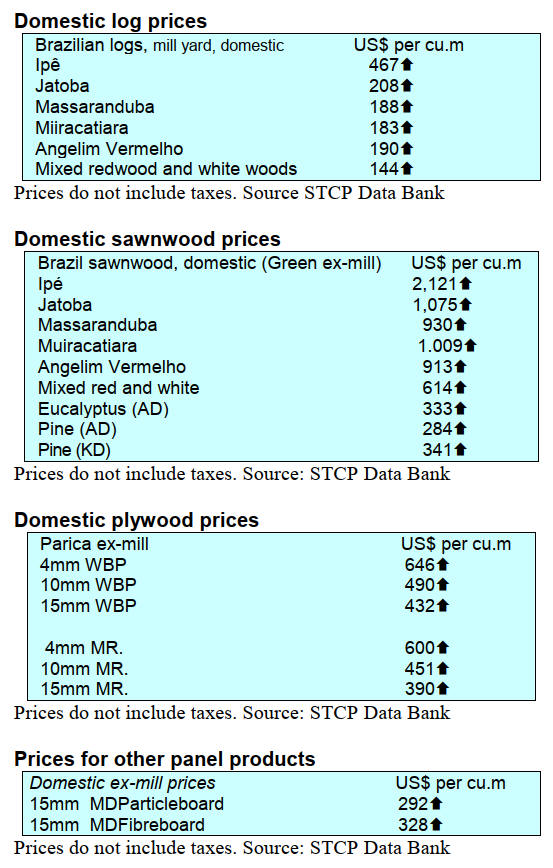
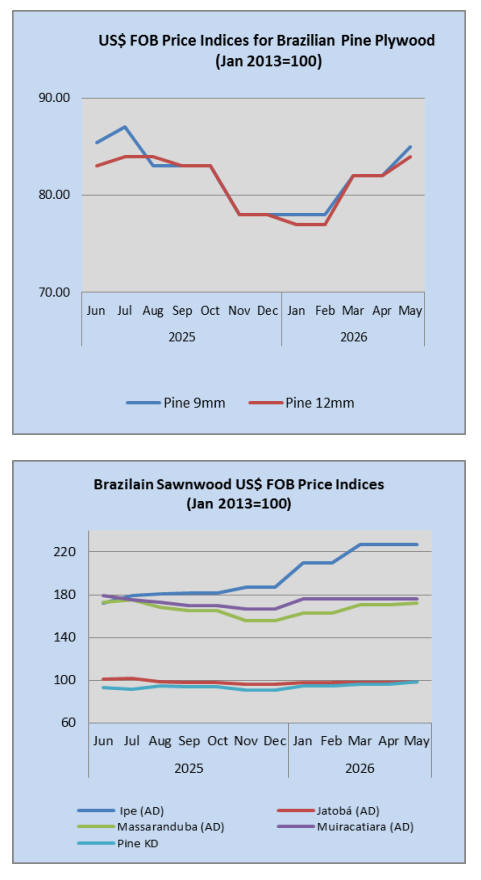
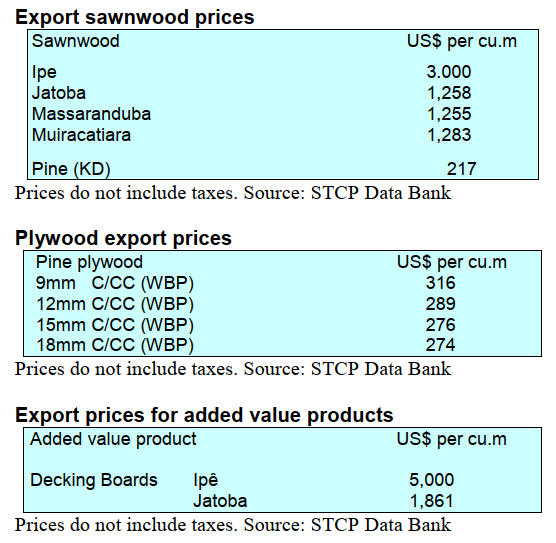
Export prices
Average FOB prices Belém/PA, Paranaguá/PR,
Navegantes/SC and Itajaí/SC Ports.
Through the eyes of industry
The latest GTI report lists the challenges identified by the
private sector in Brazil.
See: https://www.itto-
ggsc.org/static/upload/file/20260615/1781506386105682.pdf
9. PERU
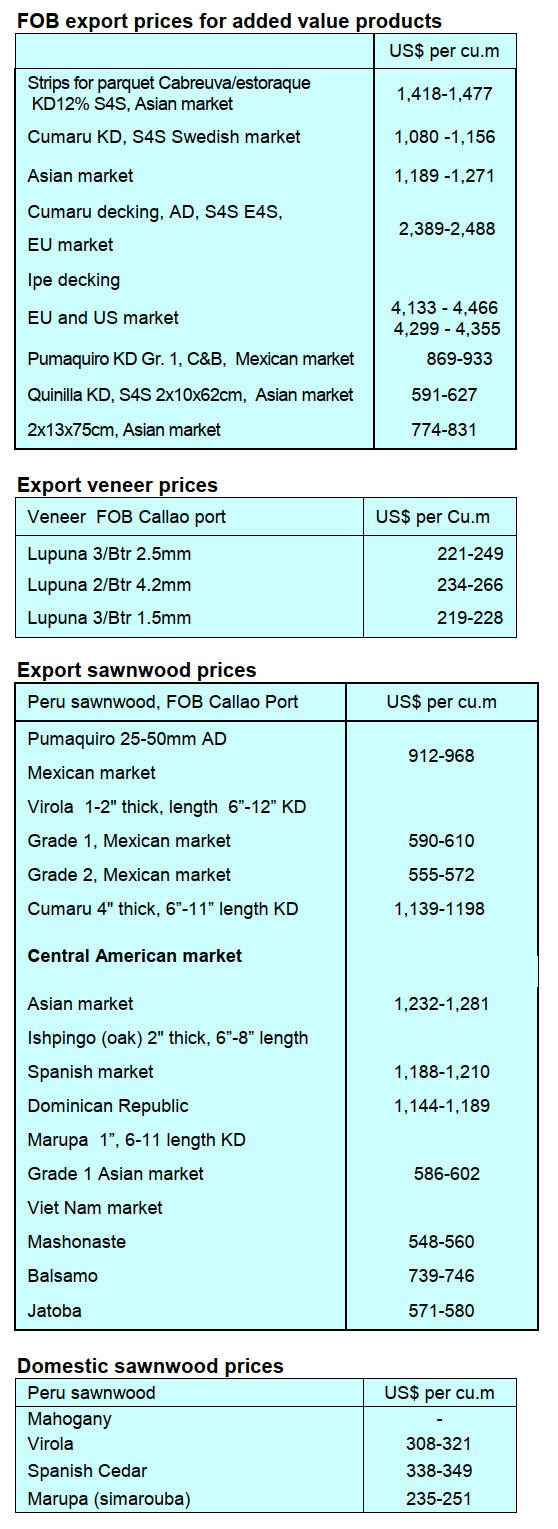
April 2026 exports 11% higher than in 2025
In April 2026, wood product exports reached a FOB value
of US$23.4 million, an increase compared to the US$21.1
million achieved in the same period of 2025. This increase
represented a positive upward trend of 11%, according to
the Center for Research on Global Economics and
Business of the Association of Exporters (CIEN-ADEX).
According to CIEN-ADEX, shipments included products
such as semi-finished goods (US$9.7 million), sawnwood
(US$8.1 million), firewood and charcoal (US$1.7 million),
furniture and furniture parts (US$1.4 million) and
construction products (US$1.1 million).
The leading destination was France, with exports totalling
US$4.9 million. The Dominican Republic followed with
US$3.2 million, the United States with US$3.1 million,
then China with US$2.8 million and finally Vietnam with
US$2.0 million, completing the top five markets.
Exports of semi-manufactured products increased
According to information provided by the Services and
Extractive Industries Management of the Association of
Exporters (ADEX), during April 2026 exports of semi-
manufactured products reached a value of US$9.7 million
FOB, representing a positive variation of 137% compared
to the same period of the previous year.
France was the main export destination for this subsector,
accounting for 46% of the market share, up over 200%
compared to the same period in 2025. Denmark ranked
second with a 15% share, showing a times 4 positive
growth compared to the same period of the previous year.
Belgium was third with an 8.6% share, registering a
positive percentage change of 80% in relation to the same
period in 2025. The United States occupied fourth position
with an 8% share and a positive increase of 87%. China
closed out the list in fifth position with a 4% share of
semi-manufactured product exports and an increase of
40% compared to the previous year.
Strengthening shihuahuaco monitoring and
conservation
The Supervisory Agency for Forest Resources and
Wildlife (OSINFOR) and the University of Sheffield in
the United Kingdom presented ARBOR, an artificial
intelligence plugin that expands traditional forest
monitoring, moving from logging detection to the
identification and evaluation of specific tree species.
In its first stage, ARBOR has been programmed to
recognise shihuahuaco (Dipteryx micrantha), one of the
most emblematic timber species of the Peruvian Amazon
currently listed in Appendix II of the Convention on
International Trade in Endangered Species of Wild Fauna
and Flora (CITES).
The tool uses artificial intelligence algorithms to segment,
identify and geo-reference tree species from images
obtained by drones. For its programming a geospatial
database from OSINFOR was used consisting of 176
ortho-mosaics obtained from supervised forest
management areas, which include records of 1,883 trees
among them more than 700 shihuahuacos.
The implementation of ARBOR will strengthen the
capacity for monitoring the harvesting of shihuahuacos,
allowing for the generation of more precise information on
the distribution, abundance and condition of this species in
the forest. This will support large-scale forest censuses and
contribute to more efficient decision-making for the
sustainable management and conservation of this resource.
See: https://www.gob.pe/institucion/osinfor/noticias/1410811-
arbor-la-ia-que-llega-al-peru-para-fortalecer-la-supervision-y-
conservacion-del-shihuahuaco
 |