Japan
Wood Products Prices
Dollar Exchange Rates of 10th
July
2026
Japan Yen 161.70
Reports From Japan
Transitioning out of long deflationary era
It would appear that Japan has transitioned out of its
decades-long deflationary era, entering a phase of
moderate inflation, wage increases and interest rate
normalisation. According to the Bank of Japan (BoJ), the
economy continues to expand moderately but faces short-
term deceleration from global energy shocks and imported
cost pressures.
To firmly establish the exit from deflation, the government
is introducing an economic package which includes
temporary energy subsidies to insulate households while
implementing structural tax reforms. The primary national
focus has shifted entirely to supply-side growth strategies,
specifically targeting artificial intelligence, digital
transformation (DX) and green technology.
See: https://www.boj.or.jp/en/mopo/outlook/gor2604a.pdf
Producer prices rising fast
In June, corporate goods prices rose at the fastest pace
since early 2023, adding to evidence of rising inflationary
pressures that support the case for the BoJ to keep raising
interest rates.
The measure of input prices for Japanese firms rose 7.1%
in June from a year earlier and May’s increase was revised
higher, the BoJ reported. On a month-on-month basis,
prices climbed 0.4%, also after an upward revision to the
prior month.
The producer price data adds to a streak of rising readings
after monthly prices rose in April by the most in 12 years
and continued to climb in May shortly following the
outbreak of war in Iran. Taken with other recent data that
point to accessible credit conditions and strong business
activity, the data reinforces further rate increases by the
BoJ.
In related news, Japan's wholesale inflation accelerated in
June at the fastest pace in more than three years as firms
passed on rising costs. The BoJ warned that the passing
on of rising input costs was proceeding at a faster pace
than in the past and could lead to higher consumer
inflation later this year.
See:
https://www.japantimes.co.jp/business/2026/07/10/economy/corp
orate-goods-prices-june/
and
https://asia.nikkei.com/economy/inflation/japan-s-wholesale-
inflation-hits-3-year-high-as-fuel-costs-weak-yen-bite
Economic and fiscal policy guidelines fuel concerns
The first draft of the government’s annual economic and
fiscal policy guidelines has fueled concerns among
investors that Japan may experience further fiscal
deterioration and faster inflation stemming from a possible
delay in interest rate hikes by the BoJ.
The yield on the most recent issue of 10-year Japanese
government bond has risen to a 30-year high which could
lead to slowing corporate investment if interest rates
continue to move higher.
In the draft guidelines, the government said that
appropriate monetary policy management by the BoJ is
“extremely important” to achieve a strong economy which
was taken by market participants as a signal to slow down
the pace of interest rate rises.
Bond yields serve as a critical economic indicator because
they reflect investors' collective expectations regarding
inflation, future interest rates and overall economic
growth. Because bond prices and yields move inversely,
changes in yields act as a real-time barometer of market
sentiment and capita.
See: https://www.nippon.com/en/news/yjj2026070800989/
Current account surplus in May on firm exports
Japan posted a current account surplus in May as the trade
balance swung into the black on strong exports of
semiconductor-related devices to other parts of Asia and
vehicles for the United States. However, The trade deficit
in services widened to 10.3 billion yen from a surplus of
130.9 billion yen a year earlier due to a decline in inbound
tourism.
Japan's May current account surplus, one of the broadest
measures of international trade, increased by 19.5% from a
year earlier, marking the 16th consecutive month of
surplus. The goods trade balance turned positive, with a
surplus of 6.9 billion yen compared to a deficit of 497.1
billion yen the previous year.
Exports gained 15% reflecting robust demand for chip-
related electronics driven by the widespread adoption of
artificial intelligence technology.
Imports rose 8%, including crude oil from the United
States, as the government taps alternative sources of fuel
and petroleum products due to supply disruptions caused
by the Middle East conflict.
See:
https://mainichi.jp/english/articles/20260708/p2g/00m/0bu/0180
00c
Consumer confidence index edged higher in June
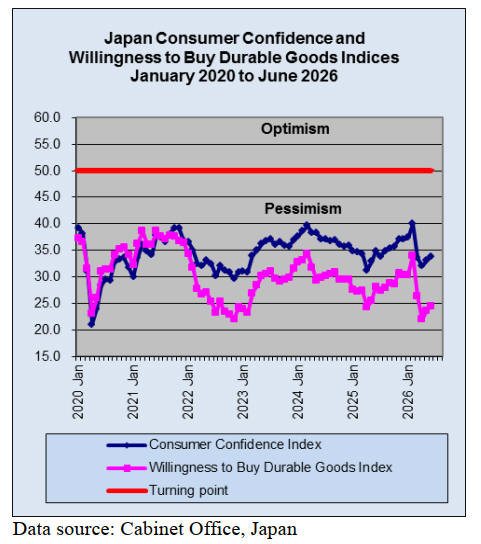
Rising to 33.8 in June, up from 33.6 in May, the index
moved to the highest level since February. While
signalling an improvement in consumer sentiment
following the easing of the Iran/US conflict, the overall
reading continues to be below the 50-threshold, indicating
sustained pessimism among households.
See: https://tradingeconomics.com/japan/consumer-confidence
Yen sinks to 162
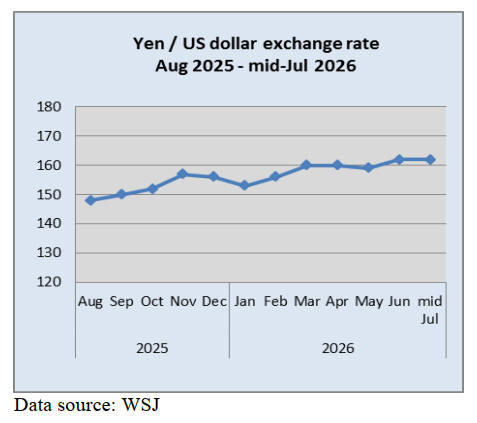
The yen plummeted to a historic 39-year low in early July,
streaking past the 162 mark against the US dollar due to
severe market anxiety surrounding the aggressive fiscal
policies of the government.
This drop, to levels unseen since December 1986, persists
despite previous record-breaking government currency
interventions. The administration's proposed yen 370
trillion public-private investment plan and a 2-year
consumption tax cut on food (from 8% to 1%) have
sparked concerns in the money market.
See: https://japannews.yomiuri.co.jp/business/market/20260701-
335998/
Introduction of vacant house tax
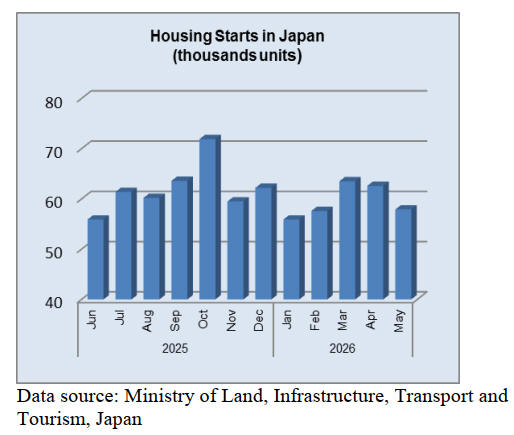
Making Japan's 9 plus million vacant homes available is a
recogonised strategy to revitalise urban centres and
stabilise real estate prices. However, systemic issues such
as complex inheritance laws and updated earthquake
safety code require targeted policy reforms and market
incentives to unlock this unused housing stock.
A Municipal Assembly in Osaka Prefecture, western
Japan, has approved an ordinance to impose a tax on
owners of vacant housing in the city.The measure is
intended to encourage owners of housing left vacant to sell
their properties to increase the availability of homes for
families. The city aims to introduce the tax in fiscal 2029
after obtaining approval from the Ministry of Internal
Affairs.
Another city in western Japan plans to introduce a similar
tax in fiscal 2030 for areas designated for urbanisation,
See: https://www.nippon.com/en/news/yjj2026070900703/
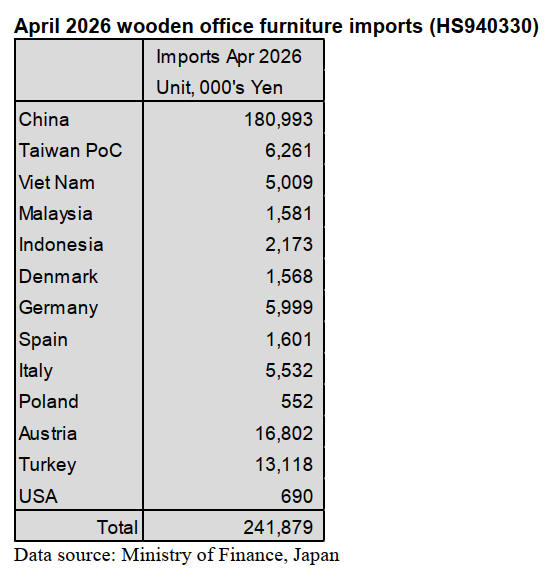
April 2026 wooden office furniture imports (HS940330)
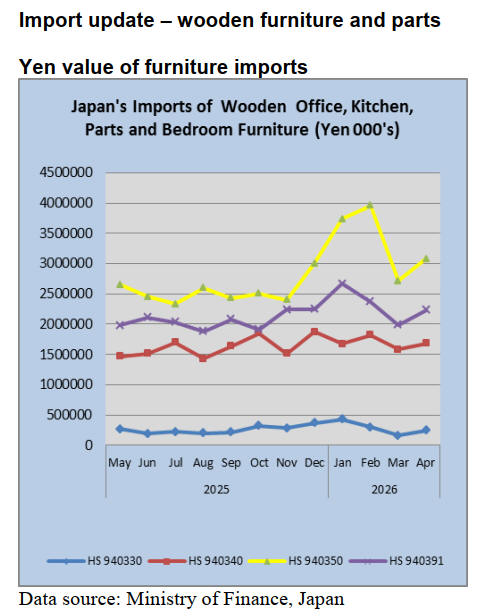
After two months of decline, the value of April 2026
imports of HS940330 was up 50% from March 2026 and
at around the same level as in April 2025. The value of
April imports from the top shippers, China, Austria and
Turkey was well above levels reported for March.
The top suppliers of wooden office furniture (HS940330)
in April 2026 were manufacturers in China, accounting for
75% (89% in March) of imports. The other two main
suppliers in April were makers in Austria and Turkey.
Shippers in Austria accounted for 7% of the value of
April’s imports while shippers in Turkey saw a fourfold
rise in the value of shipments to Japan.
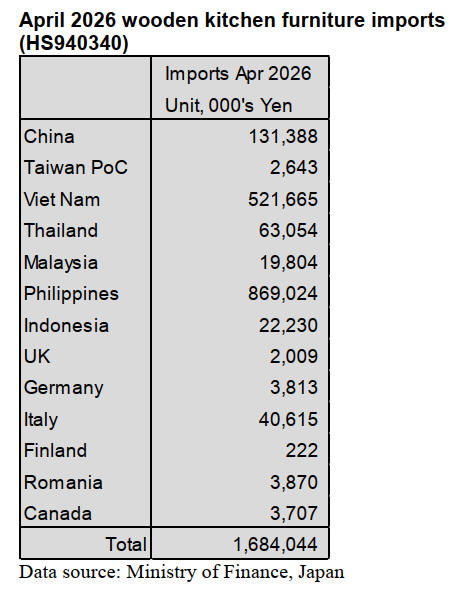
April 2026 wooden kitchen furniture imports
(HS940340)
In April 2026, the top two shippers of wooden kitchen
furniture (HS940340) were the Philippines and Viet Nam.
These two countries accounted for over 80% of Japan’s
imports of wooden kitchen furniture in April.
The value of shipments from the Philippines in April was
the highest, accounting for 52% (51% in March) of the
total value of shipments of wooden kitchen furniture and
an 8% increase on levels in March. The other main
supplier, Viet Nam which accounted for 31% (31% in
March) of the value of April imports. Year on year the
value of April wooden kitchen furniture imports was down
11%. The value of April arrivals from shippers in China
accounted for 8% of the total value of HS940340 imports.
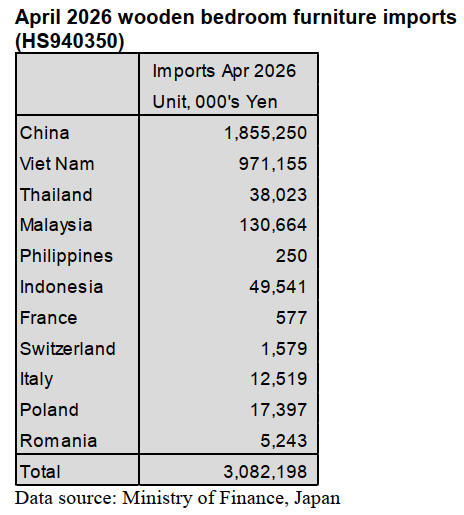
April 2026 wooden bedroom furniture imports
(HS940350)
The upward trend in the value of wooden bedroom
furniture (HS940350), which began at the end of 2025,
ended abruptly in March, howeve, the value of April
imports rose 14% month on month.
Four countries accounted for 84% of the value of
HS940350 imports in April, China ,60% (44% in March),
Viet Nam 32% (43% in March) and Malaysia 4%. The
other significant suppliers of wooden bedroom furniture to
Japan in April were Thailand and Indonesia.
The value of April 2026 imports was 9% below that of
April 2025. The value of imports from China was up 40%
month on month, from Viet Nam, down 16% month on
month and from Malaysia up 35%.
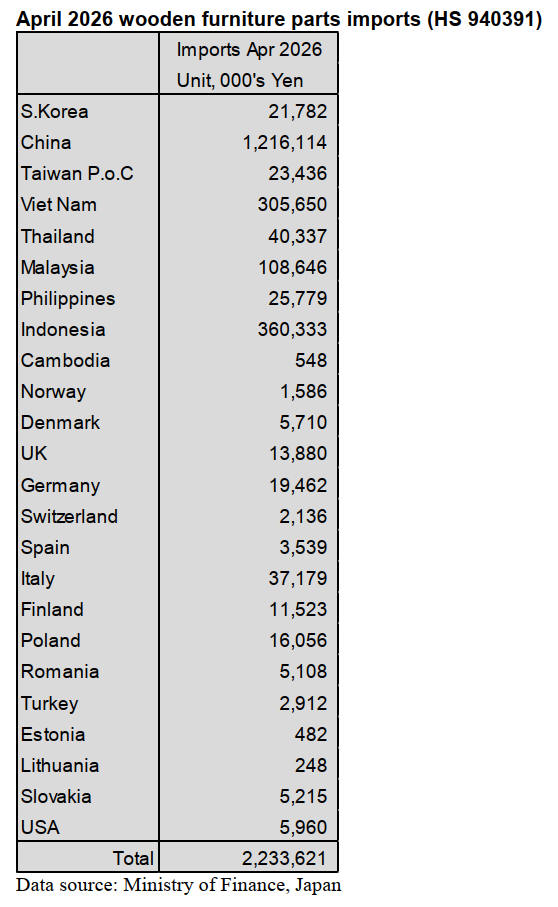
April 026 wooden furniture parts imports (HS940391)
In the last quarter of 2025 there was a surge in imports of
wooden furniture parts (HS940391). The strong
performance spilled over to January 2026 but this was not
sustained. The value of arrivals in both February and
March edged down. April brought a reversal of the
downtrend with a month on month rise of 47% and a year
on year increase of 6%.
As in previous months shippers in China and three SE
Asian countries, Viet Nam, Indonesia and Malaysia
accounted for 89% (84% in March) of Japan’s imports of
wooden furniture parts (HS940391) in April 2026.
The main shipper of wooden furniture parts to Japan in
April was China at 54% (42% in March) followed by
Indonesia at 16% (23% in March),Viet Nam 14% (13% in
March) and Malaysia 6% (6% in March). Of the non-
Asian suppliers arrivals of wooden furniture parts from
Italy and Poland were notable.
Trade news from the Japan Lumber Reports (JLR)
The Japan Lumber Reports (JLR), a subscription trade
journal published every two weeks in English, is
generously allowing the ITTO Tropical Timber Market
Report to reproduce news on the Japanese market
precisely as it appears in the JLR. For the JLR report
please see: https://jfpj.jp/japan_lumber_reports/
South Sea logs and lumber
Prices for tropical hardwoods and China-made products
continue to show strong upward momentum at the source.
Among tropical species, selangan batu decking has risen
by roughly 20% this month, as local mills push through
price increases amid higher production costs driven by
rising oil prices.
The same trend is evident in laminated free-board
products. Export prices for Indonesian merkus pine
remained unchanged from the previous month, but
producers are maintaining firm pricing due to persistently
low log supply and elevated log costs. In Japan, domestic
prices had held at pre-increase levels thanks to older,
lower-priced inventory in distribution channels. However,
as those inventories have been depleted and replaced with
new-price stock, domestic prices have climbed to around
¥140,000 per cubic meter (wholesaler delivered)—an
increase of more than ¥10,000 from the previous month.
Chinese red pine products, which had been kept at stable
prices to capture substitution demand, also saw price hikes
beginning in late April. Export prices rose by US$20, and
domestic prices have increased by ¥5,000, now hovering
around ¥135,000 per cubic metre (wholesaler delivered).
North American logs
In North America, Douglas fir log prices remain firm as
sawmills secure volumes amid wildfire concerns, despite
weak demand. Japan-bound log prices have not risen, but
shipping costs continue to increase. Because many May
contracts were signed before freight hikes, Canadian
Douglas fir veneer logs saw limited gains, though newer
contracts are expected to be about US$20 higher—over
¥3,000 in Japan—making domestic plywood mills
cautious about buyer acceptance.
In Japan, expectations for further price increases in
Douglas fir products are strengthening. Prices for
domestically sawn material have remained steady since
spring, but strong European lumber prices, low inventories
of imported Douglas fir, and rising import costs from
higher freight rates are supporting a firmer outlook. Many
market participants now anticipate additional domestic
price hikes.
|


