US Dollar Exchange Rates of
10th
August
2026
China Yuan 6.75
Report from China
Decline in sawnwood imports
According to the data from China Customs, in the first half
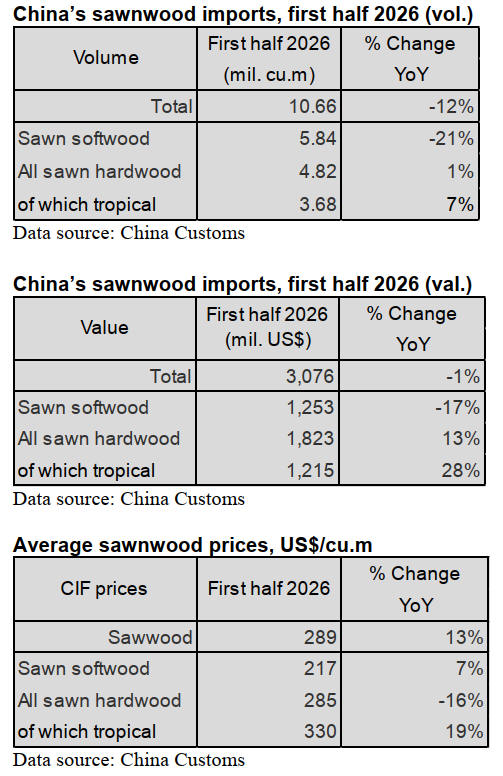
of 2026 China’s sawnwood imports totalled 10.66 million
cubic metres valued at US$3.076 billion, down 12% in
volume and 1% in value. The average CIF prices for
imported sawnwood rose 13% to US$289 per cubic metre
over the same period of 2025.
Of total sawnwood imports, sawn softwood imports fell
21% to 5.84 million cubic metres, accounting for 55% of
the national total, down 6 percentage points over the same
period of 2025. The average CIF price for sawn softwood
imports grew 7% to US$217 per cubic metre over the
same period of 2025.
Sawn hardwood imports rose 1% to 4.82 million cubic
metres in the first half of 2026. The average CIF price for
sawn hardwood imports dropped 16% to US$285 per
cubic metre over the same period of 2025.
Of total sawn hardwood imports, tropical sawnwood
imports were 3.68 million cubic metres valued at
US$1.215 million, up 7% in volume and 28% in value and
accounted for about 34% of the national total. The average
CIF price for tropical sawnwood rose 19% to US$330 per
cubic metre over the same period of 2025.
The following are some of the reasons for the decline in
sawnwood imports in the first half of 2026:.
Supply side: the largest source country for China's
sawnwood imports, Russia, has experienced a contraction
in sawnwood exports.
China’s sawnwood imports from Russia dropped 22% in
the first half of 2026. The ruble's strengthening has made it
more convenient for Russia to sell sawnwood to Central
Asia and the Middle East, thereby diverting the supply
from China.
The railway carriage capacity in the Far East is tight and
cross-border logistic costs remain high which has
hampered trade.
The local timber processing policy in Russia encourages
high-value-added processing, reducing the motivation for
directly exporting raw sawnwood.
The supply of European spruce and Nordic timber has
decreased. New Zealand mainly exports logs and the
increase in sawnwood is limited, making it difficult to fill
the gap.
Demand side: the real estate and home decoration sectors
in China are weak, the fundamental internal factor for the
drop in national sawnwood imports.
The largest consumption scenarios for sawnwood are
construction materials, formwork timber planks, furniture,
wooden doors and floors and full-house customisation.
The new construction of real estate is weak in China and
the demand for sawn softwood for construction has
significantly decreased. The recovery of housing
completions has fallen short of expectations and an
increase in the purchase of furniture and luxury housing
has not been achieved.
The recovery of the furniture and home furnishing
industry has been slow. Enterprises have insufficient
orders and are actively controlling raw material purchases
and not holding large stocks.
A seasonal slowdown caused by the rainy season in many
provinces of China such as Guangxi Zhuang Autonomous
Region impacted overall sawnwood demand.
Cost and trade factors: these have restrained the
willingness to import sawnwood.
International prices of imported sawnwood have risen. The
average price of imported sawnwood has increased year-
on-year. Domestic processing factories have thin profit
margins and have reduced the purchase of high-priced
imported sawnwood, instead prioritising the consumption
of their inventories.
The inventory at the ports was initially high. In the first
half of 2026, traders actively reduced their inventories and
the purchasing pace slowed down. The volume of imports
arriving at the ports decreased.
After the inventory was consumed by June 2026 there was
a month on month rebound in sawnwood imports.
Fluctuations in exchange rates and the increase in cross-
border freight costs have further reduced the profit
margins of sawnwood import traders. Importers have
become more cautious in their purchasing of sawnwood in
the first half of 2026.
Domestic substitution: this has expanded in China,
reducing reliance on imported sawnwood.
The processing of domestic planted forests (cypress,
poplar and eucalyptus) has increased and the self-
sufficiency rate for common construction sawnwood has
continued to rise. The demand for imported medium and
low-grade specifications has been replaced by domestic
sources.
The application of domestic wood panels, modified wood
and engineered wood has increased and some furniture
and decoration scenarios have replaced solid wood.
It is worth noting that domestic products mainly replace
common construction materials, high-end sawn hardwood
and specific sawn softwoods still need to be imported.
Surge in sawnwood imports from Viet Nam
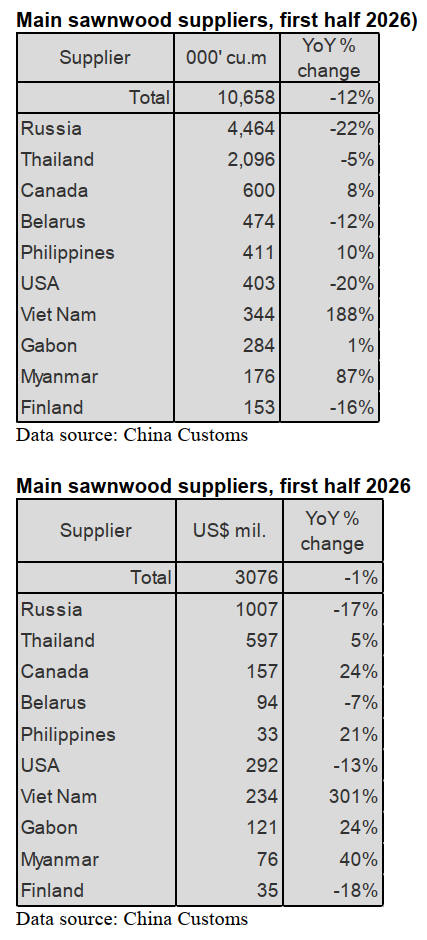
According to China Customs, in the first half of 2026
China’s sawnwood imports from Viet Nam surged 188%
over the same period of 2025.
Russia was the largest supplier of China’s sawnwood
imports in the first half of 2026 but the proportion of
China’s sawnwood imports from Russia continued to
decline to 42% in the first half of 2026 from 47% in the
first half of 2025.
Thailand was the second largest supplier for China’s
sawnwood imports in the first half of 2026, accounting for
20% of the national total sawnwood imports.
However, China’s sawnwood imports both from Russia
and Thailand fell 22% and 5% to 4.464 million cubic
metres and 2.096 million cubic metres respectively and it
was this trend that impacted the decline in the total
sawnwood imports. China’s sawnwood imports fell 12%
in volume in the first half of 2026.
China’s sawnwood imports from Belarus, USA and
Finland dropped 12%, 20% and 16% respectively over the
same period of 2025.
In contrast, China’s sawnwood imports from Canada, the
Philippines, Gabon and Myanmar rose 8%, 10%, 1% and
87% respectively in the first half of 2026.
Rise in sawn softwood imports from Canada
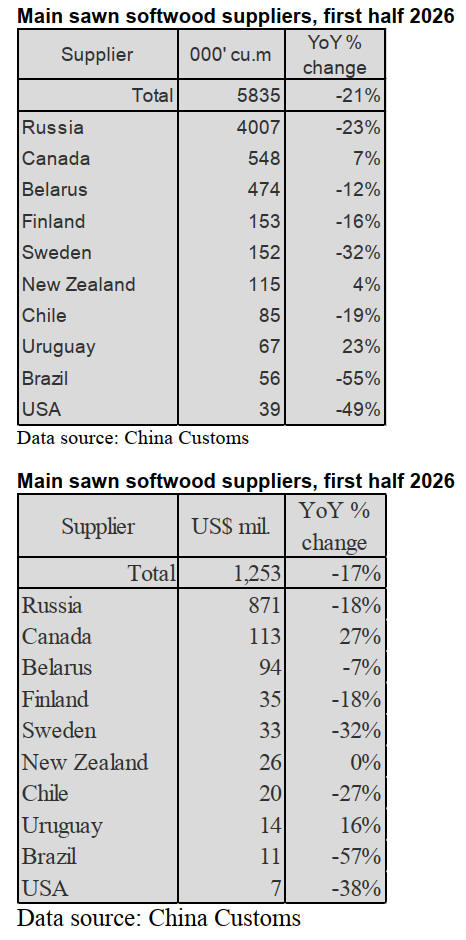
According to China Customs, in the first half of 2026
China’s sawn softwood imports from Canada rose 7%
over the same period of 2025.
China's total import of sawnwood softwood has declined
in the first half of 2026 but Canadian supplies have grown
against the trend reflecting a structural substitution driven
by supply gaps.
The core driver behind the growth of China's sawn
softwood imports from Canada in the first half of 2026 lies
in tariff dispute of sawn softwood between the United
States and Canada, which has led to a slowdown in exports
to the United States resulting in the diversion of sawn
softwood supplies by Canada to other markets.
The United States has continued to impose tariffs on
Canadian sawn softwood. As a result, the profit margins in
the North American domestic market have been reduced.
Canadian forest farms and processing plants have
voluntarily diverted some of their SPF (spruce-pine-fir)
supplies to Asian markets such as China and South Korea
thus reducing their reliance on the single market of the
United States.
Forest products trade communication between China and
Canada has improved in recent years. The forestry sector
in British Columbia has collaborated with the domestic
wood structure construction sector making the trade
process and certification alignment more smooth. The
willingness of domestic processing plants and traders to
purchase Canadian materials has increased in China.
China’s sawn softwood imports from New Zealand and
Uruguay grew 4% and 23% respectively over the same
period of 2025. In contrast, China’s sawn softwood
imports from Belarus, Finland, Sweden, Chile, Brazil and
USA dropped 12%, 16%, 32%, 19%, 55% and 49%
respectively in the first half of 2026.
Rise in tropical sawnwood imports
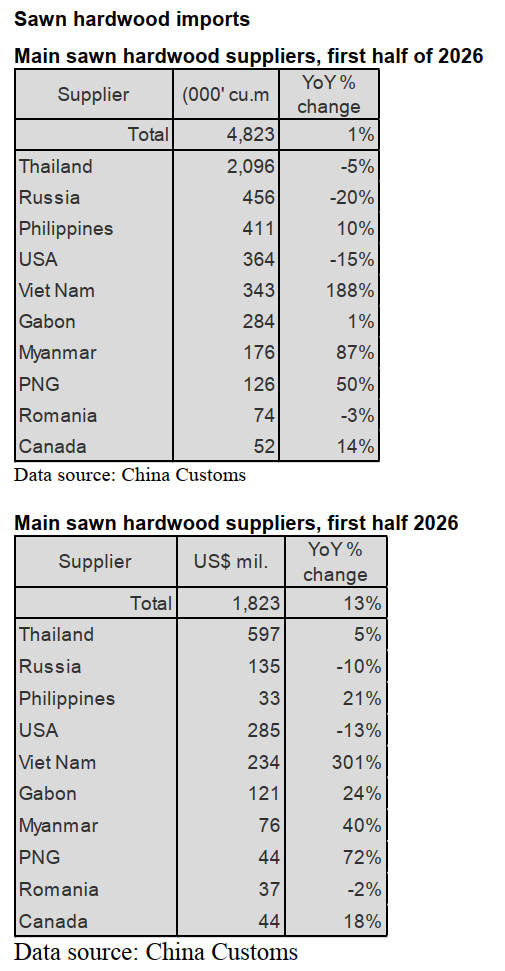
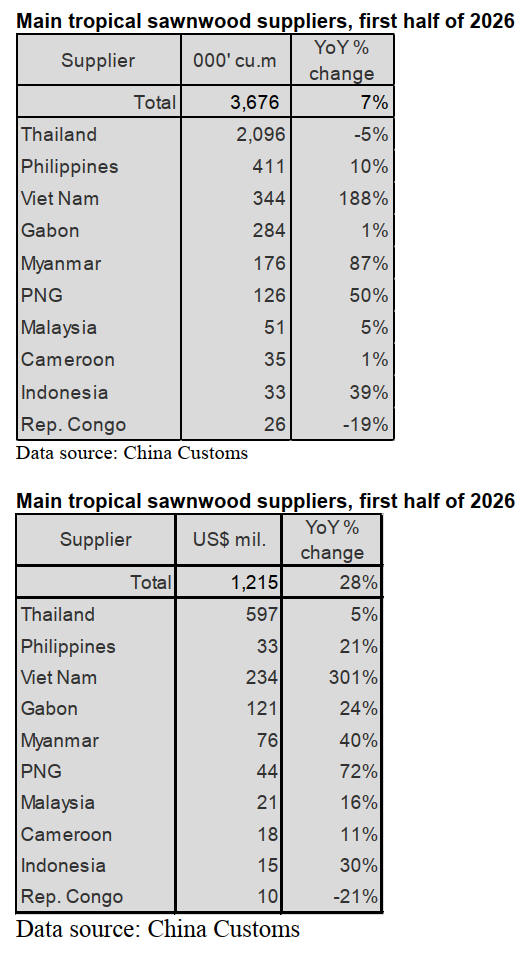
China’s tropical sawnwood imports were 3.676 million
cubic metres valued at US$1.215 billion, up 7% in volume
and 28% in value and accounted for about 34% of the
national total in the first half of 2026. The average CIF
prices for tropical sawnwood rose 19% to US$330 per
cubic metre over the same period of 2025.
Thailand has been the largest supplier shipping tropical
sawnwood (rubberwood) to China for many years.
However, China’s tropical sawnwood imports from
Thailand in the first half of 2026 dropped 5% to 2.096
million cubic metres valued at US$597 million, up 5%
over the same period of 2025.
In addition, China’s tropical sawnwood imports from the
Republic of Congo fell 19% in the first half of 2026. In
contrast, China’s tropical sawnwood imports from the top
suppliers rose at different rates in the first half of 2026. It
is worth noting that China’s tropical sawnwood imports
from Viet Nam surged 188% in the first half of 2026.
Domestically, overall
imports of sawnwood have
decreased by 12%, while sawn softwood imports has
dropped significantly by 21%. However, tropical sawn
hardwood imports have experienced a counter-trend
growth. This is a structural phenomenon. It is not due to an
overall surge in domestic real estate demand, it is driven
by supply shifts, substitution effects and the
reconfiguration of trade patterns.
The main reason for the growth of tropical sawnwood
imports is that overseas tropical sawnwood producers have
experienced weak demand in traditional markets and
turned to China.
The European and American markets for Myanmar timber
closed so supplies have been directed to China.
Myanmar tropical wood products including sawnwood
have lost their PEFC international forest certification and
the United States and the European Union imposed bans
making it impossible to sell to Europe and America.
A large amount of accumulated tropical wood products
inventory could only be exported to the Chinese market,
resulting in a clearance-style export trade with increased
quantity and decreased price which was an important
reason for the increase in tropical sawnwood imports in
China in the first half of 2026.
The processing capacity in African production areas has
been enhanced and the export of products has shifted from
raw logs to sawnwood.
Countries in Africa such as the Republic of Congo, the
Democratic Republic of Congo and the Central Africa
Republic have implemented policies to restrict the direct
export of raw logs and encourage the establishment of
local sawmills for processing. Previously, a large amount
of raw logs were exported but now they are processed into
sawnwood locally and then exported. The quantity of
African tropical sawnwood imported by China has
increased.
Some tropical and North American hardwood logs are
transported to Viet Nam for processing into sawnwood
which is then re-exported to China. The import of
sawnwood from Viet Nam to China has significantly
increased by 188% in the first half of 2026, driving up the
overall import volume of sawn hardwood.
African and Southeast Asian producers have shifted more
tropical sawwood to the Chinese market as demand in the
EU is subdued.
|


