US Dollar Exchange Rates of
10th
September
2026
China Yuan 6.71
Report from China
Slight decline in wooden furniture exports
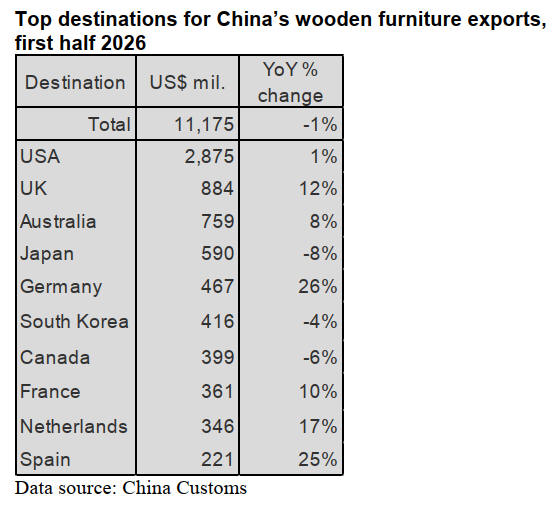
According to China Customs, the value of China’s wooden
furniture exports dropped 1% to US$11.175 billion in the
first half of 2026.
The US was the main destination for China’s wooden
furniture exports in the first half of 2026 accounting for
26% of wooden furniture exports. In the first half of 2026
the value of China’s wooden furniture exports to US rose
1% to US$2.875 billion over the same period of 2025.
China’s wooden furniture is shipped to over 200 countries.
The proportion of China’s wooden furniture exports to the
top 10 destination countries was just 65% in the first half
of 2026.
In the first half of 2065, China’s wooden furniture exports
to UK, Australia, Germany, France, Netherland and Spain
rose 12%, 8%, 26%, 10%, 17% and 25% respectively over
the same period of 2025. In contrast, the value of China’s
wooden furniture exports to South Korea and Canada
dropped 4% and 6% respectively.
Decline in wooden furniture imports
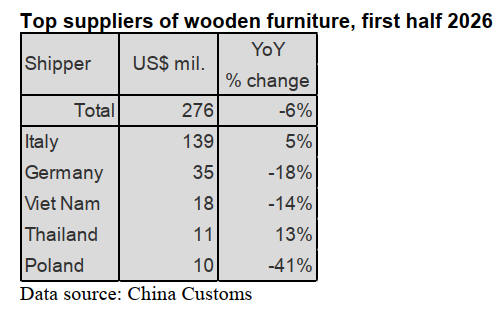
According to China Customs, in the first half of 2026 the
value of China’s wooden furniture imports fell 6% to
US$276 million over the same period of 2025. Italy and
Germany were the first and second largest suppliers of
China’s wooden furniture imports in the first half of 2026.
The value of China’s wooden furniture imports from Italy
and Thailand rose 5% and 13% respectively in the first
half of 2026. In the first half of 2026 China’s wooden
furniture imports from Germany and Poland declined.
Decline in wooden furniture imports from tropical
countries
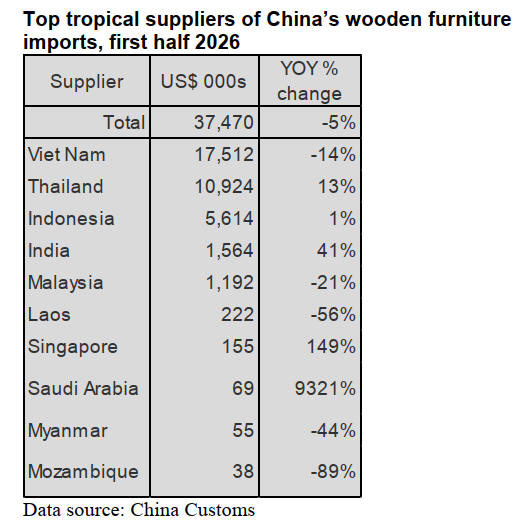
China Customs data shows that, in the first half of 2026,
the value of China’s wooden furniture imports from
tropical countries fell 5% to US$37.47 million over the
same period of 2025.
Wooden furniture imports from the top three tropical
countries, Viet Nam, Thailand and Indonesia accounted
for over 90% of the national total from tropical countries
in the first half of 2026.
China’s wooden furniture imports from Viet Nam, the
largest tropical countries supplier, fell 14% to US$17.512
million in the first half of 2026. Wooden furniture imports
from Thailand and Indonesia, the second and third largest
tropical countries suppliers, rose 13% and 1% respectively
in the first half of 2026.
It is worth noting that China’s wooden furniture imports
from Saudi Arabia and Singapore surged in the first half of
2026. In contrast, China’s wooden furniture imports from
Malaysia, Laos, Myanmar and Mozambique dropped 21%,
56%, 44% and 89% respectively in the first half of 2026.
The main reasons for the decrease in China's imports of
wooden furniture from tropical countries in the first half of
2026 were as follows.
The Chinese domestic demand for real estate and home
decoration is weak. Furniture factories in tropical
countries prioritise exports their wooden furniture to
Europe and the United States. The cost of raw materials
for tropical furniture has risen and there has been
substitution by domestic furniture.
In addition, the compliance threshold for wood traceability
has increased. These factors led to a decline in China's
imports of finished wooden furniture from tropical
countries in the first half of 2026.
The shrinking domestic demand is the most crucial factor
among the demand-side factors. Domestic residential
construction and new home decoration demand are weak
in China. Consumers' willingness to purchase imported
solid wooden furniture has declined. The overall market
for imported finished furniture has contracted.
The domestic furniture manufacturing sector is well-
equipped. Domestic panel and solid wooden furniture
production capacity is sufficient and has a higher cost-
performance ratio. A large number of enterprises have
substituted mid-to-low-end finished wooden furniture
imported from tropical countries.
The core target markets of furniture factories in the
tropical regions of Southeast Asia (Viet Nam, Indonesia
and Malaysia) are the US and the EU. Most of the
production capacity is dedicated to supplying customers in
Europe and the United States and the priority for
supplying to the Chinese market is low.
The cost of wooden furniture raw materials in tropical
countries has risen leading to a decline in the
competitiveness of finished wooden furniture prices.
The rain season in the main rubberwood-producing areas
of Thailand has persisted, causing difficulties in logging
and transportation within the forest areas. This has led to a
reduction in rubberwood production and an increase in
prices, thereby raising the production costs of furniture in
the local market.
Tropical countries in Africa (such as Gabon) have raised
export tariffs on logs and primary wood and have also
tightened the quotas for logging. As a result, the supply of
tropical hardwood has become tight and the prices have
risen.
The costs of labour and energy have continued to increase
pushing up the prices of finished furniture in tropical
countries.
Compared with domestically produced furniture, exporters
have lost the price advantage and China’s domestic
consumers have reduced their purchases.
There are increased legal, quarantine and environmental
compliance standards for wood products. China’s Customs
have strengthened plant quarantine and pest inspection for
imported wooden furniture. Tropical wood is prone to
carrying pests and the inspection requirements have
become stricter. The risk of cargo being detained or
returned at the port has increased, leading to a decrease in
orders placed by importers.
Requirements for wood traceability and legal logging
certificates have been raised. Some tropical countries have
imperfect forestry traceability systems, making it difficult
to provide complete and legal logging documents, which
then fail to meet domestic entry requirements resulting in a
reduction in orders. Some tropical hardwoods are subject
to CITES control and the cost and duration of document
processing are high.
Domestic enterprises in China no longer import large
quantities of finished wooden furniture from tropical
countries. Instead, they directly import tropical logs,
sawnwood and rubberwood blanks and then processed
them into furniture in domestic factories.
As a result, the import volume of finished wooden
furniture decreased but the import of tropical raw material
has been maintained.
Rise in fibreboard exports
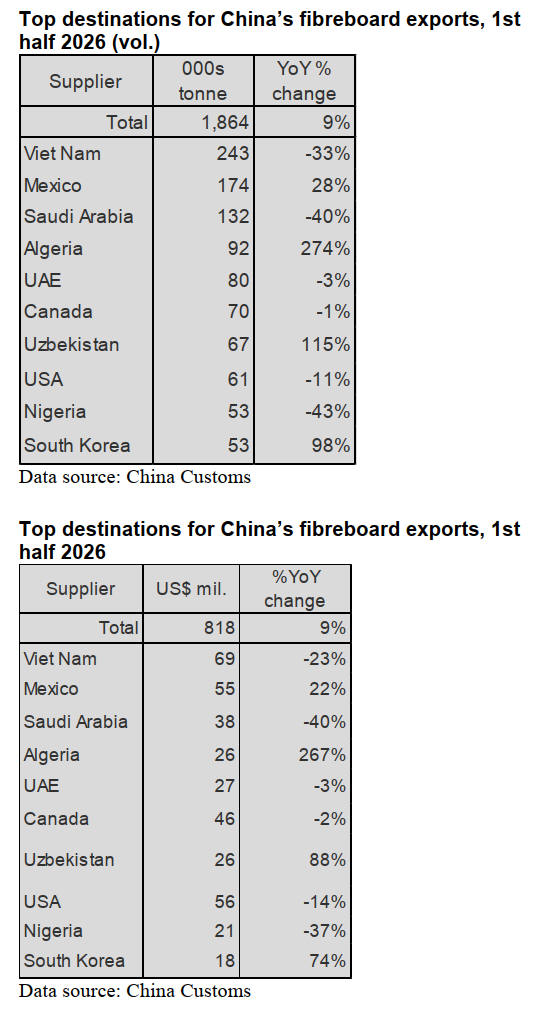
China Customs reports that in the first half of 2026
China’s fibreboard exports totalled 1.864 million tonnes
valued at US$818 million, up 9% over the same period of
2025.
Viet Nam was the largest destination country for China’s
fibreboard exports in the first half of 2026 but exports to
Viet Nam fell 33% to 243,000 tonnes, accounting for 13%
of the national total in the first half of 2026.
China’s fibreboard exports to Mexico and Saudi Arabia, as
the second and third largest destination, grew 28% but
dropped to 174,000 tonnes and 132,000 tonnes
respectively over the same period of 2025.
China’s fibreboard exports to Algeria, Uzbekistan and
South Korea surged 274%, 115% and 98% respectively in
the first half of 2026. In contrast, fibreboard exports to
UAE, Canada, USA and Nigeria fell 3%, 1%, 11% and
43% respectively in the first half of 2026.
In January 2026 Viet Nam implemented anti-dumping
duties on Chinese fibreboard which led to a significant
decline in China's exports to Viet Nam. However, the
growth of Chinese fiberboard exports in the first half of
2026 was not a simple expansion of a single market in the
world but the result of market diversification and
substitution. It relied on explosive increments in
international markets such as the Middle East, North
Africa, Latin America and some European markets to
compensate for the decline in traditional markets.
The growth of fiberboard exports in the first half of 2026
was driven by market diversification substitution, overseas
furniture industry chain demand, product green upgrading
and optimisation of domestic supply structure.
A large proportion of wood panel furniture production
capacity has been captured by Viet Nam and Malaysia.
These factories mainly purchase Chinese fibreboards,
process them into furniture and flooring and then export to
Europe and the United States.
Although Viet Nam imposed anti-dumping duties on
Chinese fibreboards starting from January 2026 which led
to a significant decline in exports to Viet Nam, enterprises
quickly shifted to new markets such as Mexico, the United
Arab Emirates, Egypt, Algeria and the United Kingdom.
These countries saw extremely high import growth in the
first half of 2026 becoming the main sources of expansion.
Demand in the infrastructure and residential decoration
sectors in the Middle East, Latin America and North
Africa are recovering. Countries such as the United Arab
Emirates, Saudi Arabia, Egypt and Algeria have increased
projects for affordable housing, commercial decoration
and prefabricated buildings.
The demand for medium-density fiberboard (MDF) for
door panels, cabinets and interior wall materials has risen
recently. Mexico, as an alternative base for the North
American supply chain, has expanded its furniture
manufacturing and the demand for imported fibreboards
has continued to grow in the first half of 2026.
Global green panel standards bring structural benefits.
European and American brands have mandatory
requirements for ENF-level panels. Chinese domestic
enterprises have completed CARB and ENF
environmental certifications and can therefore secure
orders under the global shortage of compliant panels
supply under the EU's low-carbon and traceability rules,
the competitiveness of renewable raw material fibreboard
has improved and qualified Chinese fibreboard have
seized the production capacity gaps in other countries.
Rise in fibreboard imports
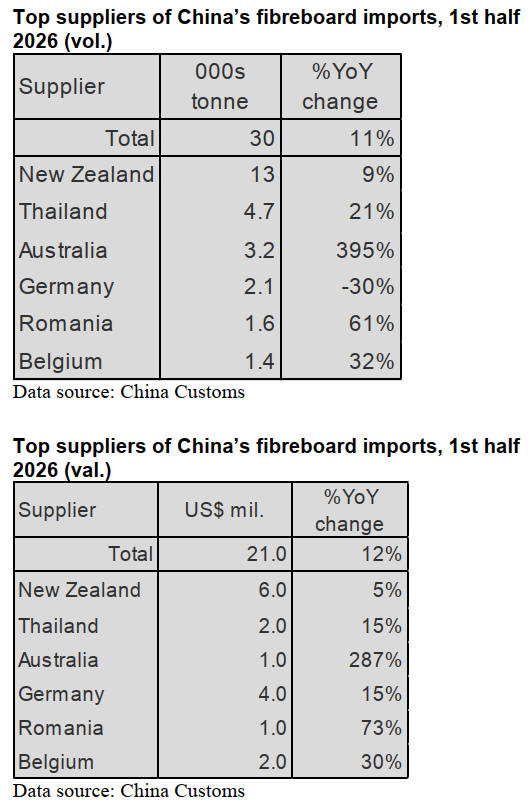
Although China's fibreboard imports are not large they
increased significantly in the first half of the year. China’s
fibreboard imports totalled 30,000 tonnes valued at US$21
million, up 11% in volume and 12% in value over the
same period of 2025. Fibreboard imports from most top
suppliers rose at faster rates in the first half of 2026.
Imports from New Zealand, as the first largest supplier,
rose 9% to 13,000 tonnes in the first half of 2026. It is
particularly worth noting that China’s fibreboard imports
from Australia surged 395% over the same period of 2025.
In addition, China’s fibreboard imports from Thailand,
Romania and Belgium grew 21%, 61% and 32%
respectively in the first half of 2026. In contrast, China’s
fibreboard imports from Germany alone among top
suppliers dropped 30% over the same period of 2025.
The main reason for the significant increase in China's
imports of fiberboard from Australia in the first half of
2026 was the substitution of import sources by different
countries. The traditional high-end fibreboard supplier,
New Zealand, reduced their exports of high-level
fiberboard to China. Domestic, export-oriented, furniture
enterprises in China still have a strong demand for high-
end MDF/HDF that meets international environmental
protection certification regulations.
Domestic purchasers have shifted some of their high-end
panel orders to Australia relying on the advantages of the
China-Australia Free Trade Agreement and the zero-tariff
policy of RCEP, combined with the stable supply of
Australian radiata pine raw materials, complete product
certifications and smooth maritime Customs clearance,
thereby increasing the import volume of Australian
fibreboards.

|


