Japan
Wood Products Prices
Dollar Exchange Rates of 10th
October
2026
Japan Yen 158.31
Reports From Japan
Economy grows - household spending falls
The Bank of Japan has stated the economy is expected to
continue growing moderately, albeit at a decelerated rate
in fiscal 2026. This is because, although the rise in crude
oil prices since early spring is expected to push down
economic activity, the economy is underpinned by factors
such as the various government measures and
accommodative financial conditions. In addition the
increase in global AI-related demand will help.
The International Monetary Fund recently raised its
economic growth projection for Japan to 0.7% for 2026,
up 0.1 percentage point from its July forecast. The IMF’s
World Economic Outlook report cited “fiscal support
measures partly cushioning the impact from higher energy
prices.”
The IMF said global economic activity has proven
resilient once again because strong investment in artificial
intelligence has helped mitigate the damage from
geopolitics-driven disruptions.
However, the report said that “risks are skewed to the
downside.” A further escalation in the Middle East will
likely weigh on growth and a reassessment of AI-related
profitability and productivity prospects could sharply
reduce investment, it said.
In August household spending in fell 3.1% from a year
earlier amid price hikes and bad weather declining for the
ninth consecutive month, according to the Ministry of
Internal Affairs and Communications. The data is a key
indicator of private consumption which accounts for more
than half of Japan's gross domestic product.
Rising prices prompted consumers to cut spending,
particularly on food and beverages. Heavy rain and
typhoons also dampened spending as people stayed home
rather than going out.
During the summer months outlays for energy and water
bills declined 5% as cooler temperatures reduced the need
for air conditioning. Spending on culture and recreation
dropped 4.3%, due largely to a drop in domestic package
tour spending following a surge during last year's World
Exposition in Osaka.
See: https://adalytica.com/news/japan-household-spending-falls-
c6970b20
and
https://www.boj.or.jp/en/mopo/outlook/gor2607a.pdf
and
https://www.japantimes.co.jp/business/2026/10/13/economy/imf-
growth-forecast/
Business leaders - two-year limit lower consumption
tax on food should be strictly observed
The Prime Minister recently defended her plan to combine
a consumption tax cut on food with income-based cash
payments, citing relief from rising living costs. The
proposed tax reduction from the current 8% would last two
years. Legislation to implement the package is expected to
be submitted soon.
The Prime Minister argued that using income information
already held by public agencies would allow cash
handouts to be made next year. The consumption tax
reduction on food is set to start in April 2027 which will
give businesses time to complete system changes.
Nearly three quarters of Japanese business leaders say a
two-year limit on the government's planned consumption
tax cut on food should be strictly observed, a Nikkei
survey shows, reflecting concerns about undermining
competition and fiscal discipline.
See:https://www.japantimes.co.jp/news/2026/10/07/japan/politic
s/takaichi-defends-tax-cut/
and
See: https://asia.nikkei.com/economy/most-japan-business-
leaders-want-strict-2-year-limit-on-food-tax-cut-nikkei-poll
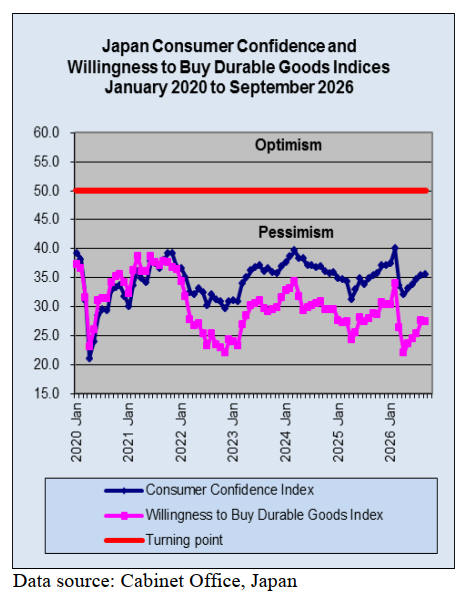
BoJ - economiy and price developments in line with
forecasts
At its next policy meeting on 29 October analysts
anticipate the Bank of Japan (BoJ) is likely to conclude
that the country’s underlying inflation rate has reached
around 2%.
BoJ Governor, Kazuo Ueda, said it was becoming more
important to anchor underlying inflation around the
Bank’s 2% target, signaling readiness to keep raising
interest rates to blunt the risk of too-high inflation.
Ueda said economic and price developments were broadly
in line with the BoJ’s forecasts, with the economy
recovering moderately with the BoJ’s “tankan” survey
pointing to solid business sentiment.
He noted rising raw material costs are pushing up
wholesale inflation with price pressures spreading to
consumer inflation. He also warned of the risk of
underlying inflation overshooting the BoJ’s target due to
price pressures from the conflict in the Middle East, strong
AI-related demand and the weak yen.
He concluded that “it has become more important than
before to ensure underlying inflation becomes anchored
around 2%”.
See:
https://www.japantimes.co.jp/business/2026/10/05/economy/ban
k-of-japan-underlying-inflation-rate/
and
https://www.asahi.com/ajw/articles/16945477
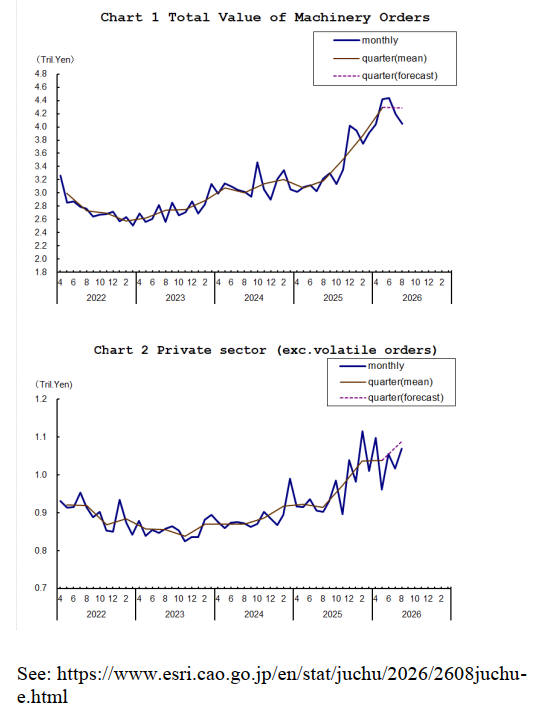
Private-sector machinery orders rose in August
Japan's core machinery orders serve as a key leading
indicator of corporate capital expenditure (capex) and
business investment over the next 6 to 9 months. Private-
sector machinery orders, excluding volatile ones for ships
and those from electric power companies, increased a
seasonally adjusted by 5.2% in August.
Yen weakness could accelerate inflation
An article in the domestic media argues that, irrespective
of how efforts are made to check the yen's weakness, these
efforts will remain no more than a temporary fix. The
author argues “Japan should instead review its fiscal
policy, which lies at the root of the problem.”
With the weakness threatening to accelerate
inflation in
Japan the government likely grew more alert. Verbal
intervention, in which remarks by senior government
officials are used to curb market swings, is normally
undertaken by the finance minister so it was unusual for
the Prime Minister to step in.
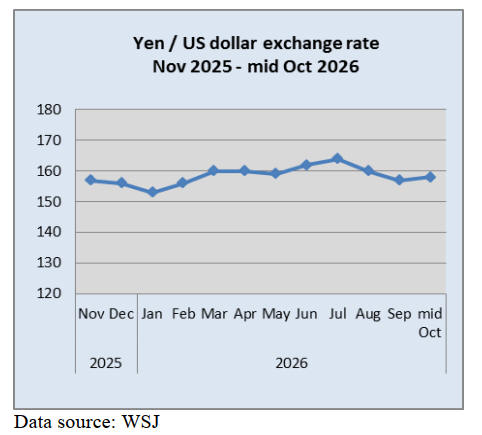
In mid- October the yen was standing a 158 to the US
dollar back close to where it was before the several rounds
of intervention. The planned consumption tax cut could
reduce annual tax revenue by more than 4 trillion yen
(around US$25.32 billion). The source of funds to cover
this shortfall remains unclear.
See:
https://mainichi.jp/english/articles/20261002/p2a/00m/0op/01400
0c
Home buyers face a unique financial dilemma
Unlike in Western countries where a home is an
appreciating, wealth-building asset residential structures in
Japan are treated as consumer goods that rapidly lose
value. The Japanese real estate market enforces a strict
separation between land value and building value.
The building itself suffers a government-mandated
straight-line tax depreciation curve. Wooden structures
have a statutory useful life of 22 years, while reinforced
concrete condominiums are capped at 47 years.
As a result, domestic buyers are caught in a "scrap-and-
build" cycle. A staggering 85% of home purchases in
Japan are new builds compared to Western markets where
secondhand homes make up the vast majority of real estate
activity.
Young adults are increasingly bypassing traditional
real
estate and building wealth through the financial assets
instead, driven by high home prices, high mortgage rates
and rising maintenance costs.
See: https://www.oldhousesjapan.com/blog/understanding-why-
japanese-real-estate-depreciates
and
https://www.theguardian.com/cities/2017/nov/16/japan-reusable-
housing-revolution
Furniture market analysis
Mordor Intelligence has produced an analysis of Japan’s
furniture market the size which, in 2026, has been
estimated at US$23.57, billion growing from a value of
US$23.02 billion in 2025.
The report identifies key takeaways, home furniture
dominates demand but that the fastest growth was in the
healthcare sector and that wooden furniture commanded
just over 60% of the Japan furniture market share in 2025.
See: https://www.mordorintelligence.com/industry-reports/japan-
furniture-market
Japandi style in every room
Japandi wooden furniture is growing more popular in
Japan. While consumer interest in Japandi historically
peaked overseas, specialty furniture makers, architects and
lifestyle brands in Japan have increasingly adopted the
aesthetic for residential homes, boutique hotels and urban
space.
Japandi blends Japanese wabi-sabi (simplicity, natural
aging and quiet imperfection) with Scandinavian hygge
(warmth, coziness and functional comfort). Both traditions
share a deep respect for natural wood, honest
craftsmanship and clutter-free living. The style relies
heavily on light-to-mid-tone natural woods (such as oak
and walnut), low-profile proportions and clean lines that
naturally complement both modern Japanese apartments
and traditional room layout.
Some Japanese designers find Indonesian materials a
natural fit for Japandi design because of a commitment to
raw, unadorned earth-born resources, artisanal
craftsmanship and the philosophy of wabi-sabi (finding
beauty in natural imperfection).
See: https://www.receno.com/pen/coordinate/u51/2024-02-
16.php
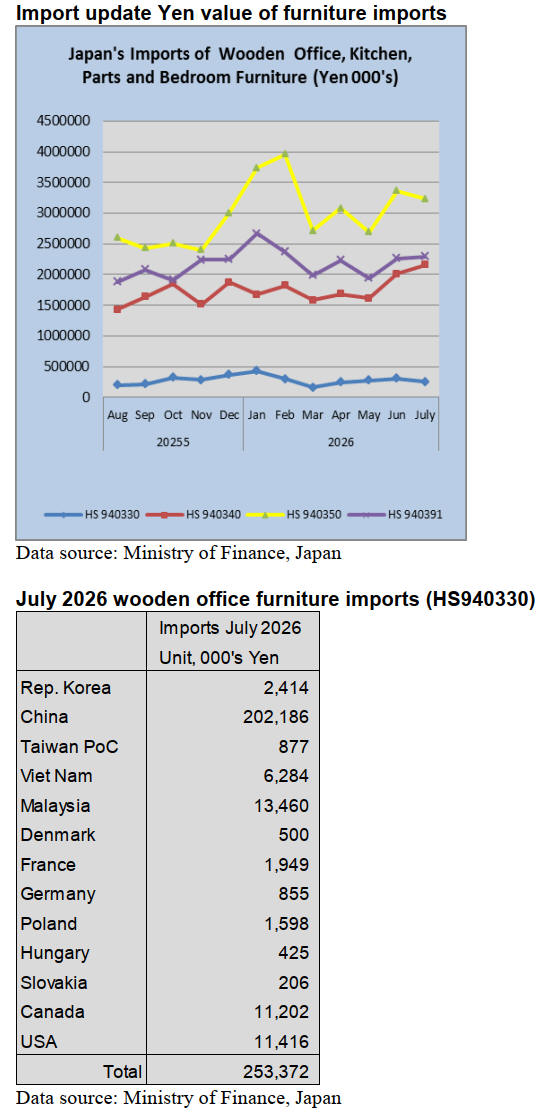
Year on year, the value of wooden furniture imports
in
July 2026 rose a further 12 building on the 60% increase
seen in June, however, there was a 20% month on month
decline in the value of imports.
The value of June imports of wooden office furniture
imports from the top shipper, China fell 38% month on
month but exporters in China still maintained the major
market share (80%, a slight drop compared to the June
market share).
A further10% of the total value of wooden furniture
was
shipped from Malaysia (5%) and from North America
(Canada and US combined 4.5%). Exporters in Malaysia
saw an almost doubling of the value of their exports of
HS940330 to Japan in July.
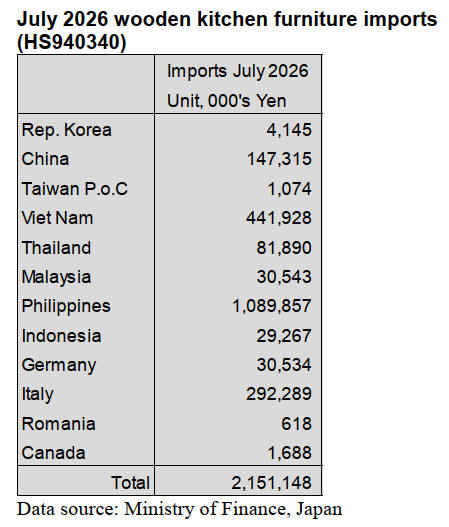
July 2026 wooden kitchen furniture imports
(HS940340)
After the significant rise in the value of wooden kitchen
furniture from the Philippines in June, July figures were
flat, unchanged from the previous month. Despite the
value of July shipments from the Philippines being
unchanged from a month earlier, the share of imports was
maintained at 51% (53%% in June). Of total July wooden
kitchen furniture imports a further 21% (25% in June) was
sourced in Viet Nam but this was down 13% compared to
the value of June arrivals.
In July there was a sharp rise in shipment of HS940340
from Italy which lifted the country into third place in
terms of the value of arrivals. This pushed shippers in
China into the fourth spot, the result of the almost 50%
decline in the value of shipments from China.
Year on year, the value of July 2026 wooden kitchen
furniture imports was up 27% compared to the value of
June imports while month on month there was a 7%
increase.
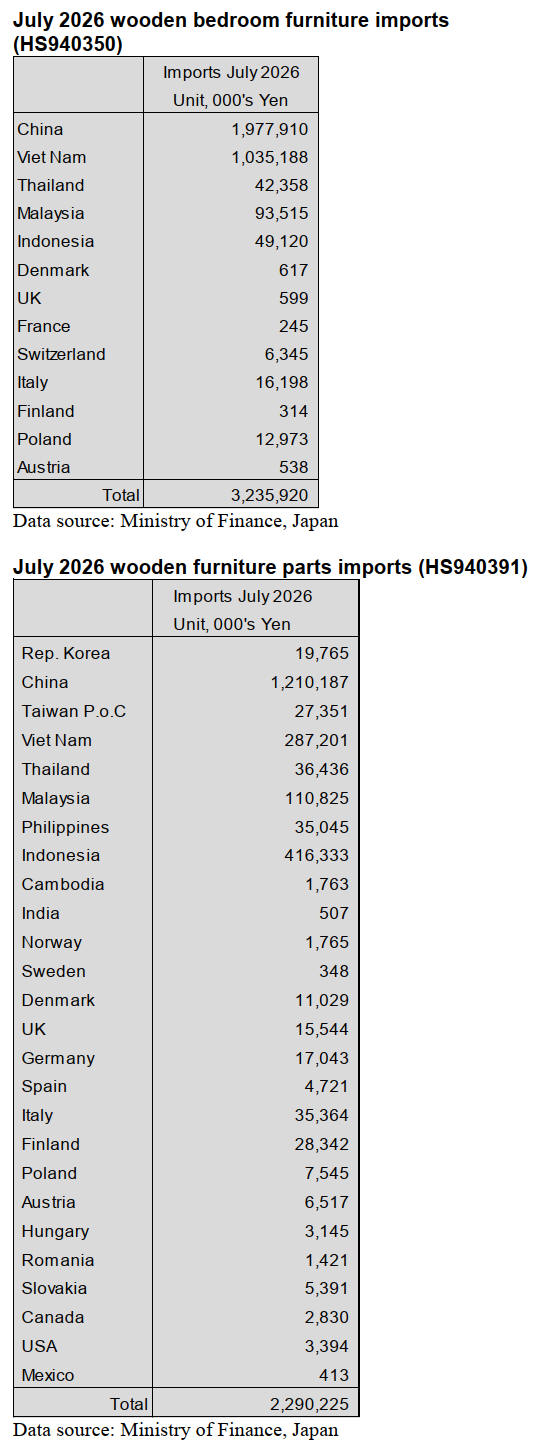
July 2026 wooden bedroom furniture imports
(HS940350)
Two countries, China and Viet Nam, accounted for 93% of
the value of Japan’s imports of wooden bedroom furniture
(HS940350). Shipments from China in July accounted for
61% of all HS940350 imports (59% in June 2026) while
shipments from Viet Nam contributed a further 32% to
overall imports of HS940350.
The other two top suppliers of wooden bedroom furniture
to Japan in July were Malaysia (3% share, up 27% from a
month earlier) and Indonesia (1%, around the same level
as in June).
The total value of arrivals of wooden bedroom furniture in
July 2026 was up around 39% 44% compared to July 2025
but compared to June 2026 there was a 4% decline in the
value of imports.
The reversal of the downward trend in the value of
imports
of wooden furniture parts during the early part of 2026
ended in June and extended into July when there was a
further slight increase.
In July, as in previous months, shippers in China and three
SE Asian countries, Indonesia Viet Nam and Malaysia
accounted for most (89%) of Japan’s imports of wooden
furniture parts (HS940391). The main shipper of wooden
furniture parts to Japan in July was China at 53% (51% in
June) followed by Indonesia at18% (20% in June), Viet
Nam 13% (10% in June) and Malaysia 5% (6% in June).
The value of imports from China in July 2026 was around
the same level as in June, imports from Indonesia were
down 8% compared to June, imports from Viet Nam were
up by 31% after a few months of declines. Arrivals of
HS940391 from Malaysia were down 24% from June.
Major Japanese furniture and retail brands (such as Nitori)
source the vast majority of their goods and components
from wholly-owned foreign factories, independent
contract manufacturers or direct suppliers overseas rather
than strict joint ventures.
During the last decade, much of Japan’s industrial
manufacturing capacity has gone off-shore to Asian
countries. The furniture manufacturing sector has been no
exception. As a result, much of US hardwood exports,
used primarily for furniture and interior production in
Japan, are sent to Japan’s off-shore ports, used for
furniture production in these neighbouring countries and
exported back to the Japanese market as finished products
or parts for final assembly and finishing in Japan.
Trade news from the Japan Lumber Reports (JLR)
The Japan Lumber Reports (JLR), a subscription trade
journal published every two weeks in English, is
generously allowing the ITTO Tropical Timber Market
Report to reproduce news on the Japanese market
precisely as it appears in the JLR. For the JLR report
please see: https://jfpj.jp/japan_lumber_reports/
Plywood
Demand for domestic softwood plywood remained mixed
in September. Sales to major precut plants and large
homebuilders stayed firm, but weak demand through
traditional lumber and building materials channels
continued to weigh on the market. Prolonged rainfall,
particularly in the Kanto region, also delayed construction
projects, leaving many distributors disappointed with
September sales.
Manufacturers kept October prices for softwood structural
plywood unchanged after a planned increase to ¥1,450 per
sheet failed to gain sufficient acceptance. Market prices
remained at around 1,420-1,430 per sheet, although some
transactions were reported below that level. While
producers continue efforts to raise prices amid higher
production costs, growing inventories and production
exceeding shipments for a second consecutive month have
raised concerns about oversupply.
Imported plywood markets were also sluggish. Demand
for coated concrete-form plywood weakened in the Tokyo
metropolitan area due to fewer condominium starts, while
shortages of thinner standard plywood continued.
Export prices from Malaysia and Indonesia remained firm
on higher log and material costs, but weak demand in
Japan limited trading activity.
Despite sluggish end-user demand, inventories at port
warehouses remain full. Importers said products are
accumulating within distribution channels and warned that
procurement conditions could become increasingly
difficult if demand fails to improve during October and
November.
Domestic lumber and logs
Demand for domestic lumber products has remained
sluggish despite the autumn housing season, which is
typically a peak period for residential construction.
However, log prices have continued to rise across several
regions as log supply has failed to recover following an
extremely hot summer and prolonged rainfall.
With inventories at many sawmills remaining below
normal levels, competition for logs has intensified,
pushing procurement costs higher.
In Kyushu, producers have announced price hikes of
around ¥2,000 per cubic meter from October, reflecting
stronger log prices and persistently high transportation
costs. KD cedar posts and studs are currently trading in the
mid-¥60,000 range per cubic meter. Supply-demand
conditions have also tightened due to reconstruction
demand following the Kumamoto earthquake.
Meanwhile, attention is focused on whether sawmills in
northern Kanto and other regions will follow suit with
product price increases. Current market prices stand in the
upper ¥50,000 range per cubic meter for KD cedar posts
and the lower ¥60,000 range for KD studs. Some sawmills
in the Chugoku region have raised prices for KD cypress
posts by ¥3,000 per cubic meter, with offers reaching the
¥80,000 range.
Log markets have strengthened nationwide amid
continuing supply shortages. In northern Kanto, cedar logs
suitable for 3-meter posts have climbed to around ¥19,000
per cubic meter, nearing levels seen during the wood
shock. In Kyushu, strong demand from sawmills and log
exporters has pushed medium-diameter cedar log prices to
¥16,000-17,000 per cubic meter, with some earthquake-
affected areas reporting prices as high as ¥20,000.
Cypress log prices have also increased, with 3-meter post
logs in the Chugoku region trading at around ¥23,000 per
cubic meter. Larch markets remain firm as demand from
the lumber and civil engineering sectors complements
stable plywood consumption, with medium-diameter logs
in Iwate Prefecture reaching about ¥21,000 per cubic
meter. Market participants expect prices to remain firm as
inventories stay tight and supply recovery remains slow.
METI seeks ¥7.8 trillion budget, including investment
framework
Japan's Ministry of Economy, Trade and Industry (METI)
has requested a record ¥7.79 trillion budget for fiscal
2027, up 153.6% from the previous year's initial budget.
The proposal includes ¥6.31 trillion under its "Strong and
Prosperous Japan" investment framework, which focuses
on growth-oriented investment, economic security,
corporate innovation and wage-led economic growth.
Major spending priorities include artificial intelligence,
semiconductors, and green transformation (GX)-related
projects. METI has allocated ¥1.98 trillion for resource,
energy and decarbonisation initiatives, including support
for GX supply chains and energy-saving measures in the
residential sector.
The ministry also plans substantial support for small and
medium-sized enterprises, regional industrial cluster
development and supply chain strengthening, with ¥1.38
trillion earmarked for these efforts. Key measures include
subsidies for new business creation, manufacturing
innovation and regional supply chain projects.
In addition, METI has requested ¥650.5 billion for
Fukushima reconstruction, disaster recovery and
resilience-building initiatives, underscoring the
government's commitment to strengthening Japan's
economic and social foundations while enhancing
preparedness for future challenges.
|


