US Dollar Exchange Rates of
10th
October
2026
China Yuan 6.69
Report from China
Real estate secor continues to struggle
The National Bureau of Statistics of China has reported
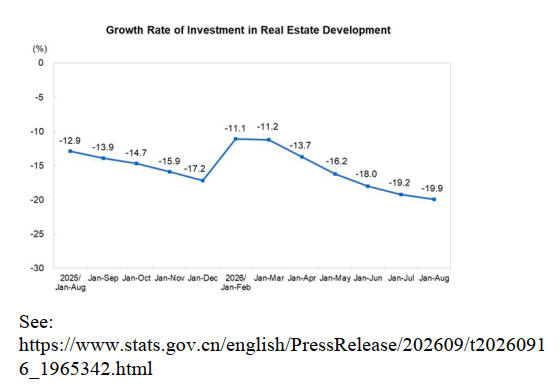
investment in real estate development from January to
August 2026. Between January and August investment in
real estate development declined 19.9% year on year, of
which investment in residential buildings was down
19.7%.
From January to August the floor space of buildings under
construction by real estate development enterprises fell
12.8%.
New economic direction with domestic consumption at
its core
China appears to be adjusting policies related to the
domestic economy, shifting from a debt-fueled real estate
model to consumption-led growth. This has involved
tighter property presale rules.
To rebuild homebuyer confidence and mitigate the risk of
unfinished housing projects, financial regulators have
dismantled the traditional property pre-sale financing
approach adopted in the real estate sector and are
undertaking a consumption-tax revenue review.
Developers can no longer apply for presale permits or
access buyer down payments at early stages of
construction. The building’s main structure (the core
frame and roof) must be complete before a presale permit
is issued.
In addition, mortgages and down payment proceeds are
now disbursed to developers only when projects are fully
completed. Previously, developers could tap these funds
much earlier, being tempted to divert them to finance
separate projects. A newly enacted "lead bank" system
places development loans into closed-loop escrow
accounts, shifting real estate credit from corporate-level
financing to strict project-based management.
To offset the massive fiscal shortfalls from declining land
sales, The government is reportedly redrawing its tax-
sharingsystem. For decades, China's consumption tax
belonged exclusively to the central government.
Under new legislative plans, the government is steadily
delegating consumption-tax revenue directly to local
municipal governments. Experts estimate that distributing
a share of high-yielding taxes (such as fuel, tobacco and
luxury automobile taxes) could yield over RMB700 billion
annually for local budgets.
To streamline this transition further, the Ministry of
Finance has drafted a Local Surtax Law. This merges three
legacy education and urban construction surcharges into a
single, comprehensive tax category charged on top of
value-added tax (VAT) and consumption tax payments.
Provincial governments will have the flexibility to fix
local rates between 11% and 13%, with 100% of the
revenue retained by local coffers.
These policy shifts change the fundamental incentives for
local officials. Under the old system, the fastest path to
balancing a municipal budget was aggressive land sales
and speculative construction, regardless of organic
demand.
By linking a city’s primary revenue to localised
consumption, local authorities are now incentivised to
stimulate consumer spending power, upgrade local
business districts and foster sustainable infrastructure.
See:
https://english.www.gov.cn/policies/policywatch/202607/14/cont
ent_WS6a56347fc6d00ca5f9a0c2e8.html
and
https://www.businesstimes.com.sg/international/chinas-new-
home-presale-rules-could-cut-land-sales-30-goldman
and
https://www.scmp.com/economy/policy/article/3367608/will-
chinas-new-local-surtax-provide-relief-its-regions-fiscal-
headaches
Rise in wood panel prices
The Chinese woodbased panel industry has once again
announced a further round of price increases. The price
increases for different types of panel vary and wholesalers
have stated that they will not accept verbal reservations,
do not accept advance payments and the transaction price
will be based on the quoted price on the day of the order.
The main reason for this price increase is the continuous
rise in prices of chemical raw materials. Affected by
factors such as fluctuations in international crude oil prices
and tense geopolitical situations in the Middle East, prices
of chemical raw materials have been experiencing a steady
increase this year.
Decrease in rubberwood imports from Thailand
According to China Customs, in August 2026 China
imported 323,000 cubic metres of rubberwood from
Thailand, a decrease of 8% in volume but increase of 9%
in average price over the same period of 2025.
.
From January to August 2026, a total of 2.78 million cubic
metres of rubberwood from Thailand were imported, a
decrease of 5% compared to the previous year. During the
same period, the average import price increased by 10%,
continuing the typical volume decline but price increase
operating pattern that has been characteristic of
rubberwood industry this year.
It has been noted that the main rubberwood production
areas in Thailand have recently suffered from continuous
heavy rain and floods causing complete disruptions in the
rubberwood logging and transportation processes. Coupled
with factors such as the increase in energy costs and the
cancellation of logging subsidies since this year the supply
of Thai rubberwood is expected to tighten in the future.
Anti-dumping duties on Chinese wooden bedroom
furniture makers
It has been reported that US has imposed anti-dumping
duties on 11 Chinese enterprises manufacturing wooden
bedroom furniture. The US Department of Commerce
decided that 11 Chinese companies under review failed to
prove their eligibility for separate tariff rates. As a result,
all of them are regarded as China-wide entities and are
subject to the China-wide entity tariff rate, with an anti-
dumping rate of 216.01%.
The taxable product range includes wooden bedroom
furniture produced in China. The US tariff codes (HS) of
the involved products include 9403.50.9042,
9403.50.9045, 9403.50.9080, 9403.90.7005,
9403.90.7080, 9403.50.9041, 9403.60.8081,
9403.20.0018, 9403.90.8041, 7009.92.1000 and
7009.92.5000.
Any bedroom furniture made of all wood or mainly of
wood and with a unified style (beds, cabinets, tables, etc.)
falls under subjected products of the US anti-dumping
duty. Other no-bedroom non-bedroom furniture (tables,
chairs, office desks, etc.) or pure rattan, rattan strips, rattan
vines furniture are completely excluded from this list.
See:
https://www.federalregister.gov/documents/2026/08/12/2026-
16446/wooden-bedroom-furniture-from-the-peoples-republic-of-
china-final-results-of-antidumping-duty
New standard for antibacterial building materials
A new industrial Standard for antibacterial building
materials (JC/T 2039—2026 Antibacterial, Anti-Mildew
and Anti-Virus Performance of Wood Decorative Panels)
has been released and will be implemented soon.
This Standard is under the jurisdiction of the Technical
Committee for Environmentally Friendly and Health-
Beneficial Building Materials in the Building Materials
Industry. It was announced in April 2026 and will come
into effect in November 2026.
This Standard will replace JC/T 2039 - 2010
Antimicrobial and Mold-Resistant Wood Decorative
Panels.
The Standard specifies the classification and marking of
the antibacterial, anti-mildew and anti-virus properties of
wood decorative panels, general requirements, technical
requirements, test methods and determination of test
results.
It will be applicable for the inspection and determination
of the antibacterial, anti-mildew and anti-virus properties
of wood decorative panels and baseboards used in building
decoration and renovation. Other material panels can also
be referred to.
It should be noted that this Standard does not apply to
photocatalytic panels that generate antibacterial and anti-
virus functions through light exposure.
See:
https://www.kjj.com.cn/index.php?m=content&c=index&a=sho
w&catid=256&id=18637
Particleboard factory for Zambia
A Chinese enterprise recently concluded a study for a
particleboard production plant in Zambia as part of the
Belt and Road initiative. A company team visited Ndola,
Kitwe and Lusaka in Zambia conducting a series of
negotiations regarding the project site conditions, technical
plans, implementation paths and market opportunities.
See:
https://www.sinomach.com.cn/xwzx/zgsdt/2026_qydt/202610/t2
0261010_657370.html
|


