Japan
Wood Products Prices
Dollar Exchange Rates of 25th
October
2026
Japan Yen 157.86
Reports From Japan
Can stable inflation support the Yen?
Expectations of additional interest rate tightening are
underpinned by the latest inflation figures in the United
States and Japan. Japanese inflation, excluding fresh food,
climbed from 1.7% to 2.1%, exceeding the Bank of
Japan’s (BoJ) 2% target. Excluding both fresh food and
energy the measure advanced from 1.9% to 2.4%.
The BoJ, say analysts, is “widely expected to keep rates on
hold at 1.25% and assess September’s 25 basis point raise
before tightening again.” In September the BoJ governor
warned that rapid rate hikes could unsettle asset prices and
cautioned that “it could take some time to confirm that 2%
inflation is entrenched.”
However, The BoJ governor is reported as saying “I
cannot tolerate underlying inflation rising further above
2%”, reinforcing expectations for policymakers to raise
interest rates further in coming months. He added that the
bank will consider the timing and pace of hike while
monitoring developments in the Middle East, AI-related
demand and exchange rates and assessing the risks
surrounding them.
“The policy phase has recently shifted toward making sure
inflation settles at around 2% as a key objective,” he said
after attending annual meetings of the International
Monetary Fund and World Bank.
The Japanese yen is trading steadily around 157.80 per US
dollar as the BoJ prepares for its upcoming policy
decision.
The yen has been sliding for years, driven down largely by
near-zero Japanese interest rates that turned the currency
into the world’s cheapest source of funding. In late July,
the U.S. joined Japan in a historic intervention to
strengthen the yen but it is again losing ground.
The yen traded at around 163 per dollar in July 2026
before strengthening about 5% to reach 155 to the US
dollar following the intervention but by August it had
weakened 2.5% to around 159 per dollar. That left the
currency close to its weakest level. Intervention briefly
changed the market sentiment but not the key drivers of
the currency’s standing. It is widely considered that
strengthening the yen requires lower US interest rates
and/or faster tightening by the BoJ.
The key question is whether the forces behind the yen
weakness are starting to reverse. Morgan Stanley Global
Chief Economist and Head of Macro Research has
commented “For the yen, the outlook depends much more
on the US Federal Reserve than on the intervention or the
Bank of Japan.”
See: https://www.tmgm.com/en-in/analysis/market-
news/article/japanese-yen-weakens-with-fed-and-boj-monetary-
policy-meetings-in-focus-202610261812
and
https://www.japantimes.co.jp/business/2026/10/17/economy/boj-
2-percent-inflation/

Rising prices weigh on household sentiment
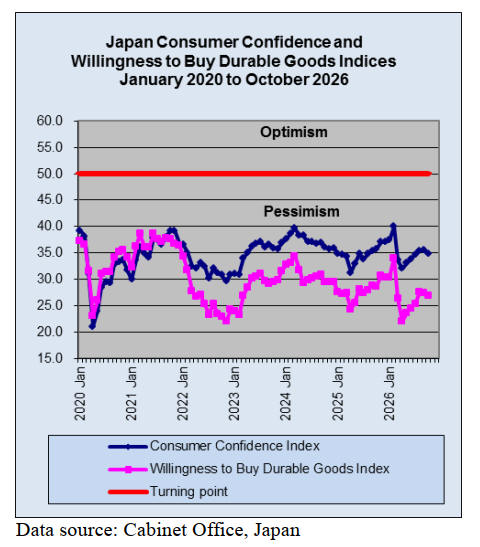
The October Consumer Sentiment Survey released by
Japan's Cabinet Office reports the Consumer Confidence
Index fell from the previous month, deteriorating for a
second consecutive month. All four components declined,
with livelihood and employment conditions each dropping.
Rising prices for food and beverages weighed on
household sentiment. The Cabinet Office kept its baseline
assessment unchanged at "signs of a pickup are seen."
The share of respondents expecting prices to rise a year
from now climbed to 91%, underscoring persistent
inflation vigilance.
See: https://www.esri.cao.go.jp/en/stat/shouhi/shouhi-e.html
Labour Federation calls for 6% wage hike in 2027
Japan’s largest labour union Federation (Rengo) has
indicated in its draft policy framework it will seek wage
increases of around 6% in next year’s pay negotiations,
seeking to build on recent gains as the government targets
sustained pay rises to help drive consumer spending and
boost growth.
Rengo Chair, Tomoko Yoshino, said we have achieved
wage increases of at least 5% for three consecutive years
and a norm of rising pay is beginning to take hold but that
‘real’ wage growth of at least 1% needs to be established.
Member unions typically submit their wage demands by
around February, with companies responding from March
onward.
Workers affiliated with Rengo secured an average wage
increase of 5% in negotiations earlier this year. Along with
easing inflationary pressures, the pay increases helped lift
Japanese workers’ real wages for an eighth straight month
in August, the longest streak of gains in almost a decade.
See:
https://www.japantimes.co.jp/business/2026/10/22/economy/japa
n-rengo-union-wage-hike-demand/
5-year ban on condo resales
Chiyoda Ward in Tokyo is exploring ways to slow soaring
property prices fueled in part by speculative buying. The
authorities in Chiyoda have urged condominium
developers to include a clause in contracts explicitly
banning reselling units for five years after purchase. It also
urged developers to prohibit buyers from purchasing
multiple units in the same building under the same name.
According to the Ward, ‘scalping’ has driven up the prices
of new condominiums, which in turn has pushed up prices
in the used home market and apartment rents.
The ward also said that the quick profit ‘scalping’ could
increase the number of unoccupied units. The ward made a
similar request to the real estate industry July last year but
nothing appears to have changed.
See:
https://mainichi.jp/english/articles/20261028/p2g/00m/0bu/0120
00c
Government considers curbs on speculative condo
trading
A project team of the ruling Liberal Democratic Party has
submitted a proposal for measures to restrict speculative
trading of condominiums. In the proposal, the team cited
an increase in short-term transactions as a reason for
recent surge in prices. It also said that residential
properties in urban areas bought for speculative purposes
are fueling concerns among local residents.
The team called on the government to take action,
including tax measures, as soon as possible, saying that
speculative transactions that are not based on actual
demand should be restricted, regardless of whether they
are conducted by Japanese or foreign nationals.
See:
https://www.japantimes.co.jp/news/2026/10/01/japan/politics/ldp
-condo-speculative-trading/
Foreign residents reach 4 million as regional housing
demand evolves
Japan's foreign resident population reached a record 4.28
million in June 2026 even as the country's overall
population continues to decline. For Japan's housing
market, the more interesting development is where these
residents are settling and how their accommodation needs
differ.
See: https://www.patiencerealty.com/post/japan-foreign-
residents-reach-4-million-as-regional-housing-demand-evolves
Import update –assembled wooden flooring and
plywood
China accounts for roughly 55–60% of Japan's multi-layer
and assembled wood flooring imports, heavily driven by
the HS441875 product category. Southeast Asian nations
including Vietnam, Malaysia and Indonesia supply the
remaining share.
Japanese brands frequently use outsourced manufacturing
or joint-venture production hubs in China and Southeast
Asia to blend low-cost processing with strict Japanese
quality and low-VOC standards. The Japanese market
favours multi-layer engineered wood flooring and light-
colored timber species over heavy solid wood.
Japan's transition from imported Southeast Asian Meranti
to domestic logs for plywood production represents one of
the most significant structural shifts in the global timber
industry over the last few decades.
Historically, Japanese end-users strongly favored tropical
hardwoods, collectively known as lauan or South Sea logs,
dominated by Meranti (Shorea spp.) These logs yielded
clear, knot-free, uniform veneers that were ideal for
concrete formwork and premium panels. However, a
combination of resource depletion, environmental
concerns, and strict government policies fundamentally
reshaped the market
Assembled wooden flooring
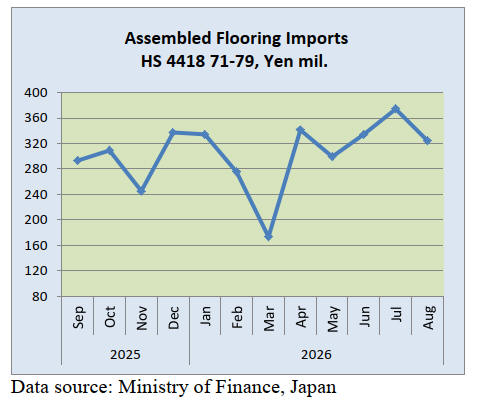
Year on year, in August 2026 the value imports of
assembled flooring (HS441871-79) declined 23% and
compared to July 2026 August imports were down 13%.
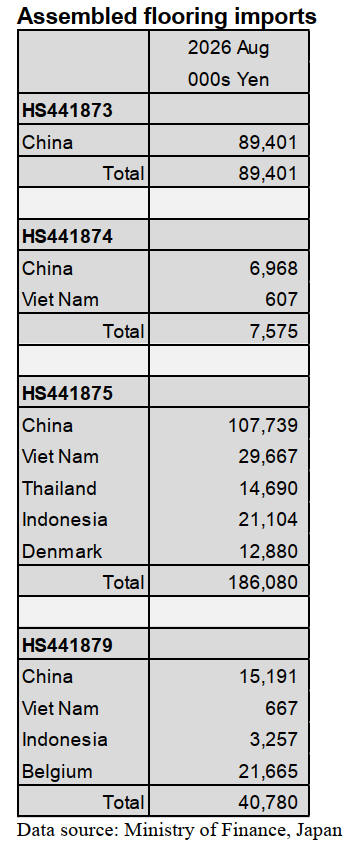
Of the various categories of assembled flooring imports,
HS441875 was the largest accounting for 57% of all
assembled flooring imports (63% in July). In August,
arrivals were from the main shipper in China and shippers
in SE Asia. The only EU shipper of HS441875 in August
was Denmark.
In August 2026, shippers in China accounted for the total
value of HS4418-73 imports the value of which was down
month on month by more than half.
The value of August imports of HS4418-73 accounted for
28% of total assembled flooring imports (23% in July).
The value of HS4418-74 imports in August 2026 was
down by a factor of 4 from a month earlier extending the
decline seen in July. China was the main shipper
accounting for over 90% of the value of arrivals.
HS4418-79 accounted for 13% of total value of imports in
August (8% in July) with Belgium and China being the top
shippers. The value of HS4418-79 imports was more than
30% below that of the previous month.
Plywood imports
Over the past few years Japan's plywood sector has shifted
to increased domestic log utilisation for plywood
manufacturing at a time when supply from traditional SE
Asian exporters has declined. Japan's plan for the forestry
sector prioritises domestic roundwood, targeting an
increase in deliveries to processing and plywood mills
(aiming for 21 million cubic metres by 2030).
Japan’s plywood imports rose in the first half (including
Q2) of 2026, climbing 6% year-on-year to over 1.09
million cubic metres.
It has been suggested that this was driven by speculative
advance procurement, domestic adhesive shortages and
geopolitical/logistics disruptions.
See:
https://www.globalwood.org/news/2026/news_20260518.htm
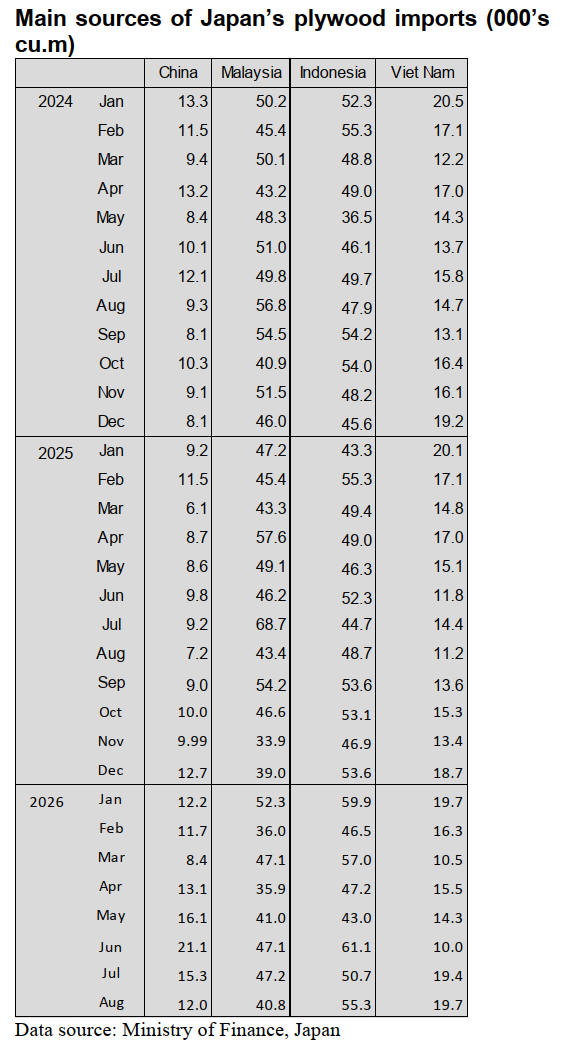
The volume of plywood imports in August rose around
20% year on year clawing back some of the year on year
losses report in July. However, August 2026 import
volumes were reported at around the same level as in July.
Month on month, there was a decline in the volume of
August arrivals from China and Malaysia while imports
from Indonesia increased. The volume of plywood imports
from Viet Nam is not large (19,700 cu.m in August) and in
August import volumes were at around the same level as
in the previous month.
In August arrivals of HS441210-39 were reported at
133,163 cu.m (138,681 cu.m in July). As in previous
months, of the various categories of plywood imported in
August 2026, HS4412-31 accounted for 81% (80% in
July) followed by HS4412-33, 7% (7% in July), HS4412-
34 and HS4412-39 each at 6% (6% in July) with the
balance being HS4412-10.

Trade news from the Japan Lumber Reports (JLR)
The Japan Lumber Reports (JLR), a subscription trade
journal published every two weeks in English, is
generously allowing the ITTO Tropical Timber Market
Report to reproduce news on the Japanese market
precisely as it appears in the JLR. For the JLR report
please see: https://jfpj.jp/japan_lumber_reports/
Laying the groundwork for cedar and cypress exports
The Japan Wood Products Export Association announced
on September 24 that Japanese cypress timber had been
approved for design values by the American Lumber
Standard Committee (ALSC) on July 14. The approval
covers “timbers, defined as structural lumber with a cross-
sectional dimension exceeding 4 inches on the shorter
side.
Design values have already been approved for Japanese
cedar and cypress 2×4 structural lumber dimension
lumber), as well as Japanese cedar timbers. This latest
approval covers cypress timbers.
As in previous cases, the project was carried out by the
Japan Lumber Inspection and Research Association as a
commissioned project, with the cooperation of Oregon
State University in the United States and the Forestry and
Forest Products Research Institute of Japan.
According to the association, efforts are now underway to
obtain design value approval for todomatsu (Sakhalin fir)
from Hokkaido for use as 2×4 structural lumber, following
Japanese cedar and cypress. However, full-scale testing is
not expected to begin until the next fiscal year or later.
To export structural lumber made from Japanese domestic
timber to the United States, the lumber must be graded for
structural use by the Pacific Lumber Inspection Bureau
(PLIB), a U.S. inspection agency. To support this process,
the Japan Wood Products Export Association is also
working to train personnel, including lumber graders.
South Sea logs and Lumber
Demand for tropical hardwood logs remains firm,
particularly for blocking materials used in the steel and
shipbuilding industries, as well as heavy-duty pallet stock.
Domestic sawmills have sufficient inventories but
shipments of Papua New Guinea logs scheduled for year-
end may be delayed by unfavorable weather in the
producing region, raising concerns over future supply.
Prices for tropical hardwood and Chinese-made products
remain high due to limited log supplies, low procurement
by plywood mills in producing countries and higher
import costs caused by the weak yen. Market participants
see little prospect of price relief in the near term.
Laminated edge-glued panel prices also remain elevated.
Indonesian merkus pine products are expensive,
discouraging distributors from making large purchases,
while Chinese red pine and radiata pine products continue
to trade near recent highs.
SE Asian plywood Industry raffirms commitment to
shared growth
A trilateral plywood conference involving Japan,
Indonesia and Malaysia was held in Jakarta in September,
bringing together 48 industry representatives. Participants
exchanged views on market conditions and agreed on the
importance of sustainable growth in the Asian plywood
industry, while confirming that the next meeting will be
held in Tokyo in September 2027.
Indonesia reported that high U.S. tariffs, including
antidumping and countervailing duties, have significantly
reduced plywood exports to its largest market, forcing
some producers to scale back or withdraw from the United
States.
As a result, Japan has become an increasingly important
export destination. Malaysia said market conditions
remain challenging but less severe than those facing
Indonesia.
The Japanese side said the domestic plywood industry
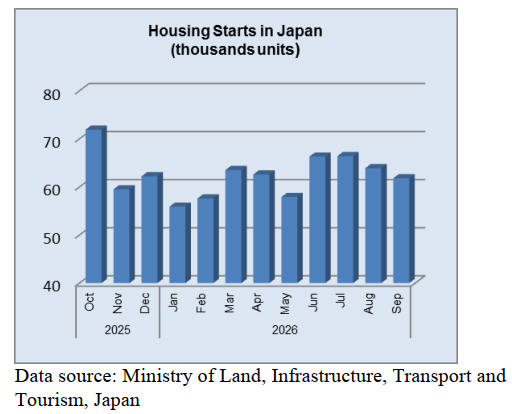
continues to struggle with weak demand caused by falling
housing starts and rising costs linked to labor shortages
and the weak yen. Nevertheless, the industry intends to
strengthen its foundations through market development
and greater efficiency.
During the discussion, Indonesian participants expressed
concern over rising imports of Russian plywood into
Japan. Japan responded that Russian plywood mainly
serves project-based demand and does not directly
compete with tropical hardwood plywood. Indonesia also
noted that plywood exports to India have been limited by
BIS regulations, which restrict transactions to approved
companies despite expectations for market growth.
Cumulative CLT Building Completions to Exceed 2,000
The cumulative number of completed buildings utilizing
cross-laminated timber (CLT) is expected to exceed 2,200
in fiscal 2026, according to data compiled by the Cabinet
Secretariat. The total stood at 1,850 projects in iscal 2025,
meaning the cumulative figure is set to surpass the 2,000
mark for the first time.
By application, the housing sector, particularly detached
houses, is expected to record another substantial increase
in the number of CLT projects in fiscal 2026 following
strong growth in fiscal 2025.
In addition, CLT has been selected for use in the Thematic
Pavilion (Atrium Building) being developed by the City of
Yokohama and the Japan Government Garden (East
Building) being developed by the national government for
Green × Expo 2027, the International Horticultural Expo
scheduled to open in Yokohama next March.
Wood calms the brain
A study by Chiba University has foound that touching
wooden surfaces can promote relaxation, providing
evidence for the wellbeing benefits of wood interiors. The
research was conducted for the Tokyo Timber Wholesalers
Cooperative Association to explore wood's effects on
human wellbeing in everyday settings.
In the experiment, 25 healthy male university students
touched either a wooden or melamine-faced conference
table while blindfolded. Results showed that touching the
wooden table reduced activity in both sides of the
prefrontal cortex, while participants reported greater
comfort and relaxation.
A separate experiment at Mokuzai Kaikan also found
that
viewing wooden walls reduced prefrontal cortex activity,
suggesting that wood interiors can have calming effects on
both the body and mind.
See: https://www.chiba-u.jp/news/research-collab
|


