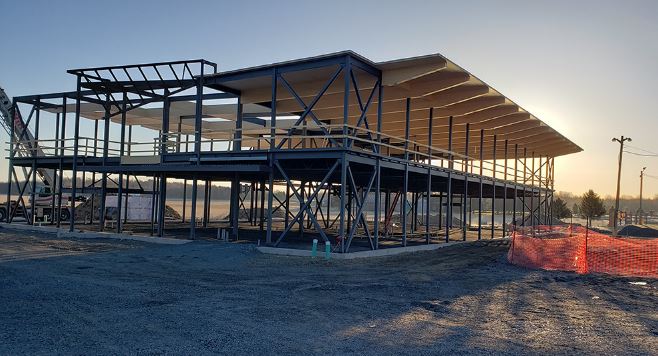
Mass timber’s profile is rising but many architects and
engineers are still unfamiliar with how it can be integrated
into their designs.
Over-engineered solutions can lead to complications, resulting
in wasted time, unnecessary costs and heightened execution
risks.
Design efficiency starts by emphasizing repetition and
standardization in sections and connections, says Pierre-Yves
Leroux, sales representative and technical adviser with Art
Massif, a mass timber glulam manufacturer based in
Saint-Jean-Port-Joli, about 80 kilometres southwest of Quebec
City.
Leroux, who presented a webinar, hosted by Woodworks Atlantic,
covered structural optimization methods, moisture protection as
well as anchor and connection details that can result in cost
and time savings.
He says one of the keys to success is retaining a mass timber
manufacturer early in the design process to validate spans,
assembly feasibility and installation logistics.
Using a 3D model to ensure fit across disciplines, including
mechanical, steel and envelope designs is critical, Leroux says,
adding mockups and testing of critical path connections allow
for reserve time in the schedule, if required.
“With too many sections and beam references, you increase your
designing time for screw and steel connections. It increases the
time for ordering the material, fabricating it and co-ordinating
it with our supplier and it also increases the risk of error at
installation.”
Among the challenges with long spans, he adds, are shipping
complications to site, increased risk of damage and excessive
deflection and tolerance issues with other members.
Leroux says Art Massif has developed a prefabrication process
for glulam timber decking planks with attached plywood and a
temporary membrane that reduces the time/risk of exposure of the
structure to the elements. It can also eliminate up to 60 per
cent of the installation time.
The prefabricated decking panel system was used on the roofs of
two 27,000-square-foot middle schools in Quebec, cutting
installation time by four to five weeks over a conventional
installation.
He adds the decking can be manufactured in a variety of
thicknesses.
For the 13,800 square foot theatre at the Hudson Valley
Shakespeare Campus in the Hudson Valley, New York, Art Massif
specified a slim 1.5” decking that provides design flexibility
on the “signature project.”
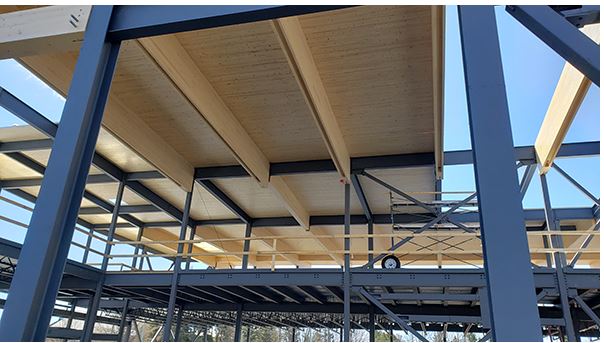
The decking can be manufactured in a variety of thicknesses.
The curved glulam beams offer “sweeping shapes” to the
structure, he says.
“The panelization of the GLT decking on glulam is a very
interesting solution to use for an optimized decking system on a
large surface.”
While engineering design is often established by the time Art
Massif enters the picture, in some cases such as the Shakespeare
theatre job, the manufacturer was involved in a design assist
capacity.
Leroux says another important factor early in a project is to
design a structure with moisture protection in mind. Roof
overhangs, elevated column bases, the elimination of drill hole
perforations and moisture protection during concrete pours can
eliminate headaches later on.
In its plant a waterproof wax is applied to the non-visible end
grain of all elements to prevent moisture infiltration, Leroux
says, adding the co-ordination of design work with the general
contractor and subs such as roofing membrane and steel suppliers
is important early on.
As for anchoring points, rather than go with the most common
method of cast-in-place steel rods, a preferred option is
chemical anchors that allow for precise positioning onsite and
can withstand gravity loads, he adds.
Source: canada.constructconnect.com


