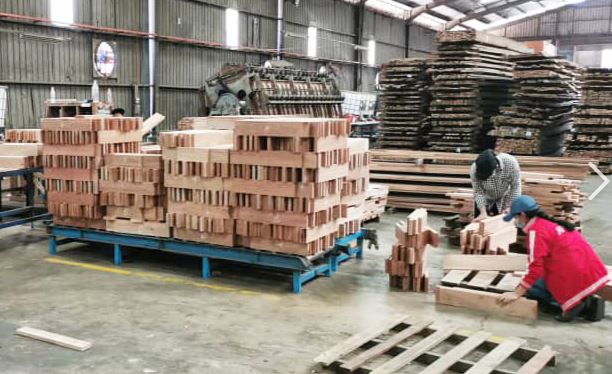
Malaysia’s timber exports continue to show resilience, achieving
a total value of RM9.03 billion from January to May this year
despite headwinds such as the United States’ imposition of
tariffs, a slowdown in the global economy and other external
challenges.
Plantation and Commodities Deputy Minister Datuk Chan Foong
Hin said the main export products during this period were wooden
furniture worth RM3.9 billion, plywood RM933.8 million, sawn
timber RM797.8 million, builders’ joinery and carpentry RM560.5
million, and mouldings RM382 million.
“Nevertheless, the industry continues to strive for better
results despite the challenges faced, to maintain the
competitiveness of Malaysia’s timber exports,” he said at a
Timber Exporters’ Association of Malaysia (TEAM) anniversary
event recently that drew over 400 attendees, including
representatives from government agencies, industry councils,
international buyers and trade partners.
Chan acknowledged the industry’s concerns over the European
Union Deforestation Regulation (EUDR), which demands a high
level of supply chain transparency and verification.
In response, he said that the ministry is working closely with
relevant agencies to ensure full compliance throughout the
entire timber value chain, with a strong focus on traceability,
transparency and legality.
The ministry has also been engaging with industry stakeholders,
including TEAM, on other developments such as the proposed
listing of the Shorea species under Appendix II of the
Convention on International Trade in Endangered Species or
CITES.
“While this listing poses compliance and operational challenges,
it also presents an opportunity for Malaysia to reinforce its
position as a leader in sustainable and verified timber
production,” Chan said.
He noted that the global timber trade has become increasingly
competitive, with neighbouring countries such as Indonesia and
Vietnam recording strong growth over the past two decades.
“Nevertheless, Malaysia continues to maintain its edge through
adherence to legal frameworks, professionalism and a
long-standing reputation for quality values that TEAM has
consistently upheld,” he added.
Chan also addressed domestic concerns over the expanded Sales
and Service Tax (SST) and US trade tariffs, which have raised
costs and eroded competitiveness. The SST, he said, has
increased operational expenses by 8–12%, which has pushed up
prices across the supply chain and particularly affected small
and medium enterprises.
“Although export products aren’t directly taxed, rising
production costs are starting to erode Malaysia’s long-standing
export strength. Meanwhile, US trade tariffs may reduce export
volumes and profit margins, although economists believe the
overall impact on Malaysia’s 2025 trade balance will be
minimal,” he said.
To mitigate these effects, Chan said, the ministry, along with
agencies such as the Malaysian Timber Industry Board, the
Malaysian Timber Council, TEAM, and the Malaysian Furniture
Council, are actively engaging stakeholders to identify
challenges, ease compliance burdens, and protect the timber
sector’s global standing.
“These efforts include gathering industry feedback and
supporting businesses in maintaining high standards of quality
and sustainability. The ministry encourages unity and innovation
among industry players to ensure Malaysian timber products
continue to be valued worldwide,” he said.
Looking ahead, Chan said the domestic timber industry’s future
will be shaped by three major trends – sustainability, digital
transformation and evolving consumer lifestyles. “Through the
National Agricommodity Policy 2021–2030, we are addressing these
challenges via five key thrusts: sustainability, productivity,
value creation, market development, and inclusivity.:
Chan emphasised that global consumers now place strong emphasis
on environmentally responsible products, adding that Malaysian
manufacturers are already at the forefront of sustainable
practices, backed by internationally recognised certification
such as the Malaysian Timber Certification Scheme (MTCS).
MTCS is the first tropical timber certification in the
Asia-Pacific to be endorsed by the Programme for the Endorsement
of Forest Certification (PEFC), the world’s largest forest
certification system.
Source: thesun.my


