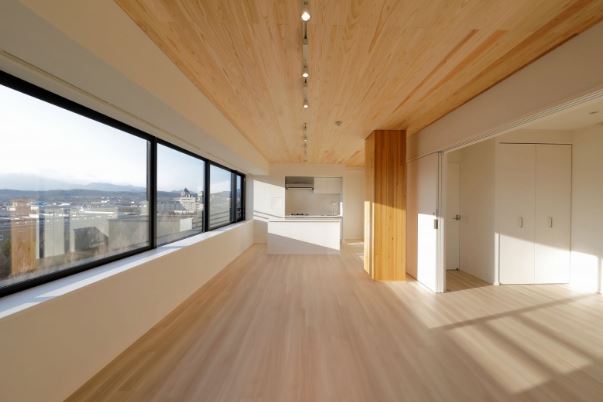
Construction of wooden mid-rise and high-rise buildings, as well
as the incorporation of wood into the interior and exterior of
buildings, is gradually increasing in the Tohoku region.
Major real estate developers and construction companies are
focusing on wood, pushed by legislation and systems encouraging
the use of domestically produced lumber created amid the trend
of decarbonization.
The country's forestry industry, however, is losing industrial
competitiveness because of the decline of people engaging in the
business and dwindling lumber prices.
The forestry industry is trying to take advantage of the
business opportunity through adopting digital technologies and
improving supply chains.
“Mid-rise and high-rise wooden buildings are shifting from the
phase of assessing whether they are technologically viable to
the phase of whether they can be chosen by clients and users,”
said Hiroyuki Adachi, managing director of Shelter, a wooden
architecture construction firm in the city of Yamagata, during a
seminar in Sendai in July.
According to the infrastructure ministry, construction began for
a total of 59 mid-rise wooden buildings with between four and
nine stories across Japan in fiscal 2024, which ended in March
this year.
Since the 1970s, Shelter has been working on developing
technologies to enhance the strength of wooden buildings and
boost the efficiency of constructing them.
In 2021, the firm completed the construction of Takaso Mokko
Building, Japan’s first fully wooden seven-story building, in
front of Sendai Station in the city of Sendai.
“If local businesses start taking on the challenge of
constructing wooden buildings using locally produced lumber, the
system of distributing lumber and returning the profits to
forests will change,” Adachi said.
Attempts to use more wood in buildings spread after the
government took legislative actions to encourage such moves amid
growing interest in decarbonization and sustainability.
In 2010, Japan enacted a law to promote the use of wood
materials in public buildings. The law was amended in 2021 to
expand the scope of promoting wood use to buildings in general.
Along with the development of highly heat-resistant and durable
wooden construction materials and accelerated technological
innovations, major real estate developers and construction firms
are ramping up the use of wood.
In 2019, Mitsubishi Estate built the 10-story Park Wood Takamori
in Sendai, the country’s first high-rise apartment building that
uses cross-laminated timber — prefabricated, solid engineered
wooden panels that are lightweight yet very strong — as floor
material.
Since then, the company has been expanding the use of wooden
materials in a variety of structures, including airports and
hotels.
Initially, there were challenges in producing wooden materials,
making wooden buildings about 30% more expensive to construct
than reinforced concrete (RC) buildings. But the situation has
improved as the use of wooden materials has become more
widespread.
Amid a rise in the prices of construction materials such as
ready-mixed concrete, Mitsubishi Estate’s subsidiaries are
receiving inquiries from those wishing to switch to wooden
materials.
“In mid-rise buildings (of roughly three to five stories), we
are beginning to see a price advantage in wooden structures and
wooden materials,” said a Mitsubishi Estate official. “Another
advantage is that the construction period is shorter compared
with RC buildings.
“We hope to achieve more results in high-rise buildings as
well.”
While the range of the use of wood expands, the forestry
industry that supplies the material is facing challenges.
“The price gap between domestically produced wood and foreign
wood is not that big,” said Ryota Kajiwara, head of the
corporate planning office at Miyagijujo Group, a major forestry
firm in Sendai that produces roughly 150,000 cubic meters of
timber a year.
“The biggest weakness (of the domestic forestry industry) is its
unstable supply system, attributable to the fact that many of
the forestry firms are small.”
Domestic timber prices temporarily rose during the global “wood
shock” that began in 2021, but they have since stagnated.
The forestry industry has been hit by further problems including
a decrease in housing construction — the mainstay of its
business — and rising costs of producing lumber.
About 60% of man-made forests in Japan are 50 years old or older
since saplings were first planted.
These forests are now ready for full-scale harvesting, but
logging has stalled due to the declining profitability of the
forestry industry. The reforestation rate of logged forests also
remains low, at about 20% to 30%.
In order to achieve a stable supply of domestic lumber,
Miyagijujo Group is working on establishing a traceability
system to keep track of the logging process.
The firm is also working to increase efficiency through the use
of digital technologies. To confirm forest boundaries, it is
adopting an app that utilizes the Geographic Information System,
rather than relying on the conventional method of checking paper
maps. It uses drones to survey reforested areas.
“The forestry industry has been an analog industry, meaning
there is a lot of room for productivity improvement,” Kajiwara
said. “By following the global trends of SDGs (sustainable
development goals) and ESG (environmental, social and corporate
governance), we hope to seize the opportunity by making use of
Japan’s strength of having a rich accumulation of man-made
forests.”
Source:
japantimes.co.jp


