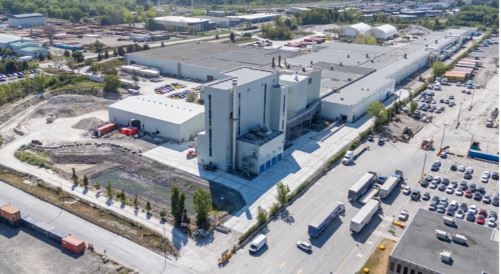
Saint-Gobain Canada has completed an expansion and upgrade
project at its CertainTeed Gypsum plant in Sainte-Catherine,
Quebec. According to the company, the facility is now North
America’s first zero-carbon (scopes 1 and 2) gypsum wallboard
plant and the largest in the world. First announced in 2022,
Saint-Gobain completed major electrification upgrades allowing
the plant to be solely powered by renewable electricity.
The facility upgrades also helped decrease energy usage by up to
30% and boost production capacity by up to 40%, the company
says.
With new processes and equipment, CertainTeed’s plant has
reduced its CO2 emissions by 44,000 tons per year – equivalent
to the average emissions of 14,000 cars annually. This milestone
also marks the launch of a new Infinaé gypsum wallboard category
in Canada, within which CarbonLow, produced locally, is
estimated to have up to 60% less embodied carbon cradle-to-gate.
“The ambitious electrification project we just completed in
Canada is a tangible and impactful example of Saint-Gobain's
commitment to making the world a better home,” shares
Jean-Claude Lasserre, CEO, Saint-Gobain Canada. “We were also
able to increase production capacity to help address the housing
shortage.”
Mark Rayfield, President & CEO, Saint-Gobain North America:
“This important investment will not only make Saint-Gobain North
America the leader in sustainable drywall manufacturing, it will
further our operations in Canada, where we remain committed to
growth and providing light and sustainable building materials
for all Canadians.”
A three-year transformation
Overall, 80% of the plant’s equipment was upgraded through this
three-year project and new processes were implemented to
significantly reduce carbon emissions:
Replacing natural gas burners with highly efficient electrical
heating elements.
Implementing real-time smart energy meters and management
system.
Implementing multiple heat recovery systems and upgrading
equipment insulation.
Adding process sensors to monitor and improve production
quality.
Improving compressed air design.
Additional improvements are being implemented and will be
deployed in the near future to further improve sustainability at
the site:
Increasing recycled content by using pre- and post-consumer
waste.
Reducing inbound transportation of natural gypsum rock from
various sources.
Source: hbsdealer.com


