The UK furniture market growth is driven by evolving consumer
preferences for multifunctional, sustainable designs, and rapid
e-commerce expansion. Market potential lies in eco-friendly
products, digital sales tools, and locally sourced furniture
amidst supply chain challenges and raw material volatility.
The "United Kingdom Furniture Market, By Region, Competition,
Forecast and Opportunities, 2020-2030F" report has been added to
ResearchAndMarkets.com's offering.
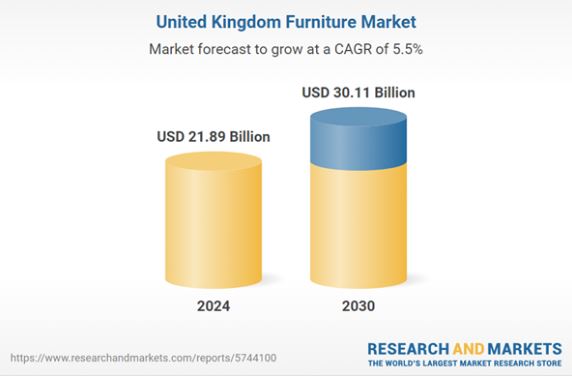
The United Kingdom Furniture Market was valued at USD 21.89
Billion in 2024, and is expected to reach USD 30.11 Billion by
2030, rising at a CAGR of 5.46%
The United Kingdom furniture market is experiencing steady
growth, driven by evolving consumer preferences, rising
urbanization, and a surge in home renovation activities. Demand
is particularly strong for multifunctional, space-saving, and
sustainable furniture, reflecting the growing influence of
eco-conscious and minimalist lifestyles.
The online furniture retail segment is expanding rapidly due to
convenience, wider product variety, and advanced visualization
tools like AR and VR. Increasing disposable income and the
popularity of interior design trends promoted through social
media also fuel market expansion. While imports play a key role,
there is a rising preference for locally sourced, artisanal
furniture.
Key Market Drivers
Growth in E-commerce and Digital Transformation
One of the primary drivers of the United Kingdom furniture
market is the rapid growth of e-commerce and digital
transformation in retail. The UK's eCommerce revenue is
projected to reach USD 285.60 billion by 2025, driven by an
average annual growth rate of 12.6%. Online platforms have
revolutionized the way consumers purchase furniture, offering
greater convenience, wider product selections, and competitive
pricing.
Major furniture retailers have enhanced their digital presence,
enabling features like virtual room planners, augmented reality
visualization, and AI-driven recommendations. These innovations
reduce purchase hesitation and improve the overall buying
experience. The COVID-19 pandemic further accelerated the shift
towards online channels, making digital infrastructure a
strategic priority for both large and small furniture
businesses. With consumers increasingly comfortable buying
high-ticket items online, the UK furniture market continues to
witness robust growth in the digital segment.
Key Market Challenges
Supply Chain Disruptions and Raw Material Volatility
One of the most pressing challenges facing the United Kingdom
furniture market is the continued disruption of global supply
chains and the volatility in raw material prices. The industry
relies heavily on the import of materials such as timber, metal,
foam, and textiles, many of which are sourced from countries in
Europe, Asia, and North America. Events like Brexit, the
COVID-19 pandemic, and geopolitical tensions have significantly
disrupted international trade, leading to longer lead times,
increased freight costs, and inventory shortages.
Furthermore, fluctuations in raw material prices - especially
timber and steel - have created cost pressures for manufacturers
and retailers, squeezing margins and forcing price hikes that
are eventually passed on to consumers. These cost uncertainties
hinder long-term planning and pricing strategies. Additionally,
delays in delivery schedules can negatively impact customer
satisfaction and brand loyalty. Despite efforts to localize
supply chains and source materials domestically, the industry
continues to grapple with unpredictability in logistics and
procurement, posing a serious challenge to consistent and
scalable operations.
Key Market Trends
Rise of Sustainable and Circular Furniture Design
One of the most prominent trends reshaping the UK furniture
market is the growing emphasis on sustainability and circular
design principles. Driven by increasing consumer awareness of
environmental impact and climate change, furniture buyers in the
UK are actively seeking products that are ethically sourced,
recyclable, and long-lasting. This shift is particularly strong
among younger, environmentally conscious demographics who prefer
furniture made from reclaimed wood, recycled metals, FSC-certified
timber, and low-VOC finishes. Companies are responding by
rethinking their material sourcing, adopting green manufacturing
techniques, and offering take-back or refurbishment schemes to
extend product life cycles.
Brands that embrace a circular economy model - where waste is
minimized through repair, reuse, and recycling - are gaining
favor with eco-minded consumers. Moreover, sustainability is
becoming a key differentiator, with many brands prominently
showcasing their environmental credentials through
certifications such as B Corp or Carbon Neutral labels. This
trend is not only influencing product design but also affecting
packaging, logistics, and even showroom operations. As
sustainability moves from a niche concern to a mainstream
purchasing factor, furniture companies in the UK are
increasingly aligning with eco-friendly practices to meet
regulatory expectations and customer demand, making it a
foundational shift across the industry.
Source: researchandmarkets.com


