Confidence in the market for new multifamily housing increased
year-over-year in the third quarter, according to the
Multifamily Market Survey (MMS) released today by the National
Association of Home Builders (NAHB). The MMS produces two
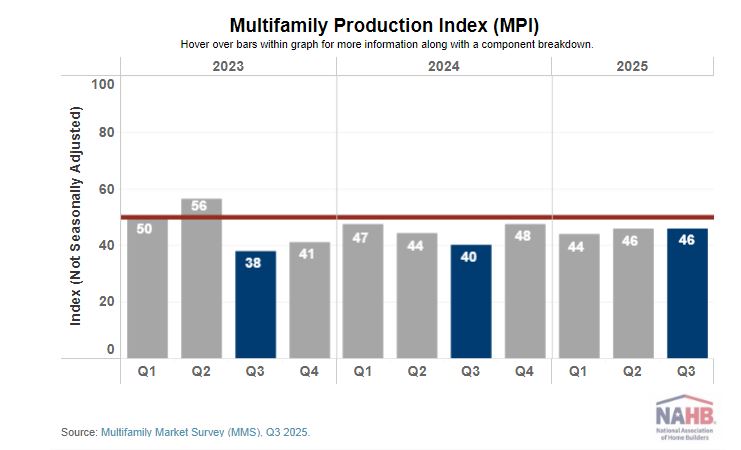
separate indices. The Multifamily Production Index (MPI) had a
reading of 46, up six points year-over-year, while the
Multifamily Occupancy Index (MOI) had a reading of 74, down one
point year-over-year.
The MPI and MOI are giving a mixed picture, creating a
bifurcation of the multifamily market. While MPI is still in
negative territory, developers of low-rise market-rate and
subsidized rental properties express increased optimism, with
both components above 50 for the quarter. Weakness is
concentrated in the mid-to-high-rise and condominium
developments which tend to be common in high-density metro
areas. This is consistent with NAHB’s Home Building Geography
Index where multifamily construction activity is growing in
areas with low population densities but weakening in the larger
metros.
Even though MOI is in positive territory and existing apartment
owners are positive about occupancy overall, this is the lowest
reading since NAHB redesigned the survey starting in Q1 2023.
Sentiment for mid/high-rise apartment occupancy is noticeably
weaker than it is for the other two rental market segments.
Multifamily Production Index (MPI)
The MMS asks multifamily developers to rate the current
conditions as “good”, “fair”, or “poor” for multifamily starts
in markets where they are active. The index and all its
components are scaled so that a number above 50 indicates that
more respondents report conditions as good rather than poor. The
MPI is a weighted average of four key market segments: three in
the built-for-rent market (garden/low-rise, mid/high-rise, and
subsidized) and the built-for-sale (or condominium) market.
All four components experienced year-over-year increases in the
third quarter of 2025: both the components measuring mid/high
rise and subsidized units jumped up nine points to 37 and 55,
respectively, the component measuring built-to-sale units
increased six points to 35, and the component measuring
garden/low-rise units increased three points to 51.
Multifamily Occupancy Index (MOI)
The survey also asks multifamily property owners to rate the
current conditions for occupancy of existing rental apartments,
in markets where they are active, as “good”, “fair”, or “poor”.
Like the MPI, the MOI and all its components are scaled so that
a number above 50 indicates more respondents report that
occupancy is good than as poor. The MOI is a weighted average of
three built-for-rent market segments (garden/low-rise,
mid/high-rise and subsidized).
Two of the three MOI components experienced year-over-year
decreases in the third quarter of 2025; the component measuring
subsidized units fell by five points to 81 and the
garden/low-rise component dipped one point to 76. Meanwhile, the
component measuring mid/high-rise units was unchanged at 66. All
three MOI components remain well above the break-even point of
50.
The MMS was re-designed in 2023 to produce results that are
easier to interpret and consistent with the proven format of
other NAHB industry sentiment surveys. Until there is enough
data to seasonally adjust the series, changes in the MMS indices
should only be evaluated on a year-over-year basis.
Please visit NAHB’s MMS
web page for the full report.
Source: eyeonhousing.org


