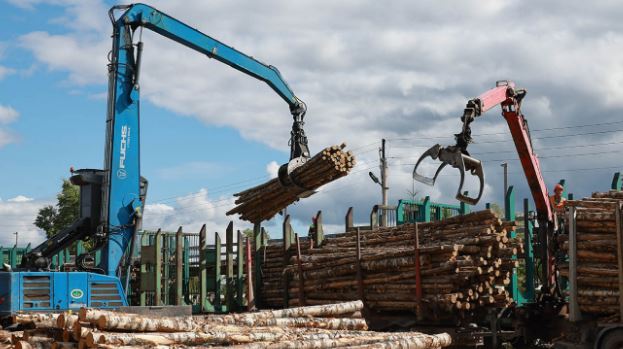
Officials caution that Russia’s timber supply chain faces
a hard winter, with sanctions, high rates and a strong ruble
compounding export losses and transport disruption.
Russia’s forestry sector could face a deep contraction next year
as sanctions tighten, interest rates remain high and the ruble
stays strong, Deputy Industry and Trade Minister Mikhail Yurin
said Thursday.
Addressing a Federation Council committee, Yurin said the
industry has entered a “downward trend,” with the worst-case
scenario pointing to a 20-30% drop in output in 2026.
The ministry expects already falling production to continue
declining into 2027 if geopolitical conditions worsen, Interfax
quoted Yurin as saying.
According to the Economic Development Ministry, wood-processing
is among the weakest performers in Russia’s industrial
landscape. Output fell 4.3% in the third quarter and the slump
accelerated to 7.8% in October.
The Central Bank’s high key rate, harsher sanctions, a
persistently strong ruble and shrinking access to remaining
export markets due to secondary and tertiary restrictions are
among the pressures weighing on the sector, Yurin said.
He said Russian timber exports have fallen by more than 20%
since before the war, from $12.5 billion in 2021 to to $9.8
billion.
Logging volumes are expected to hit a four-year low of 182
million cubic meters this year.
The sector is already seeing corporate distress. The Federal Tax
Service in September initiated bankruptcy proceedings against
Tobol, the largest timber company in the Tyumen region.
That same month, the Svyezha-Tyumen birch plywood plant, part of
billionaire Alexei Mordashov’s Sveza group, halted operations
and laid off 323 workers.
The parent company cited a sharp drop in production volumes and
capacity utilization, which had pushed the plant deep into the
red.
Source:
themoscowtimes.com


