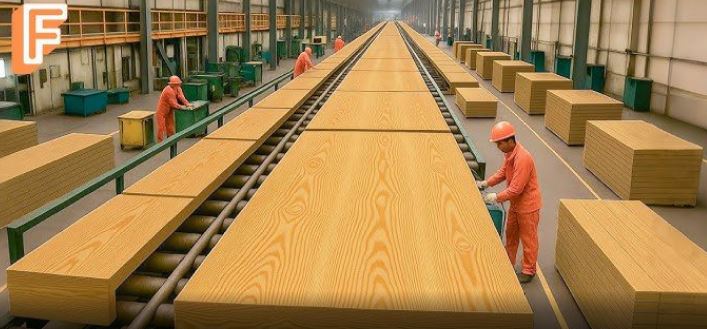
The Tech Gap: Digital Transformation in the Wood Sector
For decades, the production of wood materials, even
high-specification products like plywood and laminated veneer
lumber (LVL), lagged far behind the technological adoption seen
in the automotive, steel, and semiconductor industries.
Production relied heavily on manual labor, visual inspection,
and batch-processing—a methodology inherently prone to material
inconsistency.
This analog approach is incompatible with the demands of a
modern, global supply chain that requires near-zero defect
rates, auditable compliance, and performance certified to
standards like the IICL concentrated load test.
The solution is the full integration of Industry 4.0
principles: automation, the Industrial Internet of Things (IIoT),
and data analytics. For specialized manufacturers like TLP
Wood in Vietnam, these investments are no longer a
competitive edge—they are a mandatory prerequisite for trading
in high-value North American and European markets. This digital
shift transforms the cost of capital expenditure into an
essential ROI driver based on risk reduction and quality
certainty.
1. The Core Technological Leap: Automation for Material
Consistency
The goal of automation in wood composite manufacturing is
simple: eliminate variability in the raw material input and the
bonding process.
1.1 Precision Veneer Peeling (Input Control)
The quality of the final plywood composite is dictated by
the consistency of its core veneers. In modern facilities, the
massive rotary lathes that peel wood logs are no longer manually
calibrated. They rely on laser guidance systems and computer
vision to measure the log profile in real-time.
-- Result: This ensures veneers are peeled to a precise
thickness tolerance of $\mathbf{\pm 0.1\text{ mm}}$ across the
entire surface. This precision is critical because slight
variations in veneer thickness lead to non-uniform pressure
during the press cycle, creating microscopic internal voids
(low-density pockets) that are the primary point of structural
failure.
1.2 Robotic Layup and Assembly
The traditional manual stacking of veneers for the layup process
is susceptible to human error, resulting in overlapping veneers
or, worse, unintended gaps (voids). Automation addresses this:
-- Automated Layup Systems use semi-robotic or optical guidance
to ensure accurate, edge-to-edge alignment of veneers.
-- Impact on Performance: This consistency is non-negotiable for
products like $\mathbf{28\text{ mm}}$ Container Flooring, where
every square inch must achieve the required $\mathbf{700\text{
kgs/cbm}}$ density to withstand the $\mathbf{7,200\text{ N}}$
forklift load.
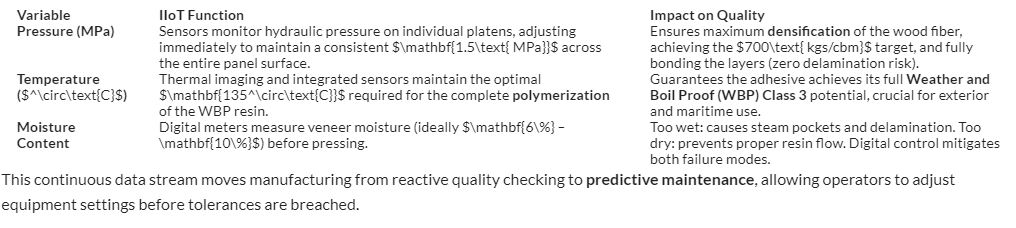
2. Data-Driven Quality Control: The IIoT Press
The most sensitive stage of plywood production is the hot press,
where heat and pressure polymerize the Phenolic WBP or MUF
resins. Any fluctuation here compromises the structural bond.
TLP Wood’s hot presses are equipped with IIoT sensors that
provide continuous feedback on the two most critical variables:
3. The Investor’s Perspective: ROI and Auditable Compliance
For investors and procurement strategists, the investment in
Industry 4.0 technology yields a tangible financial return
across four critical areas:
A. Risk Reduction and Insurance Costs
A certified, automated process translates directly to a
near-zero failure rate in the field. This reduces liability
exposure, lowers warranty costs, and minimizes the financial
risk associated with legal action (e.g., toxic tort claims for
formaldehyde or structural failure).
B. Auditable Regulatory Compliance
The IIoT system creates a digital twin of every production
cycle. This provides an auditable, non-repudiable compliance
trail for regulatory bodies. For compliance with EPA TSCA Title
VI (US) or CE Marking (EU), this data acts as a defense against
customs detention, proving continuous adherence to emission and
performance standards. This certainty drastically lowers supply
chain risk premiums.
C. Operational Efficiency and Sustainability
Automation significantly reduces material wastage by minimizing
defects, optimizing material cutting (reducing scrap), and
ensuring $100\%$ resource utilization from the veneer log.
Higher efficiency means lower cost-per-unit produced and faster
cycle times, offering superior operational value to the
importer.
Conclusion: The Digital Future of Engineered Wood
The days of viewing wood manufacturing as a low-tech, commodity
process are over. The future of high-performance industrial wood
is fundamentally digital. Investment in Industry 4.0
technologies—from laser-guided veneer preparation to IIoT-controlled
curing—is the only way to meet the stringent structural demands
of IICL and the health requirements of EPA TSCA Title VI.
Manufacturers like TLP Wood, who treat their capital expenditure
in technology as an essential investment in quality certainty
and compliance, are the partners that will successfully anchor
global supply chains in the coming decade.
About the Industry Consultant
This analysis was contributed by an Industry Consultant
specializing in manufacturing digitization and advanced
materials for TLP Wood, a premier Vietnam plywood manufacturer.
TLP Wood leverages Industry 4.0 principles to produce certified,
high-density industrial wood products for global markets.
Source:
techbullion.com


