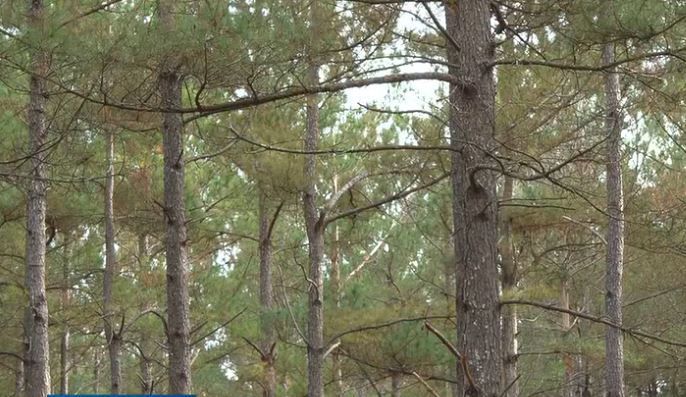
The European Union’s new deforestation rule is already
rippling through Mississippi’s timber industry - creating
confusion, restrictions, and growing financial worries for
landowners who say they never saw it coming.
The EU Deforestation Regulation (EUDR) became law in 2023, but,
after multiple delays, European officials recently shifted the
implementation timeline again - this time moving it back up to
December 2025.
Mississippi officials said mills have begun applying the rule
immediately, even though full enforcement hasn’t begun.
For eighth-generation landowner David Ham, the change was sudden
and startling.
“It kind of popped up out of nowhere,” he said. “A lot of
landowners and timber growers really don’t know anything about
it so far.”
Ham’s family has held their property since the 1830s.
Over nearly 200 years, the land has moved between timber, crops,
and cattle, depending on economic need. The idea that it must
now remain forest forever, he said, is unrealistic.
“This place has been many things over the years,” Ham said. “We
may need to do something… plant pecan trees, or we may want to
go back and plant corn or row crops for food production. It’s
unfair for anybody overseas, especially the EU, to dictate what
we can or can’t do with our property.”
Under the EU rule, companies selling into European markets
must prove their timber did not come from land being converted
to another use.
Mills have responded by inserting new contract requirements,
asking Mississippi landowners to guarantee that any harvested
land will remain forest permanently. Ham said he has already
been asked to sign language stating that, if his property is
clear-cut, it cannot be transformed back into pasture or crops.
“You’re basically having the EU dictate what you can or can’t do
with your U.S. property,” he said. “That’s unfair.”
Mississippi Agriculture and Commerce Commissioner Andy Gipson
has been fighting the rule for two years and said the latest
change pushed it to the top of his agenda.
“We’ve been pushing back against the EUDR for a couple of years
now,” Gipson said. “It actually went into effect in 2023… but
then recently, this fall, the EU decided they were going to
re-up and just make it effective immediately, like now.”
He said the sudden shift is already hurting the state’s timber
markets.
“It’s depressing the prices,” he said. “We don’t need this kind
of foreign influence here in the state of Mississippi.”
Gipson argues that the EU’s definition of “deforestation” is
incompatible with Mississippi’s forestry practices.
“They take it to mean if you cut a tree, you’re deforesting,” he
said. “That’s not the case in Mississippi. For every tree that
we harvest, we plant three or four back.”
He said Europe’s expectation — that land historically used as
forest must always remain forest — ignores the reality of
farming in Mississippi.
“It may need to be pasture land. It might need to go back into
row crop production,” Gipson said. “They’re asking farmers to
certify that this land will never change in its nature today,
and that is totally unacceptable.”
Both Gipson and Ham said Mississippi is being treated like
high-risk deforestation zones such as Brazil, even though state
data shows forests here are expanding.
“We’re growing twice the number of trees that we need,” Ham
said. “We don’t really deforest… most of it is planted back.”
“This rule was designed for Brazil, which is cutting down
rainforests. That’s not the case in Mississippi,” added Gipson.
The economic impact is already visible.
“Our landowners are losing money,” Gipson said. “Timber should
be worth this much, but it’s worth a whole lot less because this
market is going away. They just won’t buy it unless the
landowner agrees to all these restrictions, and folks are not
going to do that.”
Ham hasn’t cut timber recently, but he sees what’s coming.
“Basically the large timber companies are falling in line
because they want to sell these products overseas,” he said.
“Follow the money.”
Ham’s biggest fear is the unknown.
“How would it be enforced? Is somebody from the European Union
gonna come over and sue us?” he said. “How does somebody from
the EU enforce something on American soil?”
Gipson said he and other states are now working with the Trump
administration to block the rule entirely, not just delay it.
“We’re not going to let Europe tell us what we can and can’t do
with our land in Mississippi, period,” he said. “Get Europe out
of the business of trying to mess with our business in America.”
Ham is hopeful, but uncertain.
“We feel like it’s headed in the right direction,” Ham said. “We
will get this overturned.”
Source:
wlbt.com


