Tilhill Forestry, through its nursery Maelor Forest Nurseries,
part of the BSW Group, has launched a new national delivery
model for young trees. The company calls the service an industry
first in the UK.
The new service integrates cold chain vehicles, specialist
flatbeds, and truck-mounted forklifts. The aim is to protect
tree health from the nursery to the planting site. This method
also improves woodland establishment outcomes across the UK.
The system has been designed to safeguard both bare root and
cell grown trees from weather-related stress and handling
damage. By maintaining consistent temperatures, the transport
process supports better long-term tree performance.
Maelor Forest Nurseries is one of the UK’s largest commercial
tree nurseries. The nursery operates advanced mini-plug
facilities and continually invests in improved tree genetics.
Controlled growing environments are used to ensure high-quality
saplings.
However, temperature fluctuations during transport have remained
a critical threat to tree health. The period between lifting and
planting is particularly vulnerable. Bare root trees exposed to
temperatures of 4°C or above begin to respire. Respiration
consumes vital carbohydrate reserves. Fine root tissues can be
irreversibly damaged. This reduces the tree’s ability to
establish in soil.
Erratic spring and autumn weather in recent years has increased
these risks. Dormancy may be broken while trees are in storage
or transit. Cold chain transport addresses this by maintaining
saplings in a stable dormant state. By keeping temperatures low,
respiration is suppressed, energy stores are preserved, and the
risk of dehydration and disease is reduced.
Trees delivered via the cold chain arrive on site in optimal
physiological condition. Rapid rooting is encouraged, and
establishment is improved, even within compressed planting
windows. This ensures stronger long-term woodland performance.
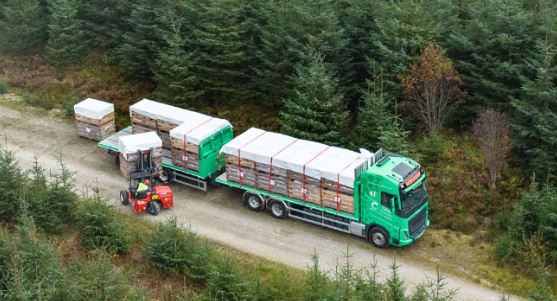
To further enhance delivery capability, BSW Group has added
specialist flatbed vehicles and truck-mounted forklifts. This
creates a fully mechanised delivery system. Flatbeds allow
secure, space-optimised loads that can reach remote or
constrained planting sites. Onboard forklifts enable fast, safe
unloading without manual handling or additional machinery.
Operational risk is reduced, and time on site is shortened for
forestry teams.
This tree-first delivery service is now standard for all Maelor
customers. High-quality handling is ensured from collection to
planting. Consistency across the supply chain is maintained,
benefiting foresters, landowners, and investors alike.
Andrew Henry, Nursery Director at Tilhill Forestry, explained:
“This development is about more than transport – it’s about
quality, consistency and giving trees the best possible start.
As part of the UK’s largest integrated forestry and timber
business, we’re uniquely positioned to innovate across the
entire supply chain. By combining cold storage, efficient
logistics and on-site mechanisation, we’re helping foresters,
landowners and investors achieve stronger establishment results
in an increasingly challenging climate.”
The new delivery model underscores the company’s commitment to
raising forestry standards across the UK. Risk is reduced.
Establishment success is improved. The long-term resilience of
new woodlands is supported.
By integrating cold chain principles, specialist vehicles, and
mechanised unloading, Tilhill Forestry and BSW Group are setting
a benchmark in tree supply logistics. Saplings are treated as
biological assets requiring controlled handling from nursery to
planting.
The cold chain system provides foresters with confidence that
trees arrive in optimal condition. Woodland creation is more
reliable. The UK forestry sector benefits from this standardised
approach.
With this innovation, Tilhill Forestry and Maelor Forest
Nurseries aim to improve outcomes across all UK woodlands. Trees
are protected from transport stress. Establishment is optimised.
The company continues to combine nursery expertise with
logistics innovation to support forestry, landowners, and the
wider industry.
Source:
tilhill.com


