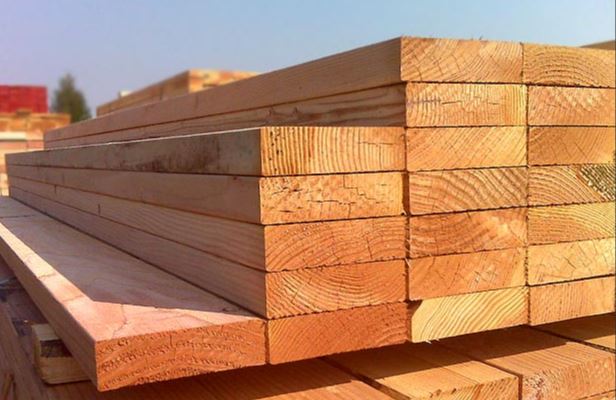
Fastmarkets has just released published the European sawn timber
price assessments and market story.
Market overview
European sawn timber markets opened 2026 with cautious sentiment
while Nordic exporters navigated a complex landscape shaped by
persistent demand weakness, evolving supply dynamics following
Storm Johannes and cautiously optimistic projections for
potential improvement by the end of the first quarter. The
January assessment period reflected a market still characterized
by structural headwinds, though with some industry participants
expressing measured hope that the worst of the downturn might be
stabilizing.
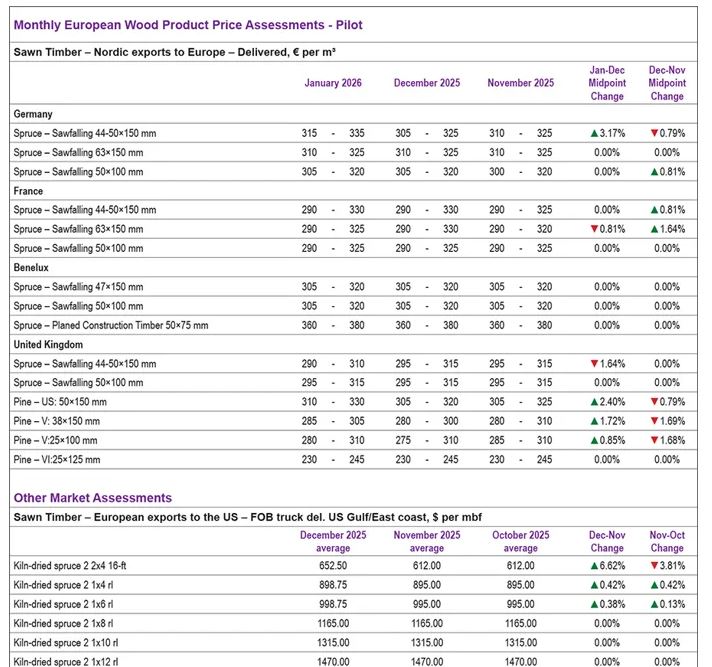
Prices across key European markets were broadly stable in
January 2026, though modest shifts were recorded in select
grades and destinations. Germany saw the most notable movement,
with spruce sawfalling 44-50×150 mm edging up by 3.17% against
December’s midpoint, on account of a rise in the lower limit of
the range. But the other grades held flat in the German market.
The UK displayed a mixed picture: spruce 44-50×150 mm slipped by
1.64%, while pine grades generally increased, with US 50×150 mm
up by 2.40% and V-grade 38×150 mm gaining by 1.72%. France and
the Benelux region were the quietest markets, with virtually all
grades unchanged month on month, the sole exception being spruce
63×150 mm, which edged down by 0.81%. Overall, the data points
to a market in a holding pattern, with no broad directional move
in either prices or sentiment while buyers continued to manage
inventories conservatively heading into the new year.
Market outlook and structural considerations
The Nordic sawn timber sector entered 2026 facing a complex
interplay of persistent structural challenges and tentative
optimism about potential stabilization, according to sources.
While the catastrophic demand collapse of 2022-2023 had
moderated, meaningful recovery remained elusive while European
construction activity continued to lag historical norms due to
elevated financing costs, weakened consumer confidence and
sluggish commercial building pipelines.
January market activity started slower than some participants
anticipated, with importers appearing to have learned cautionary
lessons from 2025’s spring buying surge that left some holders
overextended when summer demand failed to materialize. This
conservative positioning reflected rational inventory management
in an environment of continued macroeconomic uncertainty rather
than fundamental pessimism about longer-term prospects.
Sources expressed cautiously optimistic views that market
conditions could show improvement by the end of the first
quarter of 2026, though such projections remained highly
conditional on broader economic developments and construction
sector recovery. The combination of Storm Johannes supply
uncertainties, evolving species availability dynamics and
persistent cost pressures suggested that Nordic producers would
continue navigating challenging conditions through at least the
first half of the year.
The ongoing industry restructuring across the Nordic region,
characterized by capacity adjustments, operational
consolidations and strategic repositioning, continued to shape
sector dynamics. Producers focused on aligning production with
subdued demand levels while preserving financial flexibility to
respond when market conditions eventually improve. The sector’s
ability to maintain operational readiness while managing through
an extended period of weak fundamentals would prove critical to
positioning for eventual recovery when European construction
markets regain momentum.
European market outlook – WFFC2026 workshop
A dedicated workshop on European markets held at WFFC 2026 in
Helsinki painted a picture of stabilization rather than recovery
across five key destination markets reviewed – Germany and
Austria, France, the UK, Estonia and the Netherlands. Housing
remained the principal demand brake in all markets, partly
offset by steadier activity in renovation, non-residential and
civil engineering segments. Supply chains reshaped by the 2022
loss of Russian and Belarusian timber have hardened into a new
normal, with Finland emerging as a significantly enlarged
supplier in several markets, notably Estonia where it now holds
around two-thirds of import volumes.
Buyers across markets are tightening specifications, requiring
sustainability documentation such as environmental product
declarations (EPDs) and life cycle assessments (LCAs), and
moving toward leaner, more frequent replenishment models –
trends most sharply visible in the UK, where hand-to-mouth
purchasing with 24–48-hour replenishment windows has become
standard. The Netherlands highlighted a persistent shortage of
6-metre lengths and growing demand for C24 rough-sawn timber as
specific product opportunities. France and the DACH region
pointed to engineered wood – CLT, glulam and I-beams – as the
steadiest growth segment, underpinned by low-carbon building
policy.
The overarching conclusion from the WFFC2026 workshop was that
2026 will reward precision over volume: suppliers able to meet
tighter technical, documentation and logistical requirements are
better positioned than those competing on price alone.
Source:
fastmarkets.com


