This was the first decline in the rate of price growth since
April of last year, according to analysis from the National
Association of Home Builders.
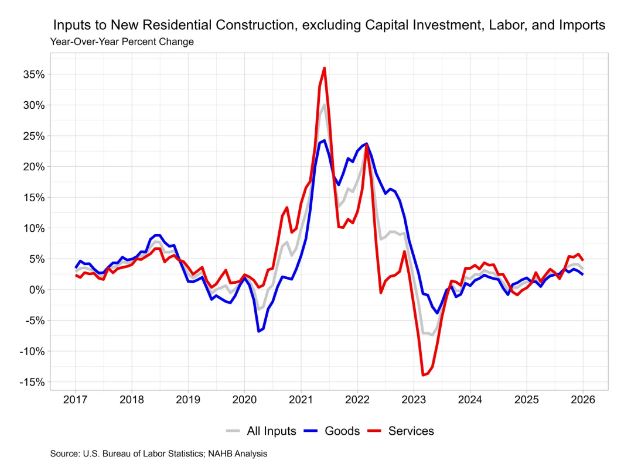
Residential building material prices rose at a slower rate in
January, according to the latest Producer Price Index release
from the Bureau of Labor Statistics. This was the first decline
in the rate of price growth since April of last year. Metal
products continue to experience price increases, while specific
wood products are showing declines in prices.
The Producer Price Index for final demand increased 0.5% in
January, after rising 0.4% in December. The January increase in
final demand is linked directly to final demand services, which
saw prices rise 0.8% in January. The index for final demand
goods decreased 0.3% in January.
The price index for inputs to new residential construction rose
0.7% in January and was up 3.3% from last year. The price of
goods used in new residential construction was up 0.9% over the
month and 2.4% from last year. Meanwhile, the price for services
was up 0.3% over the month and up 4.7% from last year.
Input Goods
The goods component has a larger importance to the inputs to
residential construction price index, representing around 60%.
On a monthly basis, the price of input goods to new residential
construction was up 0.9% in January.
The input goods to residential construction index can be further
broken down into two separate components, one measuring energy
inputs with the other measuring remaining goods. The latter of
these two components simply represents building materials used
in residential construction, which makes up around 93% of the
goods index.
Energy input prices fell 0.9% in January and were 10.3% lower
than one year ago. Building material prices were up 1.0% in
January and up 3.3% compared to one year ago, marking the lowest
year-over-year price change since July of last year.
The largest year-over-year price increases continue to show in
metal products. Topping the list in January was metal molding
and trim, with prices up 48.3% from last year. One product that
has seen rapid price growth acceleration over the past few
months has been nonferrous metal and cable with prices up 19.7%.
Price declines for materials over the year are concentrated
among wood products with prices for particleboard and fiberboard
down 24.4%, treated wood products down 5.0%, and softwood lumber
down 3.3%.
Input Services
Prices for service inputs to residential construction reported
an increase of 0.3% in January. On a year-over-year basis,
service input prices were up 4.7%. The price index for service
inputs to residential construction can be broken out into three
separate components: a trade services component, a
transportation and warehousing services component, and a
services excluding trade, transportation, and warehousing
component (other services).
The most significant component is trade services (around 60%),
followed by other services (around 29%), and finally
transportation and warehousing services (around 11%). The
largest component, trade services, was up 7.1% from a year ago.
The transportation and warehousing services rose 2.0%, while
prices for other services were up 1.1% over the year.
Expanded Inputs to New Construction
Within the PPI that BLS publishes, new experimental data was
recently published regarding inputs to new construction. The
data expands existing inputs to industry indexes by
incorporating import prices with prices for domestically
produced goods and services. With this additional data, users
can track how industry input costs are changing among
domestically produced products and imported products. This data
focuses on new construction, but the complete dataset includes
indices across numerous industries that can be found here on BLS
website.
New construction input prices are primarily influenced by
domestically produced goods and services, with domestic products
accounting for 90% of the weight of the industry index for new
construction. Imported goods make up the remaining 10% of the
index.
The latest available data, for November 2025, showed that
domestically produced goods continue to have faster price growth
compared to imported goods used in new construction. On a
year-over-year basis, the index for domestic goods increased
3.0%, while prices for imported goods have fallen 3.0%.
Source:
eyeonhousing.org


