Firewood prices in March 2026 – How much fireplace owners pay
for firewood
There are several reasons for this. On the one hand, wood prices
on the German timber market are also rising sharply in the first
quarter of 2026 – and with them the prices for all other uses.
Secondly, it was very cold in Germany until the end of February
and firewood consumption was significantly higher than in
previous years. This also means that demand for firewood has
risen sharply due to dwindling firewood stocks among fireplace
owners and firewood dealers.
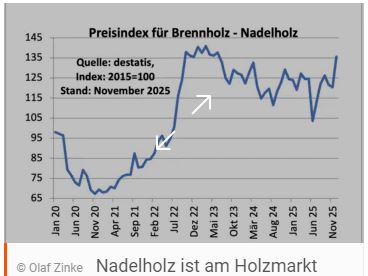
Softwood is currently extremely scarce on the timber market,
and prices for spruce roundwood are at a new record high. This
is naturally also having an impact on downstream sectors,
driving up prices for firewood and, most recently, wood pellets
and wood chips.
The scarce supply of raw timber
Epecially softwood has prompted the sawmill industry to once
again significantly increase timber prices for almost all uses
in the first quarter of 2026, according to forest owner
associations. The low temperatures until the end of February,
with persistent frost, have also led to an increase in firewood
consumption and a much faster depletion of firewood stocks among
fireplace owners and wood dealers.
Against this backdrop, demand from fireplace owners and
purchases of firewood remained very high, at least until the end
of February. In addition, prices for raw wood—especially
softwoods such as spruce and pine—rose sharply in December and
increased significantly again in the first quarter of 2026. This
price rally for softwood is also affecting the rest of the range
(such as wood pellets and wood chips), although prices for
hardwood such as beech and birch were already very high and have
hardly risen at all.
At the beginning of 2026, price increases for roundwood ranged
between €5 and €10 per cubic meter for the leading product
range, spruce B 2b+. Prices for pine wood also rose sharply. At
the beginning of 2026, new record prices were reached for both
spruce and pine wood. Most recently, forest owners on the
so-called “Waldstraße” were paid around 25 to 30 euros more than
a year earlier. In sawmills that need and process fresh logs,
stocks are empty in many places because very little fresh wood
is being delivered, according to forest owners.
The German Federal Association of the Wood Industry describes
the current market development on the entire wood market – and
consequently also for firewood – as a “raw material shortage.”
If more wood does not come onto the market soon, the situation
will escalate into an “existential crisis for the sawmill and
wood industry,” according to the wood industry.
The extreme shortage has apparently been caused by the extremely
low supply of so-called damaged wood, which, according to the
Bavarian State Institute for Forestry and Forest Management,
accounts for a good half of the timber harvested and thus also
covers half of the supply. This wood, which was abundant in
previous years, is now missing from the timber market, where
there is hardly any difference in price between
beetle-damaged/damaged wood and undamaged wood.
Price increase for beech and birch - spruce firewood becomes
significantly more expensive
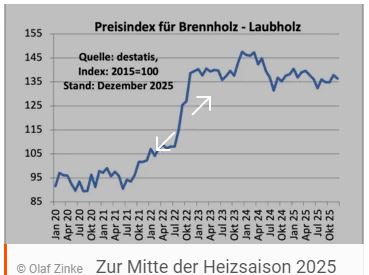
(Until December), hardwood prices returned to levels
similar to those seen during the last price peak in fall 2024.
At the beginning of 2026, however, hardwood prices rose sharply
again. Year-on-year, heating with hardwood is therefore likely
to be significantly more expensive this heating season than in
the last two years.
Hardwood firewood was recently about as expensive as it was at
the same time last year, according to the latest official price
surveys conducted by the Federal Statistical Office (Destatis)
in December. However, firewood prices have risen sharply since
then (including for hardwood) and continue to climb in March
2026.
In “normal years,” firewood prices actually peak in March and
April, according to data from Destatis and firewood dealers. By
then, the wood dealers' warehouses and boiler rooms are empty.
And firewood prices are at their highest. It is also a fact that
most firewood buyers and fireplace owners prefer to buy hardwood
(beech, birch) or hardwood. There are various reasons for this.
In any case, data from Destatis shows that prices for hardwood
had fallen by more than 10 percent by July 2025, prior to the
2025/26 heating season. After that, however, hardwood firewood
became significantly more expensive again. By the middle of the
2025 heating season (in December), hardwood was costing about
the same as it did at the last price peak in fall 2024. At the
beginning of 2026, however, hardwood prices rose sharply again.
Year-on-year, heating with hardwood is therefore likely to be
significantly more expensive this heating season than in the
last two years.
At the same time, prices for softwood firewood shot up
dramatically by around a quarter between June 2025 and September
2025, making it almost as expensive as it was at the last price
peak in March 2024. The reason: softwood is currently extremely
scarce on the timber market and prices for spruce roundwood are
at a new record high.
This is naturally also affecting downstream sectors, driving up
firewood prices and, most recently, the prices of wood pellets
and wood chips. The next price surge for coniferous firewood
came in December. Prices rose by a further 13 percent
month-on-month to a level not seen before. This is also likely
to drive up hardwood prices further.
It remains unclear whether the current wood shortage in spring
and summer will lead to an easing of prices – or whether
firewood prices will remain high or even rise further.
Firewood prices in March 2026 – softwood at record levels
However, fireplace owners should also bear the following in mind
when purchasing firewood: firewood prices vary considerably from
region to region. On the one hand, this has to do with the
distance between firewood dealers and the major consumption
centers and sales markets. On the other hand, the degree of
dryness of the firewood offered by the wood dealer also has a
major influence on firewood prices (fresh, air-dried ready for
use, or kiln-dried).
The length of the firewood logs and the degree of processing are
also decisive factors in determining firewood prices – wood
dealers offer firewood logs in lengths of 25 cm, 30 cm, 33 cm,
or even 40 cm. In addition, there are very different units of
measurement (cubic meters, ster, cubic meters) that are
difficult for firewood buyers to compare. These make it even
more difficult to compare firewood prices.
If you look at the prices charged by professional firewood
dealers in March 2026, the price for ready-to-burn beech wood
with a log length of 30 to 33 cm is predominantly between €115
and €125 per cubic meter, with an upward trend. However, beech
wood can sometimes cost up to €145. If you buy the same beech
wood at a DIY store, you can easily end up paying €190.
At the same time, fresh beech wood (not yet dried!) costs
between €95 and €105 per cubic meter on average. Sometimes,
prices of more than 110 euros are charged for fresh beech wood.
For birch or the relatively popular beech/birch mix, prices in
March 2026 are mostly between 105 and 110 euros per cubic meter.
Here, too, firewood buyers can easily pay 160 euros when
purchasing at a hardware store.
Source:
agrarheute.com


