
Germany is Europe's largest furniture market, making
developments in the country an important signal for the broader
European sector. After the strong demand surge during the
pandemic period, the market has entered a weaker phase as
consumer spending and housing activity slowed. This analysis
reviews several indicators related to German furniture demand,
including retail turnover, online search behaviour, housing
market activity and consumer confidence, to provide a broader
perspective on how the market has evolved and where it may be
heading.
Furniture retail turnover
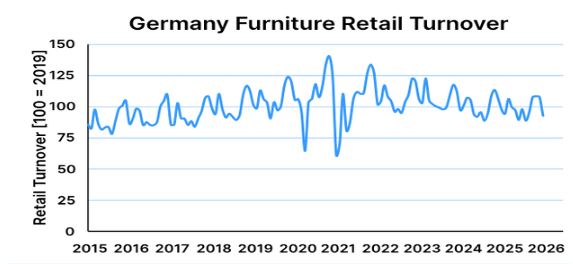
German furniture retail turnover has weakened in recent years
following the demand surge during the pandemic period. Sales
volumes increased strongly in 2020 and early 2021 as households
spent more on home improvement and furnishings, but this was
followed by a clear correction as inflation, higher interest
rates and weaker consumer spending reduced demand for durable
goods.
Recent data suggest that the decline has moderated but has not
yet reversed. Furniture retail turnover in Germany fell –1.6%
year-on-year over the last 12 months and –1.4% over the last six
months, indicating that the market remains slightly below the
levels seen in previous years, with demand stabilising but still
subdued.
Furniture search demand improves
Online search behaviour suggests that consumer interest in
furniture products in Germany has strengthened again in recent
years. After declining between 2021 and 2023, the product search
index began to recover and has gradually moved upward through
2024 and 2025. Recent values are among the highest in the
series, indicating that consumers are increasingly searching for
furniture-related products again after a period of weaker
interest. This improvement suggests that early-stage demand
signals for furniture may be recovering even though realised
retail sales remain subdued.
At the same time, searches for furniture retailers have remained
comparatively weaker, creating a divergence between product and
retailer search trends. This may indicate that consumers
increasingly start their purchase journey with product searches
rather than retailer brands.
Early signs of recovery in German housing
Housing activity is closely linked to furniture demand, as home
purchases, relocations and new construction typically trigger
furniture spending. Changes in the housing cycle therefore often
translate into shifts in furniture market activity.
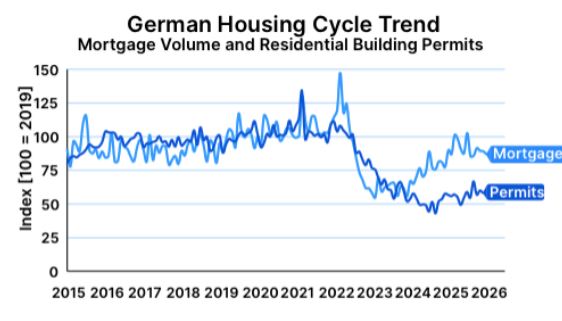
After a sharp downturn between 2022 and 2024, the German housing
cycle is showing early signs of recovery. Both mortgage lending
and residential building permits declined significantly during
the period of rising interest rates, with permits falling
particularly strongly. More recently, however, mortgage volumes
have begun to increase again and building permits appear to have
stabilised after the steep decline, suggesting that the housing
market may be gradually bottoming out.
German consumer confidence remains subdued
Consumer sentiment plays an important role in furniture demand,
as furniture purchases are typically discretionary and linked to
households' willingness to make larger expenditures. Changes in
consumer confidence therefore often translate into shifts in
spending on durable goods.
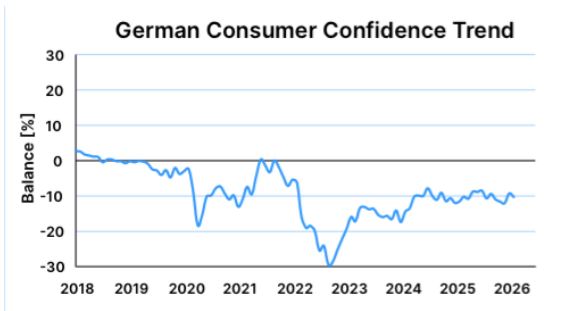
In Germany, consumer confidence dropped sharply during the
inflation shock of 2022, reaching the lowest levels in the
series. Since then sentiment has recovered somewhat, but the
indicator has remained consistently negative over the past two
years. While the worst of the decline appears to be over,
confidence remains below pre-2020 levels, suggesting that
households are still relatively cautious in their spending
outlook.
Conclusion
Taken together, the indicators suggest that the German furniture
market may be approaching the end of its recent downturn, but a
clear recovery has not yet emerged. Retail turnover remains
slightly below recent years, indicating that realised demand is
still weak even though the rate of decline has moderated.
At the same time, several forward-looking signals are becoming
more positive. Furniture product searches have strengthened
again and housing indicators show early signs of stabilisation
after a sharp contraction. However, the continued weakness in
consumer confidence suggests that households remain cautious
about discretionary spending. Overall, the data point to a
market that is stabilising with tentative early demand signals,
but where a sustained recovery will likely depend on further
improvement in housing activity and consumer sentiment.
Source:
furnilytics.com


