In Spanaway, Washington, adaptability is the driving force
behind Rainier Veneer’s success. Known for its peel-to-order
model and customer-first philosophy, Rainier Veneer has built a
strong reputation for precision and responsiveness. The recent
upgrade to its lathe line, in collaboration with USNR, further
strengthens this reputation, allowing the plant to produce
custom veneer orders with even greater efficiency.
“We don’t peel ahead,” says Steve Shriver, Plant Manager at
Rainier Veneer. “Every order is customized, and we adjust
production every two and a half hours. That flexibility is what
sets us apart.”
Rainier Veneer’s Spanaway plant serves a diverse range of
markets, from Canada to Central Oregon, providing both softwood
and hardwood plywood. The plant’s ability to quickly adjust
production to meet customer needs has made it a trusted partner
in the veneer industry. The upgrades to the lathe line further
bolster this adaptability, ensuring that every order meets the
exact specifications of clients, even when last-minute changes
are required.
From Patchwork to High-Performance Lathe Line
Before the upgrade, Rainier’s lathe setup consisted of a mix of
salvaged and retrofitted equipment. Operators worked tirelessly
to keep production moving, often relying on ingenuity to
overcome mechanical challenges. While the team managed to
maintain production, the equipment’s limitations hindered
efficiency.
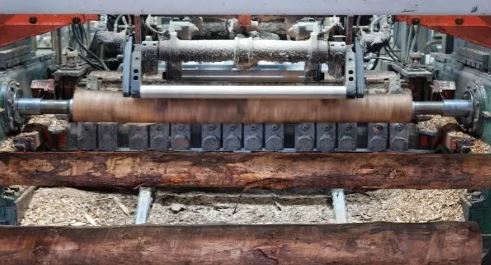
That all changed with the installation of USNR’s Model 790
Charger system. This major upgrade included several key
components:
Block Step Feeder: The new feeder unscrambles and
geometrically centers the veneer blocks before feeding them into
the lathe charger. With a 7-step, single-acting design and a 29”
stroke, the system ensures consistent block presentation and
flow.
Model 790 Charger with BlockLogix Optimization: The
upgraded system integrates block rotation, scanning, and
positioning using four GigE 3D laser sensors. This allows the
system to capture up to 500,000 measurement points per block,
optimizing alignment and maximizing recovery. A precision
pendulum then delivers each block to the lathe spindles with
pinpoint accuracy.
Lathe Control System: The new control system, featuring
Allen Bradley ControlLogix® PLCs and touchscreen HMIs, improves
operator visibility and streamlines control and diagnostics.
This system interfaces with all major lathe components, enabling
faster issue resolution and reducing downtime.
Hydraulic Power Unit (HPU): The HPU, with a 2,000-gallon
reservoir and pressure-compensated pumps, ensures consistent
hydraulic performance across the lathe line. Dual-stage
vane-style recirculation pumps deliver 90 GPM each, supporting
smooth operations even under heavy use.
The difference was immediate,” says David Fields, Plant
Superintendent. “The new system is intuitive, easier to
maintain, and far more reliable. We’re diagnosing issues faster
and reducing downtime.”
Operator Ownership Drives Excellence
At Rainier Veneer, operator ownership plays a crucial role in
maintaining high standards of performance. Lathe operators are
responsible for performing their own maintenance, which gives
them a deeper understanding of the equipment and allows them to
identify issues early. This hands-on approach not only keeps
machines running smoothly but also fosters a sense of pride
among the team.
“We don’t have a dedicated greaser,” Fields explains. “Operators
handle it themselves. It builds pride and keeps the machines
running smoothly.”
The company’s culture of operator ownership has proven effective
in both training and promoting from within. Employees with
diverse skill sets are stepping confidently into operator roles,
supported by user-friendly systems and strong mentorship. This
approach has resulted in a more versatile workforce, capable of
adapting to changing operating conditions and contributing to
the plant’s overall success.
A Strong Partnership with USNR
Rainier’s relationship with USNR dates back decades, and the
recent lathe line upgrade was a collaborative effort between the
two companies. The project was completed on schedule, thanks to
the involvement of Rainier staff, contractors, and the USNR
team.
“We had ownership from day one,” Shriver says. “USNR listened,
adapted, and delivered. Their support has been outstanding.”
This ongoing partnership is a testament to the value of
collaboration and mutual trust. It’s through this long-standing
relationship that Rainier has been able to continue evolving its
operations, ensuring that it remains a leader in the veneer
industry.
Looking to the Future
With the 8-foot lathe line now optimized, Rainier Veneer is
focusing on further improvements across the entire plant. The
goal is to bring all operations up to the same level of
performance and consistency.
“We’re simplifying processes and improving consistency,” says
Shriver. “It’s about staying ahead of market demands and
building long-term resilience.”
By continuing to invest in cutting-edge technology and nurturing
a skilled, adaptable workforce, Rainier Veneer is positioning
itself for ongoing success in the ever-evolving veneer industry.
Source:
woodandpanel.us


