
Fastmarkets is pleased to publish the following European sawn
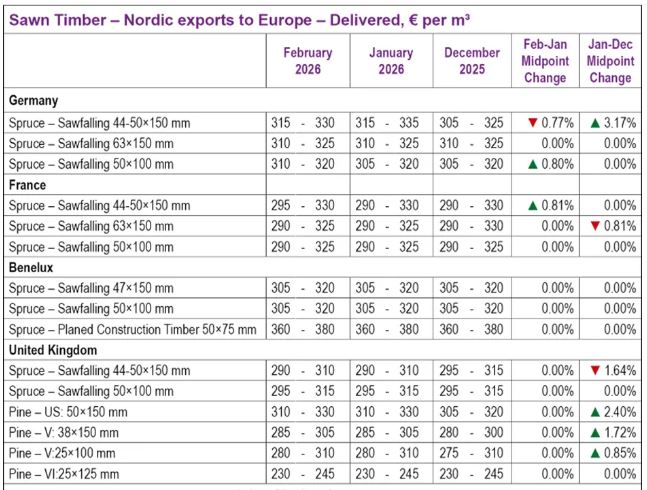
timber price assessments and market story. The price table below
is in pilot phase, and we are continuing to recruit price
contributors.
Market overview
European sawn timber markets moved into February 2026 in a
broadly cautious mood, with price stability across most grades
and destinations masking a more anxious undercurrent driven by
the eruption of the Iran conflict and its mounting consequences
for global freight markets. The geopolitical shock arrived at an
already delicate juncture for Nordic exporters navigating
elevated log costs, sluggish European construction demand and
the residual uncertainties of Storm Johannes.
Price movements in February were narrow. In Germany, spruce
44-50×150 mm edged down 0.77% against January’s midpoint, while
spruce 50×100 mm moved in the opposite direction, rising 0.80%
on a firmer lower limit; other German grades held flat. France
showed quiet firmness, with spruce 44-50×150 mm nudging up 0.81%
on a lifted lower limit; other French grades were unchanged.
Benelux and the UK were the quietest markets, with all assessed
grades flat across the board. The overall picture is one of a
market in a holding pattern, with buyers managing inventories
conservatively and no broad directional impulse in either
direction.
The Middle East conflict: freight costs and the MENA shadow
The conflict in Iran has sent shockwaves through global shipping
markets, with direct consequences for Nordic sawn timber
exporters. As of mid-March, war surcharges on container
shipments to the Middle East and North Africa had jumped by
approximately $3,000 per container, about $60-plus per cubic
meter, or around €55 per cubic meter, on a standard 40-foot
container carrying 45-47 cubic metres of timber.
Against a baseline sea freight cost of approximately €50 per
cubic meter, the surcharge effectively more than doubles the
shipping component of the delivered price, which translates to a
20-25% increase in total cost that neither buyers nor sellers
can readily absorb. Sources active in MENA markets described the
surcharges as too high to pass on, with a significant number of
shipments cancelled as a result.
The Middle East and North Africa had been among the more
resilient demand destinations for Nordic exporters through an
otherwise difficult 2025. Egypt alone was receiving an estimated
€240 million worth of EU sawn softwood in the first half of
2025, and the broader MENA region had been projected to grow at
a compound annual rate of around 9% through 2032, driven by Gulf
infrastructure programmes and persistent North African housing
deficits.
Major carriers including Maersk, MSC and Hapag-Lloyd have
suspended Hormuz crossings until further notice, with vessels
rerouted around the Cape of Good Hope, adding weeks to transit
times and compounding cost pressures. The Houthis, whose Red Sea
campaign had only recently wound down following a ceasefire, had
threatened to escalate again, which would layer additional
disruption on top of the Hormuz closure.
The freight shock compounds existing cost pressures at the
production level. Fastmarkets senior economist Dustin Jalbert
flagged the compounding effect on logging operations. Surging
diesel costs, especially in Central Europe, are adding to log
procurement pressures that are already almost impossible to pass
on downstream, according to Jalbert. Jalbert said a potential
stagflationary effect on the broader European wood products
complex, which is a scenario in which energy cost spikes hit
pulp and paper operations, could threaten sawmill residual
revenues when other income streams are under strain.
Producer conditions and competitive dynamics
Swedish sawmill operators continued to navigate a difficult
margin environment in February, with persistently elevated
sawlog costs pressing against flat or modestly declining sales
prices in key markets. Sources noted that sawlog prices remain
materially higher than sawn timber prices for both pine
(redwood) and spruce (whitewood). The conditions that made the
fourth quarter of 2025 exceptionally hard for Swedish producers
had not materially improved at the start of the new year, though
some participants expressed tentative hope that the first
quarter of 2026 might mark a turning point. Some decrease in
sawlog prices has become visible in recent procurement, which
would offer modest relief if the trend holds.
The pine-spruce species imbalance that characterized late-2025
markets remained a live issue in February. Spruce continued to
command a premium over pine in most markets, and while the
possibility of substituting whitewood with redwood has been
discussed, sources indicated that uptake in key European markets
remains limited. Planing mills are effectively unable to use
pine as a substitute; in construction timber applications such
as KVH and lamellas, pine can work for some products, but
tradition and client expectations–including the expectation that
redwood be priced lower than whitewood–continue to inhibit
broader switching, even in non-visible applications.
Second quarter negotiations are ongoing and sources told
Fastmarkets that the market appears to be moving after an
extended period of stasis.
Production curtailments in Sweden and among other Nordic
producers dampened their appetite to push hard in
January-February, with a degree of mutual wait-and-see evident
as participants watched moves of larger players closely, before
committing to their own moves.
In the Dutch market, particularly on SLS (Scandinavian Lumber
Standard) in broader sizes and long lengths, conditions were
described as tight.
Certification continued to attract commercial attention: PEFC
remains acceptable for the majority of buyers, but some major
clients, particularly in the Benelux region, are requiring FSC
in response to governmental procurement requirements.
Market outlook
The outlook for March and the broader first half of 2026 is
materially more uncertain than it appeared at the start of
February, principally because of the freight cost shock
generated by the Middle East conflict. European construction
demand continues to offer few positive signals, with residential
building remaining the principal brake across all major
destination markets and renovation and non-residential segments
providing only partial offset. Some Nordic producers said they
were counting on MENA demand to help absorb production volumes;
the degree to which that outlet remains viable will depend on
how quickly or slowly the geopolitical situation resolves.
For the European destination markets assessed in this pilot,
sources indicated that the immediate implication is continued
price stability underpinned by cautious buyer positioning rather
than any fundamental improvement in end-use demand. Sources
continue to monitor whether the hesitant optimism around a first
quarter inflection point will survive contact with the freight
and geopolitical risks weighing on the sector.
Source:
fastmarkets.com


