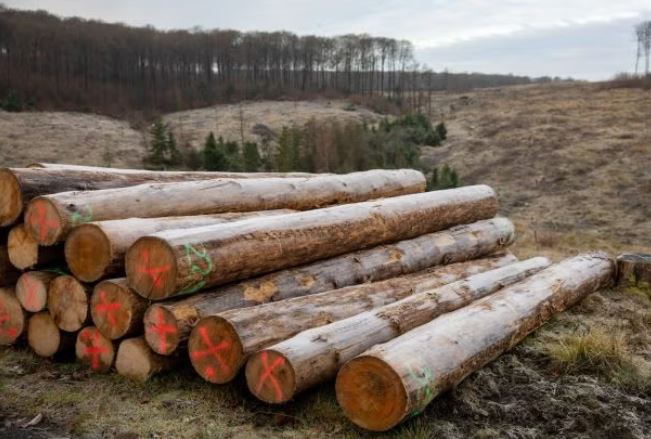
Germany’s sawmilling sector is calling for urgent action to
expand beetle-damaged spruce timber storage capacities across
the nation.
The German Sawmill and Timber Industry Association (DeSH) made
the call following the publication of new recommendations for
the storage and utilization for beetle damaged spruce timber.
Research shows that hundreds of thousands of hectares of German
spruce forest have been damaged by the spruce bark beetle,
costing the industry significant sums.
The Agency for Renewable Resources’ (FNR) collaborative project
NUKAFI (Investigations into the Material Utilization Potential
and Storage Options for Spruce Damaged Timber) found that
properly treated damaged timber remains available as a raw
material for extended periods.
Its new guidelines “Handling Spruce Damaged Timber” offers
forest owners, forestry companies, and wood-processing
businesses expert recommendations for practical application.
NUKAFI found that severely damaged trees, so-called deadwood
stands, can remain in the forest for a certain time, depending
on the weather. After about two years, however, the processing
options for the sawmill and timber industry become severely
limited due to declining quality and significant disruptions in
production.
The storage options described can help to stagger timber
harvesting, marketing, and processing, and ensure the
preservation of wood quality over a longer period. At the same
time, the guideline clearly identifies the limitations and risks
of the methods, for example, with regard to occupational safety,
potential quality losses, and increased demands on logistics and
control.
DeSH says the technical solutions presented are only one part of
a comprehensive concept. Julia Möbus, Managing Director of the
DeSH, also emphasizes the urgent need for action regarding the
framework conditions.
“Science has shown the way – now it’s up to policymakers,” she
said.
“We need to expand storage capacities nationwide. The federal
government, states, and municipalities must work together and
develop a joint action plan for disaster management.”
DeSH says the central question is how to efficiently utilize the
large quantities of damaged timber. The storage of damaged
timber is of particular importance, as it has a decisive
influence on wood quality, usability, and processing.
Source:
ttjonline.com


