SUMMARY
- Housing Drives Demand: Research by Louisiana State University
and U.S. Forest Service Southern Research Station finds housing
starts are the dominant factor influencing lumber demand.
- Decline Through 2070: U.S. softwood lumber consumption is
projected to gradually decrease across all scenarios,
potentially dropping to ~60 million cubic meters.
- Regional Impact Varies: The U.S. South is expected to see the
sharpest decline, while the Pacific Coast shows relative
resilience.
A new study indicates that U.S. softwood lumber demand is set to
decline steadily through 2070, primarily driven by weakening
residential construction activity. The research finds that
housing starts play a far more significant role in determining
lumber demand than income levels or price fluctuations.
Analyzing quarterly data from 2000 to 2024, researchers
identified a housing-starts elasticity of 0.593 for apparent
softwood lumber consumption, compared with an income elasticity
of 0.138 and a price elasticity of -0.212. The study was
conducted by Craig Johnston, Jinggang Guo of Louisiana State
University, and Jeffrey P. Prestemon of the U.S. Forest Service
Southern Research Station.
The findings show that U.S. housing starts averaged 1.3 million
units annually during the study period, peaking above 2 million
units in 2005 before dropping sharply to nearly 0.54 million in
2010. By integrating housing activity into the Forest Resource
Outlook Model, researchers found that demand projections shift
from growth to a gradual long-term decline, aligning more
closely with recent observed trends.
Across five modelled scenarios, U.S. softwood lumber consumption
is projected to fall by 2070, with the lowest case reaching
nearly 60 million cubic meters. The steepest regional declines
are expected in the U.S. South, while the Pacific Coast is
projected to remain comparatively resilient.
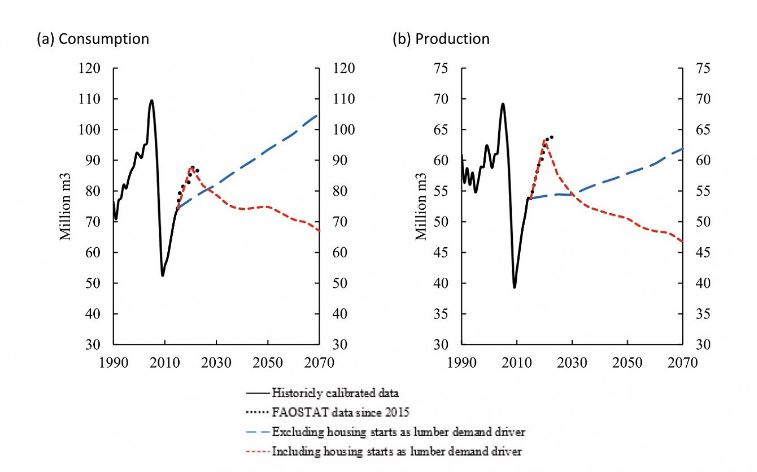
US softwood lumber consumption (left) and production (right)
from 1990 through 2070. The blue dashed line shows FOROM’s older
forecast, which relied on GDP growth and projects demand
exceeding 100 million cubic metres by 2070. The red dashed line,
with housing construction centred, drops to roughly 67 million
cubic metres over the same horizon, tracking what the market has
actually done far more closely. (Source: Johnston, Guo &
Prestemon, 2026)
Source:
USDA


