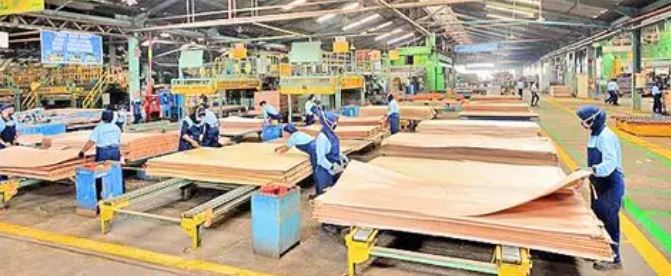
Sarawak: Malaysia plywood manufacturers have raised Japan-bound
12mm-size plywood prices by US$20-US$30 per cubic metre (cu m)
(cost & freight) in April, according to Japan Lumber Reports (JLR).
JLR said the Indonesian plywood producers have also issued large
price-increase proposals or halted new offers.
“Export prices remain firm."
Indonesian standard plywood is around US$970/cu m for 2.4mm
sheets, US$880 for 3.7mm and US$950 for 5.2mm.
For 12mm products, coated formwork plywood is US$600-610,
formwork plywood US$500-510 and structural plywood US$510-520.
“Domestic spot prices in Tokyo also continue to rise."
Coated formwork plywood (12mm 3×6 panel) is trading around
1,900yen per sheet, formwork plywood around 1,620yen and
structural plywood around 1,650-1,700yen. Indonesisan standard
plywood is roughly 780yen for 2.5mm,930yen for 4mm and 1,150yen
for 5.5mm,” it added.
The JLR is a bi-monthly trade journal, and its publication is
reproduced by International Tropical Timber Organisation (ITTO)
in its Tropical Timber Market Report.
JLR said demand for domestic softwood structural plywood,
including speculative e-buying, remained firm through April,
allowing manufacturers’ price hikes to stick.Plywood
“Producers raised 12mm structural plywood (3×6) to 1,100-
1,150yen per sheet (delivered to wholesalers), with 1,100yen
widely accepted in the Tokyo area and some deals concluded above
that level.
“For May, major mills are seeking effective prices above
1,300yen as adhesive shortages linked to the Strait of Hormuz
disruption force production cuts and push manufacturing costs
higher. Imported tropical plywood is facing similar cost
pressures,” it added.
In its latest report, ITTO said in March, Indonesia and Malaysia
continued as the top suppliers of tropical plywood to Japan,
with the combined volume of shipments accounting for 84 per cent
of Japan’s total plywood imports for the month, up from 74 per
cent in February 2026.
In March, Japan imported 57,000 cu m from Indonesia, which was
about 25 per cent higher than March 2025 whereas it imported
47,100 cu m from Malaysia, about the same volume from a year
ago.
In the first three months of 2026, Indonesia was far ahead
Malaysia in the shipments of plywood to Japan, totalling 163,400
cu m against Malaysia’s 135,400 cu m.
“The other main shippers of plywood to Japan in March were
Vietnam and China."
March arrivals from Vietnam were down around 35 per cent (to
10,500 cu m) from the previous month (16,300 cu m) and arrivals
from China were also down (to 8,400 cu m) compared to the volume
recorded in February (11,700 cu m).
“In March 2026, arrivals of HS441210-39 were reported at 123,896
cu m (February: 111,600 cu m).Price Comparisons
As in previous months, of the various categories of plywood
imported March, HS4412-31 accounted for most (87%), followed by
HS4412-33 (7%), HS4412-34 (4%), with the balance being HS4412-39
and HS4412-10,” said ITTO.
On assembled wooden flooring (HS441871-79), the ITTO report said
Japan’s imports of the product continued the downtrend in March
after a sharp drop in February.
Shippers in China account for most of Japan’s imports of
assembled flooring and shipments, with all imports of HS4418-73
and HS4418-74 originated in China.
China was also the main shipper of HS4418-75, followed by
Vietnam and Thailand. For HS4418-79, the main suppliers to Japan
in March were Indonesia, Germany and China.
In March, Japan spent about RM556,100 for the imports of
assembled flooring products.
In another development, JLR said the Japanese government has
released the fourth five-year roadmap for expanding the use of
cross laminated timber (CLT), beginning in fiscal 2026.
CLT is an engineered wood panel made by laminating thin layers
of sawn lumber perpendicularly to create large, solid panel.
The government maintains the annual production target of 500,000
cu m of CLT. The country’s domestic CLT production capacity
stands at about 100,000 cu m but the 2024’s actual output
reached only about 21,000 cu m.
“The new roadmap adds three initiatives: developing design
manuals for hybrid structures combining CLT with steel and other
materials; promoting visualisation of CLT’s environmental
performance through LCCO assessments, and advancing exports of
domestically produced CLT.Newspapers
The JLR said the Land, Infrastructure, Transport and Tourism
Ministry has indicated that it will consider cutting CLT panels
into linear members for use as columns and beams.
Source:
sarawaktribune.com


