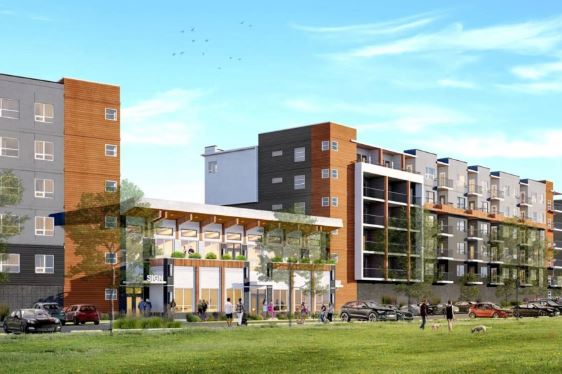
The Evoke housing project in
Kitchener is using prefabricated wood panels in its walls and
floors. Evoke/Supplied
Three years ago, the Ontario Building Code required that any
developer taking on a mid-rise wood-frame building had to
construct stairwells out of non-combustible material.
That was expensive. It made construction challenging, and,
according to the Canadian Wood Council, resulted in a lower
adoption of wood-frame building.
Since that requirement was removed in 2023, allowing full
buildings to be constructed with wood, interest in mid-rise
wood-frame building has increased considerably, especially for
residential builds, said Hailey Quiquero, senior manager with
the WoodWorks Ontario program, an initiative of the Canadian
Wood Council.
“Now, in our market, we’re sitting at around 50 per cent of
five- and six-storey buildings being built out of wood
construction, so a great jump,” Quiquero said during a June 4
online webinar.
“We've still got a long way to go. In British Columbia, I think
it's greater than 80 per cent of this market is built out of
wood, so lots of room and opportunity to keep educating our
market here about this really cost-effective method of building
housing, especially.”
Under the code, wood-frame building is permitted for five- and
six-storey buildings that fall into Group C major occupancy
buildings — apartments, hotels, motels, student residencies and
dormitories — and Group D major occupancy buildings, which are
classified as business and personal services, such as banks,
offices, or medical or dental offices.
But currently in Ontario, mid-rise wood-frame building is
largely being used in residential projects, Quiquero said.
“This type of construction is one of the most cost-effective
ways of building housing in our market right now,” she said.
“It's very fast and lightweight, especially if you make use of
panelization, and due to the fact that you can now do
combustible stair shafts and exit shafts, this really just makes
it extremely cost-effective and easy to build.”
Panelization, which involves constructing wood panels off site
to use for walls or floors, allows developers to do parallel
construction, Quiquero noted, so panels can be built in a
factory at the same time as work is done on site.
This approach results in higher quality buildings, fewer
reworks, less waste, a shorter build time, lower neighbourhood
disruption, and safer labour conditions, she said.
Different types of composite structural lumber are used for
different purposes and each has its benefits, she added.
Laminated veneer lumber is made up of veneers of wood a few
millimetres thick that are shaved off a log and glued and
pressed together in the same direction, Quiquero said.
With laminated strand timber, wood shavings are cut into strands
a few inches wide, glued and pressed together into a dense mass
of wood fibre.
Parallel strand timber, which has the highest strength rating,
uses the same process as laminated strand timber, but the
strands are oriented parallel to each other.
In using structural composite lumber, “you’re not limited to the
length of the tree, so you can get unlimited length in
production of these studs or beams, whatever you’re using them
for,” Quiquero said.
“It’s a more effective use of the wood fibre in the trees as
well, which is nice.”
Structural composite lumber also has a lower moisture content
than standard lumber, which makes them more dimensionally
stable, and it has increased fire resistance, she added.
Dimensional stability, and the fact that it tends to be more
square or rectangle, makes structural composite lumber a popular
choice in factories, because it’s easier to handle, especially
if the factory uses automation, Quiquero said.
“Of course, they do come with a bit of a cost premium to lumber,
so it’s worth exploring whether or not it’s worth investing in
those engineered products in certain applications inside these
buildings,” she said.
......
Source:
elliotlaketoday.com


