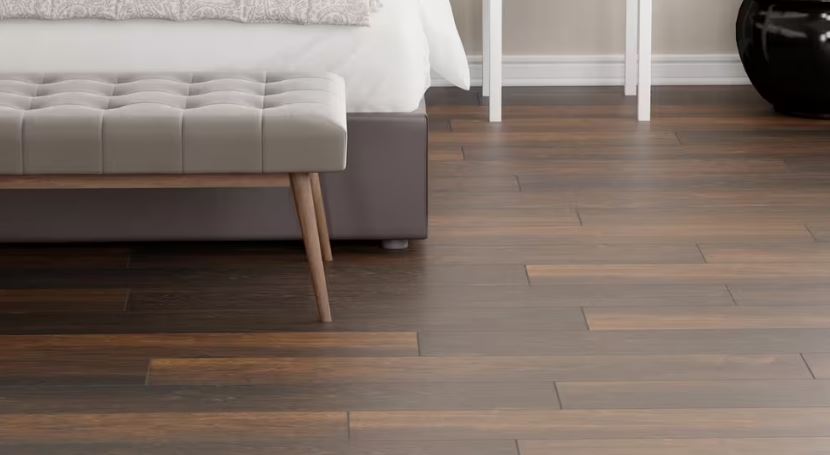
For laminate manufacturers, innovation is happening across
multiple areas of the product’s construction.
Advancements in digital printing, embossing technologies,
surface treatments and waterproof construction are helping
create floors that not only look better and more authentic but
also perform in more demanding environments. Rather than a
single breakthrough driving the category forward, a collection
of manufacturing and design innovations is working together to
narrow the gap between visual realism, tactile authenticity and
everyday durability.
The entire category has experienced a renaissance, said Eric
Ruppert, vice president of soft surface product development and
marketing, Engineered Floors. “Historically, laminate forced a
compromise: you either got decent durability with
artificial-looking patterns, or you sacrificed moisture
resistance for aesthetics. Today, the convergence of
high-density core engineering and digital imaging has erased
those compromises.”
He continued, “On the performance side, the shift toward
ultra-dense HDF cores combined with advanced melamine and
aluminum oxide finishes have made modern laminate far more
scratch and dent resistant than traditional LVP. On the design
side, we are no longer bound by the limitations of traditional
gravure printing on decor paper.”
Printing Precision
Much of laminate’s recent development has depended on more
realistic wood visuals. Digital printing improvements, embossing
and surface technologies are producing the details that
consumers want from natural hardwood with better accuracy.
Today, the vast majority of laminate surfaces are crafted with
Embossed-in-Register (EIR) technology, which aligns a plank’s
texture to its printed grain pattern. EIR continues to play a
significant role across the category because it aligns surface
texture with the printed décor layer beneath it. This is what
creates a floor that looks and feels more natural underfoot.
Stanton reported that advancements in texture and sheen control
are helping manufacturers further refine those visuals. “Recent
innovations in laminate manufacturing have significantly
expanded what is possible from both a design and performance
standpoint by pushing advancements in texture and sheen
technology,” said Natalie Sheinfeld, director of merchandising
and hard surface design, Stanton.
For Mohawk’s Signature technology, the company combines advances
in embossing and manufacturing precision. “Advancements in
embossing, texture development and manufacturing precision allow
us to elevate laminate to a level that consumers would really
struggle to distinguish from real hardwood,” said Justin Hicks,
senior marketing director.
Another benefit comes from advances in digital imaging and
scanning technologies that allow them to capture the subtle
characteristics found in natural wood species.
“Advanced scanning and imaging systems enable us to capture the
subtle details found in natural hardwood, including grain
variation, texture and character marks,” said Jerry Guo,
president, Lions Floor. “At the same time, manufacturing
innovations such as precision embossing, enhanced pressing
technologies and spray-coating applications allow us to
translate those designs into finished products with remarkable
authenticity.”
The combination of digital printing, synchronized textures and
increasingly sophisticated surface treatments is creating a
higher level of coordination between what consumers see and what
they feel.
“There are still opportunities for more innovation in the
laminate industry, particularly opportunities for visual
enhancements such as digital printing and improved plate
technologies,” said Natalie Cady, hard surface brand product
director at Shaw Floors.
Engineering Performance
While visual realism continues to advance, investments are being
heavily invested in technologies designed to improve
performance.
Water resistance continues to be a focal point of development.
“In the past five years, ongoing advancements in water
resistance have been the performance enhancing headline,” said
Al Boulogne, senior vice president, residential product and
marketing, Mannington.
------
------
------
For Today's Consumer
As design and performance technologies continue to evolve,
there’s opportunity for laminate to gain share among consumers
seeking a balance of aesthetics and value.
One of laminate’s long-standing strengths are in scratch
resistance, particularly in active households.
At the same time, affordability remains a strategy. “There is a
lot of opportunity for laminate to capture market share, given
its attainability and realistic wood-like visuals that offer a
more affordable look than hardwood,” Cady said.
There are also opportunities in residential replacement,
multifamily and other high-traffic applications where durability
and ease of maintenance are priorities.
“Laminate has a strong opportunity to gain share in residential
replacement, multifamily, and high-traffic spaces where buyers
want durability, easy maintenance, and realistic wood visuals,”
Frith said.
Source:
floorcoveringweekly.com


