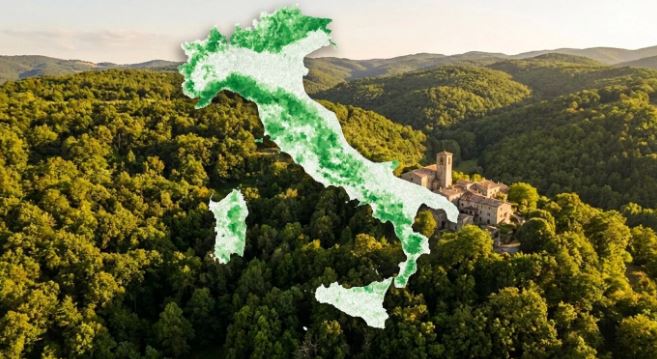
For the first time since the Middle Ages, Italy’s forests cover
a larger area than agricultural land. They now span 60,000
square miles of the Italian Peninsula, primarily concentrated in
mountainous regions, representing the gradual reversion of
cultivated land back to woodland.
The milestone was officially reached in 2020 but was only
revealed this week in a report published by the National Union
of Mountain Municipalities and Entities. The report emphasizes
the significant benefits of reforestation, particularly noting
the forest’s role in providing work for free.
In the municipality of Marcetelli, located in the Province of
Rieti, 94% of the land is covered in trees. The forests here
provide essential natural functions such as carbon storage,
water and air filtration, and erosion prevention. If industrial
solutions were required to achieve these functions, it would
cost approximately $9.5 million.
Forest Health
The expansion of forest cover does not guarantee forest health.
The summer of 2025 saw 94,070 hectares burned by
wildfires—nearly double the 2024 toll—with Sicily, Calabria,
Puglia, and Campania bearing the brunt. Prolonged drought and
heat waves linked to climate change leave forests tinder-dry for
months, while firefighting budgets struggle to keep pace.
In the Alps, the spruce bark beetle (bostrico) has ravaged
high-altitude plantations, destroying an estimated 2.7 M cubic
meters of timber in Trentino alone between 2019 and mid-2024.
Warmer winters allow beetle populations to explode, turning
economically valuable spruce monocultures into biological
graveyards. Adapting forest composition to climate
realities—mixing species, restoring native broadleaves—requires
exactly the kind of active management that Italy currently
lacks.
Relocating
Additionally, the increase in forested acreage is creating a
somewhat ironic reversal of rural Italy’s emigration crisis.
For the last 2 decades, young people have increasingly left
mountain and rural-plains areas for the big cities, resulting in
the abandonment of marginal land or traditionally
farmed/pastured lands, as well as an emptying of small
towns—many of which have habitation records going back to
medieval times.
Since 2021, however, 932 Italian municipalities showed a
positive net migration of 10 per 1,000 inhabitants, with a
significant share of these municipalities being located in
heavily forested areas.
Geography
Discounting the coastlines, Italy’s geography is pretty
straightforward. The Alps give way to the pre-Alpine hills which
fall into the North Italian Plain, which give way to the
Apennines until you reach the far south. These three mountain
regions and the 3,598 municipalities nested therein account for
three-quarters of Italy’s total forested area, even though they
harbor just 13.5% of the country’s population.
It's a statistic that captures their rurality, but also
highlights the benefit beyond these trends in migration.
For locally endangered species like bears and wolves, more woods
in mountain areas will go a long way toward supporting their
populations.
There are ample opportunities to use these new forests for
eco-tourism and sustainable forestry, while expansion of habitat
for animals like wild boar and red deer offers increased bounty
for Italy’s hunters who supply so many national restaurants with
these favored game meats.
The report nonetheless points out that many of these forests
weren’t just appearing out of nowhere—they’re taking over
agricultural land where farmers and ranchers used to ply there
own trade.
All things being equal, however, the supply of farmland and
pasture in Italy was clearly in a glut, otherwise the demand for
agricultural products would have kept farming families there to
satisfy it. In economic terms, the demand for living close to
nature has grown, while the demand from living in farming
communities has declined.
The report highlights that many of these forests did not appear
spontaneously; rather, they are taking over agricultural land
that was once utilised by farmers and ranchers.
Overall, it is evident that there is an excess of farmland and
pasture in Italy. If that were not the case, the demand for
agricultural products would keep farming families in these areas
to meet it. Economically speaking, the demand for living close
to nature has increased, while the desire to reside in farming
communities has decreased.
Source: forestmachinemagazine.com and
uisjournal.com


