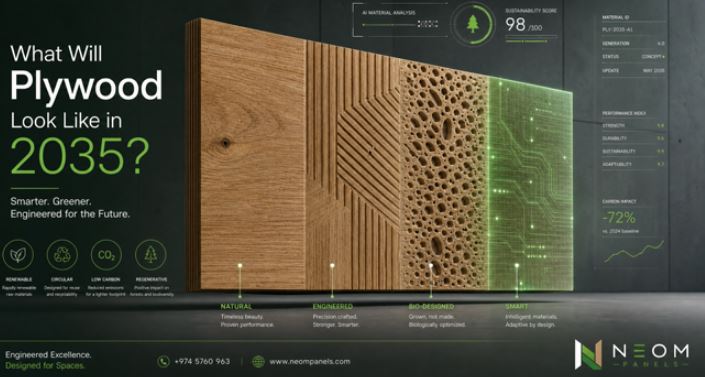
The plywood industry is entering a period of significant
transformation. Over the next decade, technological innovation,
sustainability goals and changing construction requirements are
expected to reshape the way engineered wood products are
designed and manufactured. Industry experts believe that plywood
in 2035 will be defined not only by its structural strength but
also by its environmental performance, manufacturing precision
and digital transparency.
For decades, plywood has remained one of the most dependable
materials used across residential, commercial and industrial
construction. It has supported furniture production, interior
design and architectural projects while remaining largely hidden
beneath decorative finishes. That role is expected to evolve
considerably in the coming years.
Rather than focusing solely on stronger boards, manufacturers
are investing in smarter production methods and
higher-performing materials. The industry’s future is being
shaped by innovation, efficiency and sustainability.
Sustainability Is Becoming the Industry Standard
Environmental responsibility is no longer viewed as a
competitive advantage alone. It is becoming an essential
requirement across the construction sector.
Developers, architects and project owners are placing greater
emphasis on the environmental impact of construction materials.
Purchasing decisions are increasingly influenced by responsible
timber sourcing, reduced emissions, manufacturing efficiency and
overall product lifecycle performance.
Greater attention is also being given to healthier indoor
environments. As a result, lower-emission adhesives and
environmentally responsible production methods are expected to
become standard industry practices.
Sustainable manufacturing is likely to become a fundamental
expectation rather than a premium feature.
Intelligent Manufacturing Is Changing Production
Production facilities are expected to become far more advanced
by 2035.
Artificial intelligence, machine vision and factory automation
are already improving manufacturing efficiency. These
technologies help identify microscopic defects during production
while reducing waste before finished panels reach customers.
Quality control processes are also becoming more precise.
Production data can now be analysed in real time, allowing
manufacturers to maintain greater consistency across every
batch.
Higher productivity is expected. Material losses may also be
reduced significantly.
As digital manufacturing expands, greater operational efficiency
will be achieved throughout the industry.
Performance Will Replace Traditional Specifications
The plywood market is moving beyond basic measurements.
Thickness alone is becoming a less important purchasing
criterion. Instead, construction professionals are paying closer
attention to real-world performance.
Moisture resistance is receiving greater importance. Dimensional
stability is another priority. Fire performance, acoustic
properties, screw-holding strength and long-term durability are
also influencing product selection.
This shift reflects changing building requirements. Modern
projects demand materials that deliver reliable performance
throughout their service life.
Engineered wood panels are increasingly being developed to meet
these expectations.
Digital Traceability Will Improve Transparency
Digital technology is expected to strengthen trust throughout
construction supply chains.
By 2035, many plywood products could include unique digital
identities. A simple QR code may provide instant access to
manufacturing records, timber origin, certification details,
environmental credentials and technical specifications.
This information can simplify project documentation. It can also
improve product verification and regulatory compliance.
Greater transparency is being encouraged across the global
construction industry. Digital traceability is expected to
support that transition.
Greater Design Flexibility Is on the Horizon
Architectural design continues to evolve.
Modern buildings require materials that combine aesthetics with
structural reliability. Manufacturers are responding by
developing panels that offer improved dimensional stability,
lighter construction and enhanced decorative finishes.
Larger panel sizes are also expected to become more common.
Compatibility with modular construction techniques will further
expand design possibilities.
Engineered wood products are becoming valuable design tools
rather than simply structural materials.
This development is expected to support architects, designers
and furniture manufacturers alike.
Engineering Wood for Tomorrow
Industry specialists do not expect wood to lose its importance
within modern construction.
Instead, the focus is shifting towards engineering timber more
effectively through advanced manufacturing technologies and
responsible resource management.
The plywood industry is preparing for products that deliver
greater consistency, improved sustainability and enhanced
technical performance. Manufacturing processes are also being
refined to reduce waste while maintaining high production
standards.
These developments are expected to benefit both manufacturers
and end users.
The future of plywood is therefore unlikely to be defined by
stronger panels alone. Greater intelligence will be built into
manufacturing. Better environmental performance will be
prioritised. Digital transparency will become increasingly
valuable.
Construction professionals are expected to benefit from
materials that combine reliability with measurable
sustainability credentials.
As the built environment continues to evolve, engineered wood
panels will remain central to modern architecture. Their role
will extend beyond structural support to include innovation,
environmental responsibility and long-term value.
The next generation of plywood will quietly shape buildings in
much the same way as today’s products. The difference will lie
in how intelligently those materials are designed, manufactured
and managed throughout their entire lifecycle.
Source:
woodandpanel.com


