In the summer heat, the timber market is lacking a clear
direction. Demand varies from region to region. Here and there,
there is renewed demand for industrial timber.
For several months, the sawmill industry bucked the general
economic trend and continued to purchase coniferous sawlogs at
attractive prices. That has now come to an end. The order book
for timber construction in Austria remained weak in the first
half of the year. Consequently, this sector is not performing
any better than the construction industry as a whole. With the
resumption of hostilities in the Middle East, it is also
virtually impossible to predict how energy prices will develop.
This complex situation is having a negative impact on sawn
timber sales and, consequently, on demand for coniferous sawlogs.
“Demand varies from region to region, as the stock levels at
sawmills range from well-stocked to those with capacity to take
on more, right through to those with very low stock levels,”
reports the forestry department of LK Austria. In Upper Austria,
for example, all sawmills have capacity to take on more. In
Styria, by contrast, deliveries from the affected areas are
being rationed.
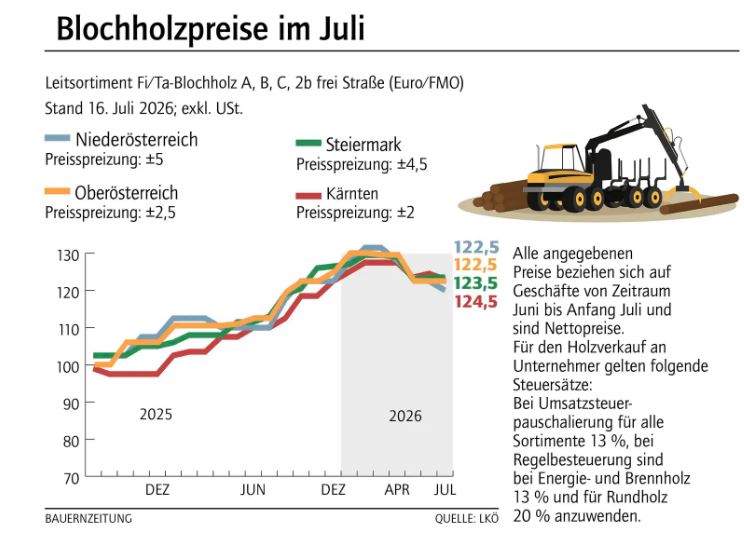
In terms of price, the core spruce/fir range (Grades A, B, C,
2b) stands at a national average of 121.06 euros per solid metre
(net, free at roadside). This represents a fall of a few cents
compared with the previous month. The purchasing capacity of
Upper Austrian sawmills is not yet reflected in the prices.
Prices have merely remained at the level seen over the past two
months. LK analysts recorded the highest prices in Salzburg and
Styria, where up to 128 euros per solid metre was paid. The
lowest prices were reported in the far west of Austria, with
foresters in Vorarlberg in some cases receiving as little as 112
euros per solid metre.
The latest developments in Lower Austria are of interest. There,
following the usual seasonal lull in late spring, pine is once
again being sold. In terms of price, however, it is only
hovering around the national average of 82.58 euros per solid
metre (Classes A, B, C, 2a+). “Due to the risk of blue stain,
care must be taken to ensure prompt removal,” advise the LK
forestry experts. There has been no reversal of the trend for
larch: supply remains below demand. “Prices are holding steady
at a high level,” they report. According to reports, prices of
more than 150 euros per solid metre are still common. Generally
speaking, according to the LK – with the exception of Styria –
sufficient transport capacity is available. “The forest
stockpiles have largely been cleared,” they say.
Industrial timber sought
With the decline in sawmill output, the volume of sawmill
by-products has also fallen recently. “This is causing demand
for coniferous industrial roundwood to rise steadily,” sources
in Vienna report. Despite some build-up of stock in recent
weeks, the paper, pulp and board industries’ facilities remain
fully capable of absorbing the supply. Supplied batches are
being collected and taken off the market quickly. Nationwide, a
price surge has yet to materialise. On average, 44.47 euros per
solid metre is being paid for pulpwood (spruce/fir). Salzburg is
also well above this average. According to LK statistics, prices
there have recently reached just under 60 euros per solid metre.
Seasonal Energy Wood Market
The energy wood market remains unaffected by oil price trends.
In this country, it is proceeding “in line with the season.”
“Individual buyers are trying to secure supplies for the
upcoming heating season and build up adequate inventory levels,”
the analysts report. Combined with higher procurement costs
driven by energy costs, prices have been adjusted slightly
upward in some regions. This has been the case for high-quality
wood chips (ex-factory), which now fetch an average of 119
euros. The firewood market shows little movement. Taking into
account the usual regional variations, softwood fetches an
average of 83 euros per cubic meter, while hardwood commands the
familiar 112 euros.
Meanwhile, LK Forestry Consulting emphasizes that, despite
recent rainfall, conditions remain ideal for bark beetle
infestation. This year more than ever, infested trees should be
quickly identified and removed from the stand or rendered
harmless to prevent further spread.
Source:
bauernzeitung.at


