In the first half of the year, China’s timber imports fell by
8% year-over-year, with log and sawn timber showing distinctly
divergent trends; in June, imports rebounded strongly to reach a
new high for the year. Exports from traditional supplier
countries generally contracted, while the African market showed
a significant recovery; however, demand in the second half of
the year remains uncertain.
Customs data shows that from January through June of this year,
China imported a total of 26.534 million cubic meters of logs
and sawn timber, down 8% year-over-year. Of this total, log
imports amounted to 15.876 million cubic meters, down 5.4%
year-over-year, while sawn timber imports totaled 10.658 million
cubic meters, marking a decline of 11.4%.
Looking at quarterly trends, total timber imports in the first
quarter were 12.18 million cubic meters, down 12.4%
year-over-year. Moving into the second quarter, imports in April
totaled 4.865 million cubic meters, down 6.8% year-over-year but
up 4% month-over-month; in May, imports fell to 4.402 million
cubic meters, dragged down by weak demand; and in June, they
rebounded to 5.086 million cubic meters. In response, industry
experts generally believe that downstream demand may have
bottomed out in the first quarter.
It is worth noting that China’s timber imports rebounded
strongly in June, reaching a new high for the year with a
month-over-month increase of 15.5% and a year-over-year increase
of 7.5%. This record-high import volume was primarily driven by
the log category. Data shows that log imports in June rose 11.1%
year-over-year and 21.9% month-over-month; sawn timber imports
saw a slight year-over-year increase of 2% and a
month-over-month increase of 6.6%, with both categories reaching
their peak import levels for the year.
Segment Divergence: Log Prices Rebound, Lumber Under Pressure
The most notable feature of the first half of the year was the
divergence in trends between logs and sawn lumber: the
cumulative decline in log prices narrowed to 5.4%, while sawn
lumber prices fell by 11.4%. In terms of average prices, the
average price of logs rose 4.7% year-over-year in the first half
of the year, while the average price of sawn lumber increased by
11.5%. The upward price trend significantly curbed domestic
imports of sawn lumber.
The divergence at the timber species level was equally
pronounced. In the first half of the year, imports of coniferous
logs totaled 11.616 million cubic meters, down 5.6%
year-over-year; imports of hardwood logs totaled 4.261 million
cubic meters, down 5%. Imports of coniferous lumber plummeted by
20.2% in the first half of the year, while imports of hardwood
lumber saw a slight year-over-year increase of 2%, indicating
that market demand for high-end hardwoods remains robust.
Supply Landscape: Contraction Among Traditional Major
Suppliers
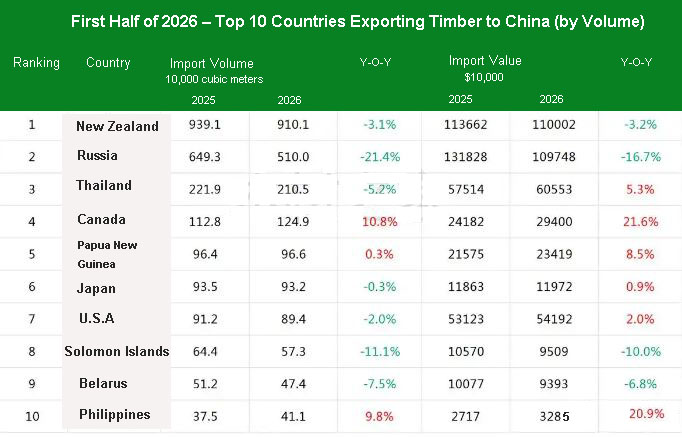
Exports to China from traditional supplier countries are
generally under pressure. New Zealand remains China’s largest
supplier of logs, with exports to China totaling 9.101 million
cubic meters in the first half of the year, down 3.1%
year-over-year. Russia, as the largest supplier of sawn lumber,
exported 4.46 million cubic meters of sawn lumber to China in
the first half of the year, out of a total export volume of 5.10
million cubic meters—representing year-over-year declines of
21.8% and 21.4%, respectively. Germany, a major European timber
supplier to China, saw its exports to China plummet by 51.8%
year-over-year in the first half of the year and has fallen out
of the top ten.
Notably, due to tariff barriers on softwood from the U.S. and
Canada, Canadian lumber has increasingly been redirected to the
Chinese market, with exports to China rising 10.8%
year-over-year in the first half of the year. The African market
has also shown a strong recovery: in the first half of the year,
exports from the Republic of the Congo to China increased by
21.4% year-over-year; during the same period, exports from the
Democratic Republic of the Congo and the Central African
Republic to China rose by 76.7% and 43.2% year-over-year,
respectively.
Overall, China’s timber imports continued to decline in volume
during the first half of the year. In addition to weak domestic
demand, geopolitical conflicts in the Middle East have driven up
shipping costs, while fluctuations in energy prices have
intensified cost pressures in logging, transportation, and
manufacturing—all of which have collectively pushed up logistics
and production costs for timber imports.
Looking ahead to the second half of the year, the demand side
remains the greatest source of uncertainty. According to
analyses by multiple institutions, demand in the second half may
follow a divergent trend, starting low and stabilizing later.
Given that the domestic real estate market remains in a period
of adjustment, the pattern of continued demand contraction is
unlikely to reverse in the short term, leaving limited room for
an overall recovery in timber imports.


