Until now, wood in vehicle interiors has primarily symbolized
quality and comfort. Hof University is now investigating how
real wood surfaces could also be used as smart control surfaces
in vehicles in the future.
At a Glance:
- Hof University of Applied Sciences Develops Smart Wood
Surfaces for Cars
- Invisible Touch Sensors Under Real Wood
- Backlit Controls Visible When Needed
- Biopolymers and Printed Sensors in Use
- First Application: Car Door Trim
Wood-effect trim in cars becomes a control surface
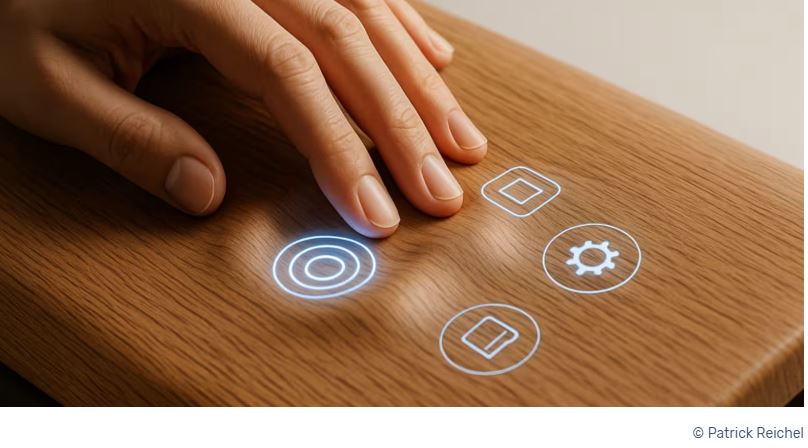
In the WoodTouch research and development project, researchers
are working to combine sustainable materials with modern
electronics. The aim is to create interior modules made of real
wood with integrated sensors, which could, for example, replace
or supplement control elements in the vehicle. The surface
remains visually unchanged: only when a function is required do
the corresponding symbols become visible through backlighting.
The basis is a capacitive control panel that recognises touch in
a similar way to a smartphone. The sensors are concealed beneath
the layer of wood and are implemented using printed conductive
inks. The concept also includes translucent veneers through
which light can shine from the rear through the wooden surface.
Existing MID (Moulded Interconnected Devices) technology is to
be further developed for use in vehicles. Instead of
conventional plastic components, the system will utilise,
amongst other things, real wood, biopolymers made from renewable
raw materials and resource-efficient conductive pastes. The
first demonstration component planned is an interior door panel
that combines backlit touch functions with other interior
elements.
Source:
meinauto.de


