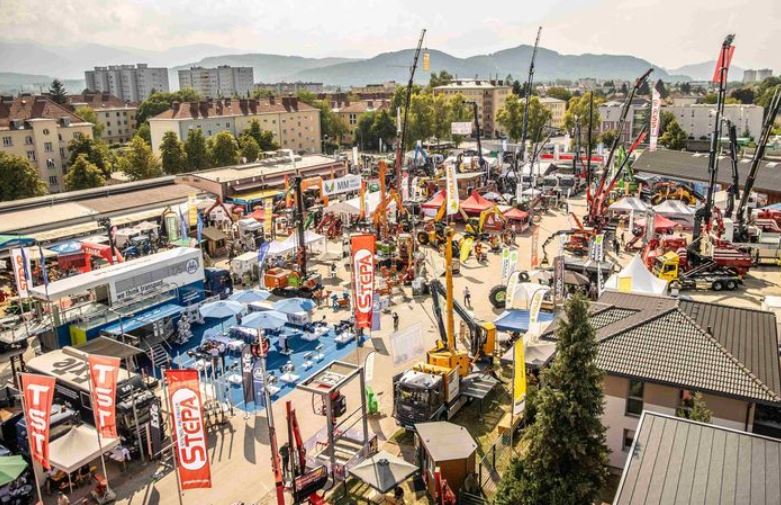
300 international industry leaders, economists, association
representatives, and experts from the Central European forestry
and timber industry gathered for International Wood Day.
From a special boom to a harsh reality: The macroeconomic
analysis of the European timber industry was the focus of
International Wood Day. There was little sign of cautious hope,
but all the more of strategic perseverance and a clear
assessment of the current situation: On Friday, September 4,
2026, approximately 300 international industry decision-makers,
economists, association representatives, and experts from the
Central European forestry and timber industry gathered at the
Klagenfurt Exhibition Center.
The key message: While the long-term role of wood as a
central component of climate protection remains undisputed, the
combination of a deepening industrial recession, a sluggish
construction sector, and regulatory hurdles such as the EU
Deforestation Regulation (EUDR) demands extreme flexibility and
perseverance from companies.
The Central European forestry, sawmilling, and wood processing
industry has experienced several years of immense macroeconomic
turbulence. Following the historic booms and record profits of
2021 and 2022—driven by unprecedented global demand for
construction and disrupted supply chains—the subsequent monetary
tightening by central banks has plunged the European
construction sector into one of the most severe crises of the
postwar era.
Gunter Deuber, Chief Economist at Raiffeisenbank International
AG, provided the attending executives, association
representatives, and industry decision-makers from the forestry
and timber sectors with an unvarnished, scientifically sound,
and empirically supported assessment of the macroeconomic
landscape. In his keynote address, which lasted about an hour,
the chief economist presented a detailed analysis of the
economic situation in Central Europe.
The analysis was structured around four central, closely
intertwined themes: the entrenched industrial recession in the
core European market, the structural consumption paradox among
private households, the medium-term interest rate and financing
outlook, and the urgent economic policy adjustments needed to
secure the region’s competitiveness.
Deepening Industrial Recession in the Core Market of Europe
Deuber began by noting that the European economic area is
experiencing a drastic geographical and sectoral divide. While
some economies in Southern and Southeastern Europe (such as
Spain or parts of the Balkan region) are experiencing moderate
growth thanks to robust service sectors and EU reconstruction
aid, the industrial heartland of the continent is mired in a
deep-rooted and entrenched recession. Germany’s persistent
structural weakness is a particular cause for concern. As by far
the most important trading partner of the Austrian wood
industry, the German economy traditionally serves as an economic
engine for the entire Alps-Adriatic and CEE regions.
If this engine stalls, Central European sawmills, panel
manufacturers, and timber construction companies will feel the
impact immediately. While the slump in private and commercial
building activity in Germany and Austria has, in purely
mathematical terms, bottomed out, there is still no sign of a
noticeable recovery. The number of building permits remains at
historic lows, and cancellations in residential construction are
still the order of the day.
Deuber warned against expecting a rapid V-shaped recovery—anyone
who bases their business plans on the hope that sales volumes
from 2021/2022 will return anytime soon is failing to take the
harsh macroeconomic realities into account. The return of
overall economic output to the pre-crisis level of 2022 will be
a protracted process spanning several years.
Economists at Raiffeisen Research expect that this level will
not be sustainably reached again until gradually in 2026 and
2027. For the wood industry, this means that capacity
utilization management at sawmills and capacity discipline will
remain the decisive factors for survival for the foreseeable
future.
The Consumption Paradox and the Record-High Savings Rate
A central focus of Deuber’s remarks was a detailed examination
of private households and their spending behavior. In theory,
the purchasing power of consumers in Austria and Germany is not
considered all that bad: Following the years of high inflation,
recent collective bargaining agreements and wage settlements
have led to noticeable increases in real wages. Households have
more disposable income in nominal terms than they did two years
ago. Nevertheless, this increase in income is not being felt in
either the retail sector or the construction sector.
Deuber described this situation as a pronounced “consumption
paradox.” Instead of injecting the additional disposable income
into the economic cycle, citizens are hoarding their capital in
the bank. Savings rates in Austria and Germany remain at
historically extremely high levels, the likes of which are
otherwise only seen during periods of acute geopolitical or
economic crisis fears. This collective uncertainty strikes the
wood industry where it is most vulnerable: in private home
ownership and residential construction. The single-family
home—for decades the reliable main customer for sawn timber,
roof trusses, glued laminated timber, and interior finishing
products—has become a distant prospect for broad segments of the
population.
In addition to rising construction costs and the unclear
political framework surrounding building energy laws, strict
lending guidelines are also acting as a major obstacle. Many
families who have the necessary equity and theoretical
creditworthiness are postponing their “home-building” projects
indefinitely or canceling them altogether. The lack of this
broad base of private demand cannot currently be offset by
public or commercial construction.
Interest Rate Landscape and Credit Conditions: The End of
Free Financing
Following the sharp wave of interest rate hikes in 2022–2023,
the ECB did indeed reverse course and began a cycle of key
interest rate cuts to counteract the weak momentum in the
industrial sector. However, Deuber tempered any euphoria
regarding the scope of these measures. He made it clear that
interest rate cuts should not be equated with a return to a
flood of cheap money.
The ECB aims to stabilize its key interest rates within a
so-called “neutral range”—a level that neither stimulates the
economy excessively nor slows it down significantly. For project
developers, real estate developers, and private homebuilders,
this means that the era of zero or negative interest rates—which
had artificially inflated the construction sector over the past
decade—is definitively over.
Loans for real estate and infrastructure projects will remain
consistently more expensive compared to the decade prior to
2022. Investors and banks are once again demanding higher equity
ratios and a more conservative approach to risk assessment. All
business models in the timber industry that were based on
extremely cheap debt financing for construction projects must be
fundamentally recalculated.
Recommendations for Policy Makers and the Timber Industry
The banker spoke out strongly against broadly distributed
government subsidies, which often fizzle out without having a
lasting impact. Instead, he said, the economy needs targeted
instruments that create incentives. He advocated for
time-limited investment incentives for new eco-friendly
buildings and comprehensive energy-efficient building
renovations. Only if the government creates incentives that
mobilize private capital can the bottleneck in the construction
sector be resolved.
Deuber issued a stark warning against a spiral of drastic
increases in labor costs without corresponding gains in
productivity. Since the Austrian and German wood industries are
highly export-oriented, excessive increases in wages and
ancillary costs lead to a direct competitive disadvantage
compared to producers from Scandinavia, Eastern Europe, or North
America.
As an energy- and logistics-intensive industry, wood processing
suffers greatly from the high energy prices in Central Europe
compared to international standards. Deuber called on
policymakers to halt the deindustrialization of core Europe
through targeted relief on energy taxes and grid fees, and to
provide manufacturing companies with planning certainty.
Conclusion and Outlook
The key message for the wood industry is this: The sector must
prepare for a prolonged period of consolidation, during which
corporate success will be determined not by volume growth, but
by operational efficiency, the depth of value creation, and the
development of new export markets outside Europe. The long-term
megatrends—climate protection, the decarbonization of the
construction sector, and the circular economy—continue to speak
unequivocally in favor of wood as a material.
However, in order to reap the benefits of this green
transformation, the industry must navigate the macroeconomic
lean years ahead with cool-headed calculation and strict cost
and capacity discipline.
Source:
lko.at


