The German kitchen furniture association VdDK presented its
figures on 21 September in Löhne. Sales rose by 2% in the first
seven months, after three years of decline, and orders grew more
in value than in volume. Imports cover 4.3% of the German
kitchen market, and a third of them come from Poland.
On 7 September we reported that the German furniture industry
closed the first half of the year 2.7% below last year and that
kitchens were the only segment still growing. On Monday, in
Löhne, the German kitchen furniture industry association Verband
der Deutschen Küchenmöbelindustrie (VdDK) presented its own
figures, for January to July 2026.
In the first seven months, German kitchen furniture factories
sold around 3.4 billion euros' worth, 2% more than in the same
period of 2025. For the first half of the year, the figures
published on 2 September gave a rise of 1%; the difference comes
from July. Exports grew faster than sales inside Germany, by
2.8% against 1.4%. Kitchen factories have 46.7% of their sales
outside the country, against the 35.3% of the whole German
furniture industry.
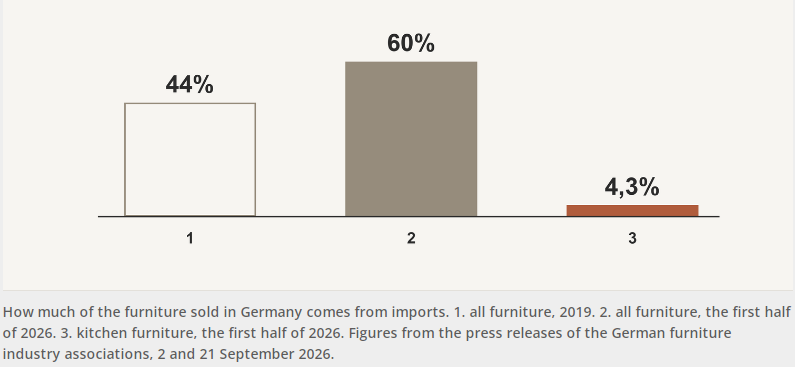
Kitchens are also the kind of furniture Germany buys least from
other countries. Imports cover 4.3% of the German kitchen
furniture market, a share the association calculates itself,
while around 60% of all the furniture sold in Germany comes from
outside it.
The July rise comes with two caveats the association set
itself
In July, German kitchen furniture factories sold 466 million
euros' worth, almost 9% more than in July 2025. Jan Kurth, the
association's managing director, attached two caveats to that
rise on the very day he announced it: the same month last year
had been weak, and the holidays started somewhat later. “We are
seeing demand stabilise, but, given the difficult conditions we
work in, we remain just as cautious as we have been”, he said.
The German trade publication Holz-Zentralblatt sums it up the
same way on the same day: a slight rise, after three years in
which sales fell.
Orders grew more in value than in volume
From January to August, the orders received by German kitchen
furniture factories came in 1.9% above last year's level
measured in money and 0.7% above it measured in the number of
kitchens. The figures are collected by the association from its
own members, not taken from official statistics.
Among the reasons for concern Kurth named the prices of what the
factories buy in order to produce, which are rising again. He
links them to the uncertainty on the raw material markets, after
the tensions in the Middle East.
At kitchen factories short-time work is at 13%, across the
German furniture industry at 40%
In a survey the associations ran among their members, short-time
work reaches 13% of kitchen furniture factories, in the third
quarter. Across the German furniture industry, the share of
companies planning it is 40%, according to the figures given at
the conference on 2 September. Short-time work means, in
Germany, that the company cuts working hours instead of making
people redundant, and the state makes up part of the lost wage.
The largest export market fell. The growth came from smaller
markets
In the first half of the year, deliveries of kitchen furniture
to France, the largest foreign market, fell by 1.9%, to 294.5
million euros. The United Kingdom fell by 4.6%. These markets
rose instead:
-Switzerland, by 12.4%;
-Belgium, by 6.9%;
-the Netherlands, by 5%;
-Spain, by 1%.
Outside Europe, the association singles out South Korea, at
20.8%, which moved it from 12th to 9th place among the export
markets. The other three markets it names went down. In the
United States, deliveries fell by 37.5%, and the association
puts the drop down to the American import tariffs. In China they
fell by 20.6%, and there Kurth speaks of a heavily undervalued
currency and of subsidies for Chinese manufacturers. Exports to
Saudi Arabia fell by 24.1%, on the effects of the war in Iran.
Germany makes its own kitchens
Imports of kitchen furniture into Germany fell by 9.2% in the
first half of the year, to around 77 million euros. Who supplies
them:
Poland alone accounts for 34% of all German kitchen furniture
imports and grew by 7.4%;
-Lithuania fell by 4.2%;
-Austria, by 5.5%;
-Italy, by 35.8%;
-China, by 58.4%.
The ready made kitchen is not the product you break into the
German market with. Of the countries the association names, the
only one that grew in the first half of the year is the one that
already supplies a third of the imports. For furniture as a
whole the ratio is the other way round: around 60% of the
furniture sold in Germany comes from imports, against 44% in
2019, and in the first half of the year Germany brought in less
furniture from both Poland and Romania.
......
Source:
revistadinlemn.ro


