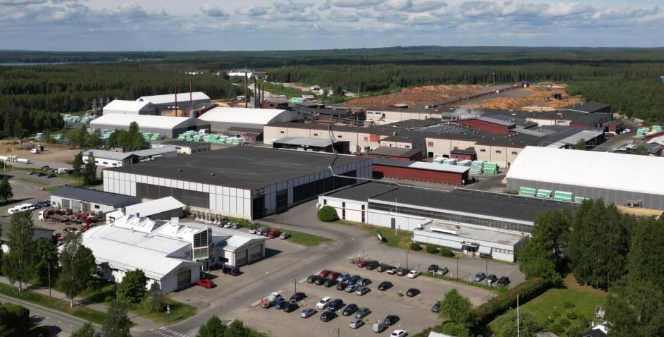
Keitele’s sawmill in Northern Savonia is undertaking an
investment programme worth around EUR 40 million to increase
annual production capacity to about 600,000 cubic metres of sawn
timber. Photo: Keitele Group.
Finland’s sawmill industry has invested heavily in new and
modernised production facilities. The sector is now warning that
future timber availability could become a limiting factor when
the expanded capacity is fully utilised. Wood supply is emerging
as a key issue ahead of Finland’s next parliamentary election.
The Finnish Sawmills Association, Sahateollisuus ry, launched
its election tour on 6 October at Keitele’s sawmill in Northern
Savonia, according to Maaseudun Tulevaisuus.
The campaign comes after several years of major investment
across the sector. Finland’s sawmills produced 11.7 million
cubic metres of sawn timber in 2025, up 7 per cent from 2024.
Production had amounted to 10.9 million cubic metres in 2024 and
10.4 million cubic metres in 2023.
However, conditions weakened during 2026. Output in the first
half of the year fell to 6.1 million cubic metres, down 3 per
cent year on year.
Exports also declined. Between January and May 2026, Finnish
sawmills exported 3.3 million cubic metres of sawn timber, 6 per
cent less than a year earlier. Export value fell 5 per cent to
EUR 870 million.
Around 80 per cent of Finnish sawmill production is exported,
making the industry particularly sensitive to both raw-material
prices and transport costs.
Keitele is one of the clearest examples of the current
expansion. The company is carrying out an investment programme
worth around EUR 40 million to increase annual production
capacity at its sawmill from about 420,000 to 600,000 cubic
metres.
At the same time, annual log consumption is expected to rise to
almost 1.3 million cubic metres.
Securing timber supply
Sahateollisuus argues that future policy decisions should
therefore be assessed partly on how they affect regional timber
availability.
The industry has warned that large-scale forest restoration and
protection measures could reduce future harvesting
opportunities. According to scenarios from the Natural Resources
Institute Finland cited by the association, different
restoration options could reduce annual harvesting potential by
between 2 million and 15 million cubic metres.
This is particularly important for sawmills because each plant
depends heavily on timber from its surrounding procurement area.
A regional reduction in available logs can therefore quickly
affect production levels and profitability.
Raw-material costs have also increased sharply
Over the past 15 years, the price of spruce sawlogs has risen by
around 62 per cent, while export prices for sawn spruce have
increased by only about 34 per cent.
For pine, sawlog prices have risen by roughly 57 per cent, while
export prices for sawn pine have increased by only around 14 per
cent.
The widening gap has added further pressure to sawmill margins.
Weaker domestic wood use
The sector is also calling for improved road infrastructure for
timber transport, stronger measures to increase forest growth
and policies aimed at boosting the use of wood in construction.
According to Sahateollisuus, wood consumption in Finnish
construction has fallen from around 5 million cubic metres per
year to approximately 2 million cubic metres.
Domestic sales of sawn timber currently amount to only about 2.2
million cubic metres annually.
The association is therefore calling for clearer government
targets for timber construction and greater use of wood in
public building projects.
Logistics is another significant cost factor, accounting for
nearly 20 per cent of total sawmill costs, according to
Sahateollisuus.
The industry’s message ahead of the election is that much of the
investment has already been made. For those investments to
deliver their full economic value, sawmills say Finland must
ensure an adequate supply of domestic timber as well as
long-term and predictable operating conditions.
Source: maaseuduntulevaisuus.fi


