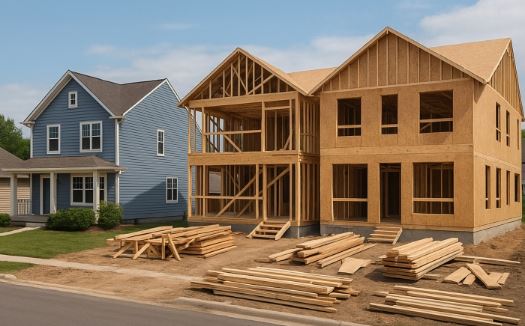
The Strong American Wood Act (H.R. 10906) would require federal
buildings to use domestic timber when available, backed by
revolving loan funds and trade measures. The bill awaits
committee review across nine House panels, with no current
procurement requirements or funded solicitations yet
established.
KEY SIGNALS
- Strong American Wood Act would mandate domestic timber in
federal buildings when available
- Bill ends Buy American waivers for wood products available
from domestic forest sources
- Canadian softwood duty deposits totaling $7B could seed
revolving loan funds for domestic wood construction
- Legislation designates US pulp, paper, hardwood, and softwood
supply chains as critical to national security
- Referred to nine House committees with full text not yet
published; no current procurement requirements
Bipartisan lawmakers introduced the Strong American Wood Act
(H.R. 10906) in October 2026, a bill that would fundamentally
reshape how federal buildings source construction materials.
Sponsored by Arkansas Republican Bruce Westerman, a forester by
trade who chairs the House Natural Resources Committee,
alongside Washington State Democrat Marie Gluesenkamp Perez, the
legislation mandates that federal buildings use domestic timber
when available. The bill arrives amid significant distress in
the American wood products industry, with 277 sawmill and
wood-business closures since 2021 and more than 50 mills closing
or curtailing operations in just 15 months, according to
Westerman's office. The national lumber association counts
40,000 jobs lost since 2022. Westerman framed the legislation in
straightforward terms: "We want to have strong markets, so that
we can have strong infrastructure."
The procurement implications for federal construction
contractors and timber suppliers are substantial. The bill would
end Buy American rule exemptions for any government component
available as a domestic forest product, directly affecting
sourcing decisions across federal building projects. Current Buy
American waivers allow agencies to procure foreign materials
under certain conditions; this legislation would eliminate that
flexibility for wood products specifically. Companies bidding on
federal construction contracts would need to verify domestic
timber availability before specifying materials, potentially
altering supply chain strategies for projects ranging from
military installations to federal office buildings. The
requirement applies whenever domestic timber is available,
creating a preference that federal contractors must incorporate
into their procurement planning and bid proposals.
The bill's trade and financing provisions carry equally
significant procurement intelligence value. The legislation
proposes directing duties collected on Canadian softwood lumber
into revolving loan funds for new homes built with domestic wood
products, with Canadian lumber companies having already paid $7
billion in duty deposits by May last year. An additional portion
would promote US softwood lumber. Westerman's office is
advocating for a statutory US response to the EU Deforestation
Regulation, which they contend unfairly targets American wood
products. The bill would impose secondary inspections on wood
and wood-look-alike imports, requiring importers to disclose
full chemical inputs. It would also designate domestic pulp and
paper, hardwood, and softwood supply chains as critical to
national security, ordering investigations into whether imports
undermine these industries. Mills would receive tariff
exemptions on machinery imports used for modernization and
expansion where no US factory manufactures the equipment.
Westerman indicated at Anthony Timberlands' sawmill in Malvern,
Arkansas, that he wants the Commerce Department to review
Section 232 and Section 301 tariffs, signaling a comprehensive
trade policy overhaul for forest products.
The bill's current status demands careful attention from
government contracting professionals. It has been referred to
nine House committees for review, and its full text had not been
published on Congress.gov as of October 26, 2026. Critically,
the proposals are not current procurement requirements or funded
solicitations. Federal contractors should monitor committee
proceedings and wait for published legislative text before
adjusting compliance strategies. The revolving loan funds could
create financing opportunities for homebuilding once
established, but no available funding opportunity exists at this
stage. Companies can use the committee review period and pending
text publication to assess potential procurement impacts, but
should not treat any provisions as current contract
requirements. The bill represents a potential sea change in
federal timber procurement, but it remains subject to the
legislative process, including committee markups, floor votes,
and potential amendments that could alter its final scope.
Source:
samsearch.co


