In October, China’s timber imports saw a decline in volume
but a rise in price, with the average price of logs surging to a
year-to-date high of 20.4%, while the value of imports bucked
the trend and grew by 7.2% — driven by prices rather than
expanding demand.
In October 2026, China’s timber imports exhibited a divergent
pattern characterized by “a decline in import volume coupled
with a counter-trend increase in import value,” with growth
driven primarily by rising prices rather than expanding demand;
the simultaneous rise in both volume and value of log imports
served as the main support for the market, while procurement of
sawn timber remained relatively cautious.
Log Volumes Rise Slightly While Prices Increase; Sawn Lumber
Accounts for Nearly 60% of Import Value
Customs data shows that in October, China’s timber imports (logs
and sawn lumber) fell 3.3% year-over-year to 4.049 million cubic
meters, a decrease of 140,000 cubic meters from September; the
import value totaled approximately $888 million, up 7.2%
year-over-year.
Of this total, log imports amounted to approximately 2.285
million cubic meters, marking a slight year-over-year increase
of 2.2% but a sharp month-over-month decline of nearly 20%
compared to September; the import value rose 23% year-over-year
to approximately $366 million, while falling 21.4%
month-over-month. The average price in October continued its
year-over-year upward trend, rising by 20.4% to reach a peak for
the year.
As for sawn timber, imports in October totaled approximately
1.764 million cubic meters, down 9.7% year-on-year and 10.7%
month-on-month from September; the import value fell by 1.7%
year-on-year and 9.1% month-on-month to $520 million, while the
average price rose 8.8% year-on-year, reaching the
second-highest level of the year.
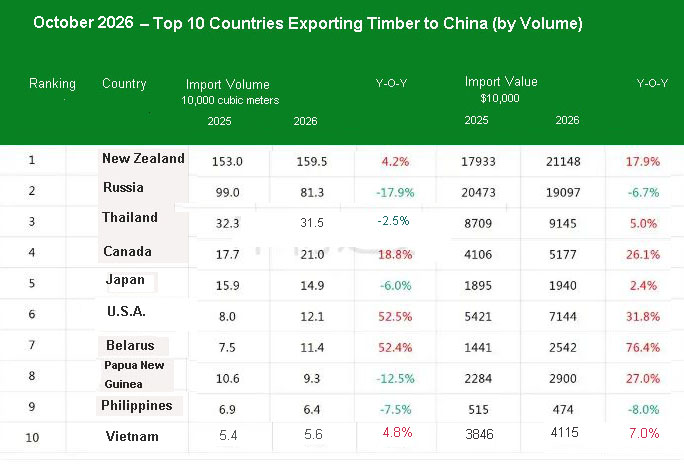
Supply Source's Concentration : Top 10 Account for 83.4%
Among the top 10 sources as of October 2026, New Zealand,
Russia, and Thailand combined accounted for approximately 2.723
million cubic meters, representing 67.2% of the total volume;
The top 10 sources accounted for 83.4%. Among them, imports from
New Zealand totaled 1.595 million cubic meters, up 4.2%
year-over-year; imports from Russia fell 17.9% year-over-year to
813,000 cubic meters; and imports from Thailand totaled 315,000
cubic meters, down 2.5% year-over-year.
Growth was concentrated in Belarus (volume +52.4%, value
+76.4%), Canada (+18.8%, +26.1%), and the United States (+52.5%,
+31.8%). While Russian timber supplies contracted, other sources
helped offset the decline; however, overall concentration
remained relatively high.
Overall, from January through October 2026, China’s cumulative
imports of timber (logs and sawn timber) totaled approximately
44.484 million cubic meters, a 4.1% decrease year-over-year; the
import value was approximately $971,000, a 3.7% increase
year-over-year. Of this total, cumulative imports of logs
amounted to approximately 26.085 million cubic meters, remaining
essentially flat compared to the same period last year (-0.4%);
imports of sawn timber totaled approximately 18.399 million
cubic meters, down 8.8% year-over-year.
Additionally, in October, China’s exports of timber and timber
products rose 19.4% year-over-year to 1.74 million metric tons,
with cumulative exports from January through October reaching
14.97 million metric tons, up 12.6% year-over-year; Exports of
plywood and similar multilayer panels rose 20% year-on-year to
1.41 million metric tons, with cumulative exports from January
through October totaling 12.30 million metric tons, up 11.4%
year-on-year; exports of wood products for household or
decorative use increased 8% year-on-year to 90,000 metric tons,
with cumulative exports from January through October totaling
820,000 metric tons, up 3% year-on-year; and exports of
furniture and its parts rose 7.7% year-on-year to 3.60 million
metric tons, with cumulative exports from January through
October totaling 38.17 million metric tons, up 2.7%
year-on-year.


